
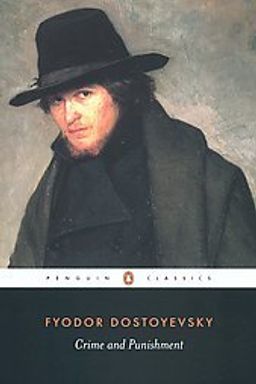
Crime and Punishment cover

Crime and Punishment

by Fyodor Dostoyevsky

Crime and Punishment is a riveting exploration of the human psyche, where Raskolnikov''s journey from murder to redemption reveals the complexity of morality, conscience, and faith. Dostoyevsky''s masterpiece offers a timeless reflection on the power of love and the path to spiritual awakening.

The Human Struggle Between Morality and Madness

Have you ever felt torn between what you believe is right and what you feel compelled to do? In Crime and Punishment, Fyodor Dostoevsky invites you into this exact psychological battlefield through the tortured mind of Rodion Raskolnikov—a man who decides to kill in pursuit of a grand idea but ends up crushed by its moral weight. The book reveals not only the story of one murderer but also a chilling exploration of what happens when intellect and conscience collide.

Dostoevsky’s core argument is that human beings cannot escape their moral and spiritual nature, no matter how much logic or philosophy tries to deny it. He contends that true redemption is only possible through suffering, confession, and love—in other words, by returning to our humanity after trying to transcend it through cold, abstract reasoning.

The novel begins in the suffocating heat of St. Petersburg, where Raskolnikov’s poverty mirrors his psychological imprisonment. Isolation and despair lead him to formulate a radical idea: what if certain “extraordinary” individuals have the moral right to break the law? Behind this chilling question lies Dostoevsky’s meditation on the limits of reason and the dangers of moral relativism—a subject that remains profoundly relevant in modern debates over ethics, ambition, and justice.

The Birth of an Idea: Reason Against Conscience

Early in the story, Raskolnikov wanders the streets haunted by the thought of killing Alyona Ivanovna, an aged pawnbroker he believes to be a parasite. His reason tells him the act might uplift suffering humanity by eliminating a corrupt source of greed. But his conscience resists violently. When he rehearses the murder, we see the schism within him—the very meaning of his name, raskolnik, which means “schismatic” in Russian. This psychological split frames the entire novel. Dostoevsky uses it to probe how rational ideologies can become monstrous when stripped of empathy.

Like modern moral dilemmas—whether ends justify means—the story forces you to question where compassion fits into the pursuit of justice. Raskolnikov’s intellectual pride convinces him that moral laws are for the weak; yet his restless conscience reminds him that human compassion cannot be erased by theory.

The Fall From Reason: Crime and Consequence

When Raskolnikov finally murders Alyona—and her innocent sister Lizaveta—his crime symbolizes not only physical violence but spiritual collapse. He expected liberation; instead, he finds torment. His rationalizations crumble under the weight of guilt. Through this unraveling, Dostoevsky insists that morality is not an abstract system but a deeply personal, emotional reality. You cannot simply “opt out” of conscience.

The dual murders reveal the difference between planned evil and accidental sin. Alyona’s killing is coldly calculated; Lizaveta’s is impulsive and intimate. Dostoevsky juxtaposes them to show how the human soul reacts differently to impersonal rationalized cruelty versus direct innocent suffering. The latter destroys Raskolnikov’s barrier between theory and feeling.

The Philosophy of the Extraordinary Man

When Raskolnikov later debates with the investigator Porfiry Petrovich, we encounter his infamous theory of the “extraordinary man”—those few individuals who, like Napoleon or Newton, supposedly have the right to transgress laws to achieve higher ends. Dostoevsky uses this exchange to critique the growing philosophical currents of nihilism and proto-Nietzschean thought. He warns that if reason detaches from morality, society risks descending into chaos, because anyone can justify evil in the name of progress.

This section resonates today when intellectual arrogance or utilitarian logic can overshadow empathy. Dostoevsky’s insight foreshadows Nietzsche’s Übermensch, yet contrasts sharply with it. Where Nietzsche envisioned the Superman as a creator of new values, Dostoevsky fears such self-created morality becomes destructive when divorced from divine compassion.

Compassion, Faith, and Redemption

As Raskolnikov plunges deeper into isolation, Sonia Marmeladov enters as his contrasting mirror—a saintly prostitute whose unwavering compassion defies his cynical worldview. Sonia embodies what Dostoevsky sees as the path to redemption: selfless love and faith. Her reading of the story of Lazarus to Raskolnikov becomes the novel’s spiritual centerpiece. Lazarus’ resurrection foreshadows Raskolnikov’s own moral rebirth through suffering and divine grace.

When Raskolnikov confesses and is exiled to Siberia, Sonia follows him, symbolizing unconditional forgiveness. Their shared suffering marks the beginning of spiritual resurrection. Siberia, vast and cold, contrasts with St. Petersburg’s oppressive heat—it’s a purification of the soul through hardship and humility. Dostoevsky concludes by emphasizing that redemption does not erase guilt—it transforms it into compassion.

Why These Ideas Matter

This tension between intellect and emotion, justice and mercy, is not only fictional—it defines human life. Raskolnikov’s journey reminds you that logic cannot save your soul; empathy can. In an age still obsessed with efficiency, abstraction, and power, Dostoevsky’s message is radical: real strength lies in vulnerability, love, and repentance.

“To become truly human,” Dostoevsky implies, “you must descend into your own suffering and rise through the love of others.”

Across this summary, you’ll journey through Raskolnikov’s internal war, the philosophical trap of moral exceptionalism, Sonia’s quiet sanctity, and the ultimate redemption that comes not from thought but from faith. Dostoevsky’s novel is a mirror held to every person struggling between moral duty and personal pride—a timeless study of agony, guilt, and grace.


Raskolnikov’s Duality and Isolation

From the first moment we meet Raskolnikov, his inner tug-of-war defines his existence. The suffocating atmosphere of his tiny St. Petersburg room amplifies his psychological imprisonment. Dostoevsky uses this setting not just as backdrop but as metaphor—the stifling heat, the cramped walls, and the persistent odor reflect the toxic weight of Raskolnikov’s thoughts, a human mind caught between ideology and empathy.

A Soul Divided

Raskolnikov’s name itself—derived from ‘raskolnik,’ meaning ‘schismatic’—sets the stage for his inner split. He’s torn between prideful rationality and deep compassion. His decision to give money to Marmeladov’s family despite his own extreme poverty shows that kindness still inhabits him. Yet, minutes earlier, he’d rehearsed murder with mechanical precision. Dostoevsky paints a man both capable of benevolence and brutality, an emblem of modern moral schizophrenia.

Isolation’s Poison

Shut in his room, Raskolnikov grows estranged from reality. His theories, born from solitude, begin to replace his human instincts. Dostoevsky believed that intellectual detachment—what we might now call “overthinking”—corrupts the soul when divorced from lived experience. The oppressive urban atmosphere intensifies this dehumanization; St. Petersburg itself seems alive with rot and fever. When Raskolnikov murmurs that mankind fears “taking a new step,” he reveals not courage but arrogance—the delusion that stepping beyond morality makes one superior.

The Rehearsal of a Crime

His visit to Alyona Ivanovna is less about pawning an object than staging the scene for his act. He memorizes light angles, furniture positions, and footsteps, all while suppressing nausea and revulsion. This “rehearsal” captures the eerie calm before moral collapse. Dostoevsky invites you to feel the dissonance between Raskolnikov’s intellect and emotions—that gap is precisely where tragedy begins. When logic overwrites empathy, monstrosity becomes possible.

The Human Need for Connection

Seeking relief, Raskolnikov enters a tavern for the first time—the moment he meets Marmeladov. Their encounter underscores Dostoevsky’s belief that suffering needs witness; isolation breeds madness, but compassion, even brief, can restore sanity. Raskolnikov’s gift of money, his sudden empathy for a dying drunk’s family, reminds us that moral impulses survive even in the darkest hearts. Yet this kindness also haunts him—it exposes the gap between his theories and his nature. He is not made for cruelty, and that realization becomes the seed of his later redemption.

(In contrast, Albert Camus’s The Stranger presents a protagonist without such empathy—Meursault’s detachment is complete. Dostoevsky deliberately offers the opposite: a murderer who still feels too much.)


The Weight of Conscience After the Crime

After committing the murders, Raskolnikov doesn’t experience triumph—only horror. His dream of the horse being brutally beaten encapsulates this guilt incarnate. In the dream, young Raskolnikov represents innocence; Mikolka, the murderer of the horse, embodies cruelty. Dostoevsky uses this imagery to dramatize Raskolnikov’s psychic split. What begins as intellectual justification for killing morphs into a visceral moral catastrophe.

Between Delirium and Denial

Once his crime is done, Raskolnikov oscillates between calm and panic. He proceeds mechanically—washing blood off his hands, hiding loot, pretending normalcy—yet deep within, his conscience screams. His physical sickness mirrors his moral disease. Dostoevsky portrays guilt as a living thing that corrodes thought, transforming intellect into torment. You can’t rationally escape remorse because morality lives not in theory but in the body itself.

The Innocent Victim

Lizaveta’s murder marks the true watershed moment. Dostoevsky contrasts her death with Alyona’s calculated execution: one impersonal, the other intimate. Lizaveta’s open, childlike face destroys Raskolnikov’s moral defense. He can no longer claim utilitarian justification; here, the act is pure evil, and he knows it. This realization becomes his spiritual punishment long before legal consequences arrive.

(Psychologically, it recalls Freud’s notion of the superego—the internalized moral voice that punishes the self even without external judgment.)

The Beginning of Moral Awakening

Raskolnikov’s horror after the dream signals awareness: he can imagine suffering from the victim’s eyes. Dostoevsky’s lesson is that conscience cannot be eradicated by ideology; it will always resurface through empathy. Lizaveta’s “childlike mouth” stays embedded in his memory as a symbol of innocence violated, proving that moral truth persists even when one tries to philosophically erase it.


Ideologies That Excuse Evil

In Raskolnikov’s philosophical debate with Porfiry Petrovich, Dostoevsky exposes the seductive logic of moral exceptionalism—the idea that some people stand above universal law. Raskolnikov’s essay, “On Crime,” becomes his manifesto. He argues that “extraordinary” individuals have the right to commit crimes if their actions serve humanity’s progress. Porfiry’s gentle but penetrating questioning dismantles this theory, revealing its absurdity and danger.

The Dangerous Power of Rationalization

Raskolnikov's justification echoes historical tyrants and intellectuals who believed violence could birth utopia. Dostoevsky uses this to critique the emerging Russian nihilism of his time—a movement rejecting moral, religious, and social norms. Without divine or communal ethics, every action could be logically defended, even murder.

(This anticipates Nietzsche’s later Übermensch concept, though Nietzsche intended his ideal as creative, not cruel. Dostoevsky, however, foresaw how self-made morality could slide into moral anarchy.)

The Limits of Logic

After the conversation with Porfiry, Raskolnikov’s belief in his theory collapses. His intellect can no longer silence his emotions. Dostoevsky illustrates that rational systems fail when they deny conscience. Humans are wired for empathy; moral transgression is followed by existential pain. The so-called “extraordinary man” myth disintegrates under the pressure of guilt.

Beyond Law—Toward Humanity

Dostoevsky’s broader argument is that true greatness lies not in breaking laws but in embodying compassion. Porfiry’s investigative style—the patient, ethical probing—stands in contrast to Raskolnikov’s arrogance. Through their intellectual duel, Dostoevsky teaches that intellect without morality breeds corruption, while humility, paradoxically, reveals true wisdom.


Sonia’s Faith and the Redemption of the Soul

Sonia Marmeladov enters the story as a creature of contradiction—a prostitute who radiates purity. Her humanity challenges every philosophical abstraction in Raskolnikov’s mind. Where he dissects morality logically, she simply lives it, guided by compassion and faith. Dostoevsky deliberately portrays her as a modern saint, a vessel through which divine forgiveness manifests in a fallen world.

The Mirror of Suffering

When Sonia reads the story of Lazarus to Raskolnikov, she embodies resurrection through love. Her trembling faith reflects her personal agony—selling her body to feed her family—but also her unwavering belief in God’s mercy. Dostoevsky ties this parable directly to Raskolnikov’s internal rebirth. Just as Lazarus rises from the grave, Raskolnikov must rise from spiritual death.

The Power of Compassion Over Theory

Sonia’s kindness does what logic cannot—it melts Raskolnikov’s isolation. When he confesses his crime to her, she doesn’t recoil or condemn; she embraces him, crying “What have you done to yourself?” That phrase encapsulates Dostoevsky’s ethics: sin wounds the sinner more than society. Compassion, not judgment, heals such wounds.

Her act of giving him a cross symbolizes shared suffering—the Christian path of redemption. Both bear their burdens together, transforming punishment into spiritual renewal. Sonia’s moral force isn’t intellectual but emotional, practical, and embodied—a corrective to Raskolnikov’s detached moral theorizing.

Faith as Action

For Dostoevsky, Sonia’s religiosity is not fanaticism but the most humane form of wisdom. She lives faith through compassion, while Raskolnikov misuses faith to rationalize cruelty. Her belief in God contrasts with his belief in ideas. Eventually, he realizes the futility of intellect without love. In Sonia’s arms, faith becomes tangible—a relationship, not a doctrine.


Confession and Resurrection in Siberia

The climax of Raskolnikov’s transformation occurs not in the moment of murder but in the act of confession. When he bows to the earth at the crossroads—just as Sonia advised—he symbolically submits to humanity and divinity. For Dostoevsky, redemption requires acknowledging guilt to both God and people. True penance is public and spiritual, not just legal.

From Pride to Humility

Raskolnikov’s decision to confess unfolds slowly. At the police station, he hesitates until he meets Sonia’s gaze. That silent moral witness completes his conversion. His confession ends his intellectual rebellion and begins his rebirth. Dostoevsky teaches that confession isn’t weakness—it’s the restoration of moral equilibrium.

Siberia: A Landscape of Renewal

Once exiled, Raskolnikov experiences a paradoxical peace. The cold, vast openness of Siberia contrasts with St. Petersburg’s feverish confinement. Here, he begins his inward healing. Sonia’s continued devotion becomes his anchor, transforming punishment into purification. When he weeps at her feet, it marks his resurrection—the death of pride and the birth of love.

The Eternal Story of Redemption

In the end, Dostoevsky leaves the story open: Raskolnikov’s spiritual journey has only begun. His acceptance of Sonia’s love and his tentative turn toward faith represent humanity’s endless cycle of fall and renewal. Like Lazarus, he rises through compassion, not intellect. The book closes with hope—that suffering, honestly embraced, becomes the doorway to transformation.

Dig Deeper

Get personalized prompts to apply these lessons to your life and deepen your understanding.

Go Deeper

Get the Full Experience

Download Insight Books for AI-powered reflections, quizzes, and more.