
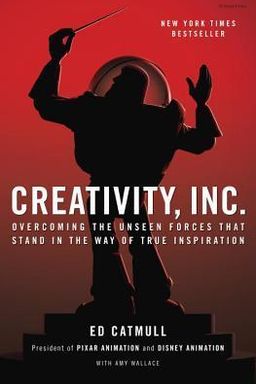
Creativity, Inc cover

Creativity, Inc

by Ed Catmull with Amy Wallace

Creativity, Inc. by Ed Catmull with Amy Wallace unveils the transformative management practices that propelled Pixar and Disney Animation to creative brilliance. This insightful guide equips leaders with tools to foster innovative, empowering, and flexible work environments, turning teams into creative powerhouses.

Building Creative Cultures that Last

Building Creative Cultures that Last

How can you protect creativity as your company grows? In Creativity, Inc., Ed Catmull—cofounder of Pixar and longtime president at both Pixar and Disney Animation—proposes that the real work of creative leadership is not commanding people but designing and defending environments where imagination can take root. Catmull contends that creativity thrives only within cultures that consciously invite candor, protect the new, manage failure, expose the unseen, and integrate art with technology.

The book operates as both memoir and operating manual. Catmull recounts Pixar’s evolution—from the dream of making the first computer-animated feature to the merger with Disney—and extracts principles applicable to any creative organization. The central thesis: ideas are fragile, culture is the true product. Success does not reveal your hidden weaknesses; it hides them. Leaders must continually make those hidden forces visible and repair the cracks before complacency sets in.

Culture is a Designed System

Catmull insists culture is not organic; it must be designed, protected, and repaired like any other system. When Pixar became famous after Toy Story, new hierarchies and pressures threatened its openness. Catmull discovered that even trivial artifacts—a long conference table or formal place cards—could stifle participation. By replacing the table and removing the cards, Pixar learned that small physical cues reflect invisible power structures. Designing spaces and rituals that echo your values creates environments where people dare to speak truth instead of deferring to rank.

Candor and Safety as Core Infrastructure

Creativity demands honest feedback without fear. Pixar institutionalized this through the Braintrust: a recurring meeting of peers whose only rule is candor. The Braintrust gives directors sharp, specific feedback but never commands fixes—the director decides what to do. This removes hierarchy and keeps accountability with creators. Over time, candor became routine rather than risky; problems surfaced early enough to prevent disaster, as in the rescue of Toy Story 2 through Braintrust critique.

(Note: Catmull’s principle echoes psychologist Amy Edmondson’s idea of “psychological safety.” Without it, organizations default to silence, and silence kills learning.)

Failure as Learning, Not Judgment

Pixar reframed failure as inevitable data. Andrew Stanton’s motto—“be wrong as fast as you can”—captures the company’s rhythm. Early dailies and small experiments allow quick course corrections before errors become expensive. Leaders intervene only when teams lose trust; otherwise, failure fuels adaptation. This approach created programs like SparkShorts: compact experiments where teams could fail safely and discover new techniques or voices without risking a major release. In Catmull’s words, “Protecting the new” often means designing ways to fail intelligently.

Balancing the Beast and the Baby

Every studio—and every company—has a Beast: the relentless need for production and profit. The Beast ensures survival but can devour early ideas—the “ugly babies.” Pixar and later Disney learned to protect these fragile beginnings, whether shorts or rough story reels, until quality and originality mature. Catmull demonstrates through Toy Story 2 and the Disney renaissance that protecting quality beats feeding output. As John Lasseter put it, “Quality is the best business plan.”

Learning to See What’s Hidden

Behind every success lie blind spots. Catmull categorizes “the hidden” into personal, structural, and systemic layers. Leaders rise in organizations and begin to lose visibility. The cure is to create artifacts—dailies, postmortems, and Notes Day—that surface the unseen. Pixar’s Notes Day, which involved the entire company in proposing fixes, exemplifies cultural self-repair. These processes transform “hiddenness” from a liability into a source of discovery.

Imagination Anchored in Reality

Authenticity also drives originality. Pixar’s teams travel, research, and observe: the kitchens of Ratatouille, Venezuela’s tepuis for Up, the ocean plumbing for Finding Nemo. Real-world immersion yields detail that audiences unconsciously trust. Catmull contrasts this with lazy reference imitation—authentic research makes fiction believable and produces story breakthroughs impossible from a desk. (Note: This approach mirrors ethnographic methods championed by design thinkers and field researchers like IDEO’s teams.)

Limits and Integration

Catmull reminds you that unlimited resources do not yield unlimited creativity. Pixar visualized limits through “popsicle sticks”—each representing a person-week of work—to force trade-offs. Constraints became fuel for invention. Similarly, integrating art and technology created mutual evolution. Tools like Review Sketch and Pitch Docter emerged from artists’ real pain points, turning technical work into creative enablers. Cross-studio initiatives like DISGRAPH reinforced Pixar’s principle: teach, don’t impose.

Scaling and Renewal

The Disney–Pixar merger tested these principles. Ed and John preserved Pixar’s autonomy through a “Social Compact” of cultural guarantees while helping Disney rebuild its own creative processes. They taught by example rather than mandate, revived broken systems, and advanced diversity and authenticity. The lasting lesson: creative culture scales only through protection, humility, and generosity.

Core Message

Creativity, Catmull argues, is not magic—it’s system design. Your job as a creative leader is to expose what’s hidden, make failure fertile, and sustain candor through deliberate structures. Protect the new, balance the Beast, and keep learning faster than fear.


Protect and Repair Creative Systems

Protect and Repair Creative Systems

Catmull teaches that culture itself is a product. Left unattended, it deteriorates into bureaucracy and fear. After Toy Story, Pixar felt invincible until production managers began feeling excluded, and communication networks collapsed into hierarchy. The repair demanded not slogans but structure: leaders eliminated rigid reporting channels and encouraged direct, cross-level conversations.

Your workspace sends signals about your values. The famous West One table story—an elegant but long table—revealed how physical design enforces hierarchy. When replaced by a square table, conversation equalized, creativity returned. The moral: organizational health depends on constantly aligning form and values.

Designing for Candor

True candor emerges only through safety. You must remove cues that punish speaking up. Pixar leaders routinely model openness by admitting mistakes or inviting critique. When production managers complained of being “lesser citizens,” Catmull invited one-on-one conversations rather than audits. That investigation led to policy reform and restored trust. In creative environments, small acts of acknowledgment repair enormous fractures.

(Parenthetical note: Organizational theorists often note this pattern—physical and procedural systems transmit emotional logic. If you want psychological safety, begin with literal spaces.)

Repair as Leadership

Leadership is less about enforcement and more about continuous repair. Catmull calls leaders “gardeners” whose job is to keep creative soil fertile. When fear or hierarchy sprouts, prune it publicly. When systems fail, don’t blame—dig for root causes. Treat every cultural lapse as engineering feedback. Pixar’s evolution from Toy Story to A Bug’s Life shows how proactive repair prevents cultural rot.

  • Inspect culture as routinely as product quality.
  • Design meetings and furniture that encourage voice equality.
  • Empower people to surface problems—even those invisible to you.

Catmull’s definition of creative leadership

"Your job is to create and maintain a fertile environment for creativity, not to manage it into predictability." That redefinition transforms management from control to cultivation.


Candor and Collective Learning

Candor and Collective Learning

The Braintrust represents Pixar’s single most transferable invention. It institutionalizes peer-driven feedback stripped of rank or authority. The principle: focus on the problem, not the person. In each meeting, directors present rough cuts, peers diagnose narrative issues, and no one prescribes solutions. That combination breeds trust and productive vulnerability.

Applying Candor Safely

Candor fails if it feels dangerous. Pixar built rituals so feedback feels like partnership. Notes must be actionable, not abstract; they should inspire, not shame. Andrew Stanton’s mantra—“make notes that make people want to redo their homework”—captures this nuance. Feedback becomes creative energy, not punishment.

Learning Systems that Scale

Catmull expands this principle into multiple learning systems: daily critiques (dailies), Two-Day Offsites, and formal postmortems. Each exposes hidden flaws early and keeps teams nimble. The dailies transform isolated artists into a collective learning organism—errors are shared, fixed, and archived for future reference. When Pixar replicated these environments at Disney through its Story Trust, it started rebuilding the studio’s creative resilience.

Braintrust in Action

Toy Story 2 exemplifies Braintrust power: when the film drifted into lifelessness, peers alerted the team without stripping directorial authority. Lasseter and Stanton synthesized those insights, reshaping the emotional spine around Jessie and Woody’s attachment. The turnaround preserved ownership while improving story structure—proof that peer critique beats bureaucratic intervention.

Lesson

When you separate feedback from control, you make honesty easy. Candor, handled with respect, becomes an engine of evolution rather than fear.


Failure, Risk, and Safe Experimentation

Failure, Risk, and Safe Experimentation

In creative work, failure is not deviation—it’s discovery. Catmull reframes failing as essential data. Pixar’s approach combines humility and engineering precision: stage risk so experiments fail cheaply, not catastrophically. That structure underpins shorts, Braintrust sessions, and the Incubator project.

Structured Risk Framework

Every idea passes through three stages: identify, test, commit. Stage Two—the testing phase—is where most failure should occur. It’s cheaper, faster, and emotionally safer. Pixar’s decision to kill the blue-footed newts film wasn’t waste—it was learning. By agreeing on rules of engagement before testing, teams ensure that experiments are exploratory, not destructive.

Shorts and SparkShorts

Shorts act as laboratories. Geri’s Game improved human animation; Purl and Kitbull revealed new voices and techniques. These experiments teach leadership, cross-departmental empathy, and technical agility. Even failed shorts enrich institutional memory. SparkShorts formalized this: small teams, six months, fixed budgets—a sandbox for discovery.

Fearless Iteration

Andrew Stanton’s “be wrong fast” ethos creates momentum. Pixar’s Two-Day Offsites replicate this principle at team scale—retreats designed to blast assumptions and surface fresh directions. Frozen’s creative rescue evolved from such a session. You can replicate this rhythm by planning low-cost experiments routinely instead of reserving risk for crises.

Guiding Insight

You must build systems where being wrong is acceptable early. That design converts failure from shame into progress and persistence into innovation.


Embracing Change and Hidden Forces

Embracing Change and Hidden Forces

After decades at Pixar, Catmull’s deepest insight was humility: most forces shaping success are unseen. Randomness, blind spots, and hidden dependencies drive outcomes far more than control does. Leaders must therefore design organizations capable of adapting to what they can’t predict.

Learning to See

Pixar University taught employees literal visual perception—drawing classes based on Betty Edwards’s methods—to help people recognize mental shortcuts. This training sharpened attention, producing better storytelling and design. The meta-lesson: observation skills translate into strategic vision. When you learn to see freshly, you spot emerging patterns others miss.

Managing Randomness

Catmull views randomness as a creative element, not a flaw. The merger with Disney proved that change felt threatening even when harmless. Leaders explained which changes preserved values and which merely altered processes. Pixar codified risk staging—identify, test, commit—to stay nimble. And remarkably, they used randomness systematically: by requiring directors to pitch three ideas instead of one, they escaped attachment bias and found surprise winners like Coco.

Uncovering the Hidden

From deleted files to unseen morale crises, Pixar experienced the power of hiddenness. The Toy Story 2 data wipe and Galyn Susman’s home backup highlighted systemic vulnerability. Catmull responds with principle and tool design: create habitual mechanisms—dailies, postmortems, open one-on-ones—that reveal hidden problems before they compound. Allow anyone to “stop the line,” echoing Toyota’s rule: safety for truth-telling breeds long-term excellence.

Key Advice

Accept uncertainty, respect randomness, and build analysis rituals that illuminate what you can’t see. Creative stability emerges from continuous visibility, not rigid control.


Limits, Technology, and Scaling Culture

Limits, Technology, and Scaling Culture

Resource limits and technology integration are not constraints—they’re alignment devices. Catmull shows how making trade-offs visible unleashes smart decision-making. The “popsicle stick” system quantified labor, turning scarcity into intentional design rather than hidden burnout. Boundaries became creative oxygen.

Empowering with Constraints

When teams see limits, they plan better. The Incredibles’ stick system forced choice between detail for Elastigirl or Jack-Jack. The visibility transformed endless polish into deliberate trade-offs. Catmull warns against oversight bureaucracies—Disney’s failed monitoring group proved that limits must empower teams, not control them.

Integration of Art and Technology

Pixar thrives by fusing art and engineering through empathy. Tools like Review Sketch and Pitch Docter originated from directors’ frustrations, not top-down IT demands. Engineers embedded in production built prototypes in weeks, accelerating iteration. DISGRAPH, the cross-studio forum, spread innovations through voluntary sharing, proving curiosity outperforms coercion.

Scaling Culture Post-Merger

The Pixar–Disney merger transformed these local principles into organizational theory. Catmull and Lasseter negotiated a “Five-Year Social Compact” protecting Pixar autonomy while teaching Disney by example. They dismantled micromanagement systems, encouraged Story Trust meetings for honest discussion, and promoted diversity and cultural authenticity through initiatives like Turning Red and Coco. The process demonstrated that cultural scaling demands respect, patience, and voluntary adoption.

Final Reflection

Pixar’s and Disney’s evolution illustrates the book’s promise: when you combine honest culture, purposeful limitation, and technological empathy, creativity persists through scale and time. Culture, not product, is your most enduring innovation.

Dig Deeper

Get personalized prompts to apply these lessons to your life and deepen your understanding.

Go Deeper

Get the Full Experience

Download Insight Books for AI-powered reflections, quizzes, and more.