
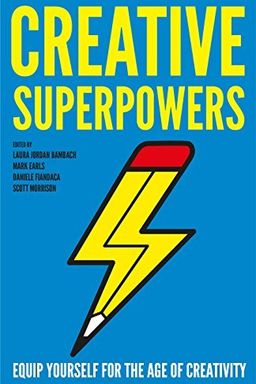
Creative Superpowers cover

Creative Superpowers

by Laura Jordan Bambach, Mark Earls, Daniele Fiandaca and Scott Morrison

Creative Superpowers is your essential guide to unleashing creativity in the digital age. Packed with actionable insights from industry leaders, this book shows you how to collaborate effectively, embrace serendipity, and rapidly learn new skills to thrive in a world driven by innovation.

Unleashing Your Creative Superpowers in the Age of Creativity

Have you ever felt that you’re losing your creative spark—that childlike curiosity and adaptability that made ideas flow freely? Creative Superpowers by Laura Jordan Bambach, Mark Earls, Daniele Fiandaca, and Scott Morrison invites you to rediscover it. The authors argue that creativity isn’t a rare talent gifted to a few but a universal human ability waiting to be reawakened. To thrive in a world redefined by technology, automation, and cultural transformation, you must activate four essential mindsets—what they call the creative superpowers: Making, Hacking, Teaching, and Thieving.

The book contends that creativity is humanity’s greatest differentiator in a future increasingly shaped by artificial intelligence. Rather than fearing technology, you can use it to amplify intelligence—a concept the authors call ‘Intelligence Augmented.’ When machines take over routine tasks, creative thinking becomes the most valuable capability left to us. But these superpowers demand retraining your mindset, breaking free from adult rationality that suppresses play, and learning to reimagine problems from unexpected angles.

Rediscovering Human Creativity

Fiandaca’s introduction sets the stage by acknowledging the anxiety many professionals feel: industries disrupted, audiences fragmented, automation looming. Yet, he reminds us that our brains are wired for reinvention. Neuroplasticity—the brain’s ability to rewire itself—means even ‘old dogs’ can learn new tricks. Creativity, he argues, isn’t magic; it’s practice. Like learning a language, it grows through immersion, experimentation, and failure. The authors position the reader as a “creative superhero,” capable of turning imagination into tangible change. The book’s global scope—from Tokyo to South Africa—underscores that creativity is a universal currency, not a Western luxury.

The Four Creative Superpowers

You learn to cultivate four powers essential for twenty-first-century innovation:

  • Making: Creating something tangible to think through an idea, not just to execute it.
  • Hacking: The art of improving systems by seeing cracks in the framework and finding clever shortcuts.
  • Teaching: Learning through shared experiences, turning mistakes into mastery.
  • Thieving: Borrowing, remixing, and adapting existing ideas into something new.

Each superpower is explored through real-world stories—Japanese innovator Morihiro Harano’s experiments in film-making, South African maker Kerry Friend’s community-driven projects, and advertising strategist Mark Earls’s exploration of human mimicry and collective creativity. These examples show that creativity thrives not in isolation but through networks, iteration, and collaboration.

Why These Ideas Matter

By integrating lessons from neuroscience, technology, and design thinking, the authors make creativity actionable. You’re asked to think like a child again—fearless and curious—but equipped with modern tools. Creativity becomes less about inspiration and more about process: reflecting, experimenting, hacking, and teaching. For instance, Fiandaca encourages you to build a Lego model “off-plan” to rediscover improvisation. Later chapters elaborate on how culture, collaboration, and shared learning unlock innovation in business and beyond.

Ultimately, Creative Superpowers isn’t just a manifesto for creatives—it’s a survival guide for anyone navigating the Age of Creativity. You’ll learn to blend human insight with technology, transform fear of change into playful exploration, and realize that creativity isn’t a skill to master—it’s a way of being. As the authors remind us: “You are the most talented, most interesting, and extraordinary person in the universe. Go make, hack, teach, and steal.”


The Power of Making

Laura Jordan Bambach opens the section on Making with a provocative statement: without making, ideas stay fantasies. She challenges you to move beyond conceptual thinking toward actual creation. Making, she explains, is both process and outcome—a dialogue between mind, hands, and materials. It’s in the flawed, messy act of bringing something to life that the brain discovers novelty.

Learning Through Imperfection

Bambach shows that creativity blossoms from error. She contrasts two creative paths—the architect’s linear planning and the sculptor’s adaptive chiseling—to stress that progress emerges from exploration. Morihiro Harano’s story epitomizes this principle. When filming OK Go’s viral music video “I Won’t Let You Down,” Harano didn’t storyboard every frame. Instead, he rented an empty mall and discovered choreography through trial and error. The team’s willingness to “play in the sandpit” turned accidents into brilliance.

Making as Conscience and Connection

Kerry Friend expands Bambach’s philosophy to the social sphere. In South Africa, maker culture isn’t about trendy 3D printers but community transformation—teaching children to repurpose plastics, supporting local entrepreneurs, and blending digital innovation with tactile creativity. Making, therefore, becomes ethical: a means of making the world better. The makers in Friend’s circle use creation to empower and educate, redefining innovation as service, not spectacle.

Iteration and the Spare Parts Pile

Australian noise artist Lucas Abela and creative director Lizi Hamer reveal the evolutionary nature of making. Abela’s journey from modified turntables to shards of amplified glass illustrates how experimentation transforms both process and self. Similarly, Hamer advocates keeping a “spare parts pile”—unfinished ideas ready to recombine. Her projects like “Heineken Sound Experiments” prove that cross-pollinating old and new concepts leads to breakthroughs.

Key Insight

Making is how thinking becomes tangible. It forces you out of abstraction and into dialogue with reality—where imperfection, play, and iteration unlock genuine innovation.

This first superpower reminds you that creative confidence comes from doing. Whether building prototypes, crafting art, or starting side projects, making transforms theory into practice. It’s less about perfection and more about presence—the willingness to begin, fail, and begin again.


Hacking as Creative Mindset

Daniele Fiandaca’s section on Hacking redefines the term from cybercrime to creative problem-solving. A hacker isn’t a lawbreaker but a curious tinkerer who assumes something is broken and strives to fix it. Through real-life examples—Team Sky’s marginal gains strategy, Florence Nightingale’s hygiene reforms, and startup growth hacks—Fiandaca demonstrates how hacking democratizes innovation.

Small Changes, Big Results

Fiandaca recounts Sir Dave Brailsford’s transformation of British cycling through 1% improvements. From customized bedding to hand-washing lessons, Brailsford’s micro-hacks compounded into Olympic success. The principle applies universally: tiny, unconventional tweaks often outperform grand strategies. You can hack your own habits by diagnosing constraints and testing quick fixes—an idea echoed in productivity models like the Pomodoro Technique.

Culture Hacking and Business Transformation

Annicken R. Day takes hacking into organizational culture. At Tandberg and Cisco, she used bottom-up design to replace rigid hierarchies with empowered teams. Her “New Hire Workshops” allowed employees to experience corporate values instead of reading them on slides. Day shares Netflix’s radical culture deck and Richard Branson’s unlimited vacation policy to show how small administrative hacks—trust-based flexibility, self-management—revitalize motivation.

Mental Hacking and Self-Reflection

In Hugh Garry’s “Have You Had Your Brain Hacked Recently?”, hacking turns inward. He compares magicians’ misdirection to creativity: by shifting attention away from conscious logic, you invite unconscious insight. Garry explains that boredom, mess, and ambient noise produce mental “white space” for ideas—echoing neuroscience’s view of the brain’s default mode network. Learning to hack your attention cultivates creativity through disconnection.

Key Insight

Hacking asks you to question norms, experiment aggressively, and treat problems as malleable. Instead of waiting for permission, simplify, prototype, and repeat.

When creativity stagnates, hacking reignites it—whether by breaking routines, rethinking workplace rules, or hacking your own brain. The hacker mindset values curiosity over compliance and celebrates ingenuity that improves systems with minimal means.


Teaching, Learning, and Relearning

Scott Morrison introduces Teaching not as instruction but as evolution—learning, unlearning, and relearning to stay adaptable in the twenty-first century. Drawing from futurist Alvin Toffler and psychologist Carol Dweck’s growth mindset theory, Morrison argues that literacy today means flexibility. The new teacher is not an authority but a self-directed learner who transforms experience into wisdom.

Learning by Doing

David Erixon’s chapter on Hyper Island highlights experiential learning. He describes the “learning spiral,” where reflection and experimentation replace rote memorization. At Hyper Island, students gain skills through projects, feedback, and iteration—mirroring agile work culture. Erixon’s mantra, “doing-by-learning,” urges you to engage physically and emotionally in creation; thinking and doing become inseparable.

Unlearning Through Streets and Serendipity

David Pearl’s “Street Wisdom” reframes urban wandering as mindfulness training. By turning everyday environments into classrooms, you can find answers through observation and reflection. Pearl tells stories of professionals who rediscover inspiration simply by walking attentively, echoing Nietzsche’s belief that “all true thoughts are conceived by walking.” Unlearning habits means noticing what you’ve ignored.

Learning in Reverse

Nadya Powell challenges age-based hierarchies in workplaces. Her concept of “Millennial Mentoring” flips dynamics: younger employees teach older ones about digital tools, adaptability, and cultural relevance. Powell argues that in the age of “creative destruction,” younger generations learn faster while older ones excel in empathy. Together, they form reciprocal classrooms—cross-generational creativity that keeps businesses alive.

Key Insight

Teaching yourself is about embracing constant transformation—doing, reflecting, and collaborating to stay curious in a world that never stops changing.

The superpower of Teaching reminds you that creativity is communal learning in motion. You grow by acting, sharing, failing, and teaching others what you discover. In this feedback loop, mastery becomes collective progress rather than solitary achievement.


Thieving—Copying with Intelligence

Mark Earls’s section on Thieving dismantles the myth of originality. We borrow, remix, and build on each other’s ideas; that’s how human culture evolves. Earls calls this ability to use others’ brains our greatest cognitive efficiency—it saves time, accelerates innovation, and enhances connection. Creativity isn’t about inventing from scratch but recombining existing materials in surprising ways.

The Science of Copying

Earls cites behavioral science research showing that humans are “homo mimicus”—the imitating ape. Most learning occurs socially, through observing and adapting what others do. From language evolution to fashion trends, copying spreads ideas faster than individual invention. Like the English language absorbing words from global sources, creativity thrives through openness and hybrid vigor.

Copy Good, Copy Bad, Copy Smarter

Architect Alistair Barr explores this concept through architectural history. From Vitruvius to Le Corbusier, imitation has shaped design progression. Barr urges “intelligent referencing”—using precedents as catalysts, not crutches. By blending references critically, architects enrich originality. Zaha Hadid’s case against Chinese “pirate architects” highlights the line between homage and plagiarism—copying becomes creative only when infused with understanding and purpose.

Stealing with Style

Justin Smith, milliner to stars, embraces copying as evolution. His hats reinterpret tradition through material exploration—reimagining turbans, velvet caps, and gold-painted leather. Smith teaches by sharing craft techniques while encouraging students to innovate within constraints. Similarly, Faris and Rosie Yakob’s “Genius Steals” framework defines creativity as abstraction and recombination. They echo T. S. Eliot: talent imitates, genius steals—but with intention and transformation, not theft.

Key Insight

Thieving means learning from everything around you—abstracting, recombining, and transposing ideas across domains until they form something lucid, pleasing, and strange.

The Thief’s superpower celebrates influence, collaboration, and adaptation. By embracing creative lineage—from Picasso to Steve Jobs—you unlock originality through transformation. Cultural progress depends not on purity but on connection—same same, but different.


Becoming a Creative Superhero

Throughout the book, the authors urge you to embody the spirit of a creative superhero—fearless, curious, and ethically imaginative. To do so, you must combine the four superpowers dynamically: make to prototype, hack to improve, teach to share, and steal to evolve. Creativity becomes not a job title but a survival trait for the Age of Creativity.

Integrating the Superpowers

Fiandaca observes overlapping themes among the four powers—reflection, experimentation, collaboration, and bravery. Each section reinforces the importance of vulnerability: accepting mistakes, sharing insights, and learning from others. Collectively, these powers encourage you to see creativity as continual dialogue between doing and thinking. When used together, they transform not just individuals but organizations and societies.

The Global Dimension

The diversity of voices—from India’s Ravi Deshpande to Japan’s Harano—demonstrates that creativity transcends culture. Deshpande’s concept of Jugaad (frugal innovation) shows hacking as resilience in resource-poor contexts, turning chaos into opportunity. The book’s international reach reminds you that creativity isn’t elitist; it’s the world’s collective muscle.

From Reading to Doing

The concluding exercises turn insight into habit—breaking problems into parts, experimenting with mash-ups, sending postcards to your future creative self. These practical tools reinforce the book’s central message: creativity thrives through action. Like Hyper Island’s doing-by-learning, self-practice builds muscle memory and confidence.

Key Insight

Becoming a creative superhero requires rediscovering your inner child—combining curiosity, empathy, and fearlessness to build, disrupt, teach, and adapt for a better world.

As a closing thought, the book reframes creativity as participation, not possession. Everyone can cultivate creative superpowers; the only prerequisite is willingness to start. In a world where machines handle repetition, creativity remains the last frontier of human imagination—a force for meaning, connection, and progress.

Dig Deeper

Get personalized prompts to apply these lessons to your life and deepen your understanding.

Go Deeper

Get the Full Experience

Download Insight Books for AI-powered reflections, quizzes, and more.