
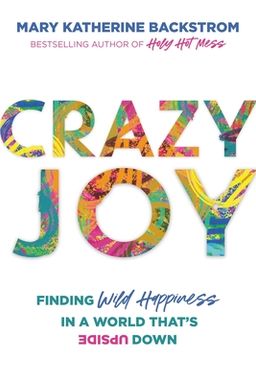
Crazy Joy cover

Crazy Joy

by Mary Katherine Backstrom

Crazy Joy invites readers on a transformative journey to discover authentic happiness amidst life''s chaos. Through humor, philosophy, and personal stories, Mary Katherine Backstrom reveals how to cultivate joy by embracing imperfections, overcoming comparisons, and facing life''s challenges with courage.

Crazy Joy: Finding Light in Life’s Messy Chaos

Have you ever felt like happiness keeps slipping through your fingers no matter how hard you chase it? In Crazy Joy, Mary Katherine Backstrom invites you to stop running after the mirage of perfect happiness and instead explore something wilder and deeper: joy. Her book argues that joy isn’t found in a polished, picture-perfect life—it’s discovered in the cracks, the chaos, and those laugh-or-you’ll-cry moments that make being human beautifully messy.

Backstrom, known for her viral humor and vulnerability about faith and mental illness, redefines joy not as fleeting emotion, but as a spiritual force resilient enough to survive upheaval. Through confessional storytelling—misadventures with premarital counselors, buying graveyard flowers for a luau, rescuing dying iguanas, and debating with her therapist—she offers an honest roadmap for living a joyful life that’s authentic rather than idealized.

Happiness vs. Joy: A Wild Contrast

Backstrom opens the book by admitting she’s “crazy”—living with bipolar disorder, OCD, and ADHD—and jokes that pursuing happiness feels like playing Duck Hunt on Nintendo: a relentless game of shooting at moving targets. She compares happiness to manic highs or pristine irises that flourish only in perfect conditions, while joy behaves more like weeds—resilient, defiant, and capable of growing in sidewalk cracks. Drawing from childhood memories of gifting her mother weeds she mistook for flowers, Backstrom shows that joy often grows where you least expect it.

Joy as a Spiritual and Emotional Force

In later chapters, she deepens the metaphor: joy isn’t just emotion; it’s an elemental force. Borrowing from Isaac Newton’s laws of motion and color theory, Backstrom reimagines joy as part of the physics of the soul—a counterforce against sadness, anger, and fear. This idea echoes thinkers like Viktor Frankl, who argued in Man’s Search for Meaning that our deepest purpose arises from tension and suffering. For Backstrom, joy isn’t the opposite of pain; it’s the companion that makes pain survivable.

Finding Joy in Mortality

In “Flowers for the Dead,” she confronts nihilistic philosopher Friedrich Nietzsche and surprises herself by agreeing with him—joy longs for eternity. Sitting in an Alabama cemetery with her kids, she realizes that fully embracing mortality deepens joy. The space between birth and death—the dash—is where our treasure lies. Accepting life’s impermanence doesn’t dampen joy but gives it urgency. This echoes Tim McGraw’s anthem “Live Like You Were Dying,” except Backstrom insists we already are dying, so the time to savor joy is now.

Joy in the Ordinary and the Absurd

Backstrom’s humor keeps the book grounded. From green Shrek ketchup disasters to freezing dead birds beside Eggo waffles, she builds the argument that life’s absurdities are fertile soil for joy. Even mistakes—like pretending store-bought pies were homemade at Thanksgiving—become lessons in authenticity. Comparison, she warns, is joy’s sneaky thief. We lose ourselves chasing perfection when the real joy hides in recognizing our “paper plate” moments—the imperfect, true selves we bring to the table.

Community, Connection, and Crazy Grace

The book moves inward—from personal healing to relational joy. Backstrom describes social anxiety, community misfires, and finding humor in rebuilding trust. Relationships, like bridges, collapse under neglect but can still be repaired. Joy flourishes in healthy connections, not isolation. Her therapist’s advice to be kind to herself transforms into an invitation for readers to stop being their own worst bully and instead befriend their inner roommate.

Resilient Joy in Fear and Crisis

In later chapters, joy battles fear, grief, and trauma—the “Upside Down” world of Stranger Things made emotional. Backstrom teaches that joy isn’t destroyed by life’s monsters; it breathes beneath the waves like a surfer caught in Mavericks. Whether in the chaos of 2020 or the daily skirmishes of mental health, joy becomes the air we fight to inhale—the stubborn survival instinct of the soul.

Ultimately, Crazy Joy isn’t about feeling good all the time. It’s about holding laughter and sorrow in the same hand, learning that joy thrives not because life is perfect, but because it’s not. Backstrom’s journey shows that joy isn’t found in the garden—it blossoms in the cracks of the sidewalk, surviving the madness, growing wild, and shining eternal.


The Weed Theory of Joy

Backstrom’s first major insight, introduced through her childhood story, is what she calls the “Weed Theory of Joy.” She recalls giving her mother bouquets of little purple flowers she loved, only to learn they were weeds called henbit. Initially embarrassed, she learned from her mom that weeds are stronger than flowers—thriving where roses and lilies wilt. To Backstrom, joy is like a weed: it grows through the cracks of adversity, whereas happiness is a fragile flower that depends on perfect conditions.

Joy Survives Where Happiness Doesn’t

Happiness wilts when life gets messy—a fight with a partner, a disappointment at work, or uncertainty about faith. But joy, like henbit, finds a way. It flourishes in grief, laughter, and everyday imperfection. This metaphor grounds the book’s argument: if you tend only to flowers, the weeds will shock you. But if you love the weeds, life’s wild terrain becomes beautiful. (Backstrom’s comparison mirrors C.S. Lewis’s idea from The Problem of Pain that joy is resilient precisely because it’s independent of circumstance.)

From Hitchhiker to Tour Guide

Backstrom admits she spent much of her life as a “hitchhiker on the road to joy,” passively waiting for ideal conditions. Her turning point comes when she decides to take the wheel—to stop letting outside forces drive her joy. She invites readers to do the same: if you live waiting for others to bring joy, you’ll end up stranded in the wrong place. Taking responsibility for joy means noticing its blooms in unexpected sidewalks rather than curated gardens.

Laughter as Fertilizer

Backstrom promises she’ll be your “tour guide” to joy, not an expert. You’ll laugh with her, think with her, drink coffee together. It’s both humble and empowering—she reframes joy as communal and playful rather than solemn or elitist. Laughter is the fertilizer for joy’s growth. The “Crazy” in Crazy Joy isn’t instability—it’s the freedom to laugh out loud at life’s absurdities and find beauty in imperfection.

Through this metaphor, Backstrom sets up her emotional and spiritual foundation: cultivate joy like weeds, not like roses. Once you stop fearing the cracks and start tending to whatever grows there, you’ll find an ecosystem of joy sturdy enough to survive every storm.


Joy as a Force of Nature

In a quirky love letter to Sir Isaac Newton, Backstrom explores the physics of joy. Her teenage heartbreak and college meltdown around color theory lead her to discover that joy follows the laws of force, reaction, and light. She humorously fuses Newton’s third law—every action meets an equal and opposite reaction—with color theory to explain how emotions push and pull like light across a spectrum.

Breaking the Myth of Emotional Opposites

In one of the book’s most memorable stories, Backstrom recalls how she tried to fight heartbreak with hatred—an “equal and opposite reaction.” But over time she discovers anger doesn’t cancel pain; forgiveness does. Using Newton’s color wheel, she explains that what seems like the opposite (red vs. blue) isn’t truly opposing; it’s complementary. Likewise, joy isn’t the opposite of sadness—it’s the light refracted through it. To heal, we must recalibrate our “laws of joy dynamics.”

Light Through the Prism

She likens the soul to a prism: even in gray seasons, the potential for color—the capacity for beauty—remains. When trauma blocks light, we mistake the absence of joy for its extinction. In truth, it’s still there, awaiting a crack for light to shine through. (This parallels Brené Brown’s work on vulnerability, where openness becomes a conduit for healing light.)

Joy as Active Energy

Backstrom concludes that joy should be treated as an active spiritual and emotional energy—stronger than hate, mightier than fear. Its power comes from movement rather than stasis. When forgiveness replaces hostility, joy’s kinetic energy restores equilibrium. This blends emotional healing with physics: you can’t expect balance without motion. Joy requires participation, compassion, and grace.

By reimagining joy through Newtonian logic and color, Backstrom turns science into metaphor—proof that beauty isn’t found in avoidance of pain but in the spectrum of feeling it creates.


The Dash Between Life and Death

Backstrom’s “Flowers for the Dead” chapter is both hilarious and profound. After making leis from cemetery flowers as a child, she reads Nietzsche’s Thus Spoke Zarathustra and muses about mortality, meaning, and eternity. Against nihilism, she discovers that joy isn’t destroyed by death—it’s deepened by it. She calls the dash between birth and death engraved on tombstones the ultimate symbol of our lives.

Joy’s Longing for Eternity

Nietzsche’s notion that joy “wants eternity” resonates with Backstrom’s belief that joy exists beyond the temporary highs of living. Holding her daughter’s flower crown made from grave blooms, she realizes that joy isn’t found by escaping mortality but by celebrating it. Death gives joy meaning: we cherish what we know we’ll lose. (This idea echoes existential theologians like Paul Tillich who argued faith becomes real through accepting finitude.)

Spending Time as Treasure

She develops a life metaphor based on Supermarket Sweep: our time is currency. We can waste it filling carts with trivial “beans” or spend it wisely on meaningful experiences. “No dying person ever said, ‘I wish I’d worked more overtime,’” she quips. True wealth is where our time is spent—on family, laughter, and love. The dash isn’t about quantity of years but richness of days.

Making Peace with Mortality

“Live like you were dying” isn’t aspirational—it’s reality. We are dying, right now, she insists. Accepting death frees us to love fiercely and live intentionally. Joy therefore becomes eternal—not because life is endless, but because its meaning transcends time. In every fleeting moment, joy whispers of heaven.

Through graveyard walks and absurd humor, Backstrom builds an elegant philosophy: only by acknowledging our impermanence can we find joy that feels permanent.


Muddy Math and the Messy Common Denominator

Backstrom’s “Muddy Math” chapter uses one of her weakest subjects—algebra—to teach one of joy’s most practical lessons: finding the common denominator. Recounting stories of disastrous green Shrek meat loaf and college roommate failures, she realizes that every repeated pattern in her life had one constant factor: herself.

Becoming the Common Denominator

In failed friendships, bad jobs, and recurring chaos, she’d blamed circumstances until noticing the recurrence. “I was the variable showing up every time,” she admits. Joy demanding accountability means recognizing how we contribute to our own unhappiness. (Echoing Jordan Peterson’s emphasis on self-responsibility in 12 Rules for Life.)

Reducing Fractions of Life

Her playful metaphor of apple pie fractions simplifies the idea: you can’t compare slices of life until you share the same denominator—joy. Without it, every pursuit (money, beauty, validation) becomes meaningless math. When joy is the denominator, life simplifies: relationships become equations of grace, not competition.

Present-Tense Joy

She identifies her mistake of treating joy as future-tense (“I’ll feel joy when…”) or past-tense nostalgia (“I had joy back when…”). True joy is present tense—a here-and-now experience. “Joy’s slice isn’t something you earn later; it’s the piece already on your plate,” she writes.

Through humorous math and messy kitchens, she transforms self-reflection into soul calculus: joy multiplies only when you own your fraction.


Lost in Translation: The Language of Self-Compassion

In “Lost in Translation,” Backstrom delivers one of her most insightful chapters: joy begins with self-compassion. She recounts reporting her dad to the D.A.R.E. officer for “doing drugs” (beer), misinterpreting Thai phrases as “permission to fart,” and misapplying therapy homework meant to teach self-kindness. Her miscommunications become allegories for the ways we mistranslate our own worth.

Inner Roommates and Self-Talk

Backstrom’s therapist Dr. C frames mental health like a house shared by roommates—mind, body, and spirit. Most of us let one part bully another. The fix? Start talking kindly within. Her revelation: self-compassion, not self-esteem, shields us from despair. (Psychologist Kristin Neff’s research supports this—self-compassion predicts resilience better than self-esteem.)

Learning Joy’s Native Tongue

Joy has a language, Backstrom says, and it’s customized—your dialect of gratitude, laughter, and spiritual connection. Many can’t hear joy’s voice because their self-talk is too loud with criticism. Her simple practice: speak to yourself as you’d speak to a beloved friend. When she did, joy’s tone became clear, gentle, and familiar.

Listening Over Judging

Joy calls softly, like music muffled by noise. Tuning in requires replacing judgment with listening. When all inner parts communicate with empathy, you achieve harmony. Backstrom calls this “getting your roommates to stop fighting over Oreos.” When internal peace is restored, joy finds its home again.

“Lost in Translation” reminds readers that discovering joy starts with learning to communicate with ourselves in kindness, translating grace into self-acceptance.


Ghosts, Bridges, and Healing Relationships

Backstrom’s chapters “A Ghost Story” and “Dragons and Bridges” explore how insecurity and trauma block joy in relationships. Using humor to illuminate pain, she connects haunting self-doubt (“red-eyed ghost girls”) to broken friendships and marital missteps. Joy, she insists, can’t thrive where insecurity haunts every conversation.

Insecurity as Self-Haunting

She describes social anxiety so intense it turns small-group Bible study into comic disaster—oversharing about “talking beavers in heaven.” Yet beneath the humor lies truth: insecurity rewrites reality. We invent ghost stories about how others see us and then act scared of our own imagination.

Bridge Collapses and Relational Engineering

The lizard rescue in “Dragons and Bridges” becomes metaphor for faulty relationships: well-intentioned efforts to fix broken connections sometimes make things worse. Love builds bridges, but without structural integrity—trust, boundaries, respect—they collapse. “Love can build a bridge,” she writes, “but love is a crappy engineer.” You must inspect the foundation instead of rushing across.

Healing from the Wild

Her therapist teaches that trauma rewires the brain to expect unsafe relationships. Healing rewires it back toward love. Wild animals resist domestication—and so should our hearts. Real joy emerges when we stop accepting captivity disguised as connection and rejoin the wildness of authentic love.

By transforming ghost stories and burnt bridges into parables, Backstrom proves that relational healing is both engineering and exorcism: rebuild what’s stable, release what’s haunted.


The Thief and the King: Rising Above Comparison

In “Thief of Joy” and “King of the Goblins,” Backstrom exposes comparison as joy’s most cunning villain. Sitting before her mantel of holiday cards, she feels envy gnaw at her peace. Every photo triggers inner devils whispering, “You’re not enough.” But rather than shame, she offers honesty—and humor.

The Great Pie Lie

Her “Publix pie scandal” at Thanksgiving becomes an analogy for performative perfection. Pretending she baked the pies to impress her in-laws, she ends up confessing in shame. “I postured myself with pastry,” she laughs. Comparison fuels deception and self-alienation. Joy, conversely, thrives on authenticity—even if that means messy truth over curated image.

Embracing the Paper Plate Life

Backstrom distinguishes between “Pinterest People”—those who orchestrate perfection—and “Paper Plate People,” who show up real, late, and flawed. Instead of idolizing elites, she praises the ordinary. Joy isn’t aspirational; it’s accessible. (This aligns with Anne Lamott’s theology of imperfection: grace meets us in our human clumsiness.)

No Basis for Comparison

Borrowing a line from Labyrinth, she reminds us, “You say that so often—I wonder what your basis for comparison is.” The cultural metrics of beauty, success, or motherhood constantly change. Our only true measure, she says, is God’s joy reflected within. We are the stars trying to fit into square holes; our edges were meant to shine.

Through humor and vulnerability, Backstrom dismantles comparison culture, revealing that it’s not flaws but authenticity that makes joy eternal.


The Science of Community and Connection

In “Tinfoil Hats,” Backstrom insists joy is impossible in isolation. Revisiting a 75-year Harvard study on happiness, she notes its shocking conclusion: the happiest lives are rooted not in wealth or success but in loving relationships. Community, she writes, “isn’t built in pajamas on the couch,” but through risk, presence, and vulnerability.

Friendship and Object Permanence

Through the lens of her scattered long-distance friendships, Backstrom reframes disappearing connections. Like babies learning that peekaboo doesn’t mean “gone,” adult friendships shift seasonally, not permanently. Understanding “object permanence of community” helps us release anxiety about change—joy doesn’t vanish; it morphs.

Expectations and Grace

Unmet expectations are friendship’s “slow poisoning.” We expect flawless understanding, constant support, perfect alignment—and get heartbreak instead. Backstrom argues joy in community requires grace, patience, and forgiveness. Let friends be flawed humans, not spiritual vending machines.

Finding Joy Beyond Self

Joy, she reminds, matures through connection. It multiplies when shared and stagnates when hoarded. The sneeze guard of self-protection doesn’t stop pain—it keeps love out. “Community takes joy and makes it multiply,” she writes. When you show up, even awkwardly, joy shows up too.

Backstrom’s communal vision echoes Martin Buber’s “I-Thou” relationship: we meet God in others. Joy, then, isn’t private—it’s relational fuel that sustains human flourishing.


Fear, Crisis, and the Upside Down of Joy

In her final chapters “Mavericks and Magnolias” and “Life in the Upside Down,” Backstrom unites all previous lessons in a climactic truth: joy is courageous. Whether surviving the pandemic, battling cancer, or facing trauma, she discovers that joy coexists with fear rather than erasing it. “Fear is healthy,” she quotes, “panic is deadly.”

Dark Humor and Crisis

Her favorite Steel Magnolias scene—Sally Field laughing through grief—shows how humor becomes survival. During COVID chaos, Backstrom and friends joked about Fort Myers stealing everything from hairlines to nipples. That laugh, she says, was “morbidly healing.” Humor keeps joy breathing when sorrow suffocates.

Surfing the Mavericks

Drawing from the film Chasing Mavericks, she equates joy with surfing deadly waves: you can’t control the ocean, only your breath. Life’s Mavericks crash unpredictably; our task is to hold joy like oxygen until we resurface. Where surfers train to handle waves, we must build spiritual resilience to handle storms.

Facing the Upside Down

Comparing trauma to the “Upside Down” from Stranger Things, she argues that pain flips life backward, but joy reverses gravity. Fear may hover, but joy becomes our compass. She invites readers to step into the ocean again—to live fully even knowing sharks exist. Only by risking the deep do we rediscover the wonder of floating.

Backstrom concludes with a radiant paradox: joy doesn’t come from escaping fear but from dancing with it. In a world perpetually upside down, joy stands upright, defiant, and divine—a whisper from God that says: “Keep breathing.”

Dig Deeper

Get personalized prompts to apply these lessons to your life and deepen your understanding.

Go Deeper

Get the Full Experience

Download Insight Books for AI-powered reflections, quizzes, and more.