
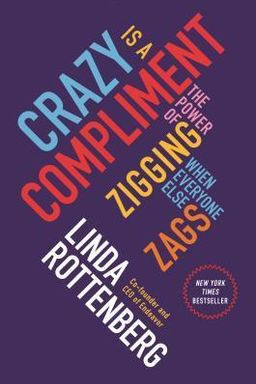
Crazy is a Compliment cover

Crazy is a Compliment

by Linda Rottenberg

Crazy is a Compliment by Linda Rottenberg inspires readers to pursue their dreams by embracing a bold, entrepreneurial mindset. Learn how to minimize risks, harness chaos for innovation, and develop leadership qualities to build the company of your dreams. This book offers practical insights and real-life examples of successful entrepreneurs to guide your journey.

The Power of Zigging When Everyone Else Zags

Have you ever been called crazy for following a dream that no one else understood? In Crazy Is a Compliment, Linda Rottenberg argues that being called crazy is not an insult—it’s the highest praise an innovator can receive. She contends that entrepreneurship is no longer reserved for hoodie-wearing tech founders in Silicon Valley; instead, it’s a mindset that everyone, from corporate employees to stay-at-home parents, can and should adopt. Her core message: in a world of constant change, safety lies in daring, and risk is not an obstacle—it’s the path forward.

Drawing from her decades of experience as the co-founder of Endeavor, a global network supporting high-impact entrepreneurs, Rottenberg shows that everyone can learn to think and act like an entrepreneur. You don’t have to start a multimillion-dollar company to do it—you simply need to zig when everyone else zags. Throughout the book, she weaves together lessons from underdog successes around the globe, rich psychological insights into how to manage fear, and actionable frameworks for getting started, scaling up, and staying grounded.

Entrepreneurship for Everyone

Rottenberg begins with an argument that entrepreneurship isn’t just for entrepreneurs anymore. The skills of agility, creativity, and problem-solving are essential for anyone navigating economic uncertainty. She categorizes entrepreneurial types into four species—gazelles (fast-growing startups), skunks (intrapreneurs within large corporations), dolphins (innovators in nonprofits and social enterprises), and butterflies (small-scale or lifestyle entrepreneurs). Each group operates in different ecosystems but shares the same entrepreneurial DNA: resilience, contrarian thinking, and fear management.

The Crazy Mindset

According to Rottenberg, to embrace entrepreneurship, you must first give yourself permission to be crazy. She tells the story of Leila Velez, who went from flipping burgers at McDonald’s in Rio de Janeiro to building Beleza Natural, an $80 million haircare business serving Afro-Brazilian women. Leila succeeded because she saw what others missed—not just selling hair products, but selling confidence. This mental courage to break conventions is what Rottenberg calls lipstick psychology: meeting needs people didn’t even know they had.

The New Language of Risk

She challenges myths about risk, arguing that entrepreneurs don’t bet the farm—they take smart risks. Like Spanx founder Sara Blakely, who tested ideas on weekends while keeping her day job, high-impact entrepreneurs learn to derisk risk by testing, iterating, and learning from failure. This mindset isn’t about reckless leaps—it’s about strategic courage guided by conviction and adaptability.

Going Big Without Losing Your Soul

Once you start, going big requires understanding your entrepreneurial personality—whether you’re a dreamer (a diamond), a trendsetter (a star), a transformer (a revitalizer of old industries), or a rocketship (an efficiency-driven analyst). Knowing who you are prevents burnout and helps you build smarter, scalable systems. But Rottenberg doesn’t stop there: she emphasizes that true success involves going home—building purpose-driven workplaces and integrating family and values into your professional life.

Why This Matters Now

Rottenberg’s work is part manifesto, part roadmap. Like Adam Grant’s Originals and Sheryl Sandberg’s Lean In, it’s rooted in empowerment but uniquely global, citing entrepreneurs from 45 countries—from snail farmers in Greece to cyber innovators in Brazil. Her central claim is that entrepreneurial thinking is society’s new survival toolkit. You can no longer rely on corporate safety nets or fixed career ladders; stability now comes from movement, adaptability, and purpose. Whether you’re reimagining a community project, rebuilding a corporate team, or launching your first product, the same rules apply: start small, fail smart, and don’t fear being called crazy. That label, Rottenberg insists, is your compliment—it means you’re onto something extraordinary.


Getting to Day One

To begin your entrepreneurial journey, you must first conquer the toughest critic of all—yourself. Linda Rottenberg calls this moment “Getting to Day One.” It’s the psychological threshold where your dream stops living in your head and starts taking shape in reality. Most people think entrepreneurship starts with a business plan or a brainstorm. Rottenberg argues instead that it begins with a shift in mindset.

Convincing Yourself First

Entrepreneurs are doers, not dreamers. Wences Casares, who grew up on a sheep farm in Patagonia, embodies this idea. With no neighbors for miles and limited resources, he learned to improvise, build bridges, and fix problems with his own hands. Later, he founded Argentina’s first online trading platform despite being told he was crazy—it’s his self-belief that kept him moving forward after thirty-three rejections. Rottenberg urges readers to adopt Casares’s formula: heart + mind – fear = entrepreneur.

Permission to Be Contrarian

Mary Jo Cook and Suzanne Sengelmann, two executives at Clorox, teach a key lesson in self-permission. Working part-time and breaking rigid corporate rules, they quietly built a green cleaning division from the ground up—what Rottenberg calls a skunk project. They succeeded because they gave themselves permission to act before being told they could. Their innovation, Green Works, later reached $60 million in annual sales.

Defeating Self-Censorship

Egyptian entrepreneur Amr Shady reveals another insight: the biggest obstacle isn’t politics or funding—it’s mental. Shady reminded Rottenberg of runner Roger Bannister’s barrier-breaking 4-minute mile story: once the psychological limit was shattered, others followed. Entrepreneurs must learn to silence internal voices telling them “it’s not possible.” She likens this to battling “the distance between your ears.”

Owning Your Identity

Rottenberg herself faced resistance when telling her risk-averse parents she was leaving law to start Endeavor. They said she was crazy for abandoning a stable career and reminded her about her “biological clock.” Yet this moment—tearing up at her parents’ kitchen table and declaring, “This is who I’m supposed to be”—became her own Day One. She teaches that becoming an entrepreneur is ultimately an act of self-definition. You’re not crazy—you’re discovering who you were meant to become.

Key Takeaway

Getting to Day One isn’t about perfection—it’s about conviction. You don’t need to have all the answers, a perfect plan, or approval from others. You simply need to believe that your “crazy idea” deserves a chance to exist. Once that belief clicks, everything else starts to follow.


Derisking Risk

The image of the fearless, risk-taking entrepreneur is misleading. According to Linda Rottenberg, successful innovators don’t plunge blindly into uncertainty—they learn how to derisk risk. This chapter offers four strategies to transform potential hazards into manageable experiments, showing how courage and calculation go hand in hand.

1. Don’t Bet the Farm

Contrary to Hollywood’s myth, smart entrepreneurs rarely stake everything on their first idea. Richard Branson sums it up best: “If you’re a risk-taker, the art is protecting the downside.” Sara Blakely, founder of Spanx, kept her day job selling fax machines for two years while prototyping her product. In the start-up world, survival depends on testing small. Rottenberg references Eric Ries’s The Lean Startup, encouraging “minimum viable products” and early feedback loops. Zappos founder Nick Swinmurn validated his idea by photographing shoes in stores and fulfilling orders manually before launching a full business.

2. Friends Don’t Let Friends Test-Drive Ideas

Early-stage ideas are fragile. Rottenberg warns against sharing them too soon with family and friends—they’ll either overpraise or undercut. Sara Blakely kept Spanx secret even from her parents. Entrepreneurs like Mel and Patricia Ziegler (Banana Republic founders) were told their illustrated catalog “wouldn’t sell.” Had they listened, the brand might not exist today. The best validation comes from strangers—real customers who give honest feedback instead of emotional reassurance.

3. Follow the Crowd (Smartly)

Crowdfunding changed the equation for testing ideas. Platforms like Kickstarter democratized risk by letting creators raise money and measure demand simultaneously. Perry Chen, founder of Kickstarter, proved that passion projects could go mainstream. For entrepreneurs in regions lacking venture capital—from Jordan’s T-shirt designers at Jo Bedu to nonprofit innovators—crowdsourcing now doubles as both funding and marketing. (Note: modern corporations like Coca-Cola and GE use internal crowdfunding to spur innovation, a practice Rottenberg calls intrapreneurial crowdsourcing.)

4. Master the Art of Stalking

Rottenberg humorously describes her own experience “stalking” key supporters—cornering investors outside restrooms and restaurants until they listened. Networking, she insists, is less about schmoozing and more about persistence. Sam Walton visited rival stores to study their shelving methods; Estée Lauder built her cosmetics empire by approaching women directly at stores and salons. Stalking, done ethically, is learning through curiosity and courage.

Key Takeaway

Entrepreneurs aren’t gamblers—they’re disciplined experimenters. By testing ideas cheaply, seeking real feedback, leveraging the crowd, and stalking opportunities, you minimize failure and maximize momentum. Risk is inevitable; recklessness is optional.


Chaos Is Your Friend

At some point, every dreamer hits a wall. Market crashes, revolutions, pandemics, or personal crises strike unexpectedly. In these moments, Linda Rottenberg argues that chaos isn’t your enemy—it’s your best friend. The entrepreneurs who thrive amid uncertainty see opportunity where others see disaster.

Embracing Setbacks

Walt Disney’s story epitomizes this principle. After losing his rights to Oswald the Lucky Rabbit, he faced financial ruin. Instead of quitting, he sketched a cheerful mouse on a train ride home—Mickey Mouse. Rottenberg uses this example to show that creativity often sparks in the midst of crisis. Entrepreneurs function best not when conditions are smooth, but when they’re messy.

Champagne for Your Enemies

When Russian troops invaded France in 1813, widow Barbe-Nicole Clicquot didn’t hide her champagne—she served it. Her audacity turned Veuve Clicquot into a global luxury empire. Rottenberg’s advice: don’t retreat from chaos; toast to it. Whether it’s Cari Lightner turning tragedy into Mothers Against Drunk Driving or Michael J. Fox transforming Parkinson’s into philanthropy, crisis becomes fuel for reinvention.

Hug the Bear

Economic downturns can be blessings in disguise. More than half of Fortune 500 companies began during recessions. Rottenberg notes that Greece’s 2009 debt collapse triggered an entrepreneurial boom—the founders of Daily Secret turned collective frustration into a million-subscriber positivity project. Like Warren Buffett, entrepreneurs should “be greedy when others are fearful.” Bear markets breed boldness.

Admit You Screwed Up

Owning mistakes earns respect. L.L. Bean refunded faulty boots and built a century of customer loyalty. Netflix’s Reed Hastings publicly apologized for a disastrous pricing change, rebuilt trust, and guided the company to record success. Rottenberg warns against “apology theater”—only sincerity and swift corrective action can restore credibility.

Return to Your Story

Howard Schultz revived Starbucks not through gimmicks but by rediscovering its soul—aroma, craftsmanship, and connection. Angela Ahrendts saved Burberry by returning to its heritage while blending modern design. Rottenberg calls this “Once Upon a Time leadership”: remembering why you started to weather storms.

Key Takeaway

When chaos strikes, don’t despair—adapt, acknowledge, and anchor yourself to purpose. As Rottenberg says, “Stability is the friend of the status quo; chaos is the friend of the entrepreneur.”


Your Entrepreneur Personality

Why do some entrepreneurs succeed wildly while others implode? Linda Rottenberg believes it comes down to personality. In partnership with Bain & Company, she identified four entrepreneurial archetypes: Diamonds, Stars, Transformers, and Rocketships. Understanding which type you are helps you lead, grow, and avoid self-sabotage.

Diamonds: Visionary Dreamers

Diamonds, like Steve Jobs or Elon Musk, are audacious visionaries who transform entire industries. Their strength lies in seeing possibilities others can’t; their weakness is arrogance or resistance to feedback. Brahms Chouity, a Lebanese gamer, built a community of 600,000 players because he dared to dream big—but his impulsiveness threatened sustainability. Rottenberg urges Diamonds to listen, share credit, and value customer insight.

Stars: Charismatic Trendsetters

Stars are personal brands—people like Oprah or Wolfgang Puck—who shape culture through charisma. Their challenge is scaling beyond themselves. The Indonesian DJ Anton Wirjono turned his creative flair into a retail phenomenon, but Rottenberg advises stars to build rock bands, not solo acts. Delegation is survival.

Transformers: Industry Revolutionaries

Transformers modernize outdated industries. From Howard Schultz (Starbucks) to Herb Kelleher (Southwest Airlines), they show how passion can revive tradition. René Freudenberg turned industrial grease into an eco-friendly innovation, proving transformation matters. Yet Rottenberg cautions: meaningful change requires substance, not slogans. Transformers must balance idealism with business pragmatism.

Rocketships: Analytical Builders

Rocketships thrive on data, discipline, and systems. Think Jeff Bezos or Bill Gates—methodical executors who measure everything. Bodytech’s founders in Colombia used metrics to power Latin America’s leading gym chain. But Rottenberg notes that numbers can’t replace heart; emotional connection fuels loyalty. Rocketships must learn to embrace ambiguity and creativity.

Key Takeaway

There’s no one-size-fits-all entrepreneur. By understanding your core type—and hiring complementary personalities—you build a balanced, enduring enterprise. Self-knowledge, Rottenberg concludes, is the first step to going big.


Leadership 3.0

If traditional leadership is about top-down authority and start-up culture is about chaos, Linda Rottenberg charts a middle path she calls Leadership 3.0. It’s built for an entrepreneurial world that craves agility, authenticity, and empathy. She defines four pillars: Agile, Accessible, Aware, and Authentic.

Agile: Experiment Constantly

Agility means replacing rigid plans with fast experiments. Haier’s unexpected success with potato-washing machines came from empowering small teams to solve customer problems creatively. Amazon follows the “two-pizza rule”—if a project team can’t be fed with two pizzas, it’s too big. WD-40’s Garry Ridge institutionalized failure as learning, creating “learning moments” instead of blame sessions. The best leaders, Rottenberg insists, reward initiative, not perfection.

Accessible: Stay Human in a Digital World

Modern leaders connect across hierarchies. GE’s Jeff Immelt blogs to employees; Marc Benioff and Colin Powell discuss accessibility as antidotes to bureaucracy. Rottenberg’s own organization, Endeavor, uses collaborative platforms like Salesforce Chatter to boost transparency. Accessibility builds trust, reminding teams that leadership isn’t distance—it’s dialogue.

Aware: Own Your Imperfections

Rottenberg champions “flawsome” leadership—embracing flaws openly. When Domino’s Pizza admitted its recipes were terrible and reinvented itself, sales soared. Brazilian founders of Spoleto partnered with comedians who mocked their brand, turning ridicule into resonance. Leaders who own mistakes, like restaurateur Danny Meyer turning mishaps into hospitality, inspire loyalty. Awareness, she says, is strength disguised as vulnerability.

Authentic: Expose Yourself Courageously

Authenticity is the soul of modern leadership. Football coach Tony Dungy led with compassion—even after his son’s death, his openness deepened his team’s bond. Brené Brown calls vulnerability “the heartbeat of innovation.” Rottenberg herself shared her husband’s cancer struggle with her team, transforming Endeavor’s culture. By showing humanity, she found genuine strength and empathy. Leadership 3.0 isn’t about superiority—it's about sincerity.

Key Takeaway

The future belongs to leaders who balance agility with empathy. In a connected era, people don’t follow credentials—they follow character. Leadership 3.0 invites you to lead with heart, humility, and a willingness to say, “I don’t know—let’s learn together.”


The Purpose-Driven Workplace

After climbing the entrepreneurial mountain, Linda Rottenberg urges readers to make sure their organizations have a soul. The new workplace isn’t about perks or paychecks—it’s driven by purpose. She calls this movement toward meaning the rise of employeeship, where people act like entrepreneurs inside their companies because they feel valued, connected, and free.

Psychic Equity Over Payday

Money motivates briefly; purpose motivates deeply. Economists like Dan Ariely confirm that overpaying can lead to underperformance. Companies like Globant in Argentina empower “Globers” with autonomy and recognition rather than grand headquarters. W. L. Gore & Associates has practiced “unmanagement” for decades—no titles, no hierarchies, only collaboration. Employees stay because they believe their ideas matter.

Building a Culture Club

Rottenberg draws inspiration from Zappos, where CEO Tony Hsieh institutionalized happiness as strategy. Hiring slow and firing fast ensures cultural fit. Debbi Fields built her cookie empire by hiring people who literally sang “Happy Birthday” during interviews to test their enthusiasm. For entrepreneurs, culture isn’t decoration—it’s infrastructure. Treat every employee as a brand ambassador.

Managing Millennials

Millennials now dominate the workforce. They seek impact, flexibility, and transparency over stability. Companies like Warby Parker and DreamWorks thrive by embracing their energy. Warby Parker founders encourage playful rituals like “Fun Facts” to build belonging. Millennials want meaning in motion—they crave contribution, collaboration, and speed. Hackathons, job rotations, and cross-functional teamwork feed this appetite for purpose.

Go Big and Go Home

Rottenberg’s final lesson flips the tired saying “Go big or go home” into “Go big and go home.” Entrepreneurs don’t have to choose between ambition and family. By setting boundaries, modeling balance, and integrating life with work, leaders create organizations that are human, not machine. She urges women and men alike to put out their family photos, take vacations, and celebrate both career and companionship.

Key Takeaway

The workplace of the future isn’t just productive—it’s purposeful. People want to belong, contribute, and matter. By integrating meaning, culture, and compassion, entrepreneurs not only build successful companies—they build communities that thrive.

Dig Deeper

Get personalized prompts to apply these lessons to your life and deepen your understanding.

Go Deeper

Get the Full Experience

Download Insight Books for AI-powered reflections, quizzes, and more.