
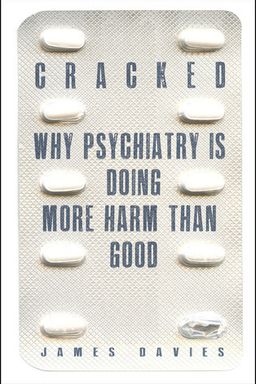
Cracked cover

Cracked

by James Davies

Cracked exposes the crisis in psychiatric science, revealing overdiagnosis and Big Pharma''s influence. It challenges the efficacy of psychiatric drugs and the validity of the chemical imbalance theory, urging a reevaluation of mental health practices worldwide.

Psychiatry’s Fragile Foundations and the Cracks Beneath

When you feel deeply anxious or sad, who decides whether it’s a passing storm of emotion or a diagnosable condition? In Cracked: The Unhappy Truth About Psychiatry, James Davies argues that modern psychiatry has lost its anchor in science, replacing genuine understanding with a confusing web of commercial interests, medicalized emotions, and unproven disorders. The book asks a provocative question at the heart of its argument: have we confused being human with being mentally ill?

Davies, an anthropologist and psychotherapist, reveals through investigative research and firsthand interviews that psychiatry’s walls are built on unsteady ground. He traveled across the U.S. and the U.K. interviewing leading psychiatrists, including DSM architects like Robert Spitzer and Allen Frances, Harvard researcher Irving Kirsch, and industry watchdog Senator Charles Grassley. The picture that emerged was one of a discipline riddled with contradictions—where diagnoses are decided by committees not biology, and where vast profits often distort what counts as treatment or even illness itself.

A System in Crisis

At its core, Davies shows that psychiatry has become a runaway train. Once a medical backwater, it now influences nearly every part of modern life. With antidepressants dispensed more often than almost any other drug class—more than 250 million prescriptions a year in the U.S.—and roughly one in four adults labeled with a mental disorder, the profession has more power than ever before. Yet its scientific foundations are alarmingly weak. Through detailed interviews, Davies uncovers the troubling truth that there are no definitive biological markers for any mental disorder in the Diagnostic and Statistical Manual (DSM), psychiatry’s “bible.” In stark contrast to other branches of medicine, where diagnosis follows from clear physical evidence, psychiatric diagnoses are built from descriptive committee votes, cultural norms, and professional consensus.

The Making of Madness

Davies traces the modern profession’s roots through the creation of the DSM-III in 1980, led by the indefatigable Robert Spitzer. Faced with a credibility crisis—fueled by studies like David Rosenhan’s infamous experiment showing psychiatrists couldn’t tell sane from insane—the field reformed itself around pseudo-scientific precision. Lists of symptoms replaced interpretive methods, creating the illusion of objectivity. “Reliability” was chased desperately, but “validity”—whether disorders actually exist—was rarely questioned. Spitzer admitted to Davies that many categories were added simply because enough experts agreed they felt like real disorders.

These man-made constellations, as Davies later calls them, were not discovered in nature; they were voted into existence. His interviewees describe the chaotic process: psychiatrists arguing around tables, casting votes, and sometimes discarding proposed disorders merely because someone recognized their own behavior within them. Despite these arbitrary roots, the DSM and its thousands of diagnoses became global standards, shaping treatment, insurance, and identity worldwide. The result: an explosion of psychiatric labeling, from social anxiety disorder to attention deficit hyperactivity disorder, redefining much of ordinary life as pathology.

The Pill Problem

If the DSM created new markets for illness, pharmaceutical companies were quick to sell the cures. Davies dedicates several chapters to the antidepressant industry, revealing how science has been bent to marketing. Through interviews with Irving Kirsch, he explores how meta-analyses of trials show that antidepressants work little better than sugar pills for most people. The tiny statistical differences that justify approval (a mere 1.8 points on the Hamilton Depression Scale) fall far below what is clinically noticeable. Even worse, pharmaceutical companies routinely bury negative studies and repackage old drugs as new miracle cures—such as Eli Lilly’s Sarafem, which turned Prozac into a “women’s-only” treatment for premenstrual dysphoric disorder.

Psychiatric medications, Davies shows, do have effects—but not the kinds doctors promise. Interviews with psychiatrist Joanna Moncrieff reveal how drugs do not correct biological illnesses but create artificial states. They numb, alter, or sedate, similar to recreational substances. Patients describe feeling emotionally flat, disinterested, or detached. Yet because these effects are framed as therapeutic “corrections,” millions accept dependency as normal. The drug-centered understanding of psychiatry, Moncrieff argues, has been replaced by a disease-centered myth—one that medicine and industry have little incentive to abandon.

When Profit Becomes the Prescription

To explain how such distortions persist, Davies follows the financial trail. His investigations with figures like Senator Grassley expose how pharmaceutical companies have embedded themselves inside academia, funding research, sponsoring journals, and even ghostwriting studies. Prominent psychiatrists such as Charles Nemeroff and Joseph Biederman received millions in undisclosed payments while producing supposedly independent findings that bolstered drug sales. Journals, dependent on advertising money and reprint fees, amplify biased research rather than challenge it. The result is what former New England Journal of Medicine editor Marcia Angell called “a marketing masquerade as science.”

A Culture Medicalized

As psychiatry expanded, so too did its reach into the everyday. Davies explores how normal human experiences—sadness, worry, grief—became conditions needing pills. Former DSM chair Allen Frances admits to Davies that the DSM-IV’s broadened definitions contributed to “three false epidemics”: ADHD, bipolar disorder, and autism. Each diagnostic inflation created lucrative new markets for drugs like Ritalin and antipsychotics, often prescribed to children. Davies warns that psychiatry’s growing empire doesn’t necessarily heal suffering—it colonizes it.

Recovering Meaning and Humanity

By the book’s conclusion, Davies offers not only critique but also a plea: for a more modest, compassionate, and meaning-oriented understanding of mental distress. Drawing from anthropological insight, he shows how Western psychiatry exports its models globally, reshaping local ways of coping into mechanical formulas dependent on medication. Interviews with thinkers like Ethan Watters emphasize that the West’s biotechnological approach may be spreading its own distress worldwide. Davies calls for humility—recognizing that healing doesn’t come from chemical correction but from human connection, contextual understanding, and community. To fix psychiatry’s cracks, we must first stop mistaking our unhappiness for illness and our crises for chemistry.


The Birth of the DSM and the Breakdown of Psychiatry

Davies begins his historical exposé with a story many psychiatrists would rather forget—the experiments of the 1970s that exposed the profession’s diagnostic chaos. He opens his lecture to students with the tale of psychologist David Rosenhan’s audacious 1973 study. Rosenhan and seven colleagues entered psychiatric hospitals claiming they heard voices saying just one word: 'thud.' Otherwise, they acted entirely normal. Despite this, all were diagnosed with schizophrenia and institutionalized for weeks or months. When Rosenhan later revealed the ruse, the profession was humiliated. One hospital even challenged him to send fake patients again; after it identified forty-one suspected fakes, Rosenhan revealed he had sent none. Psychiatry’s credibility cracked in public view.

The Crisis of Reliability

Rosenhan’s experiment spelled out a deeper problem: psychiatrists couldn’t agree on who was ill. Studies showed two psychiatrists evaluating the same patient disagreed up to 42% of the time, and diagnoses varied wildly between countries—what was schizophrenic in the U.S. might be ordinary sadness in Britain. Psychiatry, unlike other medical fields, had no objective tests—no bloodwork or biomarkers—to confirm diagnosis. As one top psychiatrist, Herbert Pardes, admitted to Davies, “psychiatry still has no objective biological tests.” Without physical evidence, psychiatry relied on subjective judgment, leaving diagnosis vulnerable to culture and bias. In medical terms, it was guesswork in a white coat.

Spitzer’s Revolution: DSM-III

Out of this crisis arose Dr. Robert Spitzer, a charismatic Columbia University psychiatrist who led the American Psychiatric Association’s crusade to restore credibility. In the mid-1970s, he and his DSM-III taskforce tore up previous manuals and rebuilt psychiatry around checklists of symptoms. The idea was seductive: if doctors everywhere used the same definitions, diagnoses would finally be reliable. They expanded and tightened symptom criteria, deleted some disputed psychoanalytic categories, and—famously—removed homosexuality as a mental disorder after an internal vote (5,854 to 3,810). Politics, not science, had decided sanity.

When Consensus Replaced Science

Davies’ interviews reveal how psychiatrists themselves admitted that the process was far from scientific. Spitzer told him outright that no biological markers existed for any DSM disorder except a few organic brain diseases. When deciding whether to add or define new categories, committees simply debated until consensus—or voting—settled the matter. Fellow taskforce member Donald Klein described it plainly: “We had a three-hour argument and a vote.” If most agreed a cluster of symptoms felt like a disorder, it became one. Paula Caplan, another insider, showed how 'Self-Defeating Personality Disorder' was added on the flimsiest evidence—a biased survey of psychiatrists who already believed it existed.

These revelations show that the DSM’s scientific precision was more illusion than revolution. Psychiatry achieved order by redefining itself as a taxonomy—a dictionary of human pain—but not by discovering new knowledge about the mind or brain. The outcome, as Davies puts it, was a professional coup: “We took over because we had the power,” Spitzer confessed. Within a few years, his manual transformed global psychiatry and tied it to the pharmaceutical industries that would soon profit from its expanded categories.

“Mental disorders are nothing more than constellations—patterns drawn between human experiences that could have been joined differently.”

Davies invites you to reimagine diagnosis as map-making—not discovery but invention. Just as astronomers imposed mythical shapes on the stars, psychiatrists have drawn lines between feelings, behaviors, and thoughts, labeling them illnesses. By the time DSM-III arrived, psychiatry had gained administrative power, standardized language, and commercial potential—but lost its soul. What began as Spitzer’s salvation project became the field’s biggest myth: the illusion of scientific certainty over the complexity of being human.


The Medicalization of Ordinary Life

Davies argues that modern psychiatry’s true epidemic is not mental illness but medicalization—the creeping expansion of what counts as a disorder. What once fell within the normal range of human emotion has been reclassified as pathology requiring diagnosis and drugs. Depression becomes 'major depressive disorder'; shyness becomes 'social phobia'; grieving becomes 'complicated bereavement.' This slow redrawing of boundaries, Davies warns, has transformed the human condition into a professional marketplace.

How Diagnosis Expands

The phenomenon can be traced through the successive DSM editions. Robert Spitzer’s DSM-III introduced eighty new disorders and turned the manual into a sprawling compendium, from sleeping to sexual to personality disturbances. His successor, Allen Frances, sought to be more conservative, yet DSM-IV still ballooned to 374 disorders once subcategories and appendices were counted. Frances would later admit to Davies that his changes inadvertently caused “three false epidemics.” Bipolar II, Asperger’s, and ADHD diagnoses tripled within years. The mechanism was simple: broaden definitions, lower thresholds, and an epidemic appears overnight. Ordinary behaviors became symptoms as pharmaceuticals offered eager solutions.

Children and the ADHD Example

One of Davies’ most striking examples is the epidemic of ADHD among schoolchildren. He recounts a Canadian study showing that the month of a child’s birth drastically affects ADHD diagnosis: December-born children—youngest in their classes—were 30% to 70% more likely to be medicated than their January-born peers. Relative immaturity, not illness, was being labeled disorder. In Britain, the story of seven-year-old Dominic put a face on this: a lively boy put on drugs because teachers found him disruptive. His mother’s heartbreak encapsulated Davies’ warning: when childhood energy is viewed through medical lenses, children lose their spirit to medication.

Frances’s Dilemma and DSM-5’s Expansion

Davies’ interview with Dr. Allen Frances, once one of psychiatry’s most influential figures, reveals startling repentance. Frances acknowledged that even cautious reform had fueled the overpathologizing of life. He criticized the forthcoming DSM-5 changes, worried about classifying grief and mild anxiety as illnesses. 'We risk turning everyday sadness into clinical depression,' he warned, predicting explosive growth in prescriptions and dependence. Frances admitted that without objective tests, psychiatry’s boundaries are unanchored—pushed wider by political pressure, cultural mood, and, especially, the interests of pharmaceutical marketing.

A Culture Reframed

By the time Davies finished speaking with Frances, it was clear their tone was elegiac: psychiatry had become not a science but a mirror of culture’s fear of discomfort. When sadness, stress, or eccentricity are deemed pathology, the result is a society afraid of its humanity. As philosopher Ivan Illich once noted (in Medical Nemesis), the more medicine claims to abolish pain, the less tolerance society has for suffering. Davies extends this thought powerfully: medicalization replaces acceptance and meaning with medication and management. We no longer ask why we suffer—but only how fast we can make it stop.


The Myth of the Happy Pill

If psychiatry’s diagnostic system created the demand, the pharmaceutical industry supplied the illusion of a solution. In one of the book’s most eye-opening sections, Davies investigates what he calls 'the placebo problem.' Through interviews with Harvard researcher Irving Kirsch, he exposes how antidepressants like Prozac and Paxil owe most of their apparent success to expectation rather than chemistry. Kirsch’s meta-analyses, including unpublished FDA data, revealed that antidepressants outperform sugar pills by only a 1.8-point difference on a 51-point depression scale—statistically insignificant and imperceptible to patients.

The Power of Belief

Kirsch had originally studied placebo effects—how belief itself can heal. He found that when patients expect improvement, their minds and bodies respond physiologically. Davies highlights studies showing how contextual factors amplify this effect: people improve faster when pills are given by doctors in lab coats, in hospitals, or in branded boxes. Even the color of the pill matters—red pills stimulate, blue ones sedate. Pharmaceutical companies, fully aware of such findings, exploit them through color design, branding, and rebranding. Sarafem, for instance, was simply pink Prozac repackaged for women under a new name—an astounding marketing success.

Drug-Centered vs. Disease-Centered Myths

Davies places these findings within psychiatry’s deeper theoretical divide. The disease-centered model claims that drugs cure chemical imbalances—restoring normal function. The drug-centered model, embraced by psychiatrist Joanna Moncrieff, argues the opposite: psychiatric drugs simply create altered mental states. They don’t fix you; they change you. Through stories like Toby—the grieving widower whose antidepressants numbed his grief but also his humanity—Davies shows how pills often suppress necessary emotional processing, offering tranquility at the expense of authenticity. 'Numbing isn’t healing,' Moncrieff warns.

When Numbness Replaces Healing

What patients call 'feeling better' often means feeling less. Oxford research confirms widespread emotional blunting: people on SSRIs feel detached, indifferent, and 'not themselves.' Relationships, empathy, and even creativity suffer. Davies concludes that we have mistaken sedation for recovery. Psychiatry’s narrative—that these substances correct chemical faults—sustains dependence while ignoring the larger truth: most emotional pain is contextual, not chemical. In short, antidepressants work, but for the wrong reason—they console our expectations, not our neurons.


Selling Sickness: Pharma’s Marriage with Psychiatry

Davies’ journalistic edge sharpens in his investigation into psychiatry’s financial entanglement with the pharmaceutical industry. He uncovers how drugs move from laboratory to prescription pad through a series of academic, regulatory, and marketing manipulations. Using U.S. Senate investigations led by Senator Charles Grassley as his guide, Davies documents scandals where prominent psychiatrists—many DSM contributors—received undisclosed millions from drug companies while authoring influential studies and treatment guidelines.

The Market for Madness

Grassley’s inquiries revealed striking examples. At Emory University, department chair Charles Nemeroff took $2.8 million from GlaxoSmithKline while researching its drugs on federal funding. Harvard’s Joseph Biederman, nicknamed the 'King of Ritalin,' earned $1.6 million promoting pediatric bipolar disorder. These conflicts were rarely punished; rather, the doctors moved to new positions with fresh funding. Davies shows that universities, dependent on industry money, often look the other way. Clinical research has effectively become covert marketing—designed to produce positive outcomes and suppress inconvenient truths.

Manipulating Science

Beyond hidden payments, Davies describes systematic manipulation of data. Companies publish only favorable studies, ghostwrite articles, and 'cherry-pick' results. Negative trials—over half, in some antidepressant classes—are buried or rewritten to appear successful. Editors of top journals, including The Lancet and New England Journal of Medicine, concede their publications have at times become 'marketing arms' of pharmaceutical companies. Even respected drugs like Seroquel and Paxil were exposed as benefitting from such deceit: claims of superiority manufactured from selective statistics while side effects like weight gain and suicidality were downplayed.

Direct-to-Consumer: Marketing the Mind

In the United States, Davies finds, the problem extends to the streets and screens. Only America and New Zealand allow direct-to-consumer advertising of prescription drugs. Commercials assure viewers that depression is a 'chemical imbalance'—a statement unsupported by evidence. The FDA rarely intervenes before ads air, allowing pseudo-science to shape public perception. Branded imagery—color-coded pills, celebrity endorsements like football star Ricky Williams for Paxil, or 'restoring balance' imagery—transformed psychiatric medication into a lifestyle commodity. In short, the industry didn’t just sell pills; it sold a vision of humanity that no longer tolerates sadness.


Bio-Babble and the Collapse of Psychiatric Science

Davies devotes a piercing section to dismantling psychiatry’s biological mythology—the story that our mental suffering is rooted in brain imbalances or faulty genes. Beginning with the hunger strikes of psychiatric survivors like David Oaks, he recounts how activists demanded proof that mental illnesses were brain diseases. The American Psychiatric Association responded vaguely, citing 'compelling evidence,' but could produce none. Independent panels scouring psychiatry’s textbooks confirmed the absence of proof: even authoritative sources admitted, 'for the most part, the causes remain unknown.'

The Chemical Imbalance Fairytale

Tracing the history of dopamine and serotonin theories, Davies shows how these hypotheses began as speculative ideas in the 1960s. Figures like Joseph Schildkraut and Alec Coppen proposed that mood disorders stemmed from deficiencies in neurotransmitters like norepinephrine or serotonin. Yet, as Coppen himself admitted to Davies fifty years later, there was never conclusive evidence—only deduction: if antidepressants raise serotonin and lift mood, then low serotonin must cause depression. It was circular reasoning, not science. Modern studies have since refuted this, showing that lowering serotonin in healthy people doesn’t cause depression.

Genes, Stress, and the New Science of Epigenetics

Davies highlights how psychiatry’s retreat into genetics fared little better. Popular claims about 'depression genes' collapsed under scrutiny. The famous 2003 study linking a serotonin-transporter gene to depression could not be replicated in large-scale trials. What genetics has since revealed, via epigenetics, is not biological determinism but the profound flexibility of nature: environment shapes genes through molecular 'switches' that turn them on or off. Studies of maltreated children and maternal stress in rats proved that nurture can rewrite biology, making it absurd to blame brain chemistry for complex human despair.

The Loss of Meaning

By replacing moral, social, and existential understanding with reductionist 'bio-babble,' psychiatry has lost its humanity. Davies insists that there is no evidence that emotional suffering is primarily biological. Instead, it is often a rational response to life’s circumstances. When medicine mislabels meaning as malfunction, it not only fails to heal—it deepens alienation. Much like Thomas Szasz’s critique in The Myth of Mental Illness, Davies concludes that the real disease afflicting psychiatry is its obsession with turning the pains of living into problems of the brain.


When Culture Becomes Contagion

Building on global examples, Davies explores a fascinating but unsettling idea: that psychiatric categories themselves can spread through culture like viruses. Drawing on journalist Ethan Watters’ research, he recounts how Western ideas of mental illness have reshaped societies from Hong Kong to Japan to Argentina. When 14-year-old Charlene Hsu Chi-Ying starved herself to death in Hong Kong in 1994, local psychiatrists had rarely seen anorexia. Yet after intense media and psychiatric attention, cases surged twenty-fivefold. The disease had entered the culture’s 'symptom pool'—a new way for distress to express itself, legitimized by psychiatry and amplified by publicity.

The Symptom Pool and Social Learning

Historian Edward Shorter’s concept of the 'symptom pool' underpins this analysis: each culture offers acceptable ways for suffering to manifest. Once psychiatry publicizes a disorder, people unconsciously adopt its traits. Self-harm, for example, was once confined to trauma victims but skyrocketed among teens after being popularized in media—and legitimated in the DSM as a symptom of borderline personality disorder. Like the famous Solomon Asch conformity tests, individuals internalize social templates of suffering. What begins as awareness ends as imitation.

Psychiatric Imperialism

Davies extends this logic globally, calling it 'psychiatric imperialism.' Western pharmaceutical and psychiatric models are exported to cultures with rich indigenous traditions of meaning. In Japan, GlaxoSmithKline rebranded mild sadness as 'utsubyo,' launching massive ad campaigns and nearly tripling antidepressant sales within two years. In Argentina, companies marketed Prozac-clones as solutions to 'globalization stress.' In Latvia, traditional 'nervi'—a social explanation for distress—was replaced by 'depression' after pharmaceutical-sponsored conferences. These interventions didn’t uncover hidden illnesses—they created them.

The True Cost of Exporting Suffering

Davies warns that as Western psychiatry spreads, it often replaces communal healing with individual pharmacology. WHO studies show that people in developing nations—where familial and social supports are stronger and medication rarer—recover from psychosis and depression faster than those in the West. Exporting pills, then, may export our epidemic of chronic mental illness. As Watters aptly told Davies, “Offering Western mental health models to fix modernization may actually be part of the problem.”


Rethinking Suffering and Restoring Meaning

After exposing psychiatry’s scientific and moral cracks, Davies ends with a profound philosophical reconstruction. He urges psychiatry—and society—to rediscover the meaning of suffering. Historically, pain was not an error of biology but an essential part of growth, morality, and community. Modern psychiatry, by defining all distress as disease, has adopted what Davies calls a 'negative vision' of suffering: one that sees it as meaningless inconvenience to be chemically silenced. Against this stands a 'positive vision'—embraced by humanistic thinkers from Carl Jung to Viktor Frankl—that interprets suffering as potentially transformative. Until psychiatry reclaims this moral dimension, he argues, its credibility cannot be restored.

Psychiatry’s Lost Humility

Throughout his interviews with reformers like Pat Bracken, Sami Timimi, and Thomas Szasz, Davies shows the path forward requires humility. Psychiatry must admit what it doesn’t know, sever its financial ties to Big Pharma, and train doctors to think socially and existentially. As critical psychiatrists demonstrate through community-based, non-diagnostic approaches, recovery flourishes when context, not chemistry, is prioritized. In Finland’s 'open dialogue' method or Timimi’s family-centered practice, patients heal through conversation, meaning, and support—not pills.

A Call for Cultural Self-Reflection

Davies’ final interviews with anthropology and philosophy converge on a sobering insight: Western societies may be producing misery faster than psychiatry can suppress it. Disconnection, inequality, loss of community, and ruthless productivity pressures spawn distress that defies chemical cure. Reclaiming mental health therefore means rethinking culture itself—reviving older systems of belonging and values that once framed pain as meaningful. 'Perhaps,' Davies writes, 'our crisis of mental health is really a crisis of meaning.'

The Final Warning

In his closing note, Davies warns patients never to stop medication abruptly—but insists that both practitioners and the public must recognize the deeper addiction: our civilization’s dependence on medical control of the soul. To heal psychiatry’s fracture, we must restore faith not in pills but in people, not in molecules but in meaning. Only by facing suffering—rather than pathologizing it—can we begin to mend what has, in every sense, been cracked.

Dig Deeper

Get personalized prompts to apply these lessons to your life and deepen your understanding.

Go Deeper

Get the Full Experience

Download Insight Books for AI-powered reflections, quizzes, and more.