
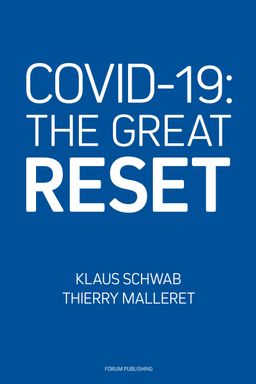
COVID-19 The Great Reset cover

COVID-19 The Great Reset

by Klaus Schwab and Thierry Malleret

COVID-19: The Great Reset explores the transformative potential of the pandemic, offering insights into reshaping our global economy, society, and environment. Authors Klaus Schwab and Thierry Malleret propose a bold vision for a sustainable and equitable future.

COVID-19 and the Dawn of the Great Reset

What if a single event could force humanity to reconsider how we live, work, and govern ourselves? In COVID-19: The Great Reset, Klaus Schwab and Thierry Malleret argue that the coronavirus pandemic marked not merely a crisis—but a global turning point. They claim that COVID-19 exposed structural flaws in societies and economies, accelerated shifts already underway, and opened a rare window to reinvent the systems underpinning the modern world.

Rather than viewing the pandemic as a passing storm, Schwab and Malleret see it as a catalyst for transformation. They propose rethinking capitalism, globalization, technology, and the social contract itself. The book, published in mid-2020, considers this juncture a bifurcation: one path toward a more equitable, sustainable world; another toward worsening inequality, fragmentation, and unrest.

A World at a Crossroads

By mid-2020, humanity found itself suspended between despair and possibility. The authors—respectively founder of the World Economic Forum and an economist specializing in risk analysis—frame COVID-19 as a defining moment. Entire industries froze; millions lost livelihoods; governments expanded their reach overnight. Yet, Schwab and Malleret insist, crises reveal hidden potential for reinvention. Historically, pandemics and wars have reset the course of civilizations—from the plague ending feudalism to World War II birthing welfare states. Could COVID-19 spark a similar renewal?

Schwab and Malleret urge leaders to seize this chance to rebuild economies on principles of inclusion, equity, and ecological respect. They stress that returning to the old normal would be impossible—and undesirable. The pre-pandemic world was, in their words, “broken”: plagued by inequality, climate degradation, and technological disruption.

The Architecture of Change

The book is structured across three levels of reset. The macro addresses global systems—economy, society, environment, technology, and geopolitics. The micro examines how industries and companies must adapt to new realities. The individual explores how the pandemic transforms our inner lives, priorities, and sense of humanity. This tripartite framework mirrors Schwab’s earlier works, such as The Fourth Industrial Revolution, which argued that technological upheaval demands moral and social recalibration.

Schwab and Malleret highlight three defining features shaping the modern era: interdependence (the world's inescapable interconnectedness), velocity (the exponential speed of change), and complexity (non-linear systems that defy prediction). These traits explain why the pandemic rippled across economies, societies, and politics with such devastating speed—and why responses must be holistic rather than siloed.

The False Trade-Off: Lives vs. Livelihoods

One of the book’s most provocative arguments is its rejection of the perceived choice between saving lives and saving the economy. The authors refute what they call a “social Darwinian” fallacy—that sacrificing the vulnerable could sustain growth. Instead, they assert that protecting health is the only path to lasting economic recovery. The pandemic proved that confidence, not coercion, drives markets: people cannot consume or invest without safety and trust. As one economist quoted in the text summarizes, “Only saving lives will save livelihoods.”

A Revolution in Consciousness

Beyond policy, the Great Reset calls for a shift in values. Schwab and Malleret believe the shock of isolation, fear, and loss can awaken empathy and collaboration. They see an emerging awareness that humanity’s survival depends on cooperation across borders and disciplines. The crisis laid bare the failures of fragmented global governance while reinforcing the need for solidarity. History, they note, suggests pandemics divide in the short term but can unite in the long term when societies confront shared vulnerability.

Why It Matters to You

Schwab and Malleret’s message transcends policy circles—it speaks directly to citizens. They challenge readers to rethink questions of responsibility, consumption, and well-being. How should we measure success—not by GDP alone, but by happiness and sustainability? How should technology serve humanity rather than enslave it? And how can each of us participate in rebuilding systems that are more resilient and fair? For the authors, the Great Reset demands both institutional reform and a personal recalibration of values. It’s an invitation to help draw the contours of the world that will emerge “on the other side of this crisis.”


The Macro Reset: Reordering a Connected World

At the macro level, Schwab and Malleret explore how five interdependent domains—economic, societal, geopolitical, environmental, and technological—intertwine to shape a post-pandemic world. This web of connection demonstrates that crises don’t occur in isolation; they amplify one another like dominoes in a global system.

Interdependence, Velocity, and Complexity

These three forces define the modern age. Globalization’s “hyperconnectivity” means that events in one region rapidly reverberate worldwide. Schwab references the World Economic Forum’s own Global Risks Report illustrating how an infectious disease triggers economic collapse, governance failures, and social instability in cascading chains. It is what Singapore diplomat Kishore Mahbubani calls living in “193 cabins on the same boat.”

Meanwhile, velocity—amplified by the internet and mobile technologies—renders global change instantaneous. The pandemic showed how nonlinear growth defies human intuition: within days, cases doubled across continents. Complexity, the third characteristic, means interconnected variables make outcomes unpredictable. Each policy choice—economic lockdowns, travel bans, stimulus—produces ripple effects across health, politics, and security.

Economic Resets and Uncertainty

Economically, COVID-19 caused the swiftest collapse in recorded history. In weeks, global trade halted and unemployment skyrocketed. Schwab likens its scale to World War II, yet argues it may usher in a new era rather than devastation. He predicts prolonged uncertainty and imagines several viral trajectories—waves of infections, slow burns, or recurrent peaks. Crucially, he dismantles the assumption that economies can recover without eradicating the virus: confidence is the oxygen of growth. He quotes the slogan, “Only saving lives will save livelihoods.”

Future growth, they claim, must abandon the blind pursuit of GDP. Emerging models, like New Zealand’s “well-being budget” or Amsterdam’s “doughnut economics” (based on Kate Raworth’s circular model), demonstrate ways to balance prosperity with planetary boundaries. The pandemic accelerates interest in fairness and sustainability, echoing economic thinkers such as Amartya Sen and Joseph Stiglitz, who advocate redefining welfare beyond consumption metrics.

Societal and Political Shifts

Pandemics test the social fabric, exposing inequality and forcing moral reckoning. Schwab calls COVID-19 a “great unequalizer.” Wealth divides widened as white-collar workers telecommuted while essential laborers faced risk. He sees two parallel outcomes: either renewed solidarity through wealth redistribution and social justice or widening resentment and unrest. The rise of major protests—from “Black Lives Matter” to global demonstrations—illustrates how health and inequality crises converge.

The authors foresee a return of “big government.” State intervention—through stimulus, welfare expansion, and industrial policy—has reasserted itself as vital. Yet this expanded power must be harnessed to build inclusive social contracts, not authoritarian control. Schwab invokes John Micklethwait’s prediction that “good government is the difference between living and dying.”

Geopolitical Fragmentation and Global Governance

Geopolitically, the pandemic catalyzed nationalism and accelerated the ongoing shift from Western dominance to multipolar competition. Schwab warns of a “G0 world” with no clear leader. The U.S.–China rivalry, he argues, risks a “new type of cold war.” Global governance faltered as multilateral institutions—from WHO to WTO—proved underfunded and constrained. The result: a vacuum where nationalism and protectionism outpace cooperation. Yet Schwab contends that the only sustainable recovery lies in renewed collaboration on shared global risks: pandemics, climate, and inequality.

Environmental and Technological Transformation

The environmental reset connects zoonotic disease to human encroachment on nature. Deforestation, wildlife trade, and air pollution are not separate risks—they directly heighten pandemics. Schwab proposes a “nature-positive economy” that views sustainability as investment, not cost. Meanwhile, technology’s rapid acceleration—automation, AI, and surveillance—poses both promise and peril. Telemedicine advanced overnight; so did digital monitoring, raising fears of techno-totalitarianism. The authors conclude that the macro reset means learning to manage interdependence with wisdom and foresight—because, in a complex system, local actions carry global consequences.


The Micro Reset: Reinventing Business Models

At the industry and corporate level, Schwab and Malleret reveal how COVID-19 obliterated traditional assumptions of efficiency and forced companies to rethink resilience. “Business as usual,” they write, “died from COVID-19.” The pandemic acted as an X-ray for corporate fragility: brittle supply chains, overleveraged finances, and outdated hierarchies crumbled under stress.

Digitization and the Rise of Contactless Commerce

Digital transformation became survival, not strategy. Confinement accelerated online work, learning, and consumption. Entire economies shifted to the “contactless” model: e‑commerce soared, telemedicine exploded, and even banking went virtual. Firms like Amazon, Zoom, and Alibaba emerged stronger, while physical retail collapsed. Schwab calls this “eversion”—the blurring of online and offline realms described by sci‑fi writer William Gibson. Instead of visiting stores or offices, people teleported digitally across screens.

For regulators too, necessity spurred innovation: telehealth laws were relaxed, autonomous delivery drones authorized, and mobile payments expanded. The crisis showed that bureaucracy could adapt when survival demanded speed.

Just-in-Case Over Just-in-Time

Global supply chains—once optimized for lean efficiency—proved dangerously fragile. Schwab predicts a shift from “just in time” to “just in case.” Companies will localize production, diversify suppliers, and build buffers against disruption even at higher cost. The quest for resilience over speed will reshape trade, manufacturing, and logistics for a generation. This transition echoes economist Dani Rodrik’s “globalization trilemma”: the pandemic revealed that hyperglobalization and sovereignty cannot coexist with democracy; nations inevitably choose resilience.

Government-Corporate Interdependence

Schwab foresees deeper government involvement in business. Bailouts carry conditions—limits on dividends, executive pay, and layoffs. States may take equity stakes, nationalize assets, or shape sectors through industrial strategy. Public-private partnerships will proliferate, especially in health and green infrastructure. The crisis dismantled the neoliberal belief in minimal state intervention. As Mariana Mazzucato argues (whom Schwab cites approvingly), governments must not only fix market failures but “actively shape markets” toward social goals.

The Era of Stakeholder Capitalism

Long a signature idea of Schwab’s, stakeholder capitalism moved from theory to necessity. The pandemic proved that companies ignoring social and environmental responsibilities risk reputational ruin. ESG (Environmental, Social, and Governance) criteria became a benchmark for resilience. Firms that prioritized employees and sustainability outperformed competitors during the downturn (as confirmed by BlackRock studies). Stakeholder value replaced shareholder primacy: what began as idealism turned into risk management.

Employee activism and consumer scrutiny intensify accountability. Schwab cites Amazon workers striking for safety and Google staff boycotting oil projects as examples of internal activism reshaping corporate ethics. “Business will be judged for years,” he warns, “by its response in the crisis.”

Industry Models Reimagined

Entire sectors face redesign. Hospitality and travel—dependent on physical proximity—must reinvent experiences through safety and technology. Real estate, once a pillar of wealth, confronts declining demand as remote work reduces office need. Meanwhile, education shifts toward hybrid online‑offline systems, forcing universities to justify their costs and embrace accessibility. Schwab evokes “the death of business tourism” and “the rebirth of local living.”

Finally, resilience—the mantra of 2020—defines success. Industries that adjusted rapidly, like tech, health, and clean energy, exemplify adaptive capacity. The future belongs to companies combining agility with empathy, innovation with responsibility. The crisis, Schwab concludes, has rewired capitalism’s DNA: profit can no longer exclude purpose.


The Individual Reset: Rethinking Humanity and Purpose

Beyond economics and politics, Schwab and Malleret turn to the intimate realm of human experience. The pandemic, they suggest, forced billions to confront fragility, fear, and isolation—conditions that catalyze introspection and transformation. These personal shifts form the foundation for any societal reset.

Human Nature in Crisis

Historically, plagues have revealed both the noblest and darkest parts of human nature. The authors cite examples from Boccaccio’s The Decameron and Defoe’s Journal of the Plague Year—moments when fear dissolved empathy. Yet, COVID‑19 also sparked remarkable solidarity: Italians singing from balconies, health workers risking lives, neighbors helping strangers. Such contrasts illustrate psychology’s duality between cooperation and self-preservation. The pandemic challenged the myth of the “great leveller,” exposing inequality even as it nurtured moments of compassion.

Moral Choices and the Common Good

Lockdowns thrust moral philosophy into daily life: Should you prioritize safety or freedom? Economy or empathy? Schwab dissects ethical frameworks—from utilitarianism to libertarianism—showing that policy decisions are moral judgments disguised as pragmatism. He criticizes attempts to justify death for growth, calling them morally bankrupt: “Only saving lives saves livelihoods.” Fairness, he adds, must guide both pricing and policy; profiteering during crises undermines social cohesion. This ethics of solidarity—valuing collective over individual gain—anchors the human dimension of the Great Reset.

Mental Health and Inner Resilience

Schwab warns of a global mental‑health pandemic paralleling the viral one. Isolation, uncertainty, and fear magnify depression and anxiety already endemic in modern life. Psychologists describe the “third‑quarter phenomenon”: despair rising near confinement’s end. Domestic violence, addiction, and “Zoom fatigue” proliferated. Yet awareness increased too: mental well‑being emerged as a legitimate public priority. Governments and workplaces must now treat psychological health as infrastructure, not luxury.

Time, Creativity, and Consumption

Crises compress and expand time. For many, lockdown erased boundaries between workdays and weekends, prompting reevaluation of pace and purpose. Schwab invokes Nietzsche’s dictum—“what doesn’t kill us makes us stronger”—to describe potential creative surges. He recalls how Newton and Shakespeare produced masterpieces during plague isolation. The pandemic thus rekindles creativity, reflection, and rediscovery of meaningful activity over mechanical productivity.

Consumption, too, undergoes a moral recalibration. “Revenge spending,” expected by some analysts, gave way to frugality. Minimalism and purpose‑driven consumption gain traction, echoing Japanese ikigai and Nordic simplicity. Displaying wealth feels gauche amid collective suffering. Happiness, studies show, correlates more with mental health and belonging than with material excess—a conclusion reinforced in this era of scarcity.

Rediscovering Nature and Well‑Being

Perhaps the book’s most optimistic message is humanity’s renewed bond with nature. During confinement, urban dwellers yearned for parks, forests, and fresh air. Schwab cites research connecting greenery to reduced inflammation, improved immunity, and psychological healing. Nature now represents both refuge and teacher, revealing the cost of our ecological estrangement. Walking, exercising, and clean living become moral acts—echoing the environmental reset at a personal scale. The final takeaway: individual well‑being and planetary health are inseparable.

The authors end on a hopeful note. The individual reset could catalyze collective empathy, inspiring creativity, mindfulness, and moral clarity. If people internalize the lessons of fragility and interconnection, Schwab believes, they can drive societal transformation from the inside out. The Great Reset, after all, begins within each person who decides to live differently after the storm.


Building the Future: Cooperation and Hope

In their conclusion, Schwab and Malleret confront a sobering question: will humanity learn from crisis or relapse into complacency? They acknowledge that the world before COVID‑19 was prosperous by historical averages—yet dangerously unequal. Improvement “on average” means little if millions remain excluded. The true measure of progress, they argue, is emotional and moral rather than statistical.

From Catastrophe to Opportunity

Like Gabriel García Márquez’s villagers who foresee disaster yet fail to act, societies risk sleepwalking toward decline. The Great Reset is thus a call to agency: the pandemic offers “a rare but narrow window of opportunity to reflect, reimagine, and reset our world.” Action must begin now, before inertia locks us back into destructive patterns. The alternative—doing nothing—invites social collapse, unrest, or ecological catastrophe.

Learning from the Past

History proves renewal possible. World War II birthed welfare systems and multilateral institutions; reconstruction anchored cooperation. Similarly, Schwab cites economists Amartya Sen and Jared Diamond, who believe that crises can motivate global collaboration. Diamond enumerates four existential threats—nuclear risk, climate change, resource depletion, and inequality—and contends that solving the pandemic can give humanity confidence to confront greater dangers.

Cooperation as Human Destiny

Schwab ends with anthropology: cooperation is what makes us human. “Shared intentionality,” the cognitive ability to act together toward common goals, propelled our species forward. The same trait must guide the 21st century. Moving from fear to hope requires recognizing interdependence—not as weakness but strength. Surveys show global citizens want change: most prefer well‑being and environmental sustainability over mere economic growth. This collective yearning could inaugurate a new era built on equity, security, and sustainability.

The Two Paths Forward

In Schwab and Malleret’s metaphorical crossroads, one road leads to inclusivity and respect for nature; the other to division and decay. The decision lies with us—all of us. Whether policymakers prioritize fairness, whether companies embrace stakeholder models, whether individuals choose empathy over isolation—all will determine which world emerges. “We must get it right,” Schwab insists, “or face a meaner, smaller world dogged by nasty surprises.”

Ultimately, COVID‑19: The Great Reset is both diagnosis and manifesto. It dissects a moment of global vulnerability and prescribes collective wisdom as the cure. The authors urge readers to envision not recovery but rebirth—to rebuild the global house on the pillars of solidarity. Their closing sentiment captures the book’s spirit: our greatest resource is hope, and it must be acted upon together.

Dig Deeper

Get personalized prompts to apply these lessons to your life and deepen your understanding.

Go Deeper

Get the Full Experience

Download Insight Books for AI-powered reflections, quizzes, and more.