
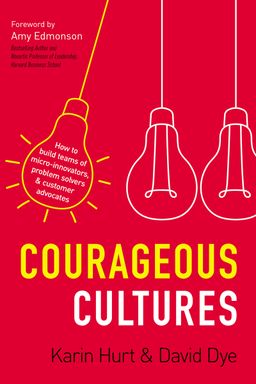
Courageous Cultures cover

Courageous Cultures

by Karin Hurt and David Dye

Courageous Cultures provides a roadmap for leaders to foster an environment of innovation and engagement. Discover practical tips and real-world examples to build a workplace where every voice is heard, driving both personal and organizational success.

Building a Courageous Culture Where Everyone Speaks Up

Have you ever looked around your organization and wondered why great ideas are hiding in plain sight—why the people closest to the customer don’t speak up about what’s broken or about how things could be better? In Courageous Cultures: How to Build Teams of Microinnovators, Problem Solvers, and Customer Advocates, Karin Hurt and David Dye argue that silence is the enemy of innovation. Too many organizations have what they call “safe silence,” where employees keep their heads down because it feels safer than being seen, heard, or possibly criticized. The authors contend that your organization’s real competitive advantage lies not in grand strategy but in cultivating daily courage: empowering every single person to speak up, solve problems, and lean into progress.

Hurt and Dye’s core argument is that courage isn’t an individual trait—it’s a collective capability. A “Courageous Culture,” as they define it, is a workplace where people consistently ask, “How can we make this better?” and know that sharing ideas, even imperfect ones, is expected, valued, and rewarded. In such cultures, leaders don’t just tolerate feedback; they actively create conditions that make candor safe and productive. This book provides the roadmap to build those conditions through a mix of personal leadership transformation, structural systems, and psychological shifts.

Why Courageous Cultures Matter Now

The authors situate their argument in today’s business environment, shaped by automation, artificial intelligence, and the gig economy. As repetitive tasks disappear, organizations increasingly rely on the uniquely human skills of empathy, creativity, and critical thinking—the heart of Courageous Cultures. People want to contribute meaningfully, not just follow orders. But without courage, leaders may never hear the next great idea or the quiet alarm before a disaster strikes (Amy Edmondson’s foreword connects this directly to Boeing’s 737 Max crisis, where employees stayed silent about life-threatening quality issues).

The Anatomy of Courage

Through research conducted with the University of Northern Colorado, Hurt and Dye identified five reasons people don’t speak up: they don’t think leadership wants their ideas, no one asks, they lack confidence, they don’t know how to share ideas effectively, and they believe nothing will happen. To overcome these barriers, the authors show that courage begins small—with “micro-courage”: tiny, daily acts of honesty and problem solving that compound into a thriving innovation culture.

A Courageous Culture unleashes three types of people. Microinnovators find quick, everyday ways to improve processes. Problem Solvers surface issues, think critically, and propose fixes. Customer Advocates see the experience through clients’ eyes and speak up on their behalf. When organizations encourage these behaviors, the result is a distributed network of engaged employees who move faster than bureaucracy and adapt better than hierarchies.

What You’ll Learn from This Book

Across fifteen chapters, Hurt and Dye teach leaders how to transform “safe silence” into active contribution. You’ll learn how to navigate personal narratives of fear and doubt, balance clarity and curiosity, respond constructively when employees share ideas, and build systems that sustain courage through hiring, training, and recognition. The authors illustrate each concept with vivid real-world stories—from Trader Joe’s blizzard-day customer giveaway, which showed how courageous empowerment drives brand love, to the nurse who faced down hierarchy to protect her patients.

Clarity and Curiosity: The Dual Engines

Throughout the book, the most powerful framework is the “Courageous Culture Cycle,” an elegant dance between clarity and curiosity. Clarity means direction, purpose, and the confidence to act. Curiosity means openness to questioning, learning, and adapting. Many organizations get stuck emphasizing one and neglecting the other—overly rigid clarity kills innovation, while endless curiosity without structure creates chaos. A Courageous Culture combines both, cultivating disciplined curiosity and courageous clarity.

Why Courage Starts with You

Hurt and Dye emphasize that leaders themselves must model courage first. You cannot command it; you must live it. Navigating your own fears, telling stories of vulnerability, and responding with openness are what invite others into the dance. Leaders must ask intentional, humble, and action-oriented questions (“What’s the biggest obstacle to your productivity?” “What aren’t we talking about that we should be?”) and then listen deeply without defensiveness. When employees see that leaders handle tough truths with respect, they follow suit.

Ultimately, Courageous Cultures asks a profound question: Do you want to build a workplace where silence feels safer than speaking up? Or do you want teams of empowered problem solvers who act with heart and conviction? The book answers with a clear roadmap—from clarifying your mission to cultivating curiosity to building infrastructures that make courage the norm. In this world of accelerating disruption, Hurt and Dye contend that courage is not just a virtue—it’s your most strategic business advantage.


The Dance of Clarity and Curiosity

At the center of Courageous Cultures lies a deceptively simple but transformative idea: courage flourishes when clarity and curiosity move together. Karin Hurt and David Dye call this dynamic the “Courageous Culture Cycle,” a rhythm where clarity provides focus and curiosity fuels innovation. Each element alone can stall an organization; together, they propel teams toward continuous improvement and meaningful action.

Clarity: Safety, Confidence, Direction

Without clarity, courage collapses into confusion. Hurt and Dye describe clarity as the shared understanding of what success looks like and why it matters. When everyone knows the goals, boundaries, and priorities, people feel safe to contribute. Clarity also creates confidence—employees know their good ideas will fit the bigger picture. Leaders communicate clearly, translate vision into behaviors, and ensure every person sees how their work connects to key organizational outcomes. (Amy Edmondson’s research on psychological safety reinforces this: clarity and safety go hand in hand.)

Curiosity: The Spark of Innovation

Curiosity ensures that processes evolve instead of stagnate. It means asking questions, exploring new methods, and challenging outdated norms. A culture of curiosity shifts teams from “permission to contribute” to “expectation to contribute.” Everyone constantly looks for ways to improve, rather than waiting for directives. But curiosity without clarity can spin out of control—endless ideas with no direction. That’s why the Courageous Culture Cycle emphasizes balance.

A Real-World Application

To illustrate the cycle in action, Hurt recounts her experience leading a twenty-two-hundred-person sales team facing a morale crisis. Competing with Apple’s exclusive iPhone partnership, her employees felt hopeless. By embracing clarity—reaffirming their mission of delivering exceptional service—and curiosity—asking, “Who’s still selling?”—she found Yomi, a salesperson succeeding by targeting small business owners instead of consumers. Empowering the team to test Yomi’s question (“Where do you work?”) led to “Small Business Madness Day,” quadrupling sales. This fusion of clarity (strategic focus) and curiosity (discovery through experimentation) revitalized an entire region.

Start Where You Aren’t

The authors challenge readers to begin with their weakest side. If your organization excels in operational discipline but lacks innovation, start cultivating curiosity. If your teams overflow with ideas but lack alignment, start sharpening clarity. The cycle is continuous—clarity guides curiosity, curiosity refines clarity. Leaders must act as dancers, shifting gracefully between direction and exploration, creating cultures that feel both safe and dynamic.

Key Principle

Clarity without curiosity leads to stagnation. Curiosity without clarity leads to chaos. Courage emerges from combining the two—it’s the confidence to explore and the discipline to act.


Navigating the Narrative: Courage Begins with Story

Before building a courageous team, you must first build courage within yourself. In Courageous Cultures, Hurt and Dye argue that courageous leadership starts by “navigating the narrative”—examining the stories you tell yourself about fear, failure, and authenticity. These internal stories quietly direct your actions, often dictating when you speak up or stay silent. Courage begins when you consciously choose different stories.

Owning Your Story

The authors present two contrasting case studies: Hope, a scientist who feared her voice was ignored, and Peter, a confident peer who spoke up even when reprimanded by his boss. Their dialogue revealed the invisible web of assumptions—Hope’s belief that hierarchy muted her and Peter’s realization that courage is contagious when modeled by leaders. Later, Peter shared a deeply vulnerable moment when he learned he was perceived as a bully. His openness transformed peers’ trust. Hurt and Dye highlight that confronting such feedback is essential for courageous self-awareness.

The Power of Reflection

To Navigate the Narrative, the authors advise constructing a “Courage Map.” You reflect on three to five personal moments when you acted courageously—speaking truth to power, managing out a poor performer, defending a colleague—and look for common motivators and values. These stories become your foundation. Revisiting how you felt, what you risked, and what you learned helps you recognize courage not as heroism but as alignment with values. Often, courage doesn’t feel brave—it feels necessary.

Stretching Your Courage Muscles

The authors encourage small, focused experiments to build confidence—like Susie’s “scary behavior challenges,” where managers deliberately practiced one uncomfortable but productive habit daily (e.g., limiting over-preparation time or learning to say no). Such rituals make courage habitual rather than exceptional. (Brené Brown’s Dare to Lead similarly frames courage as a practice, not a personality trait.)

By consciously rewriting your inner script—remembering past courage and practicing new risks—you can model vulnerability and resilience. The stories you live and share become lessons that invite others to rise. When leaders say, “I was scared but spoke up anyway,” they give permission for collective bravery. Navigating the Narrative makes courage less about heroism and more about human growth.


Responding with Regard: Creating Momentum through Respect

The authors identify a hidden truth that blocks innovation: ideas often die not because they’re bad, but because leaders mishandle the moment employees speak up. “Respond with Regard” means responding to ideas and feedback with respect, curiosity, and gratitude—rather than apathy, avoidance, or defensiveness. This chapter teaches how leaders can transform these tiny moments into major culture shifts.

Three Response Failures

Hurt and Dye’s research revealed three common reaction pitfalls. First, apathy: leaders ignore or dismiss ideas (“Just do your job”). Second, avoidance: leaders ask for feedback but vanish when the results are inconvenient. Third, clumsy reactions: managers respond poorly to incomplete ideas, discouraging employees from trying again. Each of these kills courage instantly. The antidote is mindful reaction—seeing every idea as an act of trust to be honored.

A Blueprint for Regard

Leaders should follow the three-step framework: Gratitude (thank employees for thinking critically), Process (explain what will happen next), and Invitation (encourage more contributions). Hurt shows how even small follow-ups—like the Red Cross’s automated thank-you email telling donors the hospital their blood helped—build trust and momentum. Similarly, saying “Thank you, here’s how we’ll evaluate it, and please keep thinking” makes people feel their ideas matter.

Finding the Yes

Former military leader Damon provides a memorable mantra: “Find the yes.” Even if you can’t use the entire idea, find one part you can implement. It shows respect and signals collaboration. Over time, employees learn that voicing ideas leads to results, not silence.

Turning Complaints into Contributions

The authors caution against reacting to every grievance but urge leaders to look for patterns behind complaints. Ask, “What action would make this better?” to convert frustration into problem solving. Responding with regard, they write, turns negative energy into innovation fuel. These micro-responses are emotional bank deposits that compound into loyalty and engagement.

Key Lesson

Your reaction determines whether an employee will ever speak up again. Responding with regard—through gratitude, explanation, and encouragement—builds trust faster than any engagement survey ever could.


Cultivating Curiosity through Courageous Questions

If clarity makes people confident, curiosity makes them creative. Hurt and Dye show that to build courage, leaders must ask courageous questions—specific, humble, and actionable inquiries that invite truth rather than compliance. These questions signal to employees: your perspective is valued, and candor is safe.

The Anatomy of a Courageous Question

Generic “Any thoughts?” questions often fail. Courageous questions get concrete: “What do we do that frustrates customers?” “What’s one inefficient process we tolerate that needs to go?” “What obstacles slow your progress?” They are intentional (asked regularly), vulnerable (“What should I do better as a leader?”), and action-focused (asked with commitment to act on the answers).

Making Curiosity a Habit

Creative leaders institutionalize curiosity with small rituals: “Curiosity Tours” walking through departments to learn what’s really happening; “Workaround Workouts” inviting employees to share nonstandard methods safely; “Fear Forages” anonymity exercises that surface team fears for discussion. These visible acts prove that asking is normal—and answering is respected. When employees see their ideas implemented or fears acknowledged, they move from silence to contribution.

The “How Can We?” Mindset

One of the most powerful curiosity tools is the simple phrase “How can we?” It bridges conflicting goals—efficiency and empathy, cost and quality—by asking how both can coexist. It replaces constraints with collaborative possibility. Asking “How can we?” converts organizational “either/or” thinking into creative “and” thinking, a hallmark of courageous problem-solving.

By mastering courageous questions, leaders make innovation ordinary. They teach employees to analyze, not apologize. Hurt and Dye note that every courageous question expands safety and clarity simultaneously—the exact conditions courage needs to thrive.


Practicing the Principle: Scaling What Works

A challenge many leaders face is how to replicate local innovations without killing their spirit. Hurt and Dye respond with a key principle: don’t scale practices; scale principles. When a brilliant team finds success through a unique method, you can’t copy-paste their behavior into every context. You can, however, extract the underlying value—the principle—and help other teams adapt it uniquely.

Principles Over Practices

The authors cite Trader Joe’s legendary customer service. No one trains employees on specific contests or giveaways; they train them on the principle of “wow” service and fun. Each store localizes that principle differently—turning power outages or blizzard crowds into joyful experiences. That adaptability makes courage scalable.

Testing and Localizing Ideas

When a best practice works in one region, ask why it worked. What conditions, timing, or behaviors mattered most? Then pilot it in other contexts before mandating it broadly. Hurt and Dye’s case of three contact centers increasing customer empathy exemplifies localization: one invented “What About Betty?” to humanize callers; another created “Baby CARL” (Care About Real Lives); a third focused on leader-to-employee empathy first. Each team practiced the same principle—care—but in totally distinct ways.

From Honeycrisp Apples to Microinnovations

The authors liken innovation refinement to the Honeycrisp apple—an idea that “just might work” despite complexity. Apple breeders kept testing despite setbacks until they found a win worth cultivating. Courageous leaders do the same: ask “What if this could work?” and test step by step. Courage doesn’t mean reckless leaps; it means persistent curiosity applied to promising ideas.

Key Takeaway

Scaling innovation isn’t about copying success—it’s about translating principles into local practice. Courageous Cultures thrive when people understand why an idea works, not just what to do.


Galvanizing the Genius: Making Courage Stick

Even the best teams slip back into old habits if leaders don’t reinforce new behaviors. In Courageous Cultures, “Galvanizing the Genius” means exciting action and protecting courage from corrosion. Hurt and Dye show that sustaining change requires deliberate systems: clarity of goals, consistent communication, and visible accountability.

Know, Flow, Show

The authors teach a simple, powerful method: Know what matters (clarify success and behaviors), Flow the message consistently (communicate five times in five different ways—emails, meetings, stories, visuals, coaching, recognition), and Show results (inspect, celebrate, and reinforce). This “5x5 communication” ensures everyone hears—and believes—the priorities. Repetition breeds memory; memory builds habit.

Trust, But Verify

Quoting Reagan’s dictum, “Trust, but verify,” Hurt and Dye remind leaders that accountability doesn’t mean micromanaging—it means scheduled follow-through. Observe behaviors, celebrate progress, and intervene early if drift occurs. Courage fades when leaders appear indifferent. Genuine inspection communicates care.

Be in the Arena

Borrowing Brené Brown’s phrasing, the authors urge leaders to “be in the arena.” Experience what your teams face. When one CEO personally answered calls to understand customer confusion, he discovered that training gaps, not motivation, caused poor results. His credibility skyrocketed because he lived their reality. Courage requires shared struggle, not distant supervision.

Galvanizing the Genius teaches that sustainability is a leadership choice. You must build systems that force reminders, repetition, and reinforcement until courage feels like culture, not effort. Once Clarity and Curiosity are habitual, new ideas spread faster than fear.


Building Systems that Sustain Courage

Ideas fade if infrastructure contradicts them. Hurt and Dye argue that to build truly courageous cultures, your systems—hiring, onboarding, training, compensation, and recognition—must reinforce courage, not merely reward compliance.

Hiring for Courage

Recruit for character and creative problem solving, not just industry pedigree. A leader effective in a rule-heavy corporation may flounder in a fast-moving startup. Ask behavioral questions about courage: “Tell me about an idea you pushed against resistance.” “Describe the biggest mistake you’ve learned from.” These reveal readiness for vulnerability and innovation.

Onboarding for Voice

From day one, replace “Here’s how we do things” with “Here’s how we improve together.” Share stories of employees whose ideas changed the game. Encourage new hires to bring three best practices from past experiences. When people contribute immediately, they feel ownership.

Training for Courage

Courageous leaders teach critical thinking, not blind execution. Since 45 percent of employees lack problem-solving training, Hurt and Dye insist on developing these skills across all levels. Accountability, recognition, and growth must reward curiosity and contribution.

Aligning Incentives

Rewards systems should match strategic priorities. In one case, sales bonuses conflicted with product development goals, fueling internal battles. Realignment—linking compensation to collaborative success—diffused tension and restored courage. You get what you encourage; align incentives so courage pays off.

When systems, structures, and stories align, courage isn’t a one-time act. It becomes the default operating mode. Building infrastructure for courage ensures you’re cultivating not just brave individuals, but sustainable, brave organizations.


Leading Diverse People with Clarity and Compassion

Courage looks different in every person. Hurt and Dye’s penultimate chapters explore how personality differences, past traumas, and communication styles affect people’s readiness to speak up. Diversity in temperament—introverts versus extroverts, thinkers versus doers—requires adaptive leadership. You can’t demand identical courage; you must cultivate it uniquely.

Recognizing Difference

The authors profile multiple archetypes: the Silent Wounded (those burned by toxic managers), the Silent Ponderous (thoughtful introverts who need time to process), the Just-Do-What-I-Sayers (directive personalities), and Idea Grenadiers (creative but inconsistent contributors). Each type requires distinctive management. For silent wounded, rebuild trust patiently. For ponderous minds, provide space and advance notice for reflection. For grenadiers, anchor their creativity with accountability.

Coaching Through Questions

The Nine “Whats” coaching method helps employees become problem solvers: What’s your goal? What have you tried? What happened? What did you learn? What else can you do? This question cascade teaches independent critical thinking and transforms dependency into self-direction. It’s a simple yet powerful tool for developing courage through cognition.

When Change Meets Resistance

Resistance rarely means negativity—it often signals fear or confusion. Instead of pushing harder, anchor discussions in shared purpose: present the problem first, not the solution. Ask employees what they think, let them experience ownership, and courage will follow. (Kotter’s change leadership framework offers similar advice—start with emotional buy-in, not technical rollout.)

Leaders who adapt their courage-building style to each personality unlock deeper engagement. People may differ in expression, but everyone can contribute bravery in their own way. Courage isn’t one-size-fits-all—it’s empathy tailored to potential.


Beyond Safe Silence: Your Courageous Future

The final message of Courageous Cultures is simple yet profound: courage multiplies when shared. Hurt and Dye close with the paradox that in a truly courageous organization, individual acts of bravery become ordinary. Speaking up is no longer heroic—it’s cultural.

Finding the Others

The authors urge you not to face change alone. “Find the others,” they write—those who believe that silence isn’t safe and effort matters. Connecting with like-minded colleagues transforms isolated courage into collective momentum. When leaders advocate for truth and customers, it inspires reciprocal courage throughout teams.

The Seven Practices of Courageous Cultures

Hurt and Dye summarize their entire model into seven core practices: Navigate the Narrative, Create Clarity, Cultivate Curiosity, Respond with Regard, Practice the Principle, Galvanize the Genius, and Build an Infrastructure for Courage. Together, these form a self-reinforcing cycle where courage drives clarity, clarity empowers curiosity, and the cycle continues. The more courage exists, the less you need to summon it—the environment itself sustains it.

Maya Angelou’s words anchor the finale: “Daring to dare.” The authors remind you that courageous cultures don’t appear overnight; they begin with your daily decision to engage uncomfortable truths, ask better questions, and honor those who speak. Over time, your “first tracks” of courage will become well-worn paths others can follow. That, they say, is how organizations evolve from fear-driven to fearless.

Dig Deeper

Get personalized prompts to apply these lessons to your life and deepen your understanding.

Go Deeper

Get the Full Experience

Download Insight Books for AI-powered reflections, quizzes, and more.