
Idea 1
Courage: The Virtue That Leads All Others
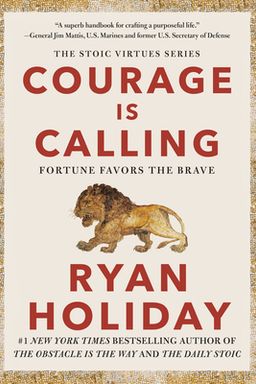
What would you do if fate called you to act—when the world seemed terrifying, uncertain, and unsafe? Would you step forward or step back? In Courage Is Calling, Ryan Holiday argues that every moment of fear is a summons to courage. Courage, he says, is not just one moral virtue among many; it is the foundation of all the others. Without courage, justice cannot be served, temperance cannot be kept, and wisdom cannot be lived.
Holiday contends that courage is the act of choosing virtue over vice in the moments that matter. It is not limited to military valor or great historical deeds—it is the willingness to do the right thing, to speak truth to power, to stand up even when you stand alone. Courage calls each of us differently, but the question is always the same: Will we answer?
The Ancient Roots of Courage
Holiday builds his argument on thousands of years of Stoic and classical philosophy. He opens with the legend of Hercules at the crossroads, who must choose between the easy path of pleasure and the hard path of virtue. This myth embodies what Holiday calls the “daily crossroads” we all face. The Stoics—Marcus Aurelius, Seneca, and Epictetus—believed that courage, justice, wisdom, and temperance were the cardinal virtues anchoring moral life. Each was interconnected, but courage came first. As C. S. Lewis wrote, “Courage is not simply one of the virtues, but the form of every virtue at the testing point.”
In this lineage, courage is the hinge upon which all goodness turns. Aristotle saw it as the craft of life: “We become brave by doing brave actions.” Holiday’s insight is that bravery is a practice, not a trait—you become courageous through repetition, through acts large and small that build moral muscle.
Fear: The Real Enemy
If courage is the virtue that lifts humanity, fear is the force that holds us down. Holiday divides the book into three parts—Fear, Courage, and the Heroic—to show the evolution of the human soul under pressure. Fear is the universal enemy, manifesting as hesitation, cynicism, apathy, conformity, and rationalizations. But he stresses that fear is natural; the brave are not without fear—they simply master it. Physical courage, moral courage, social courage—they all begin by recognizing fear without letting it rule us.
“To each comes a moment when they are tapped on the shoulder,”
Holiday quotes Churchill, “and offered the chance to do a very special thing, unique to them and fitted to their talents.” His question follows naturally: Will you be prepared? Will you be brave?
A Series of Choices
Holiday’s structure mirrors the progression from fear to heroism. You first learn how fear manipulates and paralyzes—through insecurity, social pressure, and the illusion of safety. Then you discover how courage moves us from thought to action: standing one’s ground, daring to speak, resisting intimidation, and taking initiative. And finally, you reach the stage of heroism—going beyond yourself, sacrificing for others, and translating personal bravery into selflessness.
This journey is not theoretical. Holiday tells stories: Florence Nightingale’s defiance of Victorian expectations; Charles de Gaulle’s solitary fight to save France; Frederick Douglass’s stand against a slave master; Theodore Roosevelt inviting Booker T. Washington to the White House against public outrage. These examples reveal courage in practice. They remind us that bravery is not absence of fear but the triumph over it.
Why Courage Matters Today
Holiday’s message is especially urgent in an era of anxiety, distraction, and cynicism. Fear makes us small—afraid to speak up at work, to try something new, to live authentically. But courage enlarges the soul. It forges character and makes virtue possible. “A decline in courage,” he quotes Solzhenitsyn, “has been considered the first symptom of the end.” By restoring courage—personal, social, and spiritual—we revive meaning itself.
In this book, you will learn how to redefine fear as an ally, how to practice bravery daily, and how to translate courage into compassion and leadership. You will explore stories of failure and redemption—from warriors to whistleblowers, from poets to presidents—and discover how ordinary people wield extraordinary courage. Most importantly, you will see that courage is renewable. It’s within you, waiting to be summoned—not once, but again and again, each time life calls.