
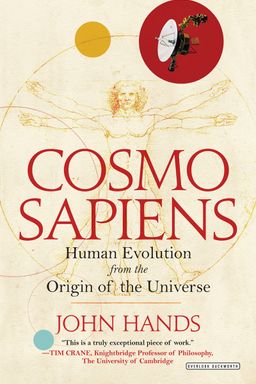
Cosmosapiens cover

Cosmosapiens

by John Hands

Cosmosapiens takes readers on a fascinating exploration of scientific theories from the universe''s origins to the evolution of human consciousness. John Hands delves into unanswered questions and challenges conventional beliefs, offering new perspectives on our existence and the uniqueness of Earth as a cradle of life.

Science’s Grand Quest to Explain Existence

How can you know where you came from, what you are, and why the universe exists? In Cosmosapiens, John Hands frames an audacious inquiry: to evaluate what science actually knows about the origin of matter, life, humans, and consciousness—and to test whether these knowledge strands converge into a coherent picture of existence. You are invited into a disciplined investigation that blends cosmology, biology, and philosophy, rooted in one guiding principle: only empirically testable ideas count as science.

Science, its limits, and its promise

Hands adopts Karl Popper’s falsifiability criterion to distinguish science from belief or metaphysics. A hypothesis must be testable and open to refutation; a theory stands only when many independent observations support it. This disciplined approach guides every chapter—from cosmology to consciousness—while constantly reminding you to separate compelling mathematics from verified observation. Hands openly admits his role as an agnostic investigator rather than a metaphysical partisan.

Science, he cautions, is uniquely constrained: you inhabit the universe you try to understand, you cannot rerun its history, and your data are limited by technological reach and interpretative bias. Still, he argues, progress is possible if you apply clear reasoning and rigorous methods. His central question remains whether the diverse sciences—cosmology, chemistry, biology, neuroscience—describe independent accidents or form one connected evolutionary process pointing toward rising complexity and consciousness.

From myths to measurable origins

Early humans explained origins through myth—creation from chaos, eggs, divine conflict—but Hands recasts these as early frameworks of meaning that prefigure scientific explanation. Just as cosmogonies gave order to mystery, cosmology now models reality through physical law. Yet both reflect a common human drive: to forge intelligibility from uncertainty. The book proceeds historically, tracing how science displaced mythic causes with empirical mechanisms while retaining our existential curiosity.

The structure of the cosmic story

Hands organizes his analysis into successive domains: (1) the universe’s origin and physical laws; (2) the emergence of matter, stars, and planets; (3) the rise of life and biological evolution; and (4) the ascent of consciousness culminating in reflective awareness. Each stage tests what current science truly explains and where speculation begins. He assigns equal importance to gaps in knowledge, viewing them as diagnostic markers of where new thinking is required.

Cosmology recounts the Big Bang’s triumphs—Hubble’s redshifts, cosmic microwave background, nucleosynthesis—but probes its unresolved puzzles: the singularity, dark matter, dark energy, and inflation’s untestable infinities. Physics, for Hands, illustrates science’s brilliance and fragility: mathematical coherence can outpace empirical reach. The same caution applies later when he examines biology’s explanations for life and human consciousness.

A unifying methodological stance

Throughout, Hands obeys five methodological rules: privilege empirical evidence, apply Ockham’s Razor to prune speculative excess, distinguish domains of science from faith or metaphysics, tolerate uncertainty instead of filling it with comforting stories, and revise conclusions as new data arrive. In doing so he honors the tradition of skeptical empiricism stretching from Newton and Darwin to Popper and Feynman.

The book’s progression—from physics to biology to mind—mirrors both cosmic history and human curiosity. Matter organizes into atoms and galaxies; chemistry becomes biology; biology develops mind capable of reflection. Along the way you examine failures of reductionism (genes or particles as total explanations) and the recurring emergence of new integrative levels—evidence that evolution is as much about cooperation and organization as about competition and chance.

What the quest reveals

In the end, Hands proposes that four broad trends underpin reality: material complexification, collaboration among entities, centration toward organized wholes, and the correlating rise of consciousness. These are not mystical laws but pattern summaries emergent from evidence across disciplines. You are left with a coherent if incomplete vision: an evolving universe that, through natural processes, becomes aware of itself. Yet the ultimate "why"—why physical laws exist, why there is something rather than nothing—remains outside empirical science’s reach.

By guiding you through the successes and limits of cosmology, physics, biology, and philosophy, Hands both celebrates science’s explanatory power and defends intellectual humility. His integrated narrative argues that humanity’s next frontier is not only discovering new facts but understanding the deep unity connecting matter, life, and mind.


Cosmic Origins and the Limits of Cosmology

Hands reconstructs how the Big Bang became accepted orthodoxy and then scrutinizes its weaknesses. Einstein’s general relativity (1915) predicted expanding or contracting universes; Hubble’s redshifts confirmed expansion, while Lemaître’s 'primeval atom' anchored the early hot-universe idea. The cosmic microwave background (Penzias and Wilson, 1965) sealed consensus, and inflation (Guth, 1980) was added to explain fine-tuning puzzles.

Strengths and anomalies

The model explains redshift, background radiation, and light-element abundances. Yet six major gaps remain: singularity, baryon asymmetry, dark matter, dark energy, cosmological fine-tuning, and creation ex nihilo. Inflation resolves some problems but introduces untestable parameters and multiverse speculations that cross into metaphysics. Hands insists that cosmology’s elegance hides its fragility; you cannot experimentally reproduce universal origins, and extrapolating physics beyond tested domains (Planck time, quantum gravity) may be unjustified.

Alternative cosmologies and empirical caution

He surveys alternatives—steady state, quasi-steady-state, cyclic, variable-speed-of-light, brane collisions, plasma cosmology, Smolin’s cosmic natural selection—stressing that creativity is healthy but only testability legitimizes theories. Episodes like the misinterpreted BICEP2 results show why extraordinary claims demand multidimensional evidence. String theory’s 10^500 vacua illustrate the peril of mathematical beauty divorced from experiment.

Measurement and interpretation biases

Cosmology faces unique observational barriers: a single universe, finite horizons, and calibration uncertainties (Cepheid variables, supernovae). Redshift anomalies (Halton Arp) and CMB irregularities remind you that consensus often depends on assumption stability. Hands formulates his 'Law of Data Interpretation': researchers’ emotional and professional investments bias how data are read. Awareness of this sociological factor may not yield new measurements but sharpens your skepticism when reading confident cosmological assertions.

In the end, the cosmos story remains provisional. The Big Bang fits much evidence but leaves fundamental mysteries unresolved. Hands advises seeing cosmology not as a final origin account but as a magnificent, incomplete sketch whose outlines reveal both humanity’s genius and our epistemic limits.


From Matter to Life

After cosmology, Hands narrows focus to the emergence of matter, Earth, and life. The narrative follows how fundamental forces produced complex atoms, stars forged heavy elements, and planetary formation set conditions for biology. Yet at each step, he differentiates solid evidence from conjecture, showing you how physical processes created possibility but not inevitability for life.

Cosmic and chemical foundations

Four interactions—gravity, electromagnetism, strong, and weak forces—govern structure. Stellar nucleosynthesis, predicted by Fred Hoyle, explains how carbon originated through a finely tuned resonance at 7.65 MeV. That resonance and similar constraints expose how subtle parameter changes would prevent chemistry as you know it. Planetary accretion, dated by radiometric clocks, created a molten Earth whose differentiation yielded an iron core, magnetosphere, atmosphere, and oceans—preconditions for life but subjects of ongoing debate (e.g., cometary vs mantle origins of water).

Habitable environments and Earth’s rarity

Hands lists six life conditions: essential elements, suitable mass, radiation protection, available energy, liquid water, and long-term stability. Within the galactic habitable zone and the Sun’s Goldilocks orbit, Earth meets them all—potentially by extraordinary coincidence. The Moon’s formation (giant impact) stabilized axial tilt and tides; Jupiter’s gravity diminished extraterrestrial bombardment. Plate tectonics later maintained a stable climate via the carbon–silicate cycle—one of science’s finest examples of planetary self-regulation.

The unresolved leap to biology

Despite this hospitable context, no model convincingly explains life’s emergence. Miller–Urey’s synthesis of amino acids, RNA-world hypotheses, clay-surface catalysis, and hydrothermal or panspermic proposals each illuminate part of the puzzle. The barriers—homochirality, polymerization in water, informational organization—remain formidable. Hands concludes that the origin of life is an unsolved scientific question analogous to cosmology’s singularity: a boundary where empirical data thin to speculation.

In this stage, you learn to value proportionate confidence. Chemistry explains the potential for complexity; physics governs possibility; but how nonliving molecules became self-maintaining systems is still open—a profound reminder that knowledge gains clarity not by answers alone but by knowing what remains unknown.


Evolution Beyond Neo‑Darwinism

Hands honors Darwin’s core insight—descent with modification by natural selection—but exposes how 20th-century Neo‑Darwinism, centered on random mutation and population genetics, cannot alone explain major innovations. The fossil record's long stasis and sudden change, genomic data revealing horizontal transfer and regulatory complexity, and symbiotic mergers—all stretch the classic model’s assumptions.

Patterns in evidence

Fossils show vast continuity punctuated by abrupt leaps (Eldredge and Gould’s punctuated equilibrium). Genomics uncovers phenomena—polyploidy, transposons, epigenetics—that produce rapid reorganization. Collaborative processes like endosymbiosis (Margulis) explain the sudden appearance of complex eukaryotes—mitochondria and chloroplasts deriving from bacterial mergers. Behavioral observations add another dimension: cooperation, mutual aid, and social learning drive survival as much as competition (vindicating Kropotkin’s 1902 insight).

New mechanistic frontiers

Genome duplication (Ohno’s 2R), epigenetic inheritance, regulatory networks (Koonin, Shapiro), and self-organizing systems (Kauffman) suggest that large-scale restructuring, not just point mutations, generated complexity. Shapiro’s 'read–write genomes' treat cells as active participants editing their own DNA, while systems theorists model universal statistical patterns of gene family birth, death, and innovation. These generalizations imply law-like tendencies toward integration and complexity.

Progress, cooperation, and consciousness trends

Across evolutionary time, complexity tends to increase: from prokaryotes to multicellular animals to self-aware humans. Critics call 'progress' an anthropomorphic bias, but the empirical pattern—more parts, greater integration—stands. Hands reformulates this as a descriptive law: systems evolve toward complexification and centration until environmental limits enforce stasis. Parallel evidence shows rising cooperation and intelligence (brain–body scaling, social networks, symbolic language) correlating with that trend.

Thus, evolution, in this expanded view, becomes multi-layered: genes, systems, symbioses, and minds co‑evolve. Natural selection remains vital but insufficient; creative novelty also arises from merging, cooperation, and emergent self-organization—principles measurable though not yet fully mechanistically understood.


Rise of Consciousness and Human Reflection

The pinnacle of biological evolution, Hands argues, is the emergence of reflective consciousness—the ability not only to experience but to know that you experience. Consciousness evolves in grades, from bacterial awareness and neural coordination to self-reflective human minds capable of science and art. This step marks a qualitative phase change, not a linear mutation count.

Neural and behavioral progression

Hands maps four neural trends: growth (more neurons), specialization, centration (cephalization), and optimization (efficient wiring). Human brains reach about 86 billion neurons and half a quadrillion synapses, far exceeding scale expectations. Behavioral correlates—toolmaking, language, social teaching—indicate mounting cognitive integration. Archaeological milestones such as Blombos Cave engravings, ritual burials, and musical instruments signal the appearance of minds aware of symbolic meaning.

Beyond reduction and gene stories

Neuroreductionism (Crick’s 'you are your neurons') fails to bridge the 'hard problem' of subjective experience—the qualia gap shown in Ramachandran’s color‑blind scientist analogy. Evolutionary psychology’s claim that minds are frozen Pleistocene software ignores culture’s transformative role. Genes set capacities; reflective consciousness reorganizes them through language, institutions, and self-awareness. Human uniqueness, therefore, lies not in raw intelligence but in metacognition.

Cultural and moral evolution

Once consciousness became reflective, it drove new evolutionary modes—symbolic thought, ethics, philosophy, and science. Hands identifies overlapping phases: primeval (mythic ritual), philosophical (rational and mystical reflection), and scientific (empirical testing). Each transforms how humanity asks and answers questions about reality. Civilizational advances—from Athens to the Upanishads and the Scientific Revolution—are thus parts of noetic evolution: the mental self-development of the species.

Eventually this awareness fosters cooperation at global scales. Declining violence statistics, the growth of international institutions, and shared technologies mark a collective trajectory toward integration. Humanity’s story becomes nature’s self-realization through mind—a theme that unifies Hands’s cosmic vision from Big Bang to thought.


Science, Synthesis, and Its Human Future

Hands closes with a double message: science is humanity’s most powerful tool for understanding reality, yet it is human, fallible, and bounded. He acknowledges measurement limits (quantum uncertainty, cosmic horizons), interpretive biases, and social constraints (careerism, funding orthodoxy) that shape knowledge. Fraud, model–reality confusion, and suppression of alternatives show that objectivity is an aspiration, not a default.

Integration and specialization

Modern science’s explosion into thousands of specialities—all productive yet fragmented—demands new synthesis. Physics seeks convergence (unifying forces and laws), while biology and neuroscience generate divergences requiring integration. Hands suggests that true progress means reconnecting insights across domains instead of deepening isolation. He recognizes both trends: specialization’s depth and physics’ drive toward unity. Their tension defines science’s internal dynamics.

Four qualitative laws

Summarizing his exploration, Hands articulates four heuristic laws: (1) competition and rapid change cause extinction; (2) collaboration drives species evolution; (3) complexity and centration increase until equilibrium; and (4) consciousness rises with cooperation and complexity. These aren’t equations but empirical generalizations drawn from physics, biology, and anthropology. They invite research programs linking self-organization, symbiosis, and cognition into one evolutionary continuum.

The open horizon

Hands rejects both reductionist materialism and supernatural design. Between them lies constructive pluralism: integrate genomics, epigenetics, systems theory, ecology, and neurophenomenology to approach a fuller explanation of existence. He urges intellectual humility—it may never be possible to know ultimate origins—but celebrates science’s capacity for self‑correction and cooperation. Global research, like global ethics, marks a cumulative evolutionary step: reflective consciousness extending its reach through knowledge.

The book ends where it began—with wonder mixed with discipline. Science, when practiced critically and integratively, becomes not only a method of discovery but an evolutionary expression of the universe contemplating itself. That insight is both Hands’s final argument and his invitation to you: stay skeptical, stay curious, but keep connecting the parts into a whole.

Dig Deeper

Get personalized prompts to apply these lessons to your life and deepen your understanding.

Go Deeper

Get the Full Experience

Download Insight Books for AI-powered reflections, quizzes, and more.