
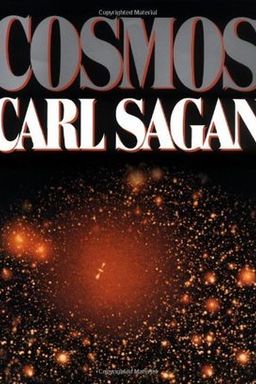
Cosmos cover

Cosmos

by Carl Sagan

Cosmos by Carl Sagan is a seminal work in popular science, exploring humanity''s evolving understanding of the universe. From ancient astronomers to space voyages, Sagan illuminates the wonders of the Cosmos, inspiring awe and curiosity about our place in the vast expanse of space.

The Human Journey Through the Cosmos

How can you truly grasp your place in the universe? In Cosmos, Carl Sagan shows that wonder, reason, and responsibility intertwine when you understand the vast story you inhabit. He argues that the same curiosity that drove ancient stargazers and Ionian experimenters should guide modern civilization, because scientific understanding is both a survival tool and a moral awakening. The book’s core claim is that knowing the cosmos is knowing ourselves: we are a product of cosmic evolution, not its spectators.

Across its sweeping chapters, Sagan traces how humanity learned to see the universe objectively—from early myths and planetary observations to relativity, stellar physics, and the search for life beyond Earth. Each turning point—Eratosthenes measuring Earth’s size, Kepler finding planetary laws, Darwin uncovering evolution—expanded the boundary of what humans can understand. By integrating history, science, and imagination, he gives you both a map of the cosmos and a mirror for civilization’s conscience.

Seeing Ourselves from the Cosmic Shore

Sagan begins by replacing parochial scales—miles, minutes—with cosmic ones: light-years, ages of universes. You learn there are a hundred billion galaxies, each teeming with stars and planets, and that Earth is a delicate speck in an immense sea. Through this humility grows perspective: our familiar world is rare, fragile, and yet, in all known existence, uniquely alive. (Note: this mirrors the famous photograph of Earth from space that redefined global consciousness.)

But humility doesn’t diminish significance—it deepens responsibility. When you see Earth as one among billions, protecting it becomes a cosmic duty. Sagan calls this the cosmic perspective: a way to judge human affairs—war, politics, knowledge—with sanity born from scale.

From Myth to Method

Science, Sagan writes, is society’s best antidote to error. He traces the birth of this method to Ionia, where thinkers like Thales and Anaximander replaced superstition with experiment and geometry. Later traditions—Pythagorean mathematics, Newton’s laws, Einstein’s relativity—deepen and universalize the same impulse: to explain the natural through natural causes. Science is powerful not because it promises certainty, but because it corrects itself. The story of the solar neutrino puzzle, for example, shows how discrepancies invite new ideas rather than denial. It is a culture of self-correction rather than dogma.

Sagan contrasts this with pseudoscience and suppression—from astrology’s persistence to rejections of inconvenient new findings. Truth in science, he insists, emerges from openness: ideas must be tested, not silenced.

Origins: From Atoms to Minds

Life’s emergence is, for Sagan, part of an unbroken cosmic evolution. You learn how early thinkers like Democritus guessed that atoms and void compose all matter—a philosophical prelude to modern physics—and how Darwin later showed that life evolves through selection and time. Experiments like Miller-Urey’s synthesis of amino acids connect chemistry to biology, while endosymbiosis (mitochondria descended from bacteria) reveals cooperation as a source of complexity. Life, then, is not imposed from above but arises naturally wherever conditions permit.

This continuity shatters dualisms: matter and spirit, cosmos and human. Even consciousness is an emergent arrangement of matter—a notion dating back to Democritus—but one that also carries ethical weight. To understand the mechanisms of life is to see ourselves as part of nature’s process, not apart from it.

The Expanding Universe and the Human Role

Science reveals a universe that had a fiery beginning—the Big Bang—and continues to expand. Hubble’s discovery of redshifts proved that galaxies recede in all directions, implying no center and no edge. Within this universe, stars live, die, and seed the next generation of worlds. The iron in your blood and the calcium in your bones were forged inside ancient supernovae. You are literally a child of the stars. (Note: the phrase “star stuff,” now ubiquitous in science communication, originates here.)

Understanding this interconnectedness bridges physics, chemistry, and philosophy. Evolution occurs in galaxies as well as in species, and at each scale—from atoms to civilizations—you see nature’s tendency toward complexity, diversity, and transformation.

Risk and Responsibility

Later, Sagan turns to planetary catastrophes as cautionary parables. The Tunguska explosion reminds you that impacts remain a real cosmic hazard; Venus warns of runaway greenhouse effects and climate neglect. The difference between Venusian hell and Earth’s habitability lies in fractions of atmospheric composition. Understanding those fractions is not optional—it is survival.

From Mars’s ambiguous Viking results to future terraforming debates, Sagan urges humility: seek life without contaminating it, explore without arrogance, and let curiosity drive ethics. Science becomes a form of care rather than conquest.

A Species That Speaks for Earth

The final chapters connect cosmology to culture. SETI and the Voyager record encapsulate the human wish to not be alone—and the responsibility to survive long enough to be heard. Using Drake’s equation, Sagan estimates hundreds of millions of possible civilizations, but the key variable is longevity. Whether we persist depends on our wisdom, not our technology.

Guiding Thought

To seek other beings is also to reflect on our own: who speaks for Earth, and what message we send, are questions of survival wrapped in wonder.

In the end, Cosmos is both an educational odyssey and a civic sermon. It teaches you that every act of understanding—measuring a planet’s curvature or decoding a radio signal—is an act of reverence. You live in a universe that made you capable of knowing it; the least you can do is keep that knowledge alive.


The Birth of Scientific Thinking

Sagan traces science’s lineage to Ionia, where sailors, artisans, and philosophers began asking what the world is made of and how it works. You learn that Thales, Anaximander, and Empedocles used simple tools—a gnomon, a water clock, a map—to reveal underlying regularities. Their daring question was revolutionary: can nature be understood without invoking gods?

Ionia to Alexandria: The Seeds of Method

The Ionian Awakening produced not only individuals but institutions of thought. Thales predicted a solar eclipse using geometry, while Anaximander sketched the first map and proposed that life originated in the sea. This practical rationalism later blossomed in Alexandria’s great library, where Eratosthenes measured Earth’s circumference by comparing shadows and distances between Syene and Alexandria. His calculation, accurate to within a few percent, proved that reasoned observation can span continents.

Atoms, Numbers, and Natural Laws

Democritus deepened this tradition by proposing atoms and void as the constituents of all matter. To him, perception and thought were physical processes—an audacious view centuries ahead of neuroscience. The Pythagoreans, in parallel, elevated mathematics to cosmic law but also cloaked it in mysticism, proving both the power and danger of abstraction. When discovery of irrational numbers violated their theology of perfect ratios, secrecy replaced inquiry. Sagan highlights this as the first scientific cautionary tale: when doctrine outranks data, knowledge stagnates.

Empiricism and the Fall of the Early Flame

Empedocles’ clepsydra and Anaxagoras’ arguments about reflected light on the Moon introduced deliberate experiments, but cultural reaction halted the movement. Slavery reduced respect for manual work; superstition punished free thought—Anaxagoras was jailed for claiming the Sun was a fiery stone. The same pattern recurred later with Hypatia’s murder in Alexandria, showing how political and religious rigidity can dismantle knowledge networks.

Lesson from Ionia

Science flourishes only where social openness, technical craft, and intellectual freedom coexist.

In this foundation lies Sagan’s recurring theme: curiosity must be protected institutionally, not only celebrated rhetorically. Every civilization that forgets the Ionian insight—Nature can be tested, not merely worshipped—risks repeating its collapse into dogma.


From Classical Skies to Universal Laws

The journey from astrology to astrophysics is one of humanity’s greatest intellectual revolutions. Sagan interlaces the stories of Ptolemy, Copernicus, Kepler, and Newton to show how observation, mathematics, and courage turned celestial myth into universal physics.

Kepler Breaks the Circle

Kepler inherited precise observations from Tycho Brahe but abandoned sacred geometry to follow evidence wherever it led. His discovery that planets move in ellipses with the Sun at one focus, sweeping equal areas in equal times, refuted millennia of circular perfection. The harmonies he sought turned out to be physical, not mystical—the first clear articulation that natural beauty lies in regularity validated by measurement.

Newton’s Unification

Isaac Newton translated Kepler’s findings into a mathematical system where one law of gravity governs both apples and planets. His synthesis—a gravitational force inversely proportional to the square of distance—turned the sky into a laboratory and made prediction possible. For Sagan, this is the moment when humanity realized it could read the cosmos using one language: mathematics grounded in experiment.

Relativity: Limits and Liberation

Centuries later, Einstein extended Newton’s insight. By insisting that the speed of light is constant for all observers, he forced a rethinking of space and time themselves. Simultaneity became relative; clocks and rulers lost absoluteness. Yet, paradoxically, this restraint opened new freedom: interstellar travel becomes theoretically possible via time dilation, even if superluminal motion remains forbidden. The cosmic speed limit thus unites humility and hope.

These developments—from Greek geometry to Newtonian gravitation to relativity—illustrate Sagan’s central moral: the universe yields its secrets not to faith or fancy but to minds disciplined by evidence. Each breakthrough reaffirms that physical law is universal, discoverable, and deeply human.


Life’s Origins and Evolutionary Continuity

Life, in Sagan’s narrative, is a cosmic phenomenon grounded in chemistry but flourished by time. You follow the unbroken chain from simple organic molecules to the explosion of species through Darwinian selection. Each step strengthens the argument that matter, given energy and stability, naturally tends toward complexity.

From Molecules to Cells

Miller-Urey experiments demonstrated that lightning through an early-Earth atmosphere could synthesize amino acids and nucleotide bases. Meteorites show similar compounds, implying that cosmic chemistry is fertile. RNA strands and viroids—self-replicating molecules that blur the line between chemistry and life—suggest a continuum rather than a miraculous jump. Mitochondria’s bacterial ancestry underlines another theme: cooperation shapes evolution as much as competition.

Evolution’s Logic and Evidence

Darwin and Wallace provided the mechanism: variation, selection, and inheritance. Sagan illustrates this with examples from artificial selection—woolly sheep, milk-rich cattle, and decorative crabs inadvertently bred by fishermen. At the molecular level, you see how a single DNA mutation alters a protein, as in sickle-cell hemoglobin producing both disease and malaria resistance. Natural selection works incrementally but relentlessly over eons, sculpting complexity without foresight.

Evolutionary Insight

The diversity of life doesn’t require divine design—it arises from cumulative selection acting on random variation.

Sagan presents this not to diminish wonder but to enlarge it. Understanding life’s natural origin connects you to the whole cosmic story: the atoms in your body assembled through stars and selection, patterned by time and chance, carrying the universe’s memory forward.


Worlds, Catastrophes, and Planetary Lessons

Planets, Sagan shows, are natural laboratories for understanding how small differences yield vastly different destinies. Venus, Earth, and Mars share origins but diverge through atmosphere, distance, and geology—each a textbook on climate, catastrophe, and chance.

Violence as Cosmic Commonplace

The Tunguska fireball of 1908 revealed how fragile life on Earth is in the face of cosmic debris. The Moon’s cratered face preserves evidence of ancient bombardment absent from Earth’s eroding crust. These events remind you that destruction and creation are entwined motifs in planetary history.

Venus: The Greenhouse Inferno

Venus, once thought Earth’s twin, turned out to be a cautionary tale. Surface temperatures exceed 480°C under a dense CO₂ atmosphere ninety times our own pressure. Sagan, who pioneered planetary climate models, warned that unchecked greenhouse gas buildup could destabilize Earth’s climate. The moral is empirical, not prophetic: physics, not politics, defines limits.

Mars: Ambiguity and Perseverance

Mars embodies both hope and humility. From Lowell’s imagined irrigation canals to Viking’s ambiguous biochemical data, each era replays the tension between imagination and measurement. Wolf Vishniac’s lost “Mars Jar” experiment, never flown due to budget cuts, symbolizes the cost of short-sighted policy. Yet Sagan insists exploration continue—with cleaner methods, mobile rovers, and cautious ethics about contamination or terraforming.

In planetary comparison you confront the fragility and rarity of balanced climates. The study of other worlds ultimately circles back to one imperative: know Earth deeply enough to keep it habitable.


Stars, Galaxies, and Cosmic Origins

When you look up at night, you see time. Every star is both a furnace and a fossil record. Sagan guides you through stellar life cycles, nucleosynthesis, and the expansion of galaxies to show that cosmic history is a story of transformation across scales.

Stellar Forges

Hydrogen, born in the Big Bang, fuses in stellar cores to helium and onward to heavier elements. When massive stars collapse as supernovae, they eject iron, calcium, and carbon—the raw materials of life. This process unites nuclear physics with existential meaning: you are made of recycled stardust, distributed by cosmic explosions and reassembled into thinking matter.

Galaxies and Expansion

Hubble and Humason’s redshift observations proved that galaxies recede at speeds proportional to distance, implying a universe with no edge or center. The cosmic microwave background later confirmed a hot, dense origin—the Big Bang. Superclusters and quasars reveal structure and youth across billions of years of light-travel time. You inhabit a dynamic, evolving cosmos, not a static tableau.

Key Realization

The same physical principles that ignite suns govern every motion, from galaxy formation to human heartbeat.

By weaving cosmology and biology together, Sagan turns astronomy into autobiography. To know how stars live and die is to understand your own material origins and the fleeting balance that sustains any cosmos capable of reflection.


The Search for Company and Responsibility

For Sagan, the ultimate question—Are we alone?—is inseparable from a deeper one: Can we last? The search for extraterrestrial intelligence (SETI) and interstellar travel are expressions of human optimism, but also tests of wisdom.

Listening to the Galaxy

Radio astronomy offers a practical bridge across light-years. Using the Arecibo dish, humanity has sent algebraic greetings to the globular cluster M13 and listens for narrowband signals unlikely to be natural. The Drake Equation breaks the unknown into factors: number of stars, planets, biology, intelligence, and lifespan of communicative civilizations. Even conservative estimates imply millions of possible others—but only if civilizations endure.

Voyager and the Human Portrait

The Voyager Golden Record, curated by Sagan’s team, carries greetings in dozens of languages, music, and images of life on Earth. It includes even brain-wave patterns and heartbeats—a gesture of self-introduction to eternity. More than a scientific experiment, it is a philosophical statement: that a species capable of introspection and kindness wished to be remembered.

Ethics Beyond Earth

Sagan insists that survival and morality are linked. The same civilization that can radio the stars also builds nuclear arsenals capable of silence forever. His plea—“Who speaks for Earth?”—is both literal and moral: science and compassion must join if we are to remain participants in the cosmic conversation.

Enduring Message

To search outward is to ask what message we send inward. Longevity, not technology, is the real measure of intelligence.

Thus, Sagan concludes the cosmic narrative with civic purpose: protecting knowledge, trusting reason, and nurturing empathy are cosmic imperatives. Whether or not anyone answers, we must remain a world worth hearing from.

Dig Deeper

Get personalized prompts to apply these lessons to your life and deepen your understanding.

Go Deeper

Get the Full Experience

Download Insight Books for AI-powered reflections, quizzes, and more.