
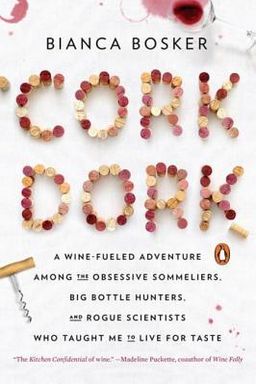
Cork Dork cover

Cork Dork

by Bianca Bosker

Cork Dork takes you on a thrilling adventure into the wine world, as Bianca Bosker sheds her journalism career to master the art of sommelier. Through her journey, you''ll learn the secrets of taste, smell, and the meticulous dedication it takes to appreciate wine fully.

The Cult of Taste and the Search for Meaning

Why do people devote entire lives to the study of taste? In Cork Dork, journalist Bianca Bosker descends into the hidden world of sommeliers, sensory scientists, and wine obsessives to uncover how the pursuit of flavor becomes both a technical craft and a spiritual journey. Through her eyes you learn that wine is not just a drink—it’s a cultural language, an apprenticeship system, a performance, and a test of perception. The book argues that the mastery of taste reshapes the brain, rewrites social identity, and reveals how much of what you experience as 'pleasure' is crafted by attention, training, and context.

From Curiosity to Cult

Bosker begins as an outsider—a former tech journalist with a curious palate—who dives headfirst into a subculture where smell and taste rule every decision. She finds sommeliers who give up perfume, endure exhaustion, and recite flash cards like sacred scripture. This 'cult of the senses' fascinates her because it fuses hedonism with self-denial: they chase beauty through deprivation. As one sommelier jokes, 'you can call it a cult if you want,' but the devotion creates transcendence through discipline. (In this sense, Bosker echoes George Leonard’s Mastery, which shows that peak performance often borders on monastic ritual.)

Apprenticeship and Gatekeeping

Her initiation begins humbly in the cellar of L’Apicio, working as a ten-dollar-an-hour 'cellar rat.' There she learns that expertise travels through apprenticeship, not academics. You start by scrubbing floors, memorizing the bin map, and counting 'tenths of bottles'—the invisible labor behind the glamour of wine service. Advancement depends not on degrees but on networks, mentors, and trust. The structure is hierarchical yet fragile, marked by what Bosker calls an 'economy of taste' in which a single bad pour can cost credibility. The ladder from cellar rat to sommelier becomes a modern guild, complete with exams, rites, and unspoken codes.

Science of the Senses

To test whether expertise is born or built, Bosker joins neuroscientists like Thomas Hummel and Martin Witt who prove that smell can be trained. Through daily odor drills—sniffing vials of rose, lemon, clove—she learns that consistent training literally enlarges olfactory brain regions. Cognitive neuroscientists scan her brain and find that expert tasters recruit circuits for emotion, attention, and language simultaneously. Expertise is not innate—it’s the result of rewired perception. Flavor, she discovers, is not just in the tongue; it’s in how your brain integrates scent, memory, and expectation. (Note: This aligns with research from Yale and Dresden proving neuroplasticity in trained noses.)

Context, Culture, and Capital

Bosker soon sees that taste does not exist in isolation—it is embedded in social rituals. At La Paulée de New York, a Bacchanalian gala where collectors pour thousand-dollar bottles, wine becomes a form of cultural capital: liquid status and belonging. The sommeliers are priests, the guests pilgrims. Yet even here, psychology distorts flavor: if a cheap wine is labeled expensive, your brain’s pleasure centers light up. Context—price, lighting, company—often manipulates what your senses report as 'quality.' Bosker challenges you to ask whether you love a wine for its taste or for its story.

The Wider Argument

As Bosker oscillates between the luxury of Marea and the populism of Paul Grieco’s Terroir bars, she poses a larger question: who is wine for? Is it the playground of elites who wield knowledge as armor, or can taste be democratized through storytelling and irreverence? By blending lab visits, restaurant apprenticeships, and sensory philosophy, she makes a case for reclaiming the pleasures of everyday perception. “Super taste,” she suggests, is not about snobbery—it’s about awareness. Train your attention and you live more vividly.

Core message

Bosker’s deeper revelation is that wine culture mirrors life itself: craft joined to community, obsession tempered by joy, and meaning distilled from sensory detail. To master taste is to cultivate presence—a way of paying attention that turns the mundane into something transcendent.

Across its chapters, Cork Dork guides you through the anatomy of smell, the psychology of value, the theater of service, and the politics of accessibility. The result is a humanistic exploration of expertise: how ordinary people, through deliberate practice, can tune their senses, rewrite perception, and rediscover what pleasure really means.


Apprenticeship and the Sommelier’s Path

Bosker learns that the sommelier’s world is built on apprenticeship—an economy where work, taste, and endurance replace formal credentials. You begin not with theory but with labor: hauling cases in the cellar, memorizing inventory, and shadowing veterans who treat a clean corkscrew as sacred. This path mirrors premodern guilds where mastery passed through observation and repetition rather than school diplomas.

From Cellar Rat to Floor Somm

At L’Apicio, Bosker works with Lara Lowenhar and Joe Campanale and discovers that every task—from stocking the lowboy fridge to logging bottle tenths—teaches discipline. Mistakes, such as losing track of an expensive bottle, damage trust. Yet the cellar is also the sommelier’s university: distributors bring tasting samples weekly, exposing the staff to wines beyond their pay grade. What you lose in wages, you gain in sensory capital.

As you move up, you must learn the unspoken etiquette: don’t interrupt a service flow, never correct a manager on the floor, and make the bottle shine—not yourself. Advancement depends on mentorship and reputation, reinforcing tight-knit hierarchies that act both as support and gatekeeper.

Learning by Immersion

Bosker’s time under multiple veterans—Morgan Harris’s intense study groups, Victoria James’s fast-paced floor work, and Yannick Benjamin’s disciplined tastings—reveals how apprenticeship fuses physical and mental stamina. Flash-card drills and nightly tastings resemble athletic regimen more than leisure. Success demands obsessive consistency: no perfume, no spicy food, strict schedules. (Note: Researchers in expertise development, such as Anders Ericsson, describe similar 'deliberate practice' conditions among concert musicians and chess masters.)

The Court and Career Gatekeeping

The Court of Master Sommeliers formalizes this system with exams testing theory, service, and blind tasting. Passing yields instant prestige, yet the grind can cost everything—relationships, health, and sanity. Bosker interviews Masters who confess to personal collapse in pursuit of the pin. The exams foster an almost monastic devotion, suggesting that professional excellence comes from both endurance and community.

Lesson from the apprenticeship model

Mastery in sensory professions grows through doing, tasting, and failing repeatedly. You acquire knowledge not by reading but by constant embodied contact with the product.

By following Bosker’s journey from cellar rat to certified sommelier, you appreciate how craft cultures encode values of patience, mentorship, and repetition—the same traits that sustain excellence across creative disciplines.


Blind Tasting as Craft and Theater

Blind tasting—the act of identifying a wine without seeing the bottle—sits at the center of the sommelier’s mythology. Bosker learns that it’s equal parts science, ritual, and performance. It demands analytic deduction, sensory stamina, and showmanship under pressure.

The Logic of Deduction

The Court’s structured grid (sight, nose, palate, conclusion) functions as both discipline and script. Sommeliers are trained to annotate color, viscosity, tannin, and acid levels before cross-referencing aroma notes to pinpoint region, grape, and vintage. The process resembles detective work: you gather clues, eliminate possibilities, and deliver your verdict aloud in twenty-five minutes. Precision of language signals competence as much as accuracy of guess.

Training and Feedback Loops

Weekly study groups at Eleven Madison Park simulate exam conditions. Colleagues critique each other’s tempo, diction, and descriptive clarity. The repeated rehearsal builds muscle memory—how long to swirl, how to pace sips, how to spit gracefully. Over time you see improvement: descriptors sharpen, intuition aligns with evidence, and nerves mutate into focus. This regimen also grows your professional network; sharing bottles is both pedagogy and social glue.

Competition as Crucible

Events like TopSomm and TopNewSomm turn private practice into public spectacle. Bosker follows contestants like Morgan Harris who juggle presentation and panic under floodlights. Winning confers access to distributor relationships and career progression. Failure, witnessed by peers, humbles and motivates. These rituals of testing mirror the greater service industry: under chaos, elegance must persist.

A ritual of identity

Blind tasting embodies the sommelier ethos: mastery through observation, speed, and calm performance. It is as much about self-conquest as external validation.

When you watch Bosker wrestle with the blind grid, you recognize that craftsmanship here is inseparable from theater. The ritual forces your senses, memory, and confidence to align—a metaphor for professionalism itself.


Training the Brain to Taste

If you assume some people are born with 'better' noses, neuroscience proves otherwise. Bosker confronts this myth through fieldwork in laboratories and through her own practice routine. The science reveals that perception is a trainable skill shaped by language, repetition, and neurological adaptation.

From Molecules to Meaning

Bosker visits researchers like Johan Lundström and Thomas Hummel in Dresden who show her how smell molecules trigger olfactory receptors connected to the brain’s limbic system. The senses of smell and taste intertwine through retro-nasal olfaction, meaning that much of what you call 'flavor' is actually aroma interpreted through memory. Training enlarges olfactory bulb volume and strengthens these memory links. In practical terms: you can sniff yourself into sharper perception.

Language as a Sensory Tool

Ann Noble’s Wine Aroma Wheel gives vocabulary a structural anchor. By naming scents precisely—blackcurrant, lychee, vanilla—you solidify them in neural storage. Bosker practices with 'Le Nez du Vin' kits to bridge scientific consistency and artistic nuance. The act of labeling transforms vague sensations into recallable categories. (Note: Linguistic theory from the Jahai people supports this; the more odor words a culture has, the more adept its members become at smell identification.)

Technology and the Expert Brain

During her fMRI scan with Seung-Schik Yoo, Bosker sees her own brain activate in areas tied to memory, attention, and reward. Experts display enhanced connectivity in the insula and orbitofrontal cortex—regions translating raw data into emotional appraisal. Training literally rewires how pleasure is processed. Each decade of disciplined tasting builds pathways that anchor sensations into structured judgments.

Practical rule

Taste improves not through better genes but through deliberate exposure, consistent naming, and mindful concentration. Your brain learns to care about what you notice repeatedly.

By integrating science and lived practice, Bosker shows that sensory literacy is democratic. Anyone willing to train can transform perception from background noise into a nuanced, joyful instrument for understanding the world.


Service as Art, Psychology, and Power

Behind the glamour, restaurant service is a form of disciplined theater. Bosker’s time at Marea and with Morgan Harris at Aureole exposes how technical ritual merges with emotional intelligence. Service, she learns, is choreography designed to create calm in the chaotic environment of fine dining.

The Mechanics of Grace

Whether decanting a 1982 Bordeaux or opening Champagne, every move serves both safety and aesthetics. The Court of Master Sommeliers standardizes motions—six twists of the wire cage, candle snuffing, controlled pours—but real restaurants adapt these rituals for efficiency. Understanding the reasoning behind each rule allows flexibility under pressure, a hallmark of professionalism.

Psychology of Reading a Table

Victoria James shows Bosker how to 'profile a party' within seconds—gauging budget, power dynamics, and emotional tone. Sommeliers tailor suggestions using subtle cues, ensuring guests feel both guided and autonomous. Emotional labor—soothing conflicts, celebrating milestones—becomes invisible artistry. The best service fades from notice because it orchestrates guest comfort without self-display.

Power and Ethics

Yet service operates within hierarchies of wealth. 'PXs,' big-spending patrons, receive rare allocations. Sommeliers act as moral gatekeepers—deciding who 'deserves' a Château d’Yquem or a DRC pour. Bosker questions whether stewardship can coexist with equality. The ethics of generosity versus elitism define fine-dining culture.

Hospitality redefined

Great service is more than ritual precision—it’s creating psychological safety and resonance. If one sip leads to another, the sommelier has succeeded.

Through Bosker’s staged performances and stumbles, you see that hospitality blends technical craft, empathy, and moral discernment. It is a mirror of human interaction itself: timing, attention, and grace under pressure.


Authenticity, Engineering, and the Taste Debate

Bosker’s exploration of mass-market producers like Treasury Wine Estates and sensory scientists like Lei Mikawa reveals that much of what the world drinks is engineered for consistency and sweetness. These wines are not accidents—they are focus-grouped to match the average palate. The revelation provokes a crisis: if pleasure can be manufactured, what happens to authenticity?

The Industrial Palate

Companies use sensory panels to fine-tune sugar, acid, and oak levels. Additives such as Mega Purple, oak chips, and designer yeasts mimic artisanal complexity. For mass audiences, these predictable flavors offer comfort and affordability—democratizing decent taste. For purists, they betray the soul of wine. The divide echoes the larger cultural battle between craft and convenience.

Meeting Drinkers Where They Are

Experts like Tim Hanni argue for empathy: people’s sensory thresholds differ, so sweeter wines are not 'worse,' merely tuned to different palates. Lei Mikawa even sees engineered wines as training wheels, tempting newcomers toward complexity. In this lens, industrial methods may widen appreciation rather than corrupt it.

Redefining Quality

Bosker dismantles the triad of price, chemistry, and critic scores as absolute measures of quality. Price inflates with scarcity, chemistry fails to predict pleasure, and critics disagree dramatically. Instead, she frames 'quality' as a hybrid of structure, story, and situation—the harmony among craftsmanship, perception, and context. (Sociologist Pierre Bourdieu’s theories of taste as class marker hover behind her observations.)

Redefinition of good

Good wine is not an intrinsic fact but a relationship between chemistry, context, and consciousness.

By comparing lab wines and grand cru bottles, Bosker forces you to rethink value: authenticity is not the opposite of design but a question of intent. Pleasure becomes plural, not hierarchical.


Context, Culture, and Democratizing Taste

Wine does not exist in a vacuum—it is alive in its setting and its storytelling. Bosker unites psychology and sociology to show that the same liquid can taste divine or dull depending on circumstance. Price, lighting, music, company, and belief all shape sensory response, while cultural rituals like La Paulée or Paul Grieco’s Terroir bars reveal how taste operates as both hierarchy and rebellion.

Expectation as Spice

Experiments from Stanford and CalTech prove that labeling a wine expensive increases neural pleasure responses—even when it’s the same bottle as the 'cheap' version. Bosker calls price 'the most powerful spice.' The mind, primed by prestige, changes the tongue’s report. Similarly, red lighting and cello music make wine seem richer, while green lights and staccato notes make it taste fresher.

Ritual as Social Mirror

At La Paulée, collectors pour rare bottles as offerings to one another, transforming consumption into ceremony. Sommeliers act as stewards of meaning—curating who receives what. The party dramatizes privilege but also belief: even potential forgeries taste sublime because the setting amplifies awe. Context, Bosker concludes, often writes flavor’s meaning as much as chemistry.

The Counterculture of Accessibility

Paul Grieco’s Terroir bars invert this hierarchy. Through irreverence and storytelling, he reframes tasting as communal play rather than status competition. His ethos—pairing a Blue Nun next to Sassicaia—asks guests to trust curiosity over pedigree. Democratization, Bosker sees, requires emotional hospitality: making exploration fun instead of intimidating.

The lived lesson

Context turns tasting into connection. Whether you chase mastery or joy, the goal is not distinction but discovery—a shared human capacity to make the ordinary extraordinary through attention.

By book’s end, Bosker redefines taste as a democratic act of noticing. The true luxury is not the bottle but the ability to care about what you’re experiencing.

Dig Deeper

Get personalized prompts to apply these lessons to your life and deepen your understanding.

Go Deeper

Get the Full Experience

Download Insight Books for AI-powered reflections, quizzes, and more.