
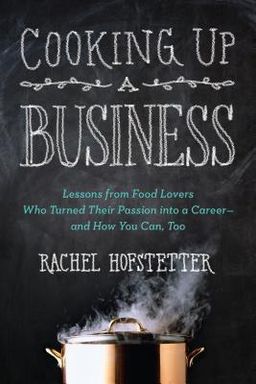
Cooking Up a Business cover

Cooking Up a Business

by Rachel Hofstetter

Cooking Up a Business is an essential guide for aspiring food entrepreneurs. Through real-life success stories and practical insights, the book reveals how to navigate challenges, from funding to scaling, and turn culinary dreams into reality. Discover how to leverage creativity, maintain brand integrity, and capture market needs to succeed in the competitive food industry.

Turning Passion into Purpose: How Food Dreams Become Thriving Businesses

Have you ever dreamed of sharing your grandmother’s cookie recipe with the world or bottling the sauce everyone begs you for? In Cooking Up a Business, Rachel Hofstetter shows you exactly how people like you have done just that—transforming kitchen-table experiments into national food brands. Hofstetter argues that starting a food business today isn’t just about creating something tasty; it’s about blending passion, grit, business acumen, and storytelling in a marketplace driven by authenticity and community.

Through a decade of conversations with food founders—from nut-butter mavericks to gluten-free pioneers—Hofstetter distills the common mindsets and methods that help entrepreneurs rise from home kitchens to supermarket shelves. She weaves these lessons through ten core stories such as Love Grown Foods, Kopali Organics, Tasty Brand, Evol, Mary’s Gone Crackers, Justin’s, Hint, Popchips, Cameron Hughes Wine, and Vosges Haut-Chocolat. Each story offers a blueprint for how creativity and hustle can outdo giant corporations in a changing food industry.

The Heart of the Modern Food Entrepreneur

Hofstetter frames her entrepreneurs as the new makers of our age—artisans who marry quality with conscience. The food revolution she captures is set in the era of Whole Foods, sustainability, and food blogging—a time when customers wanted integrity along with flavor. You don’t need investors or family money, Hofstetter insists, but you do need relentless problem-solving and the courage to keep iterating until you find what works. Whether hustling granola from Aspen coffee shops or concocting vegan crackers in a small town bakery, these founders share one mantra: start small, think big, and learn fast.

Modern Market, Timeless Lessons

Why does this matter to anyone with a creative idea? Because Hofstetter’s stories go beyond recipes—they reveal the anatomy of entrepreneurship itself. The entrepreneurs she profiles confront the same roadblocks every dreamer faces: lack of funding, legal confusion, production nightmares, and distribution barriers. But they persevere by living their brand authentically, often operating on sweat equity long before securing financial backing. These founders prove that today’s consumers crave honesty, not polished advertising—they buy your story before they buy your product.

From Side Hustles to National Brands

In these pages, you’ll learn how Love Grown’s college sweethearts hand-stuck granola labels before exploding into Kroger’s 1,300 stores in just two years; how ex-software designer Zak Zaidman transformed Costa Rican farmers’ struggle into a fair-trade chocolate revolution; and how Phil Anson’s homemade burritos evolved from a mountain-side cooler to the multimillion-dollar frozen brand Evol. Each narrative illustrates how a simple idea—if tested, branded, and scaled thoughtfully—can ripple outward to change the way America eats.

Hofstetter invites you to step into these entrepreneurs’ kitchens and see that success is rarely linear or glamorous. It’s often a 4 a.m. bake, a failed batch, or an unexpected regulatory obstacle. But she believes that with the right mentality—rooted in storytelling, community support, and adaptive hustle—food founders can shift from selling jars at farmers’ markets to shaping entire food categories. In a world hungry for sincerity, Cooking Up a Business doubles as both a master class in entrepreneurship and a delicious collection of modern origin myths. Whether you’re a foodie, a creative, or a business dreamer, the message is universal: your idea doesn’t need to stay in your kitchen. With heart and hustle, it can feed the nation.


The Power of Hustle: Scrappy Paths to the Shelf

What if your business started with nothing more than an old family recipe and a bag of oats? For Maddy D’Amato and Alex Hasulak, the youthful co-founders of Love Grown Foods, hustle wasn’t just a trait—it was their business model. Their story, as Hofstetter describes, exemplifies how passion can fuel a startup even when money and experience are scarce. They began in a college kitchen at the University of Denver and turned Maddy’s mom’s granola recipe into a natural food brand distributed in thousands of stores.

Start Small, Think Huge

Alex and Maddy didn’t dive blindly—they strategically planned for scalability right from the start. By choosing granola instead of perishable food like pesto, they selected a product that was shelf-stable, transportable, and easy to manufacture. Their clarity on short-term constraints and long-term growth meant they were designing a national brand even before selling their first bag. They avoided generic packaging by hand-stickering clear bags to look professional, proving that design legitimacy could substitute for early-scale funding. They also conducted guerrilla-style focus groups among classmates—trading samples for survey responses—to refine recipes and branding before entering the market.

From Basement Kitchens to Kroger Shelves

Success didn’t come overnight—it came from sleepless nights. The couple’s relentless baking schedule—4 p.m. to 4 a.m.—demonstrates the grind behind entrepreneurship. They built genuine relationships instead of relying on corporate cold calls. A chance bank conversation led to a connection with a grocery store manager, which launched Love Grown’s first retail test in Aspen. When their granola outsold established brands, word spread. Within eighteen months, their small-town hustle landed them in Kroger’s national network. Their motto, “Sell first, then design and build,” became their operating philosophy: say yes first, then figure out how to deliver.

The Mindset of Modern Founders

Hofstetter extends their philosophy through another case study—Back to the Roots, a student startup that turned coffee grounds into mushroom kits sold through Home Depot. The founders’ single-word mission statement, “Hustle,” echoes Love Grown’s approach: move fast, talk to anyone, and never fear rejection. Together, these stories encapsulate Hofstetter’s conviction that in food entrepreneurship, scrappiness beats pedigree. You don’t need credentials—you need curiosity, grit, and a human network you cultivate yourself.

Key lesson: If you can’t outspend your competition, out-hustle them. Build relationships before distribution, craft a brand that looks national from day one, and use every ounce of resourcefulness to turn tiny opportunities into exponential growth.


Designing Products that Sell and Do Good

Zak Zaidman’s journey with Kopali Organics reveals a truth central to Hofstetter’s thesis: profitable products can also uplift communities. Zak, a former tech entrepreneur, discovered his calling not in Silicon Valley but in Costa Rica’s pesticide-drenched banana fields. After witnessing workers’ exposure to toxic chemicals, he committed to building a business that empowered small farmers while giving U.S. consumers ethical, delicious snacks. His story introduces readers to the emergent world of social enterprise—companies that measure success by both profit and positive impact (a philosophy echoing Paul Newman’s and Ben & Jerry’s earlier models).

Rapid Turnover and Real Impact

Kopali started with banana vinegar—an exotic, values-driven product that failed commercially because it was too unfamiliar and slow-moving. Zak’s insight came when a Whole Foods buyer taught him the notion of rapid turnover: if your product sits for months, you’ll never scale. So, Zak pivoted—first to small snack packs of organic dried fruits and eventually to chocolate-covered treats that aligned indulgence with ethics. These were easy to recognize, affordable, and high-frequency purchases, proving social good can thrive when embedded in convenient, desirable products.

Social Responsibility as Strategy

Hofstetter uses Kopali’s transformation to highlight a shift in consumer values: modern customers want to buy from companies that care. Data from Cone Communications shows that nearly half of Americans will pay more for ethically positioned brands. Zak embodied that principle by championing transparency about sourcing and fair trade, blending narrative and purpose. Kopali’s packaging told stories of the farmers who produced the cacao and coffee beans, turning supply chains into emotional connections.

From Exotic to Everyday

By the time Kopali focused solely on organic chocolates, it had achieved what Hofstetter calls the “sweet spot of social business”—a marriage of conscience, simplicity, and scale. The evolution mirrors the sustainability lessons in books like Muhammad Yunus’s Building Social Business or Blake Mycoskie’s TOMS philosophy: start with a story that matters, but refine it into a product people love to buy repeatedly. You support change not through charity, but through irresistible consumer choice.


Create a Brand Before You Create a Product

What happens when your product changes but your purpose stays the same? Shannan Swanson and Liane Weintraub’s Tasty Brand exemplifies Hofstetter’s rule: a strong brand identity cushions every pivot. The duo began as concerned mothers disappointed by low-quality baby food. But when frozen storage issues crippled their first product, they reinvented themselves as purveyors of organic fruit snacks—without sacrificing their playful, trustworthy image.

Brand Therapy: Finding Your Essence

Before they chose a logo or label, Shannan and Liane underwent what their consultant called “psychoanalysis for your brand.” They distilled three words—genuine, organic, fun—that defined every decision from packaging to public relations. Bright turquoise replaced the stereotypical “earthy brown” of organic goods, signaling that natural foods could be cheerful, not solemn. This brand work enabled Tasty to remain recognizable even as its products evolved. (Marketing researchers like Seth Godin would agree: emotion, not rational claims, builds the bond between a brand and its audience.)

DIY PR and the Power of Personality

Unable to afford an agency, they mastered PR themselves—crafting pitches for media outlets like O Magazine and leveraging mommy blogs and social media long before it was common. Their hands-on approach built authenticity; customers loved that tweets and posts came directly from the founders. They epitomized Hofstetter’s larger message: your story is your greatest marketing tool. When Tasty later championed the fight against GMOs, announcing their commitment publicly before certification, they turned risk into credibility.

Tasty’s journey highlights a truth every innovator should remember: build your brand around a belief, not a product. Products can and should change—but values build movements.


Scaling Without Losing Soul

Phil Anson’s story at Evol (formerly Phil’s Fresh Foods) illuminates Hofstetter’s central warning: scaling up is harder than starting up. Phil began selling burritos out of a cooler to fund his rock climbing habit, only to realize he’d stumbled into a massive opportunity. But scaling from a cabin kitchen to national distribution required mastering the most unglamorous dimensions of the food world—regulation, logistics, and capital.

Navigating Food Safety

Phil’s early batches of hand-wrapped burritos may have been tasty, but the USDA saw them as potential hazards. Once federal inspectors intervened, Phil had to understand complex food safety laws—heat control, contamination, shelf life. Hofstetter uses Evol’s story to demystify these processes for readers, noting that each product type brings different oversight. Her takeaway for aspiring founders: learn the regulations before you scale, or the government will teach them to you the hard way.

From Fresh to Frozen

When perishability kept him chained to delivery schedules, Phil boldly pivoted to frozen foods. This shift transformed Evol from a local brand into a national one, allowing longer shelf life and lower risk. By partnering with Bear Naked founders Tom Spier and Brendan Synnott, he secured financing and rebranded as Evol ("love" backward). Their playbook followed scalability guru Tom Ryan’s three steps: design efficient systems, keep local authenticity, and embrace simplicity. Evol’s success—growing to thousands of stores—proved that maintaining soul and scale aren’t mutually exclusive.

The broader insight? Scaling should align with your values. Simplify operations without diluting authenticity. Whether you’re making burritos or running restaurants, growth must serve both your mission and your market, not consume them.


Rising from Personal Need: The Gluten-Free Revolution

Sometimes, innovation begins with pain. Mary Waldner’s lifelong struggle with undiagnosed celiac disease led her to create Mary’s Gone Crackers—decades before “gluten-free” became a universal label. Hofstetter presents Mary as both a pioneer and patient-zero of the free-from food movement, a reminder that personal necessity often sparks world-changing business ideas.

Turning Suffering into Science

Mary’s healing journey gave her moral fire, while her therapy background gave her empathy—a potent mix for building community around her snack. She and her husband, Dale Rodrigues, spent years perfecting a gluten-free cracker, navigating co-packers, manufacturing glitches, and funding obstacles. When investors urged rapid expansion, Mary resisted and chose profitability over reckless growth, reclaiming control when venture capital threatened their mission.

From Niche to Nation

By the time gluten avoidance went mainstream, Mary’s Gone Crackers had become synonymous with authenticity. The brand’s early emphasis on integrity—clear labeling, allergen transparency, and direct outreach to support groups—positioned it as a trusted leader. Hofstetter connects Mary’s resilience to a broader trend: modern “special diets” are no longer rare—they’re billion-dollar markets. From lactose sensitivity to veganism, entrepreneurs who listen empathetically to customers’ needs build not just foods, but movements.

Mary’s story embodies the book’s emotional center: healing yourself can become a way to heal others. Your vulnerability, when paired with a mission, can be your most valuable ingredient.


The Equity Equation: Growing Teams Without Losing Ownership

Justin Gold, founder of Justin’s Nut Butters, represents the quintessential modern entrepreneur: inventive, values-driven, and determined to grow without selling his soul. Hofstetter presents Justin’s story as a master class in leveraging equity creatively—using ownership as currency to attract talent and resources while keeping majority control.

From Spoonfuls to Squeeze Packs

Justin started by hand-grinding flavored nut butters in Boulder, fashioning labels that read “DO NOT TOUCH.” When roommates stole them anyway, he realized their potential. Unable to find co-packers willing to handle sticky natural ingredients, he manufactured the butters himself, creating a signature texture competitors couldn’t mimic. His breakthrough came with the single-serve squeeze pack—first dismissed by retailers, then embraced as a snack revolution. By calling on stores personally and negotiating creative terms (“first case free, I’ll restock”), Justin embodied Hofstetter’s rule: persistence sells better than PR.

Equity as Fuel, Not Debt

When Justin couldn’t afford high-caliber hires, he offered equity stakes in place of full salaries. His first big recruit, Lance Gentry from Izze Beverage Co., grew the company’s revenue multiple times. Design firms, brokers—even board advisors—all took part ownership rather than upfront payment. This hybrid compensation model expanded Justin’s resources without sacrificing autonomy. Hofstetter cautions, however, that equity isn’t free—it’s ownership. The golden rule: keep at least 51% if staying in control matters to your mission.

Justin’s philosophy blends idealism with discipline. He treats each employee as an owner, rewarding effort with shares and purpose. The result? A certified culture of stewardship and one of the fastest-growing natural nut butter brands in America. His story reinforces Hofstetter’s thesis: smart entrepreneurs share their pie but keep the recipe.


Simplicity Sells: The Rise of Hint Water

Former AOL executive Kara Goldin didn’t intend to start a beverage empire—she just wanted to get her family off sugary drinks. When her homemade fruit-infused waters became a household favorite, she did what Hofstetter calls the “founder’s pivot”: turning a personal solution into a scalable product. Hint’s meteoric growth anchors one of the book’s most practical principles—success comes from simplifying, not complicating.

From Kitchen Pitchers to Grocery Shelves

Kara’s trial-and-error journey through manufacturing hurdles demonstrates the messy reality of making “healthy convenience.” When cold-fill bottling gave her product only a three-month shelf life, experts told her to quit or add preservatives. Refusing to compromise, she discovered the hot-fill process that preserved purity while extending shelf life. Hofstetter uses Kara’s perseverance to stress a key lesson: entrepreneurship thrives on strategic compromise—protect your core belief (in Hint’s case, no chemicals) but adapt on everything else.

Think Like a Buyer

Kara and her husband, Theo, learned to speak the language of retailers. They approached grocery buyers not as supplicants but as problem-solvers: “We help you sell more by tapping into the water drinkers bored with soda.” By using real data on SKU visibility and sales multipliers, they proved Hint deserved more shelf space. Kara’s marketing followed her simplicity ethos—no gimmicks, just honesty—and the product’s clean design reflected that. Within five years, Hint became a boardroom—and Google campus—staple.

Simplicity is sophistication. Strip away excess, focus on solving one universal problem, and communicate with radical clarity. That’s how innovation becomes iconic.


Creating Buzz without a Big Budget

Keith Belling’s Popchips story proves that you don’t need a multimillion-dollar ad budget to build a household name—you need creativity and community. Belling, a self-professed chip addict, wanted a snack that tasted indulgent but felt guilt-free. His solution, popping rather than frying potatoes, created a new snack category. What made Popchips explode, Hofstetter argues, wasn’t just the product but the way Keith marketed it: through concentrated, human-scale buzz.

From Data to Delight

Before investing, Keith did something rare among food founders—he tested the idea on 100 random snackers via an online survey. Ninety percent said they’d buy popped chips. That market validation gave him confidence to invest in flavor scientists and an edgy design firm that made Popchips packaging look sleek and fun. But the brand’s major innovation wasn’t technological—it was experiential. Instead of national ads, Keith orchestrated “sixty days in New York”: a grassroots blitz mixing personal sampling, influencer gifting, and snack breaks at companies like J.Crew. Popchips became a viral lifestyle brand before “viral marketing” was a buzzword.

The Psychology of Sharing

Hofstetter dissects why Popchips’ “surprise and delight” strategy worked: people remember how a product made them feel more than what it said. Handwritten notes, branded care packages, and playful copy (“Snack. Smile. Repeat.”) built emotional attachment. Like Seth Godin’s concept of “purple cows”—remarkable products that people can’t help but talk about—Popchips leveraged delight as its main growth engine. By focusing all marketing energy into a short, audacious time frame and city, Belling created nationwide echo.

The takeaway resonates across industries: when everyone else is shouting, whisper sincerely and hand them a snack. Authentic experience trumps expensive advertising every time.


The Genius Financial Model: Profit After the Purchase Order

Cameron Hughes Wine brings finance to the forefront: how can you grow fast when cash is always tight? Cameron and his wife, Jessica Kogan, built one of the largest U.S. wineries without owning a vineyard, through a strategy Hofstetter calls the “sell-first model.” Their approach—selling premium surplus wines from elite wineries under their own label—demonstrates entrepreneurial efficiency at its finest.

Selling Before Spending

Instead of producing wine upfront, Cameron pitched samples to Costco buyers, using their purchase orders as collateral to pay suppliers. This flipped the traditional risk equation: revenue was guaranteed before production costs. The model parallels fast-fashion logistics and even today’s crowdfunding systems—proof that innovation can happen in accounting, not just kitchens. Hofstetter frames this as an essential mindset for modern founders: cash flow is oxygen. Master it early or suffocate later.

Wine for the People

Hughes’s “Lot” system—limited batches of secret luxury blends at bargain prices—turned exclusivity into accessibility. Premium wine, stripped of pretense, became a Costco bestseller. The couple’s carnival-style in-store demos, where Cameron personally preached his $30-for-$9 gospel, doubled as grassroots marketing research. When lines formed and online orders soared, they realized authenticity sells even high-end products. Their financial model kept overhead low—cheap glass bottles, minimal ad spend—and funneled savings into product quality instead of polish.

Ultimately, Hofstetter champions their genius model as an inspiration: manage finances creatively, protect cash flow like a chef guards a secret recipe, and remember that storytelling and spreadsheets don’t have to be enemies—they can ferment together into profit.


Selling Luxury Through Story

Katrina Markoff’s Vosges Haut-Chocolat closes Hofstetter’s menu of stories with a decadent lesson: luxury isn’t about price—it’s about meaning. Trained at Le Cordon Bleu and El Bulli, Katrina fused her world travels into truffles that tell tales of culture and craft. By treating chocolate like couture fashion, she built a brand that turned indulgence into storytelling art.

Crafting Desire

Markoff learned luxury marketing from her uncle, a Neiman Marcus mail-order guru: every high-end item needs narrative. So she sold not just cocoa but experience—truffles infused with wasabi, curry, or bacon, each connected to a story about travel or spirituality. Her purple-wrapped boutiques resembled fashion ateliers, inviting customers to savor chocolate as a journey for the senses. (Hofstetter compares it to Hermès packaging: elegance that tells you why it’s worth every cent.)

Expanding Without Diluting

When Vosges matured, Katrina added Wild Ophelia—a younger, mass-market sibling. She protected the core brand by giving the spinoff its own name, showing how to grow luxury responsibly. Whether in Paris couture or premium food, Hofstetter underscores the same rule: protect your mystique. Customers don’t just buy chocolate; they buy belonging to its story. Every founder—from farmers’ market sellers to haute brands—can use narrative to elevate perception and justify value.

Markoff’s journey transforms the book’s larger theme into art: products nourish the body, but stories nourish loyalty. Luxury, authenticity, and purpose all melt together in one final bite.

Dig Deeper

Get personalized prompts to apply these lessons to your life and deepen your understanding.

Go Deeper

Get the Full Experience

Download Insight Books for AI-powered reflections, quizzes, and more.