
Idea 1
Cooking and the Making of Humanity
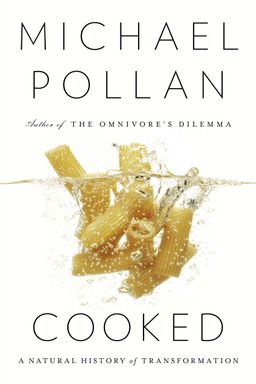
Michael Pollan’s Cooked argues that cooking is not only about recipes and techniques; it is the primal technology that made our species and sustains our civilization. Drawing on biology, anthropology, and his own kitchen apprenticeship, Pollan advances the idea that manipulating fire, water, air, and fermentation shaped human evolution, social life, and our sense of meaning. The act of preparing a meal links biology to culture, individual craft to collective ritual.
From Evolution to Everyday Life
Pollan begins with the “cooking hypothesis,” developed by Richard Wrangham at Cambridge, which proposes that the invention of cooking—controlling fire and applying heat to food—transformed early hominins. Cooked food delivered more calories for less effort, shortened chewing time, shrank our guts, and freed metabolic energy for bigger brains. In his meetings with Wrangham, Pollan learns how the chemistry of heat denatures proteins and gelatinizes starches, effectively externalizing digestion. When you roast or simmer food today, you participate in the same evolutionary loop that once changed anatomy and cognition.
Cooking, Pollan notes, freed hours for social life and creative labor. Chimps may chew six hours a day; humans, once they controlled fire, could afford to talk, plan, and form culture. Archaeological traces—a million-year-old South African hearth—suggest that human life reorganized around this practice. So the question isn’t simply what we eat; it’s how we make it. Our cuisine is a long experiment with nature’s elements.
The Four Elements Framework
Pollan structures Cooked around the four classical elements—Fire, Water, Air, Earth—and the human technologies they mirror. Each element becomes both a cooking method and a lens on civilization:
- Fire: Barbecue and live flame; ritual, community, and mastery of primal energy.
- Water: Braising and stewing; the pot as an emblem of domestication and shared nourishment.
- Air: Bread and fermentation; microbial partnership and the symbol of civilization’s expansion.
- Earth: Fermentation’s slow transformations; microbial collaboration that underpins culture itself.
In each chapter, Pollan apprentices to artisans—pitmen, chefs, bakers, brewers, monks—to re-learn what modern life outsourced to industry. The lessons form a recovery of skill and attention: how to taste smoke, stretch dough, or watch fermentation evolve. Each mode shows that cooking is an ecological art, uniting the physical world with acts of care and time.
The Cooking Paradox
Pollan begins with a paradox that defines our era: we spend less time cooking than any previous generation yet are obsessed with food culture—celebrity chefs, cooking shows, glossy magazines. Americans average twenty-seven minutes of cooking per day while devoting hours to watching others cook. Pollan calls this “outsourcing meaning” to corporations. When you let companies handle the food work, they optimize for convenience and shelf life, not ecology or health. Cheap calories and sedentary habits follow, along with the erosion of family meals.
The paradox connects back to evolution: the species that externalized digestion through cooking is now externalizing cooking itself, losing both physiological and cultural feedback. Pollan sees this as a civic loss. Restoring cooking—even a few nights a week—reasserts autonomy, skill, and shared ritual over passive consumption.
Cooking as Meaning-Making
Each element of cooking becomes moral instruction. Fire teaches humility before fundamental forces; water teaches patience and domestic intimacy; air teaches that human craft collaborates with microbes; earth teaches ecological cooperation through fermentation. Pollan’s apprenticeships with Bittor Arguinzoniz (fire precision), Samin Nosrat (the logic of braise), Chad Robertson (bread craft), and Sandor Katz (fermentation revival) all converge on a single revelation: cooking is an act of understanding the living systems that feed and surround you.
"First we cooked our food, and then our food cooked us."
Pollan’s aphorism summarizes the book’s thesis: cooking externalized part of nature, transformed us biologically, and, if done well, can restore our human balance with the world.
When you sauté onions, build a sourdough starter, or ferment vegetables, you recreate connections once built into daily life: sensory work, microbial partnership, shared time, and patience. Cooked thus reads as both history and guide—a rediscovery of what industrial speed and convenience obscured. Pollan’s answer to the Cooking Paradox is to re-engage the elements: to cook as a mindful craft, not an obligation. His conclusion—rooted in practice rather than sentiment—is that to cook is human, and to cook together is civilization.