
Idea 1
Building Better Products Through Continuous Discovery
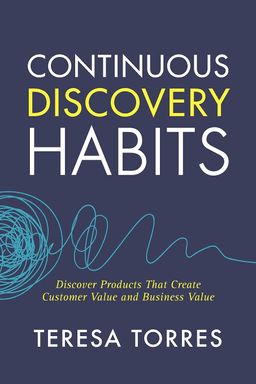
How can you consistently build products that truly delight customers while also driving business success? In Continuous Discovery Habits, product expert Teresa Torres argues that the answer isn’t a single process or tool—it's a discipline. She contends that successful teams don’t rely on occasional bursts of innovation or one-time research projects; rather, they cultivate daily habits of discovery that keep them in constant dialogue with their customers and closely tied to evolving market realities.
Torres’s contention is deceptively simple but transformative: discovery is not a phase but a constant companion to delivery. Instead of separating the work of finding what to build from the work of building it, modern product teams should integrate learning into their everyday rhythm. Her framework is built around regular customer engagement, visual thinking, assumption testing, and outcome-based decision-making—all elements that form what she calls “continuous discovery habits.”
Why Continuous Discovery Matters
Too many teams, Torres explains, fall prey to what author Melissa Perri famously calls “the build trap”—obsessing over shipping outputs instead of creating meaningful outcomes. While Agile methods improved delivery speed, most companies still measure success by output: features shipped, code written, or deadlines met. The result? A fast, efficient machine for producing the wrong things. Continuous discovery is Torres’s corrective for this pervasive problem. By maintaining ongoing contact with real customers and testing assumptions early and often, teams reduce waste, mitigate risk, and make better decisions.
This approach emerged after decades of shifts in software development—from waterfall to Agile to Lean—and reflects a key insight gained from those transformations: it’s not enough to work faster; we must learn faster. Product teams, Torres argues, must make learning about customers an everyday habit rather than a special event or a researcher’s job.
A Framework Grounded in Outcomes and Customers
Torres’s central framework proposes that discovery should be anchored in three commitments: focusing on outcomes over outputs, maintaining weekly touchpoints with customers, and empowering the product trio—a small, cross-functional group composed of a product manager, designer, and engineer—to own learning together. These trios are not passive recipients of requirements but collaborative teams responsible for making customer value and business value converge.
To support this team structure, the book introduces one of its signature artifacts—the Opportunity Solution Tree (OST). This visual map helps teams connect high-level business outcomes (the roots) to customer opportunities (the branches) and concrete solution ideas (the leaves). With it, teams can make discovery visible and rational rather than mysterious or dependent on intuition. The OST also fosters clearer communication with stakeholders, ensuring that product decisions can be traced back to evidence and outcomes.
Where many books on product management stop at theory, Continuous Discovery Habits details a fully operational system of routines: weekly interviews, mapping exercises, ideation sessions, and assumption tests. Each practice builds upon the next, creating a flywheel effect where customer insights continually inform product direction.
The Six Core Mindsets
Before building habits, Torres underscores the mindsets required for success. These include:
- Outcome-oriented thinking: Redefine success by the impact a product creates, not by its features.
- Customer-centric focus: Treat customer value as inseparable from business value.
- Collaboration: Replace handoffs with shared understanding and joint decision-making across roles.
- Visual thinking: Externalize insights through maps and sketches to avoid conversational ambiguity.
- Experimental mindset: Treat each learning effort as a small, testable hypothesis rather than a big bet.
- Continuous practice: Make discovery an ongoing rhythm, not an isolated pre-project ritual.
Together, these mindsets shift teams from short-term execution to sustained learning. You might compare them to Carol Dweck’s growth mindset or Marty Cagan’s emphasis on empowered product teams in Inspired. Implementing these mindset shifts prepares teams to thrive in uncertainty and to act without needing perfect information.
From Discovery to Delivery—and Back Again
Torres reframes the traditional linear product pipeline (“discover, then deliver”) as a cyclical system of discovery feeding delivery and delivery fueling further discovery. Insight isn’t something teams gather before building; it is embedded in day-to-day execution. When a feature ships, its real-world results fuel new discoveries. Measurement and customer feedback loop back into new ideas—making the process truly continuous.
“At a minimum,” Torres writes, “continuous discovery means weekly touchpoints with customers by the team building the product, where they conduct small research activities in pursuit of a desired outcome.”
Ultimately, Continuous Discovery Habits is not a manifesto but a manual. Teresa Torres doesn’t promise instant transformation but demonstrates that through small, iterative progress—starting with a single weekly interview—you can build the foundations of a high-performing, impact-focused product practice. The book makes you realize that discovery isn’t just a skill—it’s a habit worth cultivating for life.