
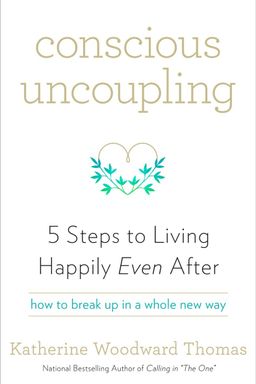
Conscious Uncoupling cover

Conscious Uncoupling

by Katherine Woodward Thomas

Conscious Uncoupling offers a revolutionary approach to ending relationships with dignity and grace. Katherine Woodward Thomas presents five mindful steps to transform the pain of separation into a journey of personal growth, emotional freedom, and future happiness. Discover how to navigate breakups with respect, responsibility, and renewed hope.

Transforming Heartbreak into Growth through Conscious Uncoupling

What if the end of a relationship wasn’t a story of bitterness, guilt, and failure—but an opportunity for transformation, healing, and evolution? In Conscious Uncoupling: 5 Steps to Living Happily Even After, Katherine Woodward Thomas challenges the traditional narrative of heartbreak. She argues that the way we end our relationships is as important as how we begin them, and that separation, when approached consciously, can leave everyone involved whole, healthy, and even more capable of love.

Thomas contends that the pain of a breakup stems not just from lost love, but from internalized shame and disempowerment. By confronting our emotions and taking responsibility for how we co-created the relationship, we can dissolve residual resentments and move forward with compassion and integrity. Conscious Uncoupling is both a structured process and a personal philosophy: it teaches you how to evolve through loss rather than be diminished by it.

A Cultural Reframing of Breakups

Thomas challenges what she calls society’s “collective fairy-tale myth” — the belief that relationships that don’t last forever are failures. Drawing from history and neuroscience, she traces how Western culture became obsessed with “happily ever after” and permanence in romantic love, even though most modern relationships are destined to change form. Statistics show that over 40% of first marriages and over 60% of second marriages in the U.S. end in divorce, yet we still carry shame about letting go. Thomas asks us to see ending a relationship as natural and evolutionary, rather than as moral failure.

Borrowing from thinkers like Viktor Frankl, Brené Brown, and Pema Chödrön, she reframes breakups as spiritual experiences — times when life strips away illusions and demands growth. Just as the Renaissance Venetians once invented fairy tales to escape their suffering, Thomas suggests we can now invent a new cultural narrative: one that honors change, emotional awareness, and conscious choice.

The Five-Step Process

Thomas’s groundbreaking system—developed from her experience as a therapist and her own divorce—guides you to reclaim your power and peace in five key steps:

  • Step 1: Find Emotional Freedom—Transform the chaos of rage, fear, or despair into energy for positive change.
  • Step 2: Reclaim Your Power and Your Life—Let go of victimhood and take radical responsibility for your part in what happened.
  • Step 3: Break the Pattern, Heal Your Heart—Identify recurring wound-based stories and subconscious patterns that drive your relationships.
  • Step 4: Become a Love Alchemist—Dissolve resentment and transform pain into compassion, goodwill, and integrity.
  • Step 5: Create Your Happily-Even-After Life—Reinvent your life and relationships based on new agreements, vision, and freedom.

Each step is supported by exercises, neuroscience-based insights, and stories from clients and cultural figures (including the highly publicized “conscious uncoupling” of Gwyneth Paltrow and Chris Martin). Though Thomas’s model gained fame through celebrity culture, it’s fundamentally a therapeutic practice rooted in emotional wisdom, mindfulness, and the ethics of goodwill.

From Pain to Purpose

Thomas invites readers to imagine that heartbreak can be used as a tool for awakening—an initiation into greater maturity. She compares breakups to shamanic death experiences: moments when an old identity must die so a truer self can emerge. She reminds you that avoiding grief or lingering in victimhood leads to “complicated grief” (what psychology calls prolonged mourning), while conscious healing allows light and compassion to enter the cracks of your heart.

By creating intentional closure, people can avoid repeating destructive relationship patterns and cultivate “post-traumatic growth.” Just as alchemists turned lead into gold, those who consciously uncouple transform suffering into wisdom. The goal isn’t merely to end well—it’s to live well after the ending.

Core Message

Breakups do not have to destroy us—they can transform us. By choosing integrity, empathy, and responsibility, we change not only our personal story of love but also the collective story of relationships for future generations.

In the end, Thomas’s work is less about separating from a lover and more about uniting with oneself. “Whether we stay or go,” she writes, “the bottom line is love.” Conscious Uncoupling calls on each of us to evolve the way we love, forgive, and begin again.


Healing Shame and Redefining Failure in Love

Thomas begins with the invisible wound beneath every breakup—shame. As she explains in Chapter 1, society frames romantic endings as personal failures. From wedding vows that declare 'till death do us part' to movies that equate everlasting love with worthiness, we've learned to measure relationships by duration rather than depth or growth. When love ends, shame floods in, whispering: 'You weren’t enough. You failed.'

How Shame Shapes Breakup Pain

Shame is different from guilt. Where guilt says 'I did something bad,' shame says 'I am bad.' Drawing on psychologist Ruth Benedict and neuroscientist Matthew Lieberman, Thomas explains that the brain reads social rejection like physical pain. We’re biologically wired to equate exclusion with death because, in our ancestors’ world, being cast out of the tribe meant annihilation. When a relationship ends, especially one that anchored your identity, the blow can feel catastrophic.

The author recounts stories like Leslie, whose husband left after just seven months—no affair, no fight, only the revelation that 'he didn’t like marriage.' Overwhelmed by shame, Leslie retreated from friends and family. Thomas notes this isolation reflex is common; shame 'derives its power from being unspeakable,' echoing Brené Brown’s work on vulnerability.

Unpacking the Myth of Happily Ever After

To dismantle this collective shame, Thomas traces the history of the 'happily ever after' myth. Fairy tales, she reveals, originated in 16th-century Venice—a society plagued by poverty, disease, and rigid class laws. These stories weren’t timeless truths; they were fantasies that comforted hopeless people with dreams of security and love. In our modern context, they’ve become psychological traps that make impermanence seem wrong. What began as escapism hardened into ideology.

By understanding these origins, you can start questioning cultural expectations that define worth by marital longevity. (Note: This mirrors Stephanie Coontz’s findings in Marriage, A History, where she shows how love-based marriage is a relatively recent invention.)

Replacing Failure with Growth

Thomas encourages you to ask new questions: Not “How long did it last?” but “What did I learn?” and “How did I love?” She argues that romantic endings are not proof of failure but evidence of evolution. Like scientist Helen Fisher’s research into serial monogamy, Thomas views our multiple loves as stages of consciousness—each an apprenticeship in the art of connection.

“Love asks many things of us,” she writes, “including actions that seem counter to loyalty or attachment.” Sometimes, honoring love means letting it change form rather than forcing it to endure dishonestly.

By redefining failure in love, Thomas frees you to approach heartbreak as sacred transformation. Shame loses its grip when you trace it to story rather than truth. Once you recognize that the 'cover' of failure hides the seed of renewal, you begin the deeper work of conscious evolution—choosing growth over guilt, compassion over condemnation.


Rage, Revenge, and Emotional Alchemy

In Chapter 2, Thomas dives into the messy underbelly of heartbreak: rage and revenge. Using vivid examples—from true crime to everyday confessions—she explores how biology and heartbreak collide to turn love into hate. Quoting biologist Helen Fisher, she explains that rejection activates the same brain circuits as addiction withdrawal. We don’t want to hurt our ex simply because we’re cruel; our brains are desperate for the dopamine fix that love once provided.

We meet Rita, a soft-spoken teacher who keyed her ex’s car in fury, then suffered months of humiliation and guilt. Or Christina Reber, whose act of violent revenge against a partner made national headlines. Though extreme, these stories show how, under love’s collapse, survival instincts take over. “Hurt people hurt people,” Thomas writes—literally and neurologically.

The Neuroscience of Negative Bonds

Thomas draws on psychologist Louis Cozolino and neurobiological studies (like Naomi Eisenberger’s UCLA research on social pain) to explain why we often stay obsessed with an ex. The brain’s attachment circuitry resists losing an emotional home; even hatred feels safer than indifference because it maintains connection. This is why many couples continue toxic contact long after splitting—their nervous systems crave the chemical regulation the other once provided.

Time Doesn’t Heal—Conscious Action Does

Against the cliché that 'time heals all wounds,' Thomas insists that only you do. Like a broken leg, a broken heart heals only if tended with care, attention, and corrective action. Without intentional healing, people suffer prolonged grief disorder—lingering numbness, irritability, and hopelessness identified by Mayo Clinic research. Healing, she teaches, requires proactive emotional processing, not passive endurance.

Transforming Pain into Purpose

Anger, Thomas says, isn’t a moral failing—it’s life energy demanding direction. Like compost turning garbage into fertilizer, rage can enrich your growth if channeled wisely. Using mindfulness techniques and self-compassion exercises, she helps you harness anger as motivation to reclaim boundaries, voice needs, and end self-abandonment. As Maya Angelou put it: “Bitterness eats upon the host. Anger burns it all clean.”

The key, she writes, is not to exorcise anger but to alchemize it—turning the energy of destruction into fuel for transformation.

By understanding the biology behind heartbreak, she reframes emotional chaos as a neurological event that can be guided toward renewal. When you stop demonizing your rage and start listening to what it’s protecting, you begin to reclaim power and equilibrium.


The Birth of Conscious Uncoupling

In Chapter 3, Thomas introduces her core model—Conscious Uncoupling—a structured alternative to the antagonistic breakups that have long characterized Western culture. She defines it as 'a breakup or divorce characterized by goodwill, generosity, and respect,' where both people strive to do minimal damage and set everyone up to thrive moving forward. This is not utopian idealism but a pragmatic call for emotional maturity in an age of serial relationships.

From Breakdown to Breakthrough

Thomas tells the story of Dianna, a successful attorney devastated when her husband left her for another woman. Initially consumed by rage and revenge fantasies, Dianna chose the Conscious Uncoupling process instead. Through it, she discovered that her overwork and emotional neglect had also hurt her marriage. As she forgave herself and took responsibility, she opened space for compassion—and surprisingly, for her ex’s success. Years later, the two co-parent peacefully, and Dianna has built a richer, more authentic life.

This vignette exemplifies Thomas’s promise: that even deep betrayal can yield personal transformation. The process is not about reconciling or “staying friends” but about evolving both on individual and relational levels.

The Ethics of Generosity

Central to Conscious Uncoupling is the practice of generosity—offering goodwill even when hurt. Thomas connects this to Buddhist and karmic philosophy, reframing forgiveness as self-liberation rather than moral obligation. Each action, she explains, plants a karmic seed that grows the life you’ll inhabit later. When you act out of spite, you sow bitterness; when you act out of integrity, you harvest peace. Generosity, then, is enlightened self-interest.

“Our goal is not to punish,” she writes, “but to preserve and protect. Most of all, to let our ethics triumph over our emotions.”

Through such ethics, Conscious Uncoupling replaces war metaphors (“fighting for custody,” “winning the divorce”) with creative metaphors (“co-parenting,” “restructuring a family”). It shifts breakup from destruction to transition—a passage that, if handled consciously, can actually deepen humanity’s capacity for love.


Five Steps from Chaos to Clarity

Thomas’s 5-step method is both structured and soulful—a journey through grief, self-discovery, and renewal. Each step gradually transforms reactivity into responsibility and heartbreak into wholeness.

Step 1: Find Emotional Freedom

You begin by learning to self-regulate emotional chaos. Using mindfulness and neuroscience exercises (like affect labeling from UCLA studies), Thomas teaches how naming your feelings literally calms the amygdala and restores rational thought. She invites readers to create an 'Inner Sanctuary of Safety'—a practice of self-witnessing compassion inspired by Buddhist tonglen meditation. Instead of repressing emotions, you breathe them in, bless them, and let them go.

Step 2: Reclaim Your Power and Your Life

Once stabilized, you move from blame to responsibility. Borrowing from Viktor Frankl’s idea that freedom lies in how we respond to pain, Thomas challenges you to identify your part in the dynamic. Monique, a client who felt abandoned by her ex-husband, discovered she had long abandoned her own independence. Taking ownership restored her strength and ended victimhood.

Step 3: Break the Pattern, Heal Your Heart

This pivotal step uncovers your 'source-fracture story'—the core childhood belief that drives recurring pain (e.g., “I’m not enough,” “Everyone leaves me”). Like shadow work in Jungian psychology, this process turns unconscious repetition into conscious choice. By identifying false conclusions formed in childhood, you begin writing a new story rooted in truth: 'I was not born to be alone. I can learn healthy love.'

Step 4: Become a Love Alchemist

Here, forgiveness becomes creative power. Through visualization (inspired by Hawaiian Ho’oponopono and Christian forgiveness prayers), you dissolve resentment and negativity. Thomas reframes forgiveness not as condoning harm but as reclaiming emotional sovereignty—severing toxic energetic ties while preserving compassion. She calls this moral chemistry “turning lead into gold.”

Step 5: Create Your Happily-Even-After Life

Finally, you design new agreements and structures that reflect your post-breakup values—whether co-parenting respectfully, reinventing your career, or crafting supportive communities. Thomas offers examples of couples who held “uncoupling ceremonies,” redrafted family boundaries, and even continued friendship with grace. The goal isn’t perfection but wholeness: leaving the past relationship enhanced, not erased.

These steps, though sequential, are cyclical. Readers might revisit earlier ones as emotions resurface. Together, they map the full journey from fragmentation to freedom—a blueprint for emotional adulthood in love’s aftermath.


The Science and Soul of Emotional Healing

Thomas’s system rests on an integrative understanding of mind, body, and spirit. She bases her approach on modern neuroscience while weaving in contemplative psychology, showing that emotional healing is both biological and spiritual.

Biology of Bonding

Citing Dr. Louis Cozolino, she describes the brain as a social organ wired for attachment. When a bond breaks, the nervous system loses its regulator, leading to anxiety, confusion, and disorientation—symptoms identical to physical trauma. Whether the breakup was mutual or not, the body perceives relational rupture as danger. Understanding this prevents self-blame: your suffering is not weakness, it’s biology.

The Power of Mindful Containment

Self-reflective practices—like labeling emotions, pausing to breathe, and mirroring your needs (“What are you feeling, sweetheart?”)—restore agency. Neuroscientist Matthew Lieberman’s research shows that naming feelings deactivates the brain’s panic response. Thomas repurposes this as spiritual practice, teaching you to become your own safe container rather than collapsing into reactivity.

Transformative Grief

Grief, she insists, is not pathology but passage. Drawing from Elisabeth Kübler-Ross’s stages of loss, she reframes depression as nature’s way of slowing the psyche down to integrate change. If anger catalyzes transformation, sorrow deepens empathy—the heart’s capacity to hold more love. Such integration converts heartbreak into humility, cruelty into compassion, loss into light.

This marriage of science and soul defines Thomas’s gift: rigorous psychology illuminated by timeless wisdom. She reminds readers that healing does not mean erasing pain but creating meaning from it—what Viktor Frankl called “bearing witness to suffering’s purpose.”


Becoming a Love Alchemist in Action

Step 4—Becoming a Love Alchemist—is the heart of Thomas’s philosophy. Here, the breakup becomes a crucible for moral courage: the choice to let love define the ending rather than pain. A Love Alchemist recognizes resentment as raw creative power and transmutes it through conscious acts of integrity.

Forgiveness as Freedom

Thomas cites spiritual teachers from Marianne Williamson to Thich Nhat Hanh to show that forgiveness doesn’t excuse harm; it releases you from bondage. She introduces simple yet profound forgiveness rituals—like Reverend Roberta Herzog’s prayer or the Hawaiian Ho’oponopono mantras (“I love you, I’m sorry, please forgive me, thank you”)—to purify lingering attachments. These practices embody her central principle: you can’t control others, but you can control the field between you.

The Practice of Generosity

Generosity is the alchemist’s secret ingredient. Thomas tells of Dianna sending her ex-husband money to finish his film, transforming bitterness into blessing. Such acts might sound saintly, but they’re neurochemically strategic: generosity releases oxytocin, counteracting stress hormones like cortisol. Kindness, she insists, is not naïveté—it’s intelligent design for peace.

Creating a Positive Future Intention

To move from scorch marks to new ground, Thomas urges readers to craft an intention for the future—an emotional North Star. It could be “May those involved leave enriched, not diminished.” Such a vision re-calibrates behavior during tense negotiations (like co-parenting or asset division). It shifts focus from retaliation to creation.

“The goal of a Conscious Uncoupling,” writes Thomas, “is not the restoration of justice—it’s the liberation of the soul.”

In practice, being a Love Alchemist means replacing instinctive reaction with creative response—summoning grace even when grace isn’t returned. This capacity, she believes, is what will evolve human love beyond its primitive patterns of possession and pain.


Creating a Happily-Even-After Life

In the final step, Thomas guides readers toward reinvention. 'Happily ever after' becomes 'happily even after'—a life expanded, not diminished, by love’s evolution. True completion, she writes, means releasing old contracts, restoring community harmony, and creating structures that allow everyone to thrive.

New Agreements and Cohesion

Thomas encourages replacing outdated vows ('I’ll always be yours') with realistic, respectful ones ('I’ll always honor you as family'). She shares stories of couples holding 'uncoupling ceremonies' or co-authoring family missions to foster unity. These rituals, like Japan’s kintsugi—repairing broken pottery with gold—transform what’s cracked into something stronger and more beautiful.

Parenting and Community as Evolution

For parents, Thomas introduces the idea of “binuclear families”: one family in two homes. Citing researcher Constance Ahrons, she argues that children don’t suffer from divorce itself but from broken systems where parents stay hostile. The cure is cooperation, not cohabitation. She describes her own experience spending holidays with her ex-husband’s new partner to model security and love for their daughter—a radical act that heals generations of fear around family fracture.

From Ending to Expansion

In closing, Thomas reframes divorce as part of love’s natural lifecycle. Quoting poet Rumi—“It looks like sunset, but it’s dawn”—she invites readers to see emptiness as potential, not loss. The work of Conscious Uncoupling, she concludes, is the work of conscious living: creating from compassion, leading with integrity, and staying open to love, wherever it next appears.

The true measure of love, she reminds us, isn’t how long it lasts—it’s how gracefully it transforms.

Dig Deeper

Get personalized prompts to apply these lessons to your life and deepen your understanding.

Go Deeper

Get the Full Experience

Download Insight Books for AI-powered reflections, quizzes, and more.