
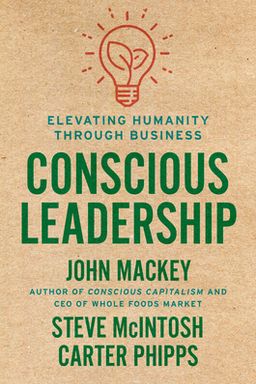
Conscious Leadership cover

Conscious Leadership

by John Mackey, Steve McIntosh, Carter Phipps

Conscious Leadership reveals how purpose-driven leadership transforms businesses beyond the bottom line. John Mackey, with co-authors, shares insights from his experience leading Whole Foods, illustrating how integrity, innovation, and social responsibility drive competitive and sustainable success.

Innovate and Create Value as a Conscious Leader

What does it truly mean to innovate—not just to invent a clever product, but to create real, enduring value for others? In Conscious Leadership, John Mackey, Steve McIntosh, and Carter Phipps challenge one of the most prevalent myths in business: that profit alone defines success. They argue that the highest form of leadership draws its vitality from continuous innovation grounded in values—a relentless quest to improve life for all stakeholders. Conscious leaders, they insist, must not only lead companies; they must cultivate cultures where creativity, experimentation, and purpose flow naturally.

The authors trace this argument through the stories of thinkers and innovators who reshaped the world—from Thomas Edison’s laboratory of “muckers” to Silicon Valley’s culture of shared creativity, to modern examples like Whole Foods Market, Airbnb, and the X Prize Foundation. Innovation, they show, is not luck or magic but the disciplined practice of connecting ideas, nourishing environments where creativity thrives, and keeping love and service at the heart of enterprise. Their thesis: capitalism is most alive when it becomes innovationism—driven not merely by capital accumulation but by the human imagination’s power to solve problems and lift society as a whole.

Reframing Capitalism: From Profit Seeking to Value Creation

Mackey and his co-authors begin by reframing capitalism itself as a moral and innovative force. Economist Deirdre McCloskey, whose work they cite extensively, calls the past two centuries of economic growth the “Great Enrichment,” crediting not resources but ideas—“piling idea on idea.” The authors remind us that nearly 85 percent of the world lived in poverty two centuries ago; now fewer than 9 percent do. The engine behind that transformation wasn’t greed but human creativity released into free exchange. This, they argue, is why capitalism at its best is innovation powered by human virtue, not consumption powered by competition alone.

Conscious leaders must thus see profit as the result, not the purpose. “Profits are downstream from value,” Mackey writes. When businesses focus on improving life through meaningful innovation, enduring prosperity follows. The examples range from Ray Kroc’s reinvention of the restaurant model to Whole Foods' recognition that health and sustainability could itself become a revolutionary retail concept. Conscious capitalism thrives when leaders innovate with purpose, aware that success expands outward to society.

The Leader’s New Role: Architect of Innovation

The authors reject the myth of the lone genius, replacing it with the idea of “scenius”—Brian Eno’s term for collective genius shaped by creative communities. Edison’s workshops, Paris in the 1920s, and Silicon Valley’s garages all testify that ideas flourish in ecosystems, not in isolation. Conscious leaders, then, must not merely create but foster the conditions for innovation: psychological safety, generosity, and openness. The chapter presents practical advice—reward experimentation, celebrate curiosity, and model authenticity. Praise and genuine appreciation, they argue (echoing Daniel Goleman’s work on emotional intelligence), are more catalytic than cash incentives alone.

Whole Foods itself embodies this philosophy through its decentralized teams and culture of autonomy. Mackey encourages leaders to empower every level of the organization to take creative ownership, warning that bureaucracy suffocates innovation. Competition, he adds, can coexist with cooperation—healthy rivalry pushes teams forward when it’s honorable and transparent. Rivalries like Whole Foods and Trader Joe’s, or Tesla’s challenge to auto incumbents, demonstrate how collaborative competition can accelerate social good.

Innovation as a Conscious Practice

To innovate consciously, leaders must treat creativity as a moral and purposeful act. The authors provide practices like “Contemplate Progress” and “The Great Idea Hunt,” which invite teams to rediscover wonder in everyday advances and learn from peers across industries. They also advise embracing humility—the trait Ray Dalio calls a “competitive advantage.” Yes, innovation requires courage, but arrogance suffocates adaptability. Conscious leaders listen more than they proclaim. They seek to get it right—not to be right.

Above all, innovation is inseparable from value creation. Citing cautionary tales like Xerox PARC—whose breakthroughs enriched Apple and Microsoft rather than itself—the authors remind us that ideas alone don’t change the world. Execution guided by purpose does. Innovation finds meaning only when it creates real value for customers, employees, suppliers, and communities. This synthesis turns “good ideas” into great contributions.

Why It Matters

In a world beset by disruption and uncertainty, Mackey’s vision reawakens faith in business as a creative, humane institution. Innovation without consciousness can be exploitative; consciousness without innovation can stagnate. The blend—the conscious innovator—defines the future of ethical capitalism. As Stuart Kauffman’s concept of “the adjacent possible” reminds us, every breakthrough reveals new edges of opportunity awaiting discovery. Conscious leaders look to those edges, poised between stability and experiment, humility and boldness, value and vision.

A Single Idea Can Elevate Humanity

Mackey’s ultimate invitation is clear: innovate consciously to evolve humanity. Every product, process, or business that creates genuine value participates in the long arc of progress—the same one that lifted billions from poverty. When led with love and purpose, innovation becomes not merely an economic imperative but a moral calling.


Create Cultures Where Ideas Thrive

One of the most compelling insights from the authors is that great innovation emerges from shared creativity, not just individual brilliance. The book’s concept of “scenius”—borrowed from musician Brian Eno—captures this perfectly: creativity is a collective property. The most fertile breakthroughs come from environments alive with curiosity, dialogue, and collaboration. Conscious leaders, then, must act as gardeners of culture, cultivating soil where ideas can sprout rather than dictating which seeds may grow.

Innovation Loves Company

From Edison’s cooperative inventors—his “muckers”—to Silicon Valley’s startup ethos, the book shows that innovation thrives where people interact freely. Stanford’s Fred Turner called this dynamic “ideas in the interactions of communities,” observing that breakthrough technologies like the personal computer arose not from solitary genius but from the social fabric connecting thinkers, hippies, academics, and entrepreneurs. The authors urge leaders to build such creative ecosystems inside their companies. That means connecting cross-functional teams, honoring curiosity, and valuing intellectual diversity.

Designing Cultural DNA

“Culture,” Mackey writes, “is what you reward.” Incentives create invisible borders around creativity. If organizations honor conformity and caution, innovation withers. A conscious leader must therefore align rewards—monetary or emotional—with exploration and adaptability. Authentic appreciation is a far greater motivator than transactional bonuses. Even a few words of visible praise can ripple through the cultural bloodstream, reinforcing what behaviors matter most. (As Peter Senge argued in The Fifth Discipline, learning organizations emerge when curiosity itself becomes institutionalized.)

The authors also encourage companies to balance rigor and freedom. Highly regulated systems can stifle novelty, while unchecked autonomy breeds chaos. The key is to hold structure lightly—to maintain a disciplined path that still invites experimentation. In this way, culture becomes a self-renewing ecosystem rather than a bureaucratic machine.

Healthy Competition and the Spirit of Play

Conscious capitalism doesn’t reject competition—it refines it. Mackey tells how Whole Foods encourages “friendly rivalry” between stores: local teams test inventive layouts or menu ideas, such as the now-famous mochi ice cream bar, born in one store and later replicated nationwide. Competition, managed honorably, motivates creativity. When rivalries are grounded in mutual respect, both companies and customers win. The story of Whole Foods and Trader Joe’s—rivals turned collaborators within the Conscious Capitalism movement—embodies this transformation from combative to constructive competition.

Start a Conspiracy

John Street, a tech entrepreneur cited in the book, describes innovation cultures as having a “conspiratorial” spirit—an exhilarating sense that employees share a secret about what’s possible before the world sees it. This, Mackey explains, unites teams emotionally around a common story. Great companies, like Salesforce or Airbnb, cultivate narratives that make every employee feel part of a pioneering mission. The shared “why” becomes a gravitational field for creativity.

But the authors warn that even visionary cultures must balance passion with autonomy. Too much ideological fervor can cross into cultishness. The conscious leader steadies that tension—nurturing belonging without suffocating inquiry. Stories unite; freedom renews.

Creating Conscious Incentives

Evolving a creative culture demands purposeful incentives. The chapter compares Nasdaq’s “Gift Council,” where CEO Bob Greifeld protected high-potential experiments from short-term metrics, to Whole Foods’ transparent wage disclosures that tie progress to fairness. Both demonstrate the conscious leader’s balance between performance discipline and creative slack. The message is clear: incentives shape imagination. Cultivate optimism, reward originality, and innovation becomes reflex rather than rebellion.

Key Takeaway

A conscious leader doesn’t generate every idea—they generate the conditions for everyone’s ideas to connect. Culture is not what you declare; it’s what you reward, model, and celebrate every day.


Innovation Emerges at the Edges

Innovation rarely starts in the center of power—it sprouts on the edges. The authors show that real breakthroughs are born in unconventional spaces where disciplines, people, and perspectives overlap. From jazz to Silicon Valley, from urban culture to sports evolution, transformation takes root wherever tradition loosens its grip. Conscious leaders, therefore, should look beyond their comfort zones and actively explore the frontiers of their organizations and industries.

The Evolutionary Edge

The book compares innovation’s geography to biology. Just as biodiversity thrives where ecosystems meet—like forests and grasslands blending—new ideas arise when cultures and functions intersect. The music genre of jazz, born at the crossroads of African, Caribbean, and European sounds in New Orleans, illustrates how hybridization creates dynamism. Likewise, the NBA’s shift toward fast-paced, three-point-heavy play started far outside the league’s elite—coach Mike D’Antoni developed it in Italy before NBA adoption. Disruption starts small, in experimental environments free from orthodoxy, and then migrates inward.

Business history tells similar stories. Silicon Valley, in the 1970s, was a peripheral mix of counterculture and technologists far removed from corporate conservatism. That “outsider” ethic of freedom, experimentation, and anti-establishment thinking birthed HP, Apple, and Google. “The story of innovation has not changed,” former Google CEO Eric Schmidt observes: small teams with misunderstood ideas reshape the future long before executives notice.

Creating Space for the Edges

The authors recommend that established organizations deliberately nurture their frontiers. One proven technique is to build autonomous “skunkworks” projects—microcultures designed to bypass the inertia of bureaucracy. Bob Greifeld’s Nasdaq “Gift Council” functioned precisely this way, giving experimental teams freedom from short-term profit pressures. These spaces act like mini–Silicon Valleys inside formal institutions, combining protection with play. The key is to measure their success differently: early metrics should reward learning, not immediate results.

But this requires humility from top leadership. Conscious leaders must admit that the next big idea may not come from them—or even their core division. They must design organizations that listen closely to peripheral signals: the “garage, basement, or dorm room” where tomorrow’s business ecosystems incubate. As Mackey puts it, “Innovation starts on the edges and moves inward. Institutionalization starts at the center and moves outward. Both are important—but leaders must know the difference.”

Recognizing Innovation When It Arrives

Spotting innovation early requires a forward-looking sensibility. The authors draw lessons from Cisco’s John Chambers, who prioritized transitions over competitors. “If you focus on competitors,” Chambers warned, “you are looking backward.” His emphasis on the next market shift kept Cisco ahead of obsolescence. Similarly, economist Carlota Perez reminds innovators that progress often involves seeing where momentum already exists and amplifying it—a principle echoed by hockey legend Wayne Gretzky’s advice to “skate to where the puck is going.”

The Humility to Learn From Others

The authors urge leaders to embrace humility as both a moral and strategic advantage. Innovation, after all, can arise anywhere—and often does so outside our own walls. Companies that cling to ego develop “not invented here” syndrome, missing chances to acquire or partner with emerging talent. Great organizations, they argue, neither copy mindlessly nor cling obstinately—they learn, adapt, and integrate. Arthur Rock, the venture capitalist who backed Intel and Apple, exemplified this boundary-spanning brilliance. He wasn’t an inventor; he was a recognizer of genius.

Leadership Lesson

To innovate beyond the mainstream, consciously cultivate your edges—people, spaces, and partnerships that don’t fit the mold. Great leaders don’t just tolerate outliers; they incubate them until the world catches up.


Rethinking Organizational Design

Mackey and his co-authors argue that if innovation is the lifeblood of conscious capitalism, organizational design is its circulatory system. The best ideas die within structures that can’t support them. That’s why leading companies are replacing rigid hierarchies with dynamic, self-managing teams that balance freedom with accountability.

From Command and Control to Create and Collaborate

Traditional bureaucracies—borrowed from military “command and control” systems—were designed for predictability and uniformity in eras when the world changed slowly. But in today’s fast-evolving economy, “bureaucratic hierarchy is simply too slow to be successful.” Instead, organizations must become “self-organizing, fast-iterating, and dynamic.” Inspired by Agile management, lean manufacturing, and decentralization, the conscious leader’s aim is to create structures that empower autonomy without losing cohesion.

Whole Foods: A Living Case Study

Whole Foods Market itself represents this philosophy in practice. Every store operates as a network of self-managing teams—from produce to seafood to bakery. Each team controls hiring, goal setting, and performance tracking. They are empowered to make tactical decisions while aligning under regional and global teams. This “team of teams” model allows local creativity and ownership while maintaining strategic coherence. Thanks to this structure, even as the company scaled to over 100,000 employees, it retained agility and a sense of family.

Crucially, such systems also cultivate meaning and engagement. Cross-training and voluntary collaboration build competence and community. Leaders function less as overseers and more as gardeners—removing barriers, providing context, and nurturing growth.

Learning from Zappos and Beyond

The authors spotlight Zappos and its late CEO Tony Hsieh as pioneers of decentralized governance. Inspired by Brian Robertson’s Holacracy model, Zappos replaced job titles with roles and distributed decision-making throughout the organization. While not perfect, this system dramatically boosted innovation and adaptability, allowing employees to act like entrepreneurs inside the enterprise. Other tech companies like Google and Netflix have pursued their own variations of networked communities that emphasize values over rigid rules.

These examples illustrate an essential polarity: too much hierarchy strangles creativity; too little dissolves focus. Conscious leaders must locate the “sweet spot” between autonomy and alignment, creativity and consistency. The North Star is always purpose—does the structure serve the mission and empower people to deliver value?

Empowerment and Purpose as Design Principles

Designing for empowerment begins with trust. Mackey calls on leaders to treat employees as partners, not subordinates. By distributing decision-making, companies unleash dormant intelligence across all levels. Bureaucracy, he warns, is the organizational immune system that rejects new ideas. A conscious structure, however, learns to reprogram its defenses to welcome innovation while maintaining resilience.

Key Takeaway

Organizational evolution mirrors biological evolution. Adaptability ensures survival. By designing from purpose and empowering teams to act, conscious leaders transform companies from rigid hierarchies into living organisms capable of growth and renewal.


Humility as a Competitive Advantage

In a world that rewards confidence and charisma, Mackey and his co-authors make a bold claim: humility is the hallmark of conscious leadership. It is also one of innovation’s most underrated catalysts. While arrogance blinds leaders to possibility, humility opens the door to learning, adaptation, and collaboration—the lifeblood of creative progress.

The Ego Trap

Corporate ego, the authors warn, is both pervasive and pernicious. The “not invented here” syndrome, where companies dismiss outside innovations, has doomed even industry giants. Success can breed hubris, and hubris blinds organizations to external signals. Leaders who once disrupted markets often become defenders of orthodoxy. The antidote is organizational humility—the willingness to learn from customers, competitors, and sometimes even critics.

Arthur Rock, the venture capitalist behind Intel and Apple, embodies this humility. He wasn’t a technologist but an astute listener who recognized genius in others and enabled it. He famously said, “If you’re building a business to make money, forget it. If you want to make a contribution to society, then let’s talk.” Rock’s quiet discernment catalyzed the birth of Silicon Valley.

Personal Humility and Team Learning

At the individual level, humility means valuing truth over ego. Ray Dalio, founder of Bridgewater Associates, teaches employees to replace “I’m right” with “Why do I think I’m right?” This subtle shift turns defensiveness into discovery. Conscious leaders model this curiosity, encouraging open debate and accepting feedback non-defensively. By admitting fallibility, they grant permission for others to do the same, fostering psychological safety—the soil of innovation.

Humility in Action

Mackey extends this idea beyond individuals to organizations. Great companies balance self-confidence with open-mindedness. Google didn’t invent the search engine; it perfected it. Facebook didn’t create social media; it evolved it. Whole Foods didn’t start the organic food movement but recognized its potential early. Even Amazon, now a behemoth, continually acts as a “day one” company—an attitude of perpetual learning.

In practice, humility means honoring good ideas regardless of source, seeking diverse perspectives, and remaining flexible enough to pivot when reality changes. Cisco’s quick abandonment of its failing Flip camera after smartphones integrated video exemplifies this disciplined humility—cut losses, preserve learning, move forward. The combination of confidence to act and humility to adapt defines lasting leadership.

A Conscious Reminder

If you’re the smartest person in the room, you’re in the wrong room. Humility doesn’t dampen excellence—it multiplies it by unlocking the genius of the group.


From Innovation to Real Value

The book concludes its exploration of innovation by emphasizing a simple truth: ideas mean nothing until they create tangible value. Creativity becomes leadership only when it improves life for stakeholders—customers, employees, communities, and investors. To innovate is to serve. Conscious leaders discipline their imagination with the question: how does this innovation add authentic value to others?

Bringing Ideas to Life

The cautionary tale of Xerox PARC illustrates this perfectly. Despite inventing the graphical user interface and laser printer, Xerox failed to operationalize its breakthroughs, which others like Apple, Microsoft, and 3Com turned into multi-billion-dollar industries. Innovation divorced from value creation becomes squandered potential. Conscious leadership closes that gap by ensuring every great idea connects to a real-world need or improvement.

The authors commend leaders who turn advocacy into innovation—for instance, Bruce Friedrich, the former PETA activist who founded the Good Food Institute. Initially trying to change minds about animal diets, he pivoted to changing the food supply itself, catalyzing the plant-based revolution. His move from ideology to practicality exemplifies how innovation operationalizes ethics. Value-driven creativity serves—not lectures—the world into transformation.

Stakeholders as Value Partners

Mackey insists that creating value must extend to all stakeholders. Customers may benefit first, but suppliers, employees, and communities must prosper too. Socially disruptive innovation inevitably upsets some incumbents, yet its long-term legitimacy depends on mutual respect. As Whole Foods learned, nurturing good will among all stakeholders makes organizations resilient during turbulence. Conscious leaders remember: how innovation is implemented matters as much as what is invented.

Innovation in the Unlikely Places

To challenge conventional thinking, the authors highlight entrepreneurs who found opportunity in neglected spaces. Miki Agrawal and her twin sister Radha built Thinx—period-proof underwear—and Tushy—a sustainable bidet company—by reimagining everyday taboos. Their courage to innovate in “periods and poo,” as they joked, epitomizes conscious creativity tackling overlooked human needs. Radha later launched Daybreaker, a movement reinventing nightlife around wellness and connection. Each of these ventures demonstrates that meaningful innovation often hides in the unglamorous corners of our lives.

Seeing the Adjacent Possible

The chapter ends with a powerful mental tool from complexity theorist Stuart Kauffman: the “adjacent possible.” Every innovation opens a new frontier of near-term possibilities just beyond our current reality. Great leaders see one or two steps ahead, not ten, expanding potential incrementally yet exponentially. “Each foray increases the diversity of what can happen next,” Kauffman writes. By staying attuned to the adjacent possible, conscious leaders bridge the present with the imaginable future—an ability that transforms vision into value.

Essential Insight

The measure of innovation is not novelty, but contribution. Conscious leaders innovate not to dazzle, but to deliver. Every idea must enrich the world around it—and in doing so, enrich us all.

Dig Deeper

Get personalized prompts to apply these lessons to your life and deepen your understanding.

Go Deeper

Get the Full Experience

Download Insight Books for AI-powered reflections, quizzes, and more.