
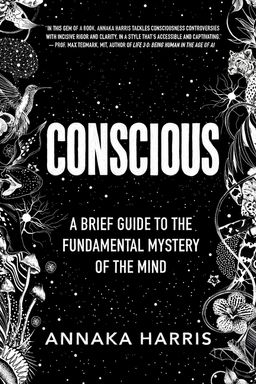
Conscious cover

Conscious

by Annaka Harris

Conscious by Annaka Harris delves into the enigma of consciousness, questioning its definition and prevalence across the universe. Through scientific inquiry and philosophical exploration, Harris challenges human-centric views, suggesting that consciousness might be a fundamental aspect of all matter.

The Astonishing Mystery of Consciousness

Why does the world feel alive from the inside? You open your eyes, take in a sunrise, and sense warmth, color, and presence—yet beneath those sensations are only particles of matter obeying physical laws. In Conscious, Annaka Harris invites you to explore one of the deepest questions imaginable: why does consciousness arise at all? Why would any arrangement of atoms—whether in a brain, tree, or star—feel like something?

Harris contends that consciousness is not a simple side-effect of brain matter lighting up; it's a fundamental and bewildering feature of reality itself. She begins by pointing out how easily we overlook the strangeness of subjective experience. From childhood, we move through life assuming the world appears exactly as we perceive it—until we pause to ask what it means that matter has an inner life. This book isn’t just philosophy—it’s a guided adventure through neuroscience, physics, and meditation, meant to shake our most basic intuitions about mind and matter.

The Core Argument: Consciousness as Experience

Harris builds on philosopher Thomas Nagel’s famous question, “What is it like to be a bat?” Her working definition is beautifully simple: an organism is conscious if there is something it is like to be that organism. It feels like something to be human—but not, as far as we can tell, to be a grain of sand. That dividing line between matter that experiences and matter that doesn’t marks what David Chalmers calls the hard problem of consciousness: how and why does awareness emerge from non-sentient physical stuff?

She reminds you that the same atoms composing your body once floated in distant stars before coming together in a way that feels the world. Somewhere along that cosmic journey, matter woke up—and Harris wants you to notice just how unfathomable that awakening is.

Challenging Everyday Intuitions

Much of the book explores how unreliable our gut intuitions about consciousness can be. Evolution gave us quick instincts—good for survival but bad for philosophy. We assume people are conscious because they act like us, and plants aren’t because they don’t—but Harris shows how reaction and sensation blur those boundaries. From plants that remember touch to robots that mimic empathy, she invites you to question what kinds of behavior really require awareness.

To sharpen this examination, she uses vivid examples: Jean-Dominique Bauby, the editor of French Elle trapped in “locked-in syndrome” yet fully conscious, blinking his memoir into existence; and “philosophical zombies”—people who might look and act normally but have no inner life at all. Reflecting on these cases transforms how you think. Could a robot, a tree, or even a star have some form of consciousness invisible to us? Harris leaves the door open to possibilities that defy intuition.

Science Meets Mystery

While consciousness is central to neuroscience and psychology, Harris shows that no experiment can yet explain why it exists. She guides you through studies of free will, binding delays in perception, and split-brain phenomena—all showing that your sense of self and choice may be illusions produced by brain mechanisms. You experience the world slightly out of sync with reality; your feelings of control often arise after decisions are made beneath awareness. Consciousness, it turns out, may be less the author of life’s story and more its observer.

Panpsychism and the Wider Universe

Eventually the inquiry widens beyond neuroscience to cosmology. Harris explores panpsychism—the idea that consciousness might be intrinsic to all matter, not just brains. It sounds wild, but she reminds you that quantum physics already reveals how strange reality can be. If consciousness pervades matter the way magnetism or gravity does, perhaps the universe itself contains awareness at every level. This doesn’t mean every rock or spoon has thoughts—it suggests instead that experience may be woven into existence itself.

Why It Matters

This question isn’t academic. Harris argues that understanding consciousness—or even just appreciating its mystery—reshapes how you see everything from ethics to artificial intelligence. How we define awareness could determine whether future machines deserve moral consideration or whether damaged brains still host experience. In her warm, precise voice, Harris urges humility: our intuitions have failed before about time, space, and motion, and they may fail again about the mind.

“Humanity is young,” she writes, “and we’ve barely begun to understand our place in the cosmos. As we look outward into space, we should remember that there is a mystery right here where we stand.”

By the end, you feel what Harris hopes you will: wonder. Consciousness—this ordinary miracle that lets you question itself—is not solved science but an invitation to lifelong curiosity. The more we peer inside, the more the mystery deepens, and perhaps that, she suggests, is exactly the point.


Questioning the Reliability of Intuition

Annaka Harris emphasizes how deeply our intuitions can deceive us when it comes to consciousness. You feel certain that humans are conscious and that plants or machines are not—but much of that certainty rests on evolutionary shortcuts. Our brains evolved to sense danger, detect social cues, and make rapid judgments, not to answer metaphysical questions.

The Elevator Intuition

She begins with visceral examples: the uneasy feeling when stepping into an elevator with someone who seems off, a sensation of threat without any cognitive reasoning. Your body is reading subtle markers—flushed skin, dilated pupils—without conscious awareness. Intuition saves lives, but it also leads to false beliefs. Evolution equipped us for survival, not objective truth.

Plants, Perception, and False Boundaries

Harris explores scientific research suggesting that plants perceive and respond to their environment in startlingly complex ways. Botanist Daniel Chamovitz found that plants sense light, touch, and temperature, even using electrical and chemical signals analogous to animal neural activity. The Venus flytrap measures touches before closing, ensuring efficient hunting. Trees communicate underground through mycorrhizal networks, exchanging carbon and chemical signals, as described by ecologist Suzanne Simard. These facts blur our intuitive divide between the conscious and the nonconscious.

Behavior Doesn’t Guarantee Consciousness

You might assume that reacting to danger or caring for offspring requires awareness, yet plants display these behaviors too. Harris points to the problem: behavior alone doesn’t prove or disprove consciousness. Artificial intelligence may soon mimic empathy or pain (“Please stop—it hurts when you do that!”), but that doesn’t mean AI feels anything. As with Google’s algorithms that suggest who to CC in your next email, sophisticated behavior often emerges from simple data patterns without subjective experience.

“Both conscious and nonconscious states,” Harris writes, “seem to be compatible with any behavior.”

Philosophical Zombies and the Collapse of Certainty

To dismantle the illusion further, Harris introduces David Chalmers’s “philosophical zombie”—someone who looks and acts exactly like you but has no inner life. Could such a person exist? Daniel Dennett argues no; Chalmers says maybe. Imagining this helps you see the emptiness of behavioral evidence. Once you picture loved ones acting without awareness, you confront how arbitrary your divisions between “mindful” and “mindless” entities really are.

By guiding readers through locked-in syndrome, anesthesia awareness, and plant communication, Harris dismantles the everyday assumption that consciousness depends on certain visible responses. You walk away realizing that intuition, though vital for life, is unreliable for understanding reality’s deepest layer.


The Illusion of Free Will

We tend to believe we’re steering the ship of our lives—that each choice we make springs from a conscious self directing the body. Harris argues this comforting feeling is mostly illusion. Experiments in neuroscience show that decisions arise in the brain before you become aware of making them.

The Brain Decides Before You Do

In Benjamin Libet’s classic experiments, subjects watched a clock and reported the exact instant they decided to move a finger. The brain’s readiness potential—the burst of neural activity preceding motion—occurred half a second before their conscious decision. Later studies with fMRI and single-neuron readings extended this window even further. Conscious will follows brain activity, not the other way around.

The Ouija Board Effect

Psychologist Daniel Wegner demonstrated that people can be tricked into believing they caused actions they didn’t perform. By playing sounds of object names just before participants were forced to move computer cursors by a confederate, subjects reported they had chosen those moves. The feeling of agency was easily fabricated. Harris uses this to show that consciousness often misattributes authorship to the brain’s automatic behavior.

Ethics Without Illusion

Does rejecting free will wreck morality? Harris argues no. We can still hold people responsible, just as we repair malfunctioning self-driving cars. The moral importance lies in understanding causes and preventing harm, not imagining a ghostly “self” floating free from physics. Consciousness is essential to ethics because suffering requires experience, but it may play no causal role in generating behavior.

“Consciousness may not steer the ship,” Harris writes, “but it bears witness to the voyage.”

Through introspective exercises—choosing between moving your arm or foot—Harris helps you see decisions simply arise. You observe thoughts as delivered, not authored. The insight is unsettling but liberating: what you call “self” is not a controller but an observer intertwined with countless physical and biological causes.


When Consciousness Is Along for the Ride

Building on the illusion of free will, Harris explores how consciousness so often trails behind behavior instead of guiding it. To test this, she turns to nature’s paradoxes—parasites, bacteria, and manipulation.

Parasites and Hijacked Minds

Consider Toxoplasma gondii, a parasite that rewires rats to seek out cats, ensuring its reproductive success. It lodges in their brains, triggers dopamine surges, and erases fear. Human infections likewise change personality traits—men become more rebellious, women more sociable—often without awareness. These examples crush our sense that desires and emotions are purely “ours.” Consciousness may observe such shifts but doesn’t prevent them.

Unseen Forces Behind Behavior

From crickets compelled to drown themselves for aquatic worms to ants nurturing butterfly larvae with fake chemical signals, evolution teems with puppetry. Harris uses these case studies to ask whether any of our own behaviors are truly self-directed. If tiny parasites can rewrite mammalian instincts, how separate are we from them? Consciousness may be less a ruler than a witness to biochemical games.

The Feedback Loop Exception

Yet Harris concedes one possible function of consciousness: the ability to reflect on consciousness itself. A zombie could simulate emotion, but it couldn’t sincerely wonder what experience is. The very act of introspection changes brain activity—a feedback loop where awareness affects thought. Contemplating the nature of consciousness may be the only behavior requiring conscious experience.

Taken together, these biological stories dismantle egoic confidence. Your emotions, choices, and personality can be manipulated chemically or biologically, leaving consciousness to watch helplessly. Harris’s phrase—“along for the ride”—perfectly captures the humbled awe she wants you to feel by the end.


The Illusion of Self and Split Brains

Who exactly experiences consciousness? Most of us imagine a unified “I,” a stable vantage point inside the mind. Harris dismantles this illusion through neuroscience, meditation, and surreal experiments on split-brain patients.

Binding: The Brain’s Editing Trick

When you strike a piano key, you think your sight, sound, and tactile feedback occur together. In reality, they reach your brain at different times. The brain synchronizes this data—a process called binding—to create the illusion of a seamless present moment. Sometimes binding fails, revealing the mind’s artifices. You might jump before hearing a crash or perceive actions out of sequence. Without binding, consciousness would be disconnected sensations, not a coherent self in time.

Meditation and Psychedelics: Dissolving the Self

Through mindfulness and substances like LSD or psilocybin, people often report losing their sense of personal identity yet remaining fully conscious. Neuroscientists find that the brain’s “default mode network,” responsible for self-reference, quiets during these states. As Michael Pollan notes, consciousness persists even when “the self disintegrates.” This shows that awareness doesn’t depend on identity—it can exist without an “I.”

Split-Brain Experiments

Michael Gazzaniga's research on patients whose brain hemispheres were severed reveals two centers of consciousness in one head. The left side, responsible for speech, invents explanations for behaviors initiated by the right—like getting up to walk and claiming thirst caused it. Harris describes this interpreter phenomenon to show how the sense of agency and unity are mental fictions. Each hemisphere acts as a distinct subjective island, possibly both conscious.

“Consciousness,” she writes, “is not a bird hovering above the brain, but a tree with roots deep inside it.”

By the end, Harris leaves you with an eerie thought: perhaps even in intact brains, multiple centers of consciousness coexist. The “I” you feel may only be one stream among many. Meditation offers glimpses of this plural awareness—a field of experience not bound to any owner.


Panpsychism: Consciousness Everywhere

Having stripped away the illusions of self and control, Harris invites you to consider the most radical possibility of all: that consciousness permeates everything. This idea, known as panpsychism, encounters ridicule but might be the simplest solution to the hard problem.

From Atoms to Awareness

Science explains behavior from the outside but never the inner feel. Panpsychism proposes that this inner dimension accompanies matter inherently, the way gravity accompanies mass. Philosophers like Philip Goff and Galen Strawson argue that denying consciousness in matter creates an unexplained leap—from dead atoms to living experience. If some matter (your brain) can feel, perhaps all matter has an infinitesimal capacity for feeling.

Modern Scientific Voices

Harris surveys physicists and neuroscientists—from J. B. S. Haldane to Christof Koch—who see consciousness as possibly fundamental. Koch even imagines bacteria or cells possessing minimal experience. Giulio Tononi’s “integrated information theory” tries to measure consciousness through complexity, while others liken awareness to the Higgs field: omnipresent, undetectable except through its effects.

Dispelling Misconceptions

Panpsychism doesn’t claim rocks have thoughts or agendas. It suggests merely that there’s something it’s like to be every system of matter, no matter how faint. Our human minds are one elaborate expression of that universal property. As Harris warns, conflating this idea with mysticism—“my ficus tree speaks to me”—misses its scientific intent. Consciousness could be as natural as electromagnetism.

Harris doesn’t assert panpsychism as truth but as a worthy hypothesis. It honors simplicity, consistency, and openness, asking science not to dismiss what intuition finds strange. If consciousness saturates the cosmos, you—like everything else—aren’t separate from it but made of its light.


Beyond Panpsychism and Toward Wonder

After defending panpsychism’s legitimacy, Harris acknowledges the vast unknown that remains. Perhaps consciousness in all matter is real; perhaps it emerges only in brains. Either way, the mystery endures—and she argues that embracing it is not failure but progress.

The Limits of Knowing

Philosopher Rebecca Goldstein notes that science may never fully grasp consciousness, since method and mathematics deal in measurable relations, not intrinsic qualities. The subjective aspect of reality might simply resist all quantification. Harris accepts this with grace: some mysteries illuminate more by contemplation than by solution.

Ethics and Artificial Minds

Still, questions of consciousness have urgent moral stakes. As AI systems grow more advanced, deciding whether they truly feel becomes a moral frontier. If we discovered they did, our obligations would multiply—empathy expanding beyond biology. Yet for thermostats or electrons, Harris cautions, notions of happiness and suffering don’t apply. The work of neuroscience on anesthesia and brain injury remains most immediate for minimizing harm among beings like us.

Wonder as the Final Lesson

In closing, Harris returns to the childlike awe that motivated her inquiry—the joy of seeing ordinary reality anew. She compares consciousness to time: ever-present yet elusive, measurable yet inherently mysterious. Whether the mind is local or cosmic, the right attitude is humble curiosity. Murray Shanahan’s words summarize her ethos: “To situate human consciousness within a larger space of possibilities is one of the most profound projects we can undertake.”

Harris ends on a hopeful note: mystery isn’t a lack of clarity—it’s an invitation. Wonder itself, she suggests, may be consciousness recognizing its own infinite depth.

When you look up at the night sky, Harris reminds you, remember: you’re not outside the universe staring in. You are part of it—matter that wakes up and asks what it means to be.

Dig Deeper

Get personalized prompts to apply these lessons to your life and deepen your understanding.

Go Deeper

Get the Full Experience

Download Insight Books for AI-powered reflections, quizzes, and more.