
Idea 1
Building Exceptional Relationships That Transform Your Life
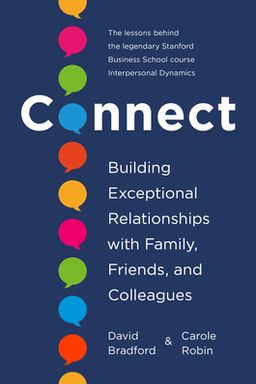
When was the last time you felt truly known by someone—not just the version you present online or at work, but the real you, with your fears, quirks, and hopes? In Connect: Building Exceptional Relationships with Family, Friends, and Colleagues, Stanford professors David Bradford and Carole Robin argue that deep connection isn’t an accident—it’s a set of learnable skills. Drawing on decades of experience teaching Stanford’s legendary “Touchy-Feely” course (officially, Interpersonal Dynamics), they share how to create relationships that don’t just function but flourish—what they call exceptional relationships.
Bradford and Robin contend that exceptional relationships are defined by six hallmarks: you can be more fully yourself, both parties are willing to be vulnerable, you can trust that disclosures won’t be used against you, honesty is the norm, conflicts are handled productively, and you’re each committed to the other’s growth. Sound aspirational? Perhaps. But through research-based frameworks and vivid stories of friendships, romantic partnerships, and workplace connections, they show how anyone can move from surface-level contact to mutual transformation.
From Surface Contact to Authentic Connection
The authors view relationships on a continuum: at one end lies minimal contact—polite, efficient, and safe; at the other are deep, authentic bonds where both people are fully known. The challenge is how to move along that continuum. Many people assume it takes unique chemistry or luck, but Bradford and Robin argue it’s about deliberate learning. Modern culture, they suggest, confuses exposure with intimacy—oversharing online is not the same as revealing your real self to someone who matters. To reach exceptional connection, you must combine self-disclosure with curiosity, feedback, and a willingness to manage conflict rather than flee from it.
The book’s structure mirrors a developmental journey: Part I (“Getting to the Meadow”) introduces foundational interpersonal skills through stories of friends, lovers, and colleagues learning to trust and disclose. The authors share scenarios like Elena and Sanjay, work friends who risk openness, and Maddie and Adam, a couple trying to rebalance influence in their marriage. Part II (“Tackling the Summit”) explores advanced challenges—entanglement, boundaries, and recovery when even good relationships falter. Each story builds on the previous lessons, showing not just the theory but the awkward, brave, incremental work it takes to connect deeply.
Why This Matters More Than Ever
In an era of digital interaction and emotional busyness, Connect feels like a manual for rehumanizing our relationships. The authors note that while intelligence and skill are prized in workplaces, emotional intelligence is what sustains fulfillment and leadership effectiveness. At Stanford, over 85% of MBA students take the “Touchy-Feely” course, not to get better at business—but to learn to be better humans. They report that the lessons often “save careers and marriages.” That same power is distilled here for anyone, whether you’re a parent, friend, leader, or partner.
The book also reframes vulnerability as strength. Bradford and Robin reject the myth that emotional exposure weakens authority. Instead, they show how showing your humanity builds trust. This echoes Brené Brown’s research on vulnerability and Daniel Goleman’s work on emotional intelligence—but Bradford and Robin go further by translating those ideas into everyday relationship mechanics: how to give feedback without attack, how to share emotions without manipulation, and how to meet others emotionally without rescuing or fixing them.
A Learning Mindset for Relationships
Perhaps the most empowering message is that deeper relationships require a growth mindset. The authors introduce their favorite acronym: “AFOG”—another f***ing opportunity for growth. Mistakes, misunderstandings, and even ruptures aren’t failures; they’re invitations to learn. They demonstrate this vividly in their personal story—how their own exceptional professional partnership nearly collapsed when trust was broken, and how, after painful reflection and repair, it became stronger than ever. Their vulnerability in admitting missteps underscores the book’s core philosophy: anyone can learn these skills, but only through courageous practice.
Ultimately, Connect argues that exceptional relationships are not a luxury or rarity. They’re the foundation of a meaningful, productive, and joyful life. Drawing from psychology, sociology, and decades of teaching, Bradford and Robin invite you to step beyond politeness into authenticity—to replace self-protection with curiosity, compliance with courage, and avoidance with learning. The climb to connection may be steep, but at the summit you find something extraordinary: the freedom to be fully known, loved, and accepted.