
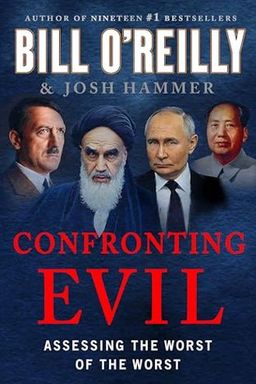
Confronting Evil cover

Confronting Evil

by Bill O'reilly,Josh Hammer

O'Reilly and Hammer profile some of history's nefarious characters.

How Evil Organizes and Scales

How do ordinary tools of administration, logistics, and belief become engines of mass cruelty? This book argues that evil is not just monstrous intent; it is intent fused to organization. The author defines evil as intentional harm without remorse, then shows you how it scales when leaders align ideology, bureaucracy, logistics, and incentives. From Genghis Khan's steppe campaigns to Hitler's rail-bound Final Solution, from Stalin's NKVD purges to the Islamic Republic's Revolutionary Guards, from slavery's auction blocks to fentanyl labs feeding cartels, you watch the same machine assemble with different parts.

The Four Motors: Ideology, Bureaucracy, Logistics, Incentives

You first see coordinated brutality in the 2023 Be'eri massacre: 150 attackers, flex-cuffs, vans, body-count reporting, and commanders giving extraction orders. That scene mirrors an older pattern: organization converts cruelty into throughput. Ideology dehumanizes targets (Hitler's racial law, Khomeini's heresy doctrine, Mao's class enemies). Bureaucracy routinizes tasks (Eichmann's transport schedules, Beria's arrest quotas, Franklin & Armfield's ledgers for human beings). Logistics move violence at scale (Mongol tumens, Nazi railways, cartel tunnels). Incentives reward perpetrators for 'performance' (careerism in totalitarian states, profits in slave and drug markets).

From Spectacle to System

The narrative moves from vivid episodes to systems thinking. Caligula's amphitheater killings and Henry VIII's scaffold justice show how a ruler's vice can hijack institutions. Genghis Khan at Merv illustrates deterrent terror as policy, where depopulation, resettlement, and trade capture align in a single design. Nazi Germany turns ideology into spreadsheets at Wannsee, proving that modernity enables murder when ethics exit administration (recall Hannah Arendt's 'banality of evil'; the book offers your case files). Stalin's order 'Not one step back' and his Great Terror demonstrate the fusion of paranoia and paperwork.

Revolutionary and Theocratic Rewiring

Mao's China shows industrial planning weaponized against its own people. The First Five-Year Plan punishes truth-tellers, the Great Leap Forward starves tens of millions, and the Cultural Revolution terrorizes a generation through youth militias and struggle sessions. Khomeini's Iran teaches you how religious legitimacy becomes state architecture: Jaleh Square bloodshed catalyzes revolution; the IRGC polices belief at home and sponsors proxies abroad. In both cases, rituals and narratives ('Little Red Book'; sermons from Qom and Paris) become compliance technology.

Autocracy and Crime as Governance

Putin's trajectory from KGB Dresden to Kremlin shows modern intelligence autocracy: secrecy, targeted killings, and hybrid war (Wagner in Ukraine) paired with kleptocracy. Outside formal states, markets of cruelty thrive: American slavery's auctions and transport networks normalize the sale of people; the Ku Klux Klan extends war crimes into domestic terror; robber barons profit amid lethal workplaces until antitrust bites; modern cartels convert synthetic chemistry and global logistics into mass addiction. Each case demonstrates that when profit or power trumps accountability, harm industrializes.

What You Can Do

The through-line is diagnostic and prescriptive. Recognize early signals: centralization without checks, dehumanizing language, youth militias or paramilitaries, data systems that erase personhood, and markets that commodify life. Then act where it counts: disrupt logistics and money flows; protect courts, media, and civil society; reinforce professional ethics; and confront propaganda with verified truth (compare Timothy Snyder's counsel in 'On Tyranny'). The book insists that neutrality feeds the machine: passivity equals complicity.

Key Idea

Evil scales when organization meets indifference. Break the organization and you break the scale.

By the end, you see a single architecture across centuries: leaders or enterprises redefine people as problems or inputs, then build systems to remove them. The antidote is equally systemic: law, memory, market rules, and moral courage working together.


Private Vice, Public Terror

When a ruler's private pathology captures the levers of state, cruelty becomes public policy. You meet Caligula after illness: he declares divinity, stages sadistic spectacles, and executes on whim. You watch Henry VIII transform marital anxiety into doctrinal warfare, repurposing courts and clerics to cleanse his court. These portraits show you how personal vice metastasizes through institutions when checks dissolve.

How Personality Becomes Policy

Caligula's whims do not stay private because Rome's system allows unreviewable decrees. When he dines as prisoners are sawn apart or appoints a horse to high honor, he signals that rational order has yielded to personal spectacle. Henry VIII similarly personalizes justice: the Tower of London cages enemies; treason statutes stretch to fit conscience; and the Church of England reorders theology to satisfy succession (note the echo with later leaders who bend law to desire, from Stalin's show trials to Khomeini's minute-long verdicts).

The Feedback Loop of Fear

Vice feeds insecurity, which justifies further repression. Caligula's theatrics alienate senators, birthing plots he then meets with more executions. Henry's purges inflame sectarian divides, setting the stage for Mary I's reprisals and Elizabeth I's stabilization. You learn an enduring pattern: once leaders make loyalty to self trump loyalty to law, politics devolves into courtiers reading moods rather than citizens enforcing norms (contrast with The Federalist Papers' case for ambition counteracting ambition).

Institutions Under Siege

The instrument set repeats across eras: courts reduced to stagecraft, prisons as personal dungeons, and religion as a badge of loyalty. Henry leverages Parliament to legalize private will; Caligula bends imperial ritual to showcase cruelty. This erosion habituates a populace to arbitrariness, which later autocrats exploit more efficiently with bureaucracy and police science. The jump from personalized terror to industrialized murder is smaller than it seems once law has been hollowed out.

What You Should Watch For

You should raise alarms when leaders demand fealty over legality, punish satire as sedition, rewrite rules around their private lives, or convert trials into pageants. These are early-warning indicators preceding the organized brutality you later see at Wannsee, in the NKVD basements, or in the Red Guards' rallies. Guarding institutional independence—judges, auditors, clergy, and press—protects society from the spillover of personal vice into public tragedy.

Key Idea

Unchecked personality becomes policy; unchecked policy becomes terror. Build guardrails early.

By pairing ancient Rome and Tudor England with 20th-century tyrannies, the book makes your takeaway practical: constitutional friction, transparency, and due process are not annoyances; they are shields against the conversion of private appetites into public harm.


Conquest As System

Genghis Khan's rise reframes conquest as an engineered process rather than a sequence of heroic battles. You encounter tumens of 10,000, elite training since childhood, and logistical mastery that turns mobility into policy. At Merv, the alleged order that each soldier kill hundreds, followed by the city's depopulation and repopulation, shows you terror as a calculated lever to reorganize space, economy, and psychology.

Military Design and Psychological Shock

The Mongol army merges discipline with adaptiveness: it borrows Chinese siege craft, experiments with explosives, and executes feigned retreats. That toolkit enables swift, punishing victories like Kalka River. Spectacle—the trampling of Shah Malik, mounds of skulls—functions as deterrence, broadcasting a message that resistance equals erasure (compare with Sherman’s harsh marches shaping civilian behavior, though on a smaller moral register).

Economy as a Theater of War

Conquest pays when it captures flows. Khan destroys rival trade nodes, reroutes caravans, and installs loyal administrators to tax and police the Silk Road. Violence clears the path; administration reaps the reward. That pairing prefigures later state violence where political control depends on economic capture—Stalin's collectivization crushing peasant autonomy or Nazi Aryanization seizing Jewish assets (note: both later regimes embed racism or class war as justification).

Legacy and Paradox

The Mongol world-system unlocks unprecedented connectivity across Eurasia. Yet its human bill reaches into the tens of millions, with environmental signatures in reduced atmospheric CO2 due to population collapse. You learn to hold two truths: governance and trade can expand under empire even as foundational crimes define the regime's DNA. This paradox returns in modern cases where growth and terror coexist (e.g., Mao's dams and factories amid famine; Putin's stability narrative amid assassinations).

Lessons You Can Apply

See conquest as a system with moving parts you can disrupt. Logistics—horses or trains, data lines or tunnels—are the arteries. Administrative cadres are the nervous system. Ideology is the story that quiets conscience. If you want to prevent modern Mervs, interrupt the arteries, replace the cadres, and counter the story with facts and shame. The book's opening at Be'eri echoes this: attackers imported a military template into a village; prevention requires breaking such templates before they launch.

Key Idea

Where violence becomes a process, deterrence and administration partner to remake the map—and people pay the price.

By drawing a line from Mongol shock-and-awe to 20th-century total wars, the book equips you to spot system-builders behind atrocities and to think in terms of levers, not just villains.


Bureaucracy Of Genocide

The Holocaust teaches you how a modern state converts prejudice into production. Hitler's consolidation through the Night of the Long Knives removes internal rivals and hands discipline to the SS. At Wannsee in 1942, officials plan mass murder with memos, minutes, and rail timetables. This is genocide as workflow: categorize, deport, select, and exterminate—administered by men whose job descriptions hide the moral core of their tasks.

From Pogrom to Process

Pre-Nazi Europe knew anti-Jewish violence, but the Nazis elevate it into state priority. Laws define Jews, Aryanize property, and assign police and railways functional roles. Auschwitz and its peers become industrial nodes receiving human cargo. That bureaucratic segmentation—rail clerks, camp accountants, guards—dilutes personal culpability while maximizing throughput (Arendt's insight appears again: the 'banal' official becomes a cog in an ethical void).

Complicity and Distance

Not every perpetrator waves a flag; many punch a clock. The system invites self-justification: 'I ran trains, I did not kill.' Yet the aggregate kills. The book underscores survivors and numbers: 1.4 million deported to Auschwitz, mere thousands alive at liberation; ghettos liquidated on schedules; children sorted on arrival. Eichmann's postwar capture and trial reveal the clerk's mind—process proud, conscience absent.

Technology Without Ethics

Modernity's tools—paper, punch cards, chemistry, communications—serve any master. When authority defines humans as pests, the same ingenuity that builds bridges can design gas chambers and optimize timetables. You should read this as a professional warning: your craft needs an ethical spine or someone will fit it to an atrocity (compare with contemporary risks in surveillance AI when dissent becomes 'extremism').

What You Can Do

Build friction where systems erase conscience. Strengthen professional oaths, whistleblower routes, and independent oversight. Teach historical specificity to inoculate against euphemism. When a memo reduces people to categories, ask who benefits and who disappears. The book ties this vigilance to every other chapter: the same administrative habits reappear in Stalin's quotas, Mao's grain seizures, and even in the accounting of slave traders and cartel logisticians.

Key Idea

When paperwork hides people, atrocity finds cover. Ethics must interrupt process.

By following the Nazi archive from conference table to crematoria, you learn how to read administrative language as a moral early-warning system.


The Totalitarian Playbook

Across Stalin's USSR, Mao's PRC, Khomeini's Iran, and Putin's Russia, you see a repeated manual for power: purge rivals, build extralegal enforcers, control information, weaponize law, and normalize fear. These regimes differ in ideology—Marxist, theocratic, nationalist—but converge on method because the method works: it breaks trust, isolates opponents, and makes survival contingent on obedience.

Purge and Terrorize

Stalin's Great Purge decapitates the party and army, while Beria's NKVD routinizes torture and quotas. Mao stages mass arrests; firing squads fill Chengdu's graves. In Iran, swift tribunals execute officials like Farrokhroo Parsa. In Russia, inconvenient critics meet poison or blasts: Dmitry Kholodov, Alexander Litvinenko. Each case signals that the sovereign can erase you quickly and publicly (a lesson as old as Caligula, now amplified by modern policing).

Paramilitaries and Youth Militias

When ordinary forces feel constrained, regimes outsource coercion. Mao unleashes the Red Guard—tens of millions bent on 'purity.' Iran formalizes the IRGC and Basij, fusing faith and force. Putin leverages Wagner, projecting violence abroad with deniability. These actors blur state lines, making accountability harder while increasing terror's reach.

Information Control and Cults

Propaganda saturates daily life: portraits of Stalin, Mao's quotations, the Ayatollah's sermons, and Kremlin media narratives. Dissent becomes heresy or treason; truth becomes what the leader says it is. The point is not persuasion alone; it is isolation. When you cannot trust news, neighbors, or archives, you self-censor. That is the victory.

Law as Weapon, Not Shield

Vague statutes criminalize thoughts. 'Anti-revolutionary,' 'insulting religion,' or 'foreign agent' charges allow arbitrary arrests. Show trials mimic justice, then erase it. Files and forms cloak vengeance in legality, making the brutal appear procedural (recall the Nazi playbook; the technique travels well).

Why It Works—and Countermoves

This playbook works by atomizing society: every person calibrates to the leader's shadow, telling smaller truths to avoid larger punishments. To counter it, the book urges: protect independent courts and media, decentralize power, fund civic groups, and keep professional ethics strong. Naming patterns early is crucial; autocracies harden quickly once these tools lock in (Snyder's 'do not obey in advance' applies here).

Key Idea

Totalitarianism is less an ideology than a toolkit. Learn the tools to blunt their force.

Reading these chapters as one manual equips you to identify creeping authoritarianism before it sprints.


Mao’s Ambition, Mao’s Catastrophe

Mao Zedong channels eclectic study—Smith, Sun Tzu, Marx—into a singular goal: total transformation at speed. The People’s Republic nationalizes industry, suppresses religion and speech, and centralizes reporting, then punishes anyone who reports reality. The result is a regime that plans in slogans and governs by fear, with cascading consequences from the 1950s to the 1970s.

Five-Year Plan: Perverse Incentives

Mao's First Five-Year Plan demands one century of growth in five years. That impossible mandate creates lies as currency: cadres exaggerate yields; Beijing requisitions grain based on fiction; peasants starve. You meet families like Li Wei's, boiling rats while granaries flow to quotas. The system punishes truth, so errors compound—what engineers call a positive feedback loop to failure (James Scott's 'Seeing Like a State' supplies a useful parallel).

Great Leap Forward: Industrial Fantasy, Human Tragedy

Communes melt pots into backyard furnaces; agriculture loses hands; famine follows. Between 1957 and 1961, roughly forty-five million die of starvation, disease, and violence tied to policy and its cover-ups. This is not mere misfortune; it is engineered scarcity sustained by repression and deceit. When the center devours truth, it inevitably devours people.

Cultural Revolution: Ritualized Humiliation

To reclaim ideological primacy, Mao launches the Cultural Revolution. The Red Guard—thirty million strong—targets the 'Five Olds.' Professors endure struggle sessions; families denounce kin; Confucian sites burn. Cities ship the young to the countryside to 're-educate,' where exposure and hunger claim thousands. Public shaming becomes pedagogy; loyalty to Party replaces all other ties.

Mechanisms and Lessons

Four mechanisms drive the catastrophe: centralized targets divorced from ground truth, suppression of feedback, mobilized youth to police thought, and a cult that equates dissent with treason. The lesson is blunt: high-modernist schemes without humble institutions will kill (Scott again). To build responsibly, you need independent data, protected dissent, and leaders who accept limits and error-correction.

Key Idea

Ambition without feedback becomes annihilation. Protect truth to protect lives.

Mao's chapters offer more than condemnation; they give you a control chart for reform: decentralize targets, incentivize honesty, stop politicizing famine relief, and never arm youth against their elders in the name of purity.


Revolution By Scripture

Ayatollah Khomeini's revolution shows you how religious authority can become a revolutionary operating system. The spark is blood: Jaleh Square, where the Shah's forces fire on crowds and kill clerics like Abdul Hossein Dastgheib. Exile becomes a broadcast booth as Khomeini uses French platforms to choreograph dissent. When the Shah flees, the Ayatollah returns not as a politician but as a supreme jurist, reformatting Iran's constitution around clerical sovereignty.

Domestic Consolidation: Faith as Law

Courts pivot to religious offense; public executions, stonings, and amputations normalize fear. Women and minorities face narrowed rights; political opposition shrinks. Farrokhroo Parsa's case—arrest, torture, shooting after a rushed trial—embodies the regime's speed and severity. The message: divine law as interpreted by the supreme leader overrides modern legal guarantees.

Foreign Policy: Proxies and Pride

The IRGC grows into a state within a state, exporting revolution through Hezbollah and Hamas. Funding, training, and rockets flow; attacks abroad signal reach. The 1979 US embassy seizure becomes theater and leverage, with hostages released to humiliate one president and greet another. Iran casts itself as the vanguard of anti-imperial Islam, embedding conflict into identity.

Why It Endures

Revolutions endure when they deliver identity, welfare to loyalists, and coercion against dissenters. The theocracy's social base includes clerical networks, paramilitaries, and patronage. Elections exist but within red lines. Information control, morality policing, and sanctions-driven siege narratives fortify the regime against internal critique (similar to how Stalin used external threat to justify repression).

Your Takeaways

When religious charisma fuses with state power, the space for compromise collapses. You should track three indicators: creation of parallel military structures (IRGC), legal redefinition of dissent as blasphemy, and external proxy wars as regime stabilizers. Policy responses must pair rights advocacy with strategies that cut financing and constrain proxies without unifying the regime around nationalist grievance.

Key Idea

A theocracy operationalizes faith into force at home and abroad; counter it with rights, pressure, and smart containment.

This chapter complements the secular autocracy of Putin and the ideological zeal of Mao, reinforcing the book's point: different creeds, same mechanics.


Intelligence Autocracy

Vladimir Putin personifies the modern security-state ruler who blends espionage, crime, and war. In Dresden, he learns to burn files, threaten crowds, and extract confessions. In Moscow, he converts that tradecraft into governance: co-opt or crush oligarchs, build a compliant media, and weaponize law while reserving poison and bullets for hard cases.

From Silovik to Sovereign

Putin rises through municipal deals, then the FSB, then the presidency. The state monetizes loyalty: allies grow vast wealth; enemies lose assets or lives. Car bombs silence reporters; polonium kills a defector in London. The line between state and mafia blurs, with protection rackets dressed as tax enforcement or anti-corruption drives.

Hybrid War and Plausible Deniability

Abroad, Putin practices maskirovka: little green men take Crimea; mercenaries test red lines in Donbas and Africa. The 2022 invasion of Ukraine strips away euphemism, revealing conventional aggression backed by propaganda. Wagner becomes both sword and shield, projecting power while buffering accountability (until mutiny exposes the bargain's fragility).

Wealth, Paranoia, and Fragility

The regime accumulates staggering hidden wealth and compounds of isolation. Sanctions narrow options; reliance on China and Iran deepens. Paranoia expands purges; suspicious crashes follow betrayals. This is stability by stasis: strong until cracks align, then brittle (recall late USSR dynamics; see also autocracy's succession problem).

Implications for You

You should treat intelligence autocracies as adaptive predators. Counter with transparency, financial tracing, energy diversification, and resilience against disinformation. Support exiled media and civic sanctuaries. Expect legal façades; document meticulously for accountability. The book's message is sobering but empowering: pattern recognition turns shock into strategy.

Key Idea

When spies rule, secrecy, violence, and theft become policy. Expose flows, harden democracies, and deny deniability.

By situating Putin with Stalin's apparatus and Khomeini's proxies, the book maps a 21st-century ecosystem of coercive states working in tandem.


Markets Of Cruelty

Not all mass harm flies a flag. Some of the book's most searing chapters show markets weaponized against people. American slavery functions as an industry: ships like the 'United States' move human cargo to New Orleans; auctions price men, women, and children; Franklin & Armfield's ledgers track profits while law shields the trade. After war, the Ku Klux Klan converts racial hatred into organized terror to suppress Black political power, while politicians look away or collude.

Commerce Without Conscience

Slave pens, inspection rituals, forged complexions, and forced overeating reduce humans to inventory. Southern lawmakers defend the system; Congress gags debate. Wealth flows to banks that outlast abolition, proving how profits outlive perpetrators. Monuments to Nathan Bedford Forrest, a slave trader turned Klan icon, illustrate how commemoration can launder violence into heritage.

Industrialists and Disposable Labor

Later, robber barons amass fortunes atop dangerous jobs: miners die in avoidable explosions; refinery workers perish without compensation. Antitrust under Theodore Roosevelt—Northern Securities broken, Standard Oil dismantled—shows the state can check predation, though philanthropy later cannot erase origins of wealth. Regulation, inspections, and worker rights emerge as partial remedies.

Cartels and Synthetic Plagues

Modern cartels perfect harm as enterprise. El Chapo's Sinaloa builds tunnels, bribes officials, and scales distribution with fentanyl—a synthetic opioid sourced from overseas precursors. Overdose deaths mount; you meet victims like Francine Doermann, dying under an overpass while the supply chain hums on. Capturing a kingpin barely dents demand; splinters sharpen violence.

Shared Mechanics and Remedies

These markets share three traits: legal cover or weak enforcement, financial plumbing that sanitizes proceeds, and narratives that normalize cruelty (property rights over people, 'jobs' over safety, 'personal choice' over addiction engineering). Remedies must mirror the system: robust labor and safety law, antitrust vigor, beneficial-ownership transparency, sanctions on complicit banks, cross-border precursor controls, and serious demand reduction.

Key Idea

When profit detaches from personhood, atrocity becomes a business model. Change the incentives and the plumbing.

By linking slave auctions to cartel labs and sweatshops to refineries, the book gives you a unified field theory of market-enabled harm—and a checklist to fight it.


Interrupting Organized Evil

The afterword sharpens the book's thesis into a tool you can carry: evil equals intentional harm plus lack of remorse. That clarity strips away relativism and spotlights action. Because modern tools magnify reach—encrypted messaging, cheap synthetics, surveillance—your countermeasures must be equally systemic and equally fast.

Map the System, Not Just the Sinner

Start with structure: who supplies ideology, who moves bodies or drugs, who keeps the books, who enforces silence? In Be'eri, that map runs from commanders to drivers; in Auschwitz, from Eichmann to station masters; in Mao's famine, from central planners to local cadres; in cartels, from chemists to launderers. Break any essential link and you reduce harm.

Fortify the Bulwarks

Independent courts, free press, civic groups, and professional ethics are your levees. Fund, protect, and celebrate them. Teach institutional memory—what happened at Merv, in the Gulag, at Wannsee—so that euphemisms trigger alarms. Encourage whistleblowing and safeguard truth-tellers; design metrics that reward honest reporting (the inverse of Mao's incentives).

Target Logistics and Money

Seize assets, sanction enablers, and regulate precursors. Police tunnels and vans as fiercely as you police speeches. Use beneficial-ownership registries, real-time customs data, and treaty-based cooperation to strangle the flows that scale harm (lessons from antitrust and counter-cartel work both apply).

Shape Norms and Memory

Remove monuments that glorify perpetrators; build ones that honor victims and resisters. Ritualize remembrance to keep bureaucratic language from sterilizing trauma. Teach that passivity is a choice with consequences. The book quotes a Mill-like warning: when good people do nothing, machinery fills the silence.

Key Idea

Confront narrative, organization, and finance together. That is how you shrink evil's footprint.

Ultimately, the book hands you a disciplined lens: identify organized harm quickly, strip its alibis, and act where friction multiplies—courts, media, logistics, finance, and memory. In a world where technology speeds both virtue and vice, speed your defenses too.

Dig Deeper

Get personalized prompts to apply these lessons to your life and deepen your understanding.

Go Deeper

Get the Full Experience

Download Insight Books for AI-powered reflections, quizzes, and more.