
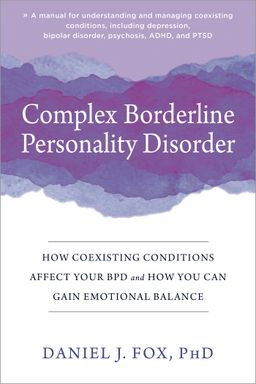
Complex Borderline Personality Disorder cover

Complex Borderline Personality Disorder

by Daniel J Fox

Complex Borderline Personality Disorder by Daniel J Fox unravels the intricacies of this multifaceted mental health condition. It offers guidance on managing intense emotions, understanding co-occurring issues, and fostering resilience. This book empowers readers and their loved ones with strategies for emotional balance and healthier relationships.

Understanding Complex Borderline Personality Disorder

How can you make sense of emotions that seem to swing without warning, relationships that feel both essential and exhausting, and inner pain that refuses to quiet down? In Complex Borderline Personality Disorder: How Coexisting Conditions Affect Your BPD and How You Can Gain Emotional Balance, psychologist Daniel J. Fox argues that Borderline Personality Disorder (BPD) is not just one thing—it’s often a web of overlapping psychological struggles that can only be untangled when we see the whole picture. Many people diagnosed with BPD also experience depression, anxiety, post-traumatic stress, ADHD, or bipolar disorder; together, these layers form what Fox calls Complex BPD (CBPD).

Fox’s central claim is empowering: BPD is real, treatable, and understandable. But gaining emotional balance requires knowing which symptoms come from BPD itself and which from co-occurring conditions. This knowledge, he insists, is the path to wellness—because knowledge is empowerment. Fox uses real-world examples—clients like Pam, Martin, Wendy, Ray, Annalise, Shelly, Karen, and Malcolm—to illustrate how misdiagnoses and fragmented treatment often leave people feeling hopeless. Through their stories, he shows how CBPD disrupts life’s patterns and how awareness and skill-building can help regain control.

The Core Argument: Complexity Creates Confusion

Fox contends that BPD isn't a simple trait disorder but a multi-layered system of emotional instability driven by both personality factors and co-occurring conditions. Because of symptom overlap—such as between depression and BPD sadness or between bipolar mania and impulsivity—patients often end up misdiagnosed or receive treatment that addresses only surface behaviors. Medication, he explains, can help with mood swings or anxiety (the surface structure) but can't reach core feelings like emptiness or abandonment (the core content). The book challenges the idea that people with BPD are ‘manipulative’ or ‘untreatable’ and reframes their struggles as survivorship behaviors learned in invalidating environments.

Why This Matters

Many people with BPD feel isolated and stigmatized, often believing their pain is unchangeable. Fox emphasizes that nearly 6 percent of the adult U.S. population has BPD, affecting men and women equally, despite common myths that it’s a “women’s disorder.” By validating readers’ experiences and offering practical self-assessment exercises, Fox bridges clinical expertise and self-help guidance. His message is clear: you are not broken—you are complex.

From Knowledge to Action

The book’s structure mirrors a treatment plan. First, Fox outlines what personality is and how traits like Neuroticism or Agreeableness influence everyday behavior. He then explains what makes personality disordered—essentially, inflexibility and maladaptive coping—and introduces the concept of CBPD. Subsequent chapters explore how BPD interacts with other conditions: bipolar disorder (chapters 3–4), depression (5–6), psychosis (7–8), ADHD (9–10), and PTSD/C-PTSD (11–12). Each section pairs medical education with practical “Consider This” exercises to build awareness and coping skills. The later chapters help readers synthesize this knowledge, identify their ten most disruptive symptoms, and create personalized growth plans. The final chapter focuses on finding suitable professional help and avoiding treatment pitfalls, such as assuming medication alone is enough or fearing therapy relationships due to abandonment sensitivity.

The Promise of Integration

Fox proposes integration—the blending of insights from psychiatry, personality psychology, trauma research, and behavioral therapy—as the real key to healing. He encourages readers to use a CBPD journal to track symptoms, emotions, triggers, and progress. By doing so, readers move from being passive patients to active participants. The work culminates in self-understanding: identifying patterns that stem from genetics, abuse, or invalidating family environments, and learning how these factors create emotional vulnerability. Through exercises like journaling five personality factors or rating distress levels for each symptom, Fox transforms psychological theory into hands-on self-exploration.

Why Fox’s Perspective Stands Out

Fox joins figures like Marsha Linehan (creator of DBT) and Judith Herman (trauma theorist) in reframing borderline personality disorder as a treatable journey rather than a diagnostic dead end. His concept of CBPD builds a bridge across specialties, recognizing that treatment-resistant cases often suffer not from untreatable personality flaws but from unrecognized comorbidities. (Note: This echoes Linehan’s biosocial theory and Gunderson’s relational models of BPD, integrating both into a self-help format.)

For readers living with BPD or supporting someone who is, Fox offers a compassionate roadmap. He argues that healing begins with understanding complexity—not fearing it. When you learn to identify the overlapping conditions that shape your behavior and emotions, you reclaim choice. And choice, Fox reminds us, is the first act of empowerment.


What Makes Personality Disordered

Fox begins by teaching that understanding BPD starts with understanding personality itself. Every person has a unique set of traits—Openness, Conscientiousness, Extraversion, Agreeableness, and Neuroticism. These create patterns of thinking, feeling, and behaving that give your life continuity. But when these patterns become rigid and maladaptive—when you can’t change your reactions based on your environment—they shift from personality to personality disorder.

Flexible vs. Fixed Personality

Healthy personality involves flexibility—the ability to adapt. A disordered personality is defined by inflexibility: responding the same way in sharply different situations. Fox uses simple examples: if you speak to your boss like you speak to your child during scolding, you may lose your job. Those with personality disorders, including BPD, often miss this adaptive adjustment; their emotions override situational awareness.

Clusters of Personality Disorders

Fox explains the three clusters used by psychiatry: Cluster A (odd/eccentric), Cluster B (dramatic/erratic—including BPD, narcissistic, antisocial, histrionic), and Cluster C (anxious/fearful). BPD sits in Cluster B because of its emotional volatility and relationship turbulence. Its hallmark features—unstable relationships, self-image disturbance, impulsivity, and intense emotions—lead to the confusion that often overlaps with depression, bipolar disorder, or trauma responses.

The Example of Pam

Pam’s story opens the book. Misdiagnosed multiple times across disorders, she feels rage, emptiness, and confusion. Fox uses her case to show how therapists often respond to complexity by “grabbing at diagnostic straws.” True progress occurred only when her therapist recognized that her symptoms weren’t random—they were interconnected parts of BPD. Pam learned insight-based management, not merely symptom control. Her journey makes the theoretical personal.

The Universal Symptom

Fox identifies one criterion common to all mental health disorders: socioeconomic dysfunction. This means the disorder affects your ability to sustain relationships, school, or work. It’s the dividing line between traits and disorders. People with BPD traits may struggle emotionally but still function. People with full BPD show pervasive dysfunction across life domains. This insight helps readers assess whether their symptoms signal personality difficulty or an entrenched disorder.

By connecting personality flexibility to socioeconomic functioning, Fox reframes diagnosis as a dynamic spectrum. You’re not “broken”; you’re learning to adapt flexibly again—a hopeful message echoing in therapeutic approaches like CBT and DBT.


Pure and Complex BPD Explained

Fox introduces one of his most distinctive insights: the distinction between Pure BPD and Complex BPD (CBPD). He borrows from trauma research (Judith Herman’s work on complex PTSD) to argue that most people with BPD also face co-occurring conditions—so treating them separately misses the point. Pure BPD results solely from personality dysfunction; CBPD arises when BPD interacts with depression, bipolar disorder, ADHD, psychosis, or PTSD.

Core Content and Surface Content

Fox uses Martin’s case—a man whose mix of mood instability, cheating, and self-loathing masked deep feelings of emptiness—to explain how CBPD works. Martin’s therapist noted that mood stabilizers helped his bipolar symptoms but not his emptiness. The underlying driver, his core content, involved abandonment fears and invisibility. Core content reflects deep-seated self-beliefs; surface content shows up as behaviors (like substance use or rage). Medication affects surface issues but cannot alter the core without psychological insight and new adaptive patterns.

Cycle of Symptom Dismissal

Fox coins the phrase “cycle of symptom dismissal.” Once BPD is diagnosed, everything else is blamed on it. Co-occurring disorders get dismissed, and symptoms worsen. Both clients and therapists fall into this trap. True change happens when each condition is recognized and treated together as a unified whole. Approximately 85–97% of people with BPD have at least one comorbid condition—yet most treatment models ignore this statistic.

CBPD as a Unified Map

Through exercises like the “Conditions Compass,” Fox helps readers identify which disorders contribute to their CBPD. This structured awareness prevents fragmented treatment. It’s also empowering: when you can name your combination, you can design strategies that fit your life. The message—your uniqueness is your asset—subverts stigma and turns diagnostic complexity into personal insight.

Fox’s concept of CBPD reframes confusion into clarity. Instead of feeling defective for not responding to standard BPD therapy, readers learn that multiple overlapping conditions require multi-directional healing—a realistic and compassionate approach.


The Link Between BPD and Bipolar Disorder

Fox devotes deep exploration to bipolar disorder, where manic highs and crushing lows often mimic BPD’s emotional swings. He uses Wendy’s story—from adolescence through adulthood—to show how unrecognized bipolar symptoms can distort a diagnosis. Her untreated mania led to impulsive sex, sleepless nights, and feelings of invincibility. Her depressive crashes followed with despair, hopelessness, and guilt. When properly treated, her mood stabilized, revealing underlying BPD patterns like abandonment fears and emptiness.

Timing and Triggers

The key to distinguishing bipolar disorder from BPD lies in timing and triggers. Bipolar episodes last days or weeks and aren’t tied to specific stressors. BPD mood shifts happen within hours, often triggered by interpersonal tension—like someone not responding to a message. This “identifiable stressor” principle helps clinicians and sufferers discern origins of emotional shifts.

Medication vs. Insight

Medication stabilizes bipolar disorder effectively by regulating neurochemistry. But Fox cautions that it can’t fix BPD’s core content. For instance, no drug treats emptiness or fear of abandonment. He recommends combining medication with cognitive and behavioral therapies—especially DBT and transference-focused psychotherapy—to work on emotional regulation and identity coherence.

Overlap and Practical Distinction

Both disorders feature impulsivity and mood fluctuations, but their rhythms differ. Fox teaches patients to track mood duration, context, and triggers through journaling. This “Daily Mood Tracking Worksheet” turns abstract symptom patterns into measurable data. He empowers readers to identify whether their “crashes” are depression-driven or CBPD reactions to interpersonal stress.

The takeaway: managing bipolar-related CBPD means stabilizing biology while retraining psychology. Medication opens the door, but mastery comes through awareness and practice—transforming confusion into clarity.


Depression and the Borderline Void

Depression’s partnership with BPD is the most common form of CBPD—and perhaps the most misunderstood. Fox uses Ray’s story, the artist who lay motionless in bed convinced life was “a dark, doomed hole,” to show how untreated depression merges with BPD’s self-loathing and emptiness. When Ray began exploring his feelings of abandonment and using cognitive tools, his creativity revived and his mood lifted. Fox uses this to highlight the difference between depressive disorder and BPD’s transient depressive episodes.

Two Faces of Depression

Major depressive disorder lasts two weeks or more; BPD depressions surge for hours or days. The former isn’t triggered; the latter often follows conflict or perceived rejection. By tracking duration and cause, you can tell which kind of depression you’re fighting. Both require compassion, but treatment paths differ: medication helps chronic depression, while emotional regulation skills help BPD-related episodes.

Core Content Drives Surface Despair

Ray’s depression wasn’t just biochemical—it was rooted in feeling abandoned by his father and afraid his wife would leave. Fox calls this “core content driving surface despair.” Once Ray identified these origins, he could practice self-talk that challenged his depression (“My art has value. I’m not empty.”). In doing so, he transformed automatic hopelessness into self-compassion.

Depression-Colored Glasses

Fox’s metaphor of “depression-colored glasses” shows how negative biases shape perception. Many with CBPD discount achievements and amplify perceived failures. Exercises like “Debunking My Depression” teach readers to write adaptive counterstatements and pair them with empowerment habits—simple daily actions like walking outdoors or cooking for others—that rebuild resilience.

Fox’s compassionate realism transforms depression from an identity into an experience—something you can observe, challenge, and change through structured effort and insight.


When Reality Fractures: BPD and Psychosis

Fox tackles one of the most frightening aspects of CBPD—psychotic and quasi-psychotic symptoms. He uses Annalise’s story, an attorney who began hearing voices urging suicide, to show how stress and anxiety can trigger temporary psychosis in those with BPD. Her case reveals a crucial truth: intense emotional overload can blur the line between reality and fear, especially when trauma and anxiety converge.

Psychosis vs. Quasi-Psychosis

Fox distinguishes enduring psychosis (lasts weeks, marked by fixed delusions or hallucinations) from quasi-psychotic symptoms (last minutes or hours, often stress-related illusions or derealization). BPD-related quasi-psychosis surfaces when abandonment fears reach panic level. Symptoms remit once safety is restored, unlike schizophrenia where paranoia endures.

Grounding and Reality Testing

To help, Fox teaches grounding techniques: sensory-based exercises like splash-cold-water, touching textured objects, or naming five things you see to restore present awareness. The “Distortion Pushback” technique invites readers to challenge catastrophic interpretations (“They’re all against me”) with balanced evidence (“Some people care, others disagree—both can be true”). Medication addresses surface symptoms, but personal strategies rebuild reality coherence.

Hope in Stability

Ultimately, Fox’s approach removes shame. Experiencing hallucinations or paranoia under stress doesn’t mean you’re ‘crazy’; it means your brain is overloaded by trauma-related hyperarousal. Through structure, reality testing, and continued treatment, Annalise regained equilibrium. In her success story, Fox reminds readers that insight and compassion—not fear—are the antidotes to confusion.

CBPD with psychotic features exemplifies Fox’s blend of empathy and science: clear diagnostic distinctions, practical coping methods, and unwavering belief that understanding complexity restores power.


The ADHD Connection: Racing Thoughts and Restless Energy

Fox explores how ADHD’s inattention and hyperactivity amplify BPD’s impulsivity and emotional chaos. Shelly’s story—a restless adult whose relationships and jobs crumble under disorganization—illustrates this CBPD type. Their constant movement and scattered focus concealed deeper abandonment issues, creating self-harm cycles and mistrust of help. Fox’s compassionate approach shows how intertwined inattention and emotional dysregulation fuel misunderstanding and frustration for both sufferers and therapists.

Overlap and Distinction

ADHD and BPD both involve impulsivity, but their roots differ. ADHD stems from neurodevelopmental attention deficits; BPD arises from emotional wounds and learned maladaptive coping. ADHD causes external chaos; BPD adds internal turmoil. Combined, they lead to erratic behavior that looks like rebellion but is actually exhaustion. Fox highlights that 38% of people with BPD also have ADHD—an intersection often misdiagnosed as “resistance.”

Strategies for Managing Dual Energy

Fox recommends multitiered interventions: medication for ADHD’s neurobiological symptoms plus psychotherapy for emotional regulation. He encourages “moving mindfulness” techniques—mindful walking, mindful eating, and a creative glitter-shake tool—to channel restless energy into focus. Pairing behavioral structure with emotional awareness lets clients replace chaos with rhythm.

Unblocking Growth

Shelly’s progress embodies Fox’s theme of empowerment. Through journaling, therapy, and patience, they stabilized routines and curbed self-punishment. Fox’s list of “hindrances and helpers” gives concrete habits—showing up on time, keeping planners, honoring commitments—turning deficits into strengths. His reminder: hyperactivity isn’t moral failure, it’s a signal that your mind needs new structure.

Fox’s portrayal dignifies ADHD-BPD as a solvable puzzle, not an impossible flaw. You can’t block the motor—but you can learn to steer it.


Trauma’s Echo: PTSD, C-PTSD, and Borderline Healing

Fox examines the trauma spectrum—from classic PTSD to complex PTSD (C-PTSD)—and how it intertwines with BPD to create deep emotional scars. Through Colby, Karen, and Malcolm’s shared group sessions, he demonstrates how distinct yet overlapping trauma profiles build CBPD. Colby’s combat memories led to nightmares and hypervigilance (PTSD). Karen’s childhood abuse generated shame, avoidance, and relational distrust (C-PTSD). Malcolm combined both with BPD’s emptiness and fear, capturing CBPD’s most multifaceted form.

Safety and Revelation

Trauma fractures safety; Fox’s therapeutic work focuses on rebuilding it. Exercises like identifying “What and Who of Safety” or creating a “Pillow of Comfort” retrain the body’s sense of calm. Once safety is grounded, he guides readers through revelation—writing personal trauma narratives that reframe survival as strength. “How I Survived” entries acknowledge pain without surrendering identity to it.

Splitting and Balance

BPD’s tendency to see people as all good or all bad (“splitting”) magnifies trauma distortion. Fox’s ‘De-Splitting’ exercises teach balanced thinking: replacing extremes with moderated language (“sometimes,” “could be”). This shift raises perceived control and perspective, changing suffering into possibility.

Integration and Worth

In final trauma chapters, Fox invites readers to write letters to both their wounded and recovered selves, merging them into one integrated narrative of worth. Inspired by Judith Herman’s trauma recovery model, these personal rituals affirm resilience. Malcolm’s example—moving from fragmented pain to self-recognition—shows how BPD’s emptiness can evolve into empowerment.

Fox’s trauma synthesis reframes suffering as the birthplace of agency. Healing is not forgetting—it’s remembering differently, with compassion and choice.


Turning Insight into Action: From Awareness to Therapy

Fox concludes with the crucial next step: finding professional help that aligns with your growth. Because CBPD spans multiple diagnoses, therapy must be collaborative and proactive. Fox redefines the client’s role—active, not passive. You’re not a patient waiting for fixes but a participant employing knowledge and practice. The final chapter bridges self-help to professional guidance.

Choosing the Right Therapist

Fox urges readers to vet therapists by asking specific questions about experience with personality disorders, BPD, or trauma therapies like DBT and schema therapy. Compatibility matters more than credentials. He advocates journaling “Treatment Successes and Impediments” to prevent repeating past frustrations and to communicate clearly.

Barriers and the Curse of “I Don’t Know”

One subtle blockade Fox identifies is habitual self-dismissal—the phrase “I don’t know.” It signals shutdown and maintains maladaptive cycles. His antidote: replace it with curiosity (“If I did know, what would I say?”). Through questioning, insight builds courage.

Substance Abuse and Sobriety

Fox warns that substance abuse is the broadest barrier to CBPD recovery, often used to numb core pain. He recommends addressing addiction first, possibly through medical detox, and later integrating therapy. His “synchronous approach” combines sobriety stabilization with emotional work.

From Problems to Core Content

Fox’s last exercises guide clients to map new triggers to core content activations—turning confusion into data for progress. This allows therapist and client to focus sessions constructively rather than replaying chaos. He even provides a companion clinician guide to link his self-help methods with professional practice.

Fox’s ending affirms that healing doesn’t end with reading—it begins with applying knowledge. Therapy becomes partnership, awareness turns into action, and every insight gained from CBPD transforms into strength to live differently.

Dig Deeper

Get personalized prompts to apply these lessons to your life and deepen your understanding.

Go Deeper

Get the Full Experience

Download Insight Books for AI-powered reflections, quizzes, and more.