
Idea 1
Radical Adaptability: The New Leadership Superpower
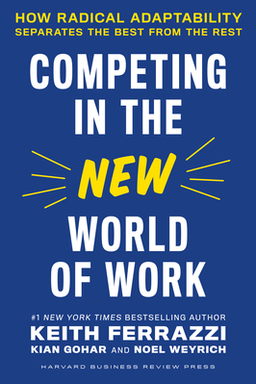
How can you lead teams and organizations through nonstop change when the entire world seems to be shifting under your feet? In Competing in the New World of Work, Keith Ferrazzi, Kian Gohar, and Noel Weyrich argue that the key to surviving—and thriving—in our turbulent, post-pandemic world is to master what they call radical adaptability. This isn’t the same as ordinary flexibility. It’s a mindset and a set of practices that help you and your organization constantly anticipate change, evolve with it, and turn disruption into advantage.
Ferrazzi’s core claim is that the pandemic didn’t just expose outdated ways of working—it obliterated them. He describes how crisis revealed what organizations are capable of when bureaucracy collapses and collaboration accelerates. Like a global social experiment, COVID forced leaders to reinvent teamwork overnight. The lesson, he argues, is clear: we should never go back. Instead, we must go forward to work.
From Crisis to Transformation
The authors open with an intriguing metaphor: Burning Man, the desert festival where creativity and survival go hand in hand. Its community thrives through “radical self-expression” and “radical self-reliance.” Ferrazzi likens this to how teams adapted under the pressure of the pandemic—people collaborated across silos, showed vulnerability, and shared responsibility in extraordinary ways. The crisis, like Burning Man’s harsh desert, forged stronger connections and innovation. This became the crucible for developing radical adaptability as a leadership model.
To capture these lessons systematically, Ferrazzi launched the Go Forward to Work (GFTW) initiative, a global research project involving thousands of leaders and companies such as Dell, Salesforce, and EY. The goal was to identify what the best teams were doing differently. From this research emerged a sustainable framework for thriving in continuous disruption—a philosophy blending emotional intelligence, technological agility, and organizational foresight.
The Blueprint for the New World of Work
Radical adaptability rests on four core team competencies and three scaling practices:
- Collaborate through inclusion – Teams that leverage diverse voices—across geography, gender, background, and function—innovate dramatically faster.
- Lead through enterprise agility – Shifting from hierarchical control to self-organizing, customer-obsessed teams creates speed and flexibility.
- Promote team resilience – Sustainable performance comes from shared emotional health and mutual accountability.
- Develop active foresight – Seeing around corners lets teams anticipate the next shock instead of reacting when it hits.
Once mastered, teams can apply these skills to three enterprise-wide levers: future-proofing the business model, building a Lego block workforce that’s fluid and reconfigurable, and supercharging purpose so that employees rally around something larger than profits. Together, these seven chapters make up a continuous improvement loop of transformation—an infinite cycle of adaptability and growth.
Disasters Don’t Just Destroy — They Reveal
Throughout the book, Ferrazzi insists that crises are teachers. Just as the Great Chicago Fire gave rise to modern fire codes and the Kobe earthquake to Japan’s seismic design standards, the pandemic revealed obsolete workplace assumptions: the overdependence on physical offices, top-down decision hierarchies, and static job roles. In their place emerged networks of empowered teams, empathy-driven leadership, and digital-first collaboration. The old world valued efficiency; the new one values adaptability.
“Disasters don’t just destroy—they reveal.” This phrase encapsulates the authors’ thesis: every disruption exposes what no longer serves us and invites transformation. The question isn’t whether change will come—it’s how courageously we embrace it.
The Courage to Act Before the Wave Hits
The final story in the opening chapter, that of ten-year-old Tilly Smith recognizing the signs of a tsunami, illustrates one of Ferrazzi’s central lessons: knowledge isn’t enough—action takes courage. Like Tilly warning her family on a beach in Thailand, leaders must act decisively on foresight even when others don’t yet see the danger. Radical adaptability, therefore, is not passive resilience but proactive leadership fueled by conviction and humanity.
In the chapters that follow, Ferrazzi and his coauthors provide detailed, research-backed playbooks for applying radical adaptability in practice—from virtual collaboration to agile experimentation, mental well-being, scenario planning, and purpose-driven transformation. Put simply, this book is both a rallying cry and a toolkit for leaders who refuse to wait for the next crisis to remind them what they’re capable of.