
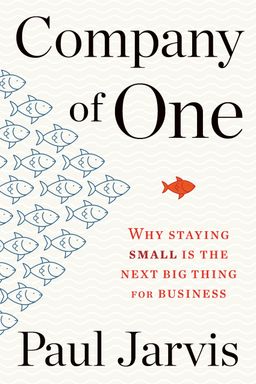
Company of One cover

Company of One

by Paul Jarvis

In ''Company of One,'' Paul Jarvis challenges the conventional wisdom of constant growth, advocating for a sustainable, small-scale business model. This approach offers entrepreneurs more independence, free time, and satisfaction. Learn practical strategies to turn your side gig into a fulfilling enterprise that aligns with your life goals.

The Power of Staying Small

Have you ever wondered if bigger always means better—especially in business? In Company of One, Paul Jarvis turns that idea on its head. He argues that true success doesn’t come from endless scaling, bloated teams, or venture-backed hustle. Instead, it emerges from building a small, intentional, and resilient business that serves your life rather than consumes it.

Jarvis invites you to consider a radical question: What if staying small is the next big thing? He contends that perpetual growth—the modern business obsession—is not a virtue but often a recipe for collapse. Rather than aiming to become 'too big to fail,' he champions being too small to fail: nimble, focused, and sustainable. Through research, case studies, and lived experience, Jarvis explores how smallness isn’t a lack of ambition—it’s a conscious design for long-term endurance and freedom.

Rethinking Growth

Jarvis begins by challenging the traditional paradigm that equates success with expansion. He notes that when businesses grow rapidly—adding employees, overhead, and complexity—they often weaken their foundations. Studies show that growth is one of the leading causes of failure among startups, with nearly 74 percent collapsing due to premature scaling. This is not because growth itself is 'bad,' but because chasing it without purpose and structure leads to instability. For Jarvis, growth must be questioned, then earned.

To illustrate, Jarvis compares two Japanese companies: the hotel Onsen Keiunkan and the temple builder Kongō Gumi. The former has thrived for 1,300 years by staying small, focusing solely on quality service and customer care. The latter, despite surviving wars and centuries of upheaval, collapsed when it expanded into real estate during Japan’s 1980s economic bubble. Their contrasting trajectories reveal Jarvis’s thesis: companies survive not in spite of staying small but because of it.

The Ethos of “Enough”

The most revolutionary concept Jarvis introduces is enough. In a world of endless desire for 'more'—more revenue, more followers, more productivity—he asks what is truly sufficient for a meaningful life and a thriving business. Success doesn’t have to mean global domination or hypergrowth; it can simply mean generating enough profit to create freedom, flexibility, and satisfaction. Jarvis writes that real independence arises when you define upper bounds for goals—when you know when to stop. That realization makes space for better work and better living.

The idea of enough flips the startup narrative. Instead of exit strategies, Jarvis proposes an “exist strategy”—building something sustainable enough to last, to serve your life for as long as it needs to, rather than to sell. He likens this to the Japanese concept of shinise, or long-lasting companies—businesses that rarely grow quickly but often endure for centuries. In these models, relationships and quality outweigh scale and speed.

Freedom as the Ultimate Profit

Jarvis understands that what most entrepreneurs truly crave isn’t just money—it’s freedom: the ability to choose work, clients, and direction. Growth often steals that away, creating stress, debt, and obligation. Being a 'company of one' restores that sovereignty. Jarvis shows how self-employed creators like cartoonist Tom Fishburne or author Danielle LaPorte built profitable, fulfilling businesses without bloated infrastructures or external investors. Their success lies in agility and personal alignment, not in dominating markets.

As Jarvis says, “Real freedom is gained when you define upper bounds to your goals.” That means resisting external pressures—from investors, from social norms, and even from your own ego—to grow endlessly. The antidote to burnout and chaos, he argues, isn’t another productivity hack or funding round—it’s clarity about what’s enough.

Why It Matters Today

Jarvis’s philosophy resonates powerfully in the modern era of remote work, automation, and digital entrepreneurship. We live in a time when one person can run a global business from a laptop, leveraging tools once reserved for corporations. Yet many still fall into the trap of endless scaling, mistaking busy growth for meaningful progress. Company of One is both a manifesto and a manual for those who want to do business differently—those who want profit without pressure, autonomy without isolation.

Ultimately, this book calls you to redefine success. Instead of asking “How can I grow?” Jarvis asks “How can I thrive?” He offers a reminder that modern accomplishment doesn’t require vast empires; often, it flourishes in small, focused corners where purpose and craft meet. Staying small is not about shrinking your ambition—it’s about making space for what truly matters: quality, meaning, and freedom.


Resilience and Adaptability

Jarvis begins his exploration of what makes a company of one thrive with resilience—the ability to recover and adapt in times of hardship. He recounts the story of entrepreneur and author Danielle LaPorte, who was fired by the very CEO she hired after taking investor money. Her experience taught a critical lesson: external funding can come with strings attached and compromise your autonomy. After being ousted, she rebuilt her business from scratch, learning that endurance comes from control, flexibility, and alignment with purpose rather than scale or capital.

Three Traits of Resilient People

According to Jarvis, resilience isn’t innate—it’s cultivated. He draws on the research of Dean Becker at Adaptiv Learning Systems, showing that resilient individuals share three learnable traits:

  • Acceptance of reality—a grounded understanding that control is limited and change is constant.
  • Sense of purpose—a drive that transcends mere profit, linked to deeper values.
  • Adaptability—the creativity to find new ways forward when conditions shift.

These characteristics epitomize the mindset of successful small enterprises. Instead of reacting to crises with panic or overextension, resilient businesses pivot, simplify, and persevere.

Adaptation in the Age of Automation

Jarvis warns that automation and AI will continue to disrupt industries, eliminating jobs and altering how we work. Yet, paradoxically, that’s where companies of one can excel. Unlike rigid corporations, small and solo businesses can adapt faster, finding niches and solving problems creatively. When automation takes over repetitive tasks, it frees individuals to emphasize creativity, empathy, and personal connection—the qualities machines can’t replicate.

His own experience as a web designer during economic downturns exemplifies adaptability: when large firms downsized, Jarvis succeeded by offering quality service at lower overhead, becoming indispensable to clients seeking affordability and talent. This ability to pivot during crises embodies the core resilience of a company of one.

Resilience as Strategy

Resilience isn’t just about surviving storms—it’s about designing your business to weather them before they arrive. Jarvis’s point mirrors Richard Semler’s philosophy (seen in Maverick): sustainable companies don’t chase infinite growth; they sustain through grounded realism. Resilience allows you to say no to “opportunities” that would actually drain resources. It helps you maintain sanity and quality during volatile times, whether facing market crashes or technological shifts.

“Resilient companies don’t survive in spite of change—they thrive because of it.”

Jarvis’s takeaway is clear: if you build resilience into your mindset and operations—through simplicity, autonomy, and responsibility—you create a business capable of lasting decades, even centuries. It’s not about avoiding risk but managing it with wisdom and flexibility.


Autonomy and Mastery

For Jarvis, autonomy is not just control—it’s self-trust earned through mastery. Companies of one seek independence from bureaucratic structures and external micromanagement. But freedom without competence quickly unravels. True autonomy emerges only when you develop mastery of the skills that generate income and value.

Learning Before Leading

Jarvis suggests that independence starts by first learning within structured environments. Freelancers like Kaitlin Maud refined their abilities inside agencies before venturing out. She spent five years mastering digital strategy and building a network before freelancing—and as soon as she went solo, clients like Beats by Dre and Adobe hired her. This blend of skill and experience secured her autonomy. Jarvis reminds us: independence requires preparation; mastery grants authority over one’s career.

Ownership and the Freedom to Say No

Another pillar of autonomy is ownership. Sol Orwell, founder of Examine.com, resisted venture capital even when his wellness database reached seven figures in revenue. By refusing investment, he avoided beholden relationships that prioritize investor ROI over customer value. Instead, Orwell could determine his working rhythm—taking breaks to walk his dog or attend dance classes midweek—because he owned both the means and terms of his labor. Autonomy enables meaningful choices about lifestyle, priorities, and time.

Systems that Empower Control

In corporate environments, Jarvis highlights structures like Google’s “20% time” and ROWE (Results-Only Work Environments), which give employees the freedom to self-direct when mastery earns trust. These systems prove that even within large organizations, autonomy can thrive if competence precedes control. Productivity and satisfaction soar when people can manage their schedules and define how work gets done.

(Note: Similar ideas appear in Daniel Pink’s Drive, which emphasizes autonomy, mastery, and purpose as core motivators for meaningful work.)

The Autonomy Paradox

While independence is appealing, Jarvis warns autonomy isn’t a magical cure. Too much freedom without structure leads to chaos, excessive workload, or poor boundaries. The key is designing personal rules and routines that reinforce balance—autonomy guided by purpose. Mastery without mindfulness becomes overwork; liberty without limits becomes burnout. Sustainable autonomy, he argues, relies on learning the discipline to say no, the courage to prioritize well, and the clarity to act within self-chosen constraints.

Ultimately, autonomy is earned, not gifted. It comes when you’ve proven your capability to deliver consistent value, when your craft speaks louder than hierarchy, and when you define success on your own terms. Companies of one embody this equilibrium: mastery brings confidence, and confidence cultivates freedom.


Redefining Growth and Success

Jarvis asks a provocative question: why must success always mean expansion? He critiques the modern myth that every thriving company must scale infinitely—that bigger is synonymous with better. In reality, rapid expansion often destroys what made a company great. By flipping the traditional notion of success, Jarvis redefines growth as betterment rather than bigness.

Better Over Bigger

Through stories like Sean D’Souza’s Psychotactics—a consultancy capped intentionally at $500,000 annual profit—Jarvis shows that improvement, not expansion, can be a viable end goal. Sean limits his earnings to sustain his lifestyle: walks, teaching his nieces, and time with family. His loyalty to clients grows deeper because he invests in making current customers happier rather than chasing new ones. This approach proves sustainable profits aren’t dependent on infinite scale.

The Beast of Growth

Jarvis warns of 'the Beast'—a metaphor for systems requiring constant feeding: more staff, more marketing, more infrastructure. Danielle LaPorte once created such a 'Beast' with a million-dollar website that demanded endless maintenance. Ultimately, she killed it, rejecting complexity to return to authentic connection with her audience. Sometimes progress means dismantling elaborate systems that distract from actual purpose.

Lessons from Those Who Grew Too Fast

From Starbucks to Krispy Kreme to Pets.com, Jarvis chronicles how blind pursuit of growth led to collapse. Starbucks diluted its brand with food and CDs before re-centering on coffee. Krispy Kreme expanded so fast that franchises fought each other and profits plummeted. Pets.com spent millions on ads while selling below cost. Their stories underscore a sobering truth: uncontrolled growth often leads to implosion.

The Upper Bound Principle

Instead of chasing endless goals, Jarvis advocates setting upper bounds. He likens this to Southwest Airlines turning down 95% of expansion opportunities to grow at a pace they could sustain. Upper bounds ensure safety margins and balance—growth only when it serves mission and culture. Psychologically, they counteract envy, the 'ulcer of the soul,' that drives entrepreneurs to mimic others blindly. Jarvis replaces envy with mudita—a Buddhist concept meaning joy in others’ success. Celebrate peers instead of competing with them.

“Small can be a long-term plan, not just a stepping stone.”

To measure success, Jarvis suggests evaluating happiness, purpose, and customer satisfaction—not just quarterly increases. Growth is optional, not mandatory. A company’s worth comes from consistent value and meaningful impact, not headcount or hype. Better beats bigger every time.


Purpose Over Passion

Jarvis dismantles the cultural myth that following your passion guarantees success. Passion, he argues, is fleeting and self-centered; purpose is steady and outward-facing. A company of one thrives when its purpose aligns with shared values and real-world meaning—not simply personal enthusiasm. This shift from passion to purpose transforms work from indulgence into contribution.

Purpose as a Guiding Lens

Your purpose filters every decision: who you work with, what you create, and how you serve customers. Jarvis points to Patagonia and Seventh Generation—companies that embed environmental and social responsibility into their operations. Patagonia’s founder, Yvon Chouinard, built a brand rooted in sustainability rather than excess, cultivating lifelong customer loyalty. Seventh Generation designs eco-friendly products reflecting its namesake principle: considering the impact on the next seven generations. Both demonstrate that purpose and profit can coexist naturally.

Why “Follow Your Passion” Fails

Studies from Robert Vallerand and Cal Newport confirm Jarvis’s claim: passion rarely precedes mastery—it emerges after it. As Newport writes in So Good They Can’t Ignore You, passion follows when you become skilled and valuable at something. Barbara Corcoran from Shark Tank shares a similar view: she discovered her passion after years of hard work, not before. Jarvis warns that confusing passion with competence leads to entitlement—a belief that enjoyment alone merits payment. Purpose, by contrast, sustains effort when conditions aren’t glamorous.

Finding Purpose Through Service

As Jarvis explains, purpose emerges through solving problems for others. By focusing outward—on helping customers succeed—you create intrinsic motivation and long-lasting fulfillment. Work becomes meaningful adventure, not a grind. He offers the example of his own career shift from web design to teaching online courses: the purpose of helping others run better businesses kept him engaged far beyond fleeting excitement for design itself.

“Engaging work helps you develop passion, not the other way around.”

By anchoring your company in purpose, you gain clarity and resilience. When setbacks occur, purpose sustains you. When opportunities arise, it helps you discern which ones align with your values. Passion flares; purpose endures.


Building Trust and Relationships

No company of one survives without trust—and trust is built through relationships, not transactions. Jarvis reminds you that customers don’t care if your business is profitable—they care if it helps them succeed. By focusing on empathy and reliability, small businesses can outperform giants in loyalty and reputation.

Customer Success as Growth Strategy

Jarvis champions customer service as a core differentiator. Drawing from Kate O’Neill’s work with Magazines.com, he shows that retention beats acquisition. It costs five to seven times less to keep existing customers than to attract new ones. Treating your clients like your only customer inspires enduring trust—and paradoxically, that intimacy creates natural growth through referrals and word of mouth.

Empathy and Ownership

Empathy isn’t sentimentality—it’s profitability. Companies that listen and apologize authentically thrive. Jarvis cites Trader Joe’s delivering food during a blizzard and RackSpace sending a surprise pizza to a hungry caller as examples of remarkable empathy. These gestures build social capital, turning customers into evangelists. Equally important is taking ownership when mistakes occur: Jarvis recounts his own experience resolving double charges for customers through transparency and personal outreach, preventing reputational harm and deepening trust.

Trust as a Scalable System

Research from Glen Urban and Nicholas Epley reinforces Jarvis’s message: long-term success flows from confidence, competence, and benevolence. Amazon’s review systems, WealthSimple’s transparent fees, and MailChimp’s referral programs all scale trust through technology without losing human connection. For companies of one, trust doesn’t require massive marketing budgets—it requires consistency, clarity, and care.

“Your word is your contract. Do what you say, when you say.”

In a world of noise and churn, Jarvis offers a simple equation: trust plus empathy equals profit. When you lead with sincerity and service, your audience repays you with attention, loyalty, and longevity.


Teaching, Sharing, and Authority

Teaching is one of the most powerful growth tools for a company of one. Jarvis argues that sharing your knowledge openly builds authority, trust, and an engaged community around your work. Instead of guarding trade secrets, he encourages transparency. The more you educate, the more customers respect and rely on your expertise.

Out-Teaching the Competition

Through the story of Brian Clark, founder of CopyBlogger (now RainMaker Digital), Jarvis demonstrates how teaching can become the foundation for major success. Clark transitioned from law to online education, freely sharing insights about content marketing. By helping others learn, he built an audience of loyal customers who eventually bought his products. His approach turned empathy into an engine for profit—proof that teaching drives trust.

Ideas Are Useless Without Execution

Jarvis insists that ideas alone have no value—it’s execution that matters. He uses examples like UFC, Facebook, and Uber to emphasize that great companies emerge not from unique ideas, but from exceptional implementation. For solo entrepreneurs, sharing ideas publicly doesn’t risk losing them—it invites feedback and refines execution.

Customer Education as Marketing

Jarvis points to MIT research showing that customer education increases trust and loyalty. Companies like Casper teach about sleep science rather than just selling mattresses, positioning themselves as experts in wellness. Teaching shifts marketing from manipulation to mentorship—it builds long-term audience reliance and respect.

“When you teach everything you know, you become the go-to authority.”

For a company of one, education is reciprocal: the more you share, the more you learn about customers’ needs. Teaching invites trust, clarifies purpose, and turns expertise into enduring connection.


The Meaning of Enough

At the heart of Jarvis’s philosophy lies one word: enough. It’s both an antidote to endless ambition and a compass for sustainable happiness. He reminds you that once you reach enough to live comfortably, more money, more followers, or more products rarely improves life quality—it simply complicates it.

Defining Enough for Yourself

Everyone’s definition of enough differs. For Jarvis’s surfer accountant friend, 'enough' meant earning enough by August to stop working and climb for the rest of the year. For others, it may mean flexibility or creative autonomy. Jarvis urges you to articulate your threshold clearly—financially, emotionally, and practically—so you can measure success accurately.

Freedom from the Growth Trap

Society glorifies endless pursuit, yet most people’s happiness plateaus after certain levels of income. By recognizing your 'enough,' you escape the hamster wheel of restless expansion. Jarvis connects this to Ricardo Semler’s analogy: chasing all possible profit is like assuming empty jail cells mean too few prisoners—growth for growth’s sake is as misguided as craving crime for profit.

The Exist Strategy

Instead of planning exits through acquisitions or IPOs, Jarvis values an 'exist strategy'—prioritizing longevity through balance, profit, and connection. Staying small doesn’t mean limiting success; it means crafting durability. A company of one can outlast corporations because it’s nimble enough to pivot and humble enough to define success as sustainability.

“Enough is the true north of building a company of one.”

In achieving enough, you unlock clarity and peace. You gain power to say no—to bad clients, misaligned opportunities, and hollow cultural pressures. Enough becomes both boundary and liberation. It’s not settling; it’s arriving.

Dig Deeper

Get personalized prompts to apply these lessons to your life and deepen your understanding.

Go Deeper

Get the Full Experience

Download Insight Books for AI-powered reflections, quizzes, and more.