
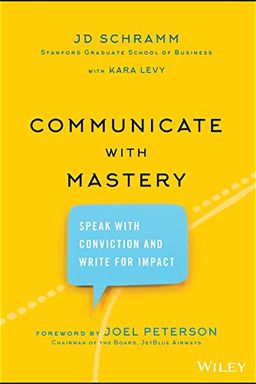
Communicate with Mastery cover

Communicate with Mastery

by J D Schramm with Kara Levy

Communicate with Mastery offers senior leaders a comprehensive guide to elevate their communication prowess. With actionable insights and practical tools, learn to speak with confidence and write with impact, transforming your ability to inspire and influence.

Communicating with Mastery: The Leader’s Ultimate Tool

When was the last time you truly felt heard—or inspired others to act on your words? In Communicate with Mastery, JD Schramm and Kara Levy argue that communication is not just a professional skill but the foundation of effective leadership. They contend that mastering how you speak and write transforms your influence, career, and relationships. But mastery isn’t about perfection; it’s about continuous improvement—the courage to iterate, learn, and refine how you connect with others.

This book, built on decades of teaching at Stanford’s Graduate School of Business, distills lessons from thousands of MBA students and executives who learned how to speak with conviction and write for impact. Schramm’s central message is simple yet powerful: great communicators don’t just talk at audiences—they craft an experience that connects thought to action, and emotion to purpose. Through frameworks, stories, and practical exercises, he shows how leaders can approach mastery in communication, even though perfection will always remain just beyond reach.

Communication as Leadership

Schramm frames communication as the cornerstone of leadership itself. The way you speak and write determines whether you inspire trust, mobilize teams, and handle crises with composure. Borrowing from Dan Pink’s Drive, he explains that mastery is an asymptote—you’ll never reach it, but continually striving toward it transforms your performance. Every interaction—whether a memo, a keynote, or a tough conversation—is a chance to get better. Leaders who embrace this mindset focus not on flawlessness but on authentic connection and growth. Communication becomes less about performing and more about influencing with sincerity.

Five Pillars of Mastery

Schramm’s framework for communication mastery at Stanford rests on five pillars: individuality, relevance, iteration, feedback, and stakes. Each reflects a principle that shapes not only classroom learning but leadership in practice:

  • Individuality—Your communication style should highlight who you are, not mimic someone else’s. Like fingerprints, no two leaders communicate identically. You double down on strengths while adding new skills.
  • Relevance—You’ll inspire more when you talk about what genuinely matters to you or your audience. Passion and authenticity make content memorable.
  • Iteration—Every draft, rehearsal, or feedback round is progress. As Anne Lamott reminds us in Bird by Bird, even “shitty first drafts” pave the way for excellence.
  • Feedback—Learning happens both ways; giving feedback sharpens your own communication instincts as much as receiving it.
  • Stakes—Raising visibility—like publishing a talk or blog—drives accountability and excellence. When your words have real-world impact, your standards rise.

Together, these pillars form the “secret sauce” for leadership communication, encouraging you to approach every interaction as part of an ongoing mastery journey. Schramm likens practice to swimming: you cannot learn it from the bleachers; you must dive in, splash, fail, and swim again.

Why This Matters

Schramm’s premise resonates deeply in today’s world of overloaded inboxes, virtual meetings, and short attention spans. Whether pitching an idea, writing a high-stakes memo, or giving feedback to your team, clarity and conviction decide outcomes. Communication doesn’t just express leadership—it creates it. As Joel Peterson, JetBlue’s chairman and Schramm’s colleague, writes in the foreword, this book helps you “water your communication flowers and cut away the weeds.” You build on strengths rather than obsess over weaknesses, practicing what Peter Drucker long advised: “Make your weaknesses irrelevant.”

Across its pages, the book explores how to manage speaking anxiety, craft messages with verbal, vocal, and visual power, write actively and persuasively, tell stories with data, and coach others toward their own mastery. In essence, Schramm and Levy provide leaders everywhere with a playbook for speaking with conviction and writing for impact—so that your words don’t just land—they last.


Speaking with Conviction: The Power of VVV

Schramm begins with what he calls the orchestra of communication: Verbal, Vocal, and Visual. Each element—what you say, how you say it, and what the audience sees—must play in harmony to create impact. Speaking convincingly isn’t innate; it’s cultivated through managing anxiety, refining your message, and aligning body language, tone, and content.

Managing Your Anxiety

Everyone feels nervous before speaking. Schramm reframes anxiety as an asset rather than a liability. Drawn from Matt Abrahams’s Speaking Up Without Freaking Out and Adam Grant’s Originals, he urges you to reinterpret nervous energy as excitement—channeling adrenaline into enthusiasm. Amy Cuddy’s research on “power poses” adds a physical dimension: expanding your body reduces cortisol and boosts confidence. Schramm’s own anecdote—choosing to read a newspaper instead of hunched over his phone before a big meeting—illustrates how posture can change presence. His mantra: ask yourself, “Where’s the lion?” to remind you that nerves aren’t danger—they’re energy to be harnessed.

Verbal: What You Say

Your words are the fabric of your presentation. Being clear, concise, and authentic matters more than jargon. Schramm uses product taglines—FedEx’s “When it absolutely, positively has to get there overnight”—to show how language builds credibility. He advises being deliberate about openings, transitions, and closings: capture attention early, keep momentum, and conclude with conviction that drives action. Simplicity is persuasive; clarity is credibility.

Vocal: How You Say It

Voice carries emotion and authority. Schramm directs you to measure yourself on five metrics—pace, volume, clarity, filler words, and animation. The progression through Maslow’s learning stages—from unconscious incompetence to unconscious competence—illustrates how speakers evolve from unaware mistakes to effortless mastery. He shares Kim Scott’s story from Radical Candor where Sheryl Sandberg bluntly tells Kim that saying “um” makes her sound “stupid.” Feedback can sting—but awareness transforms habits. Strong vocal mastery, fueled by practice and self-recording, turns hesitation into authority.

Visual: What They See

More than half of communication is non-verbal. Eye contact, posture, gestures, and presence create trust before words even form. Schramm encourages the “one person, one thought” technique—sustaining gaze with one listener for each complete idea. He offers practical advice: stand with balanced feet, avoid “T-Rex arms,” move during transitions, and minimize barriers like lecterns. He recounts how a student team’s YouTube talk, “Make Body Language Your Superpower,” became the program’s most-viewed video, proving how deeply audiences crave body-language insight.

Communication mastery is achieved when verbal clarity, vocal strength, and visual connection converge. Speak like a symphony—each element distinct, yet unified in harmony.


Writing for Impact: Active, Brief, and Clear

Schramm warns that your writing often travels farther than you do—it reaches your CEO, investors, or team long before you walk into the room. Clear writing reflects clear thinking. At Stanford, he teaches the ABCs of writing: Active, Brief, and Clear. Every email, memo, and report should embody these qualities to produce understanding, persuade action, and project confidence.

Active Voice Over Passive

Passive language—“Mistakes were made”—creates detachment and ambiguity. Active voice—“I made a mistake”—creates accountability. Replacing concealed verbs (“make a decision” → “decide”) injects power and reduces word clutter. Leaders using active voice sound credible and decisive. As Mr. Wessling, Schramm’s high-school teacher, said: “The passive voice is that which is to be avoided.”

Be Brief to Respect Attention

Attention spans are now shorter than headlines themselves. Brevity honors the reader’s time. Replace long phrases with single words (“try to make better” → “improve”) and structure paragraphs to be easily scanned. Schramm enables writers to cut through noise with precision—his colleague Glenn Kramon calls this the “miniskirt rule”: long enough to cover the topic; short enough to stay interesting.

Clarity and Synthesis Over Summary

Leaders synthesize, not summarize. Drawing on Nora Ephron’s teaching (via Chip and Dan Heath’s Made to Stick), Schramm illustrates how students summarize headlines too literally until guided to the synthesis—“No School Next Thursday.” What matters is the essence, not the details. He urges writers to follow the timeless triad: What, So What, Now What. Give information, show relevance, and prompt action.

Style Meets Substance

Good writing blends presentation and content like Yin and Yang. It must be pleasant to read and anchored in strong ideas. Use descriptive headings, strategic white space, and bullet points for clarity. In digital communication, “slidedocs”—Nancy Duarte’s concept of deck-like documents—combine visuals and words to tell one clear story per page. Schramm celebrates them as tools that “rock” for business readers who digest information fast.

Ultimately, writing for impact means cutting clutter, honing structure, and editing ruthlessly. As Kramon reminds his students: “Say what you like, and what you would like.” Leadership writing uplifts, persuades, and clarifies—it communicates not just information but inspiration.


Tailoring Communication to Your Goal: Pitch, Story, and Disclosure

No single communication fits every situation. Schramm teaches leaders to tailor their messages to their goal—whether pitching an idea, telling a compelling story, or opening up personally. The aim is always connection: moving the audience to think, feel, and act differently than before.

Pitching with Clarity

Drawing on Chris Lipp’s The Startup Pitch, Schramm outlines a four-part formula—Problem, Solution, Market, Business. Convince listeners the problem matters, present a unique solution, prove there’s a market, and show how the business earns revenue. He coaches entrepreneurs through the “Bridge Exercise”: mapping how to move investors from skepticism (Point A) to commitment (Point B). Team pitches should feel cohesive, not fragmented, each speaker advancing the big idea with “little ideas.”

Storytelling for Connection

Stories change behavior by creating empathy. Schramm and Levy teach leaders to “parachute in,” drop audiences straight into action, use the “Goldilocks” balance of details, and apply sensory description. Nancy Duarte’s sparkline and Freytag’s pyramid reveal that great narratives alternate between “what is” and “what could be.” He recalls Rachael Wallach’s viral talk “Disrupting Disability,” a masterclass in how one vivid story (“people who wear their wheels like people who wear glasses”) can shift cultural perspective forever.

Disclosing Personally and Authentically

Sometimes communication becomes personal. Schramm’s own TED talk, “Break the Silence for Suicide Attempt Survivors,” embodies vulnerability used for change. He cites Brené Brown’s message that “shame derives its power from being unspeakable.” To share authentically, leaders must check motives, confide first in trusted partners, choose the right medium, plan for questions, and prepare for consequences. Vulnerability, used wisely, bridges humanity with leadership credibility.

Tailoring your communication to the occasion—whether persuading investors, inspiring employees, or sharing your story—means understanding your goal deeply. As Schramm puts it, clarity of intent drives clarity of impact.


Tailoring Communication to Your Setting

Context shapes communication. Where you speak—and with whom—defines strategy. Schramm explores how to lead meetings, virtual calls, and stage presentations with equal mastery. Each setting demands discipline, preparation, and intentional design.

Leading Meetings

Meetings work best when purpose drives participation. Kara Levy’s sidebar, “Lead with Intent,” insists that every agenda has an end goal: what should result from the discussion? Start on time, keep focus, limit attendees (Jeff Bezos’s ‘two-pizza rule’), and encourage balanced voices. Use physical cues—positioning near decision-makers, standing strategically—to build influence. Eye contact and clarity matter more than slides.

Virtual and Hybrid Communication

In virtual settings, elevate presence by making video calls dynamic. Schramm connects better lighting, natural gestures, and keeping energy high as substitutes for physical presence. He suggests breaking long calls into breakout groups or using simple drawings, such as his clock diagram that tracks participants’ contributions. In short: create connection even through the camera.

On Stage and Co-Presenting

TED changed how we speak. Schramm founded Stanford’s LOWKeynotes to train students for these high-stakes, emotionally rich talks. Focus half your preparation on crafting content and half on rehearsing delivery. Wear confidence, not distraction; use movement intentionally; and ensure visual design supports—not overshadows—your message. When co-presenting, bookend strong speakers and choreograph seamless handoffs so transitions feel natural, not awkward (“ships in the night”).

Fielding Questions and Using Slides

Questions matter—they show engagement. Schramm teaches reframing difficult ones through three steps: curiosity, empathy, and perspective. Visuals should stay simple (“KISS—Keep It Simple, Stanford”). Each slide should contain one message and a power verb in its title. Slides support you; they are not the performance. When delivering, announce before advancing, eliminate laser pointers, and maintain control of pacing. Always end with a slide that reinforces your thesis, not a giant question mark.

In every setting—from boardroom to Zoom—you lead through structure, tone, and clarity. The setting may change, but mastery remains constant: intentional speaking, designed connection.


Communicating Through Identity

Your identity shapes how you communicate. Schramm dedicates an entire section to leaders navigating unique challenges—non-native speakers, LGBTQ professionals, women, veterans, and rookie leaders. He encourages you to honor who you are while adapting strategically to reach others.

Leading in Another Language

Don’t erase your accent; celebrate it. It tells your story. Strive for clarity, not conformity. Levy’s advice—“Slow down your speech to speed up comprehension”—helps any speaker. Simplify pronunciation or support difficult words with visuals. Slow pace shows confidence.

LGBTQ Leadership: The Lavender Diamond

Authenticity begins with deciding what to share. Schramm’s “Lavender Diamond” model visualizes four traits of presence: Confidence, Clarity, Competence, and Connection. Build self-assurance by reframing anxiety into excitement (“If not you, who?”). Clarify messages like Uber’s Frances Frei—state main points first. Demonstrate competence through preparation and storytelling. And connect through vulnerability. Schramm’s anecdotes—from sharing family stories with students to honoring LGBTQ icons like Harvey Milk—prove authenticity inspires trust across boundaries.

Women, Veterans, and Rookies

Co-teacher Allison Kluger’s guidance for women includes managing interruptions, balancing strength and warmth, and speaking with certainty. Veterans reentering civilian careers must translate skills, promote themselves confidently, and strip away military jargon. Rookies should embrace curiosity, learn from mistakes, and build allies early (“put cookies in the jar before you take any out”). Across identities, Schramm’s advice repeats: confidence without arrogance, vulnerability without apology.

Your identity isn’t a barrier—it’s a lens. Leading authentically means recognizing what makes you distinct and letting those dimensions inform—not limit—your communication mastery.


Scaling Leadership Through Coaching

Communication mastery expands when shared. Schramm’s final section explores how coaching transforms both leaders and teams. To grow, you must first learn to be coached, then how to coach others, and finally how to create a culture that sustains feedback and clarity.

Being Coached: Goals and Mindset

Start by articulating clear goals: what do you want to improve? Schramm likens coaching to receiving a gift, not a correction. Engage with humility and curiosity. Choose coaches through chemistry and credibility—someone who challenges yet encourages. As coach David Schweidel says, success requires “strong ideas loosely held.”

Coaching Others

Great coaches are patient, empathetic, flexible, and process-focused. They guide leaders without “lifting the pen.” Schramm shares exercises like the eye-contact activity (raise your hand until connection is made) and the “stop/start” feedback method. Coaching grows through iteration—observe, pause, refine. Community amplifies impact: peer lunches and shared experiences turn solitary coaches into networks of learning.

Creating a Coaching Culture

A company’s success depends on radical candor—Kim Scott’s framework for feedback that “cares personally and challenges directly.” Schramm urges leaders to apply this upward, downward, and sideways. His story of Dean Jon Levin at Stanford illustrates that transparency inspires excellence. When leaders model open, constructive feedback, coaching becomes engrained in culture. Mirroring and modeling best practices motivate others to grow through imitation and iteration.

Communication mastery is contagious. When leaders coach with empathy, candor, and clarity, organizations evolve into communities of learning—where every conversation becomes a chance for growth.

Dig Deeper

Get personalized prompts to apply these lessons to your life and deepen your understanding.

Go Deeper

Get the Full Experience

Download Insight Books for AI-powered reflections, quizzes, and more.