
Idea 1
Communicating to Influence: Turning Information into Inspiration
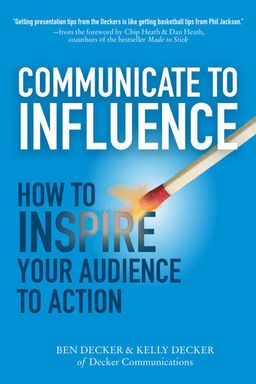
Have you ever left a meeting feeling like your words vanished into thin air? In Communicate to Influence, business communication experts Ben and Kelly Decker argue that most of us don’t actually communicate—we merely inform. They contend that spreading information isn’t enough to create change, motivate teams, or lead effectively in today’s world. True leadership communication, they insist, is about moving people from awareness to action by intentionally shaping the experience you create for your audience.
The Deckers’ central message is bold: leadership isn’t a matter of authority but of influence. Titles and hierarchy might command obedience, but they rarely earn enthusiasm. In their words, leaders must stop flashing their authority and instead learn to inspire people so they want to act, not just because they have to. Through decades of coaching executives—from tech CEOs in Silicon Valley to military officers—the authors demonstrate that influence arises when authentic behavior meets audience-focused content.
Why Communication Is Broken
The Deckers famously begin with a blunt statement: “Business communication sucks.” They show how most professionals equate talking with connecting, flooding meetings with data, bullet points, and jargon. Everyone assumes that saying the words equals being understood, yet audiences tune out because there’s no emotional link, no relevance, and no motivation to care. The book calls out five ‘white lies’ people tell themselves—like believing that sticking to a script will guarantee clarity or that winging it proves confidence. In reality, these habits destroy trust and engagement.
The Deckers use high-profile examples to illustrate these traps, from Marissa Mayer’s teleprompted and tone-deaf presentation at Cannes Lions to director Michael Bay’s meltdown at CES when his script failed. Both situations show what happens when speakers focus on content rather than connection. Communication, they explain, isn’t just about transmitting words—it’s about crafting an experience that your listeners feel.
The Shift from Information to Influence
The authors observe that society itself demands new forms of communication. Trust in traditional leaders has collapsed, attention spans are shrinking, and people crave emotional resonance. In this environment—what they call an ‘attention economy’—you earn the right to be heard only by creating fascinating, human, and purposeful experiences. They cite examples from TED Talks, where speakers connect through vulnerability and storytelling rather than slides or credentials. Likewise, brands like TOMS Shoes and leaders such as Simon Sinek show that inspiration, not information, drives loyalty and action.
The Deckers propose a powerful tool to guide this transformation: the Communicator’s Roadmap. This framework maps communication across two axes—emotional connection (vertical) and content focus (horizontal). Low emotional connection and self-centered content produce dull, informing experiences. High emotional connection and audience-centered content produce inspiration. Between these extremes lie entertainers (high emotion, self-focused) and directors (low emotion, action-focused). The goal: move up and to the right, toward Inspire. Whether you’re speaking to a crowd, leading a team, or having a hallway chat, this model allows you to intentionally design each communication moment.
Behavior Meets Content
To move toward inspiration, the Deckers combine what they call behavioral and content mastery. Behavior—the vertical axis—is the foundation of trust and connection. It’s expressed through eye contact, posture, energy, gestures, facial expression, voice, and the powerful pause. The authors draw on research (from Amy Cuddy’s work on warmth and competence to Albert Mehrabian’s famous studies on visual impact) showing that how you show up often matters more than what you say.
Next comes content—the horizontal axis. To influence, you must replace self-focused messages with audience-centered ones. This process uses the Decker Grid, a four-step structure that helps you craft a clear, actionable, and emotionally resonant message. It starts with defining your Cornerstones: listeners, point of view, action steps, and benefits. Then you brainstorm ideas, cluster them, and compose them into a logical and persuasive flow. The Deckers famously say, “Structure, not script”—because leaders who ditch the script can connect authentically while staying organized.
Inspiration in Action
Throughout the book, stories bring the method to life. A CEO who used the Decker techniques to transform his communication found that his whole organization’s culture shifted. Another executive used vulnerability—a story about teaching his daughter to drive—to inspire his sales team around trust. Whether addressing crises, launching products, or delivering compliance training, communicators who map their experience intentionally move audiences from passive listening to active participation.
Ultimately, Communicate to Influence isn’t just about presentation skills—it’s about leadership. It teaches you to lead without relying on authority, to connect with intention, and to make people feel they want to act. In the Deckers’ words, “Business communication sucks, but there is hope.” That hope lies in transforming every conversation—from the boardroom to the living room—into an inspired exchange that changes how people think, feel, and behave.