
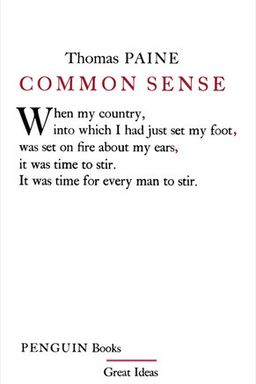
Common Sense cover

Common Sense

by Thomas Paine

Thomas Paine''s ''Common Sense'' is a revolutionary pamphlet that fueled America''s fight for independence. It eloquently argues for the necessity of representative government, equality, and freedom, challenging the oppressive rule of monarchy and inspiring generations to embrace democratic ideals.

The Call for Independence and the Power of Common Sense

Have you ever felt trapped by a system that seems unjust but so deeply entrenched that change feels almost impossible? In Common Sense, Thomas Paine challenged that very feeling for 18th-century Americans, turning their quiet frustrations into revolutionary purpose. Written in 1776, his pamphlet did more than argue for independence from Great Britain — it redefined what government should mean, who has the right to rule, and why the people themselves are the rightful source of power.

Paine’s core argument is simple yet radical: monarchy and hereditary succession are unnatural institutions that violate reason and the equality of mankind. Government, he asserts, exists as a necessary evil — its only purpose is to secure the safety and liberty that human vice makes vulnerable. When a government ceases to protect those rights, it loses its legitimacy. For the American colonies, that moment had come.

Through clear, fiery prose accessible to farmers as much as to statesmen, Paine urges readers to abandon the illusion of reconciliation and embrace self-governance. He blends moral conviction with pragmatic reasoning, asserting that it is not only possible but inevitable that the colonies should stand as "a continent unto itself.”

A Revolutionary Argument for Simplicity and Natural Law

Paine begins by distinguishing society from government — a distinction that was rarely made so boldly at the time. Society, he says, arises from our needs and affections; government, from our vices. Society unites us through cooperation, while government exists only to restrain wrongdoing. The best government, therefore, is the simplest one that effectively maintains security and liberty.

He argues that no divine right grants one man the authority to rule over others. Monarchies are both irrational and immoral — a human invention born out of fear and ambition, not design by nature or consent of the people. Paine draws on the Bible itself to undermine monarchic traditions, pointing to Israel’s rejection of divine rule in favor of earthly kings as evidence that monarchy is sinful. In doing so, he reclaims religion as a force of liberation, not submission.

The Case Against Reconciliation

To Paine, any reconciliation with Britain was both foolish and dangerous. He dismantles the sentimental argument that England was America’s “parent country,” reminding readers that people from all across Europe had fled to the New World seeking refuge from tyranny — England’s included. Britain's so-called protection of the colonies, he claims, was rooted in self-interest, not benevolence. America’s prosperity, he asserts, came in spite of Britain, not because of it.

By continuing under British rule, Americans would inherit endless conflicts and enmities in Europe. Distance itself — thousands of miles of ocean — was nature’s clear signal that the two should be separate. “Small islands,” Paine quips, “not capable of protecting themselves, are the proper objects for kingdoms to take under their care; but there is something absurd in supposing a continent to be perpetually governed by an island.”

From Reasoning to Blueprint

Unlike many philosophers who only critique, Paine offers a plan. In the latter sections, he outlines how the new continent might construct its own free government, rooted in common representation. He proposes a Continental Congress, annual elections, and a written constitution — a "Continental Charter" ensuring freedom of religion, property, and conscience. The law, not kings, should reign supreme. “In America,” he writes, “the law is king.”

He also envisions a pragmatic future for an independent America — one capable of forming alliances, protecting its trade interests, and even building a naval force. Independence would not lead to chaos, as some feared, but to greater unity and peace under sound principles of self-government.

A Moral and Emotional Appeal

What made Common Sense so powerful wasn’t only its logic — it was its passion. Paine appeals to empathy, describing the sufferings of Boston and the cruelty of British troops to awaken righteous anger in his readers. He warns against the cowardice of delay and calls on Americans to rise not just for their own sake, but as a duty to all mankind. In one of his most stirring passages, he reminds them: “The cause of America is, in a great measure, the cause of all mankind.”

This universal framing shifted the struggle from a colonial grievance to a human revolution — one that promised a new age of liberty guided by reason and independence. By combining plain language with grand ideals, Paine transformed abstract Enlightenment thought into everyday conviction. His words became not mere rhetoric but a spark that kindled an unstoppable movement toward freedom.

In the chapters to follow, Paine dismantles monarchy, exposes the corruption of hereditary power, condemns reconciliation as betrayal, and lays the foundations for a democratic society guided by moral clarity and self-reliance. Through these arguments, Common Sense remains not just a relic of revolutionary history, but a living testament to the transformative power of courage, reason, and the will of the people.


Society, Government, and the Origin of Power

Paine begins where all political philosophy must begin: by asking why government exists at all. He distinguishes two forces that shape human life — society and government — and he could not be clearer about their differences. Society is natural and beneficial, while government is artificial and restraining. Society arises from mutual needs and brings positive joy by encouraging cooperation and affection. Government, on the other hand, exists only to curb our worst impulses.

The Necessity of a 'Necessary Evil'

According to Paine, “government, even in its best state, is but a necessary evil.” It’s a structure forced on humans only by their imperfections. If people were inherently virtuous, no government would be required. But since selfishness and aggression are realities of human nature, people create systems of authority for protection. This echoes later thinkers like John Stuart Mill and modern libertarians who see government’s legitimacy as flowing only from its role in preserving liberty.

Paine uses a vivid example: imagine a small group of settlers forming a community. At first, they live harmoniously, guided by conscience and mutual aid. But as they grow in number, disputes arise, and they eventually create a common assembly to make rules. This simple, rational structure — built on representation and frequent election — is the blueprint for good government. Its strength, Paine insists, comes from simplicity and accountability, not hereditary hierarchy or divine appointment.

The English Constitution Debunked

Paine challenges one of the proudest traditions of his age — the English Constitution — exposing it as an incoherent mix of monarchic, aristocratic, and republican elements. Englishmen boasted of their “balanced” system of King, Lords, and Commons, but Paine calls it “farcical.” If the King needs the Commons to restrain him, that means he’s not trustworthy; if he can veto the laws of the Commons, that makes them powerless. The supposed balance is actually perpetual tension, with the real power lying in the Crown’s ability to corrupt Parliament through patronage and bribery.

By stripping away national pride and sentimentality, Paine invites readers to view their government as a design of flawed men, not sacred tradition. Government must be simple, transparent, and derived from the consent of the governed — not from the dust of feudal inheritance. This principle would later resonate deeply with the framers of the U.S. Constitution, demonstrating Paine’s enduring influence beyond propaganda into the realm of true political theory.


The Absurdity of Monarchy and Hereditary Rule

In one of the book’s boldest arguments, Paine takes direct aim at monarchy itself — not merely the British monarchy but the entire concept of kingship. “Mankind being originally equals in the order of creation,” he declares, “no one by birth could have a right to set up his own family in perpetual preference to all others.” The notion that one person and his descendants should rule by divine right is, to Paine, both an insult to reason and a blasphemy against God.

Monarchy: The Devil’s Invention

Tracing its origins, Paine claims monarchy began as the result of conquest or fraud — not divine will. He mocks the British line of succession starting from William the Conqueror, “a French bastard landing with an armed banditti, and establishing himself king of England against the consent of the natives.” Far from godly right, monarchies are the institutionalization of theft and violence. His sarcasm undercuts reverence with biting enlightenment irony, similar to Voltaire’s attacks on aristocracy.

Scriptural Rebellion

To dismantle monarchy’s religious defense, Paine draws on biblical authority. He highlights the Israelites’ demand for a king against God’s counsel, quoting the Prophet Samuel’s warning that the ruler “will take your sons and daughters” and make the people his servants. Thus, the Bible itself condemns monarchy as sin, associating kingship with idolatry and corruption. By wielding scripture against the king’s followers, Paine converts religion into a weapon for liberty — a revolutionary rhetorical move in a devout age.

Hereditary Rule: Nature’s Ridicule

Paine also mocks the myth of hereditary succession. Even if one generation chooses a virtuous ruler, there’s no guarantee his offspring will share those qualities. “One of the strongest natural proofs of the folly of hereditary right,” he quips, “is that nature disapproves it, otherwise she would not so frequently turn it into ridicule by giving mankind an ass for a lion.” The system rewards accidents of birth, not merit, and leads inevitably to tyranny and incompetence.

Through satire, logic, and theological critique, Paine transforms what many considered divine order into absurd superstition. His readers didn’t just see monarchy differently — they learned to laugh at it. That laughter became one of the Revolution’s most subversive weapons.


The Case for American Independence

In “Thoughts on the Present State of American Affairs,” Paine shifts from theory to action. After exposing the corruption of monarchy and the impracticality of Britain’s rule, he delivers the book’s emotional core: it is time to part. His argument is not just political but moral — continued submission to Britain is inconsistent with the natural rights of man and the dignity of a free people.

Why Reconciliation Is an Illusion

Paine ridicules those who sought reconciliation. Every petition had been rejected, every plea met with war. The blood spilled at Lexington and Boston made forgiveness impossible. “Even brutes,” he writes, “do not devour their young, nor savages make war upon their families.” Calling England the “mother country,” he argues, is sentimental blindness; Europe, not England, was America’s true parent. Most colonists were immigrants seeking refuge from European oppression. Their bond now was with each other, not with a distant crown.

The Geography of Freedom

Paine uses one of his most memorable images to capture the absurdity of empire: “Small islands not capable of protecting themselves are the proper objects for kingdoms to take under their care; but there is something absurd in supposing a continent to be perpetually governed by an island.” Geography itself, in his view, reveals nature’s will — America was destined for independence.

A Moral Duty to Future Generations

Paine urges Americans to act not merely for themselves but for posterity. To delay freedom would be to force their children into another generation of oppression. He warns against the “cold hand of prudence” that restrains the courage of the moment. “The present winter,” he writes, “is worth an age, if rightly employed.” His appeal bridges reason and passion, transforming independence from a political option into an ethical imperative.

The chapter concludes by envisioning America as a refuge for liberty worldwide — “an asylum for mankind.” By universalizing the cause, Paine transcends patriotism, inviting readers to see independence as humanity’s step forward. This blend of logical persuasion and emotional urgency turned Common Sense into the voice of a revolution.


Designing a Republic: The Continental Charter

Unlike most revolutionary writers, Paine moves beyond critique to creation. He doesn’t simply destroy monarchy — he designs liberty. In the final sections, he sketches a republican framework for the new American government, remarkable for its foresight and democratic spirit. His plan’s cornerstone is that sovereignty belongs to the people, and power must always return to them.

From Representation to Rotation

Paine advocates frequent elections so that representatives “may never form an interest separate from that of the electors.” He warns that concentrated power, even in elected hands, soon grows corrupt. To prevent this, he proposes annual assemblies and the rotation of leadership through chance selection of which colony’s delegates would preside in Congress. This fluid system ensures fairness and national unity.

The Continental Charter

Building on this vision, Paine suggests a Continental Charter — a written constitution ratified by a broad conference of representatives from all colonies. It would guarantee core rights: property, conscience, and freedom of religion. The charter would be a “Magna Charta of America,” a perpetual covenant ensuring that liberty was secured not by sentiment or tradition, but by law.

In one of his most memorable symbolic acts, Paine replaces the monarch’s crown with the law itself: “Let a day be solemnly set apart for proclaiming the charter; let it be brought forth placed on the divine law, the word of God; let a crown be placed thereon … and at the conclusion of the ceremony let the crown be demolished and scattered among the people whose right it is.” The image dramatizes republican principle: in America, the law, not a person, shall be king.

This concrete constitutional imagination distinguishes Paine from most of his contemporaries. When independence finally came, his ideas would echo in the very structure of American government — popular sovereignty, written law, and civic virtue balanced by regular accountability. His dream of “a government of our own” became the philosophical seed of the U.S. Constitution that followed a decade later.


America’s Capacity and the Global Vision

In “Of the Present Ability of America,” Paine answers skeptics who feared the colonies lacked strength to survive alone. With a blend of reason, data, and optimism, he builds the case that America is fully capable of sustaining herself — militarily, economically, and politically. Independence is not reckless; it’s natural and practical.

America’s Strength and Self-Sufficiency

Paine notes that the colonies already possess the largest standing body of armed men in the world. Their vast resources — timber, iron, and fertile land — make them uniquely suited for self-sufficiency. He champions building a navy, arguing it would combine “commerce and protection” and transform America into a global maritime power. This vision anticipates America’s eventual transformation into a superpower, rooted in the same logic that nations thrive by initiative, not dependence.

Unity as the Source of Strength

Numbers alone do not make nations strong, Paine explains — unity does. He celebrates the colonies’ cooperation as a new miracle of politics: a vast continent bound not by monarchy but by shared cause. If they declared independence together, their solidarity would give them more power than any empire could withstand. Delay, by contrast, would invite division or despotism. His warning that “the Continental Belt is too loosely buckled” remains a timeless caution against complacency in preserving freedom.

Through this pragmatic optimism, Paine transforms fear into confidence. America’s revolution, he insists, is not an act of desperation but an act of maturity — the moment when a people finally governs itself. In that sense, Common Sense is both manifesto and mirror: showing a fledgling nation the strength it already possessed but had not yet recognized.


The Moral Urgency and Legacy of Common Sense

Beyond political rhetoric, Paine’s work is an ethical summons. He writes not as a neutral analyst but as a moral witness, convinced that liberty is humanity’s natural state. “The cause of America,” he insists, “is in a great measure the cause of all mankind.” Independence, therefore, is not only a right but a duty — both to oneself and to future generations.

Common Sense as Revolutionary Scripture

Paine’s pamphlet reached hundreds of thousands, uniting merchants, farmers, and intellectuals alike. It translated Enlightenment philosophy into accessible moral truth. Like Machiavelli’s The Prince or Marx’s Manifesto, it reshaped the world by persuading ordinary people that they were the agents of history. Its influence on Jefferson and the Declaration of Independence is unmistakable — both share Paine’s tone of divine reason and universal equality.

A Lasting Vision of Freedom

Centuries later, Paine’s words still provoke reflection. His rejection of hereditary privilege anticipates modern democratic revolutions. His insistence that “the law is king” foreshadows constitutionalism. And his belief in the moral unity of humanity laid groundwork for later human rights movements. He reminds us that independence is never a one-time event but an ongoing act of courage — defending reason against tyranny in all its forms.

In essence, Common Sense endures because it speaks not only to Americans but to all people confronting injustice. It teaches that freedom begins in the mind — with the courage to question entrenched power and to believe, against all odds, that a better order is possible. That is the timeless strength of Paine’s revolution of common sense.

Dig Deeper

Get personalized prompts to apply these lessons to your life and deepen your understanding.

Go Deeper

Get the Full Experience

Download Insight Books for AI-powered reflections, quizzes, and more.