
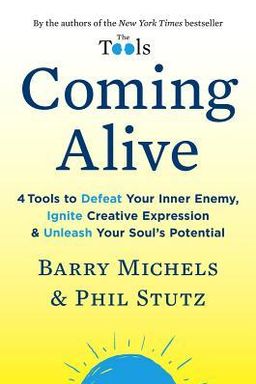
Coming Alive cover

Coming Alive

by Barry Michels and Phil Stutz

Coming Alive offers a transformative journey with four psychological tools to defeat negativity and unleash your potential. Discover how to overcome inner demons, boost energy, and transform emotional pain into a powerful force for personal growth and fulfillment.

Awakening the Life Force Within You

How can you truly come alive instead of merely existing? In Coming Alive, Barry Michels and Phil Stutz argue that most people live as though they’re sleepwalking—pulled around by fear, laziness, and self-doubt—while an unstoppable, creative potential lies dormant inside. They call this potential the Life Force, and contend that the key to a meaningful life is learning to access and strengthen it through four inner tools designed to defeat what they call your “inner enemy,” Part X.

Michels and Stutz—a psychotherapist and psychiatrist known for their unconventional yet practical approach—believe that each emotional struggle hides a deeper spiritual battle between growth and resistance. We feel stuck not because we lack insight or therapy but because we’re blocked from the Life Force by Part X: a shadowy, built-in antagonist that thrives on self-pity, inertia, and anxiety. This book opens by asking you to notice how often you feel powerless and stuck—and proposes that what you’re experiencing isn’t personal failure but a universal human struggle between two forces of nature: life and anti-life.

The Battle for Your Soul

According to Michels and Stutz, the Life Force is the animating energy that gives rise to growth, creativity, love, and renewal. You can sense it in moments of awe—a baby’s birth, an inspired idea, or an act of compassion. But each of us also contains Part X, a destructive counterforce present from birth that pulls us into fear, hopelessness, and self-sabotage. This inner enemy isn’t a pathology—it’s part of the human design, ensuring that growth requires conscious effort. The authors claim that your emotional pain doesn’t mean you’re defective; it means you’ve met the friction of evolution. To live a full life, you must face that friction with tools that turn pain into power.

Through vivid examples drawn from their patients’ lives—whether a woman drowning in self-criticism, a man crippled by fatigue, or a couple battling destructive impulses—the book presents a spiritual psychology that’s grounded, bold, and compassionate. Rather than analyzing problems endlessly (as traditional therapy might), Stutz and Michels insist that change begins with action. To awaken the Life Force, you must stop thinking your way out of stuckness and start doing your way back to life. Their mantra is clear: don’t ruminate—activate. The four tools you’ll learn become emotional can-openers, allowing light and energy to flow where deadness once ruled.

Why It Matters

Michels and Stutz contend that civilization suffers from the same malaise found in their therapy rooms: people don’t lack knowledge, they lack aliveness. Consumer culture tempts us to chase pleasure and avoid discomfort, while the Life Force requires the opposite—facing fear, pain, and frustration as gateways to strength. Every time you resist a craving, refocus your energy, restore hope, or transform an injury into growth, you expand the Life Force and weaken Part X’s grip. This simple yet profound framework unites ancient spiritual wisdom with modern psychology, reminding readers that the same divine energy behind evolution also wants to evolve through you.

The rest of Coming Alive unfolds through four powerful inner tools—The Black Sun, The Vortex, The Mother, and The Tower—each countering one of Part X’s core strategies for deadening your spirit. Along the way, Michels and Stutz show how these tools awaken Truth, Beauty, and Goodness—the timeless virtues that mark a soul fully alive. The journey ends in spiritual practicality: the Higher World, where inner work isn’t just about healing yourself but redeeming the world’s brokenness by reconnecting higher and lower energies.

If you’ve ever felt like therapy was too slow, self-help too shallow, or life too heavy to bear, this book proposes a different approach: you don’t need to wait for insight to strike—you can start building spiritual muscle today. One action at a time, using deceptively simple tools, you can awaken the Life Force and discover, as the authors promise, what it means to truly come alive.


Meet Your Inner Enemy: Part X

Phil Stutz first noticed an invisible force sabotaging his psychiatric patients over and over again—a dark, irrational power ensuring that every attempt at growth eventually collapses. He called it Part X. You’ve encountered Part X every time you procrastinate, doubt yourself, or replay painful stories from your past. It isn’t just laziness or trauma; it’s a primordial adversary built into human nature. Stutz describes it as “the guy with the gun” inside you, forcing you to choose wrong even when you know better.

How Part X Gains Power

Part X hides behind self-defeating behaviors—rage, avoidance, addiction, perfectionism—while convincing you they’re justified. It spreads negativity like a psychic poison until your world seems impossible to change. Joan, one of Stutz’s teenage patients, believed her panic attacks made it “impossible” to travel; as her sense of defeat expanded, it hijacked her creativity, confidence, and joy. Stutz realized that the feeling of impossibility itself is Part X’s signature: once trapped there, you forget you have any potential at all.

Labeling the Enemy

The first step to freedom is labeling Part X in real time. Michels and Stutz teach patients to say, “This is Part X,” whenever they catch themselves spiraling into bitterness, worry, or paralysis. Labeling activates your soul—the opposite energy that chooses truth and forward motion. Like a surgeon stopping the bleeding to diagnose the wound, you identify the source before repairing it. Joan found that simply calling out “This is Part X” slowed her panic and gave her back control. Naming brings awareness, and awareness dissolves illusion.

Commitment and Inner Action

The authors insist that commitment—not intellect—is what defeats Part X. Every time you act rather than analyze, you prove that possibility still exists. There are two forms of action: outer (writing the résumé, confronting your boss) and inner (working directly on thoughts and emotions). Inner action uses the tools to fight back from within; each time you apply them, you awaken the Life Force. Stutz and Michels call this eternal vigilance—a spiritual alertness that keeps you from slipping into autopilot. Like Oscar Wilde’s observation that “most people merely exist,” they remind you that aliveness is earned through disciplined inner work.

With every labeling act, you claim territory back from X and strengthen the Life Force. This ongoing dance between resistance and renewal is the essence of being alive. (Note: Stutz’s work parallels Jung’s concept of integrating the shadow and Steven Pressfield’s idea of “Resistance” in The War of Art.) Once you recognize the enemy’s face, you can begin learning the tools designed to fight it—and reclaim your power to evolve.


The Black Sun: Transforming Impulses

The first tool, The Black Sun, teaches you how to stop being ruled by cravings and addictions—the devil’s whisper that “you deserve a reward.” Part X uses impulses to drain your energy drip by drip: one more drink, another scroll, a bite of late-night ice cream. Each time you give in, you trade long-term potential for short-term relief. The Black Sun reverses this bargain by revealing deprivation as a portal to fullness.

Facing the Void

When you deny yourself a pleasure, Part X tells you it’s intolerable—that emptiness equals death. Michels and Stutz disagree: the void you feel is actually the womb of creation. Imagine resisting the impulse and looking inward. Beneath the craving lies a vast, dark space that, if you face it calmly, reveals a glowing sun—the Life Force rising to fill you from within. This practice teaches self-restraint not as punishment but as transformation. The sequence—Deprivation, Emptiness, Fullness, Giving—turns temptation into fuel for infinite generosity.

From Self-Indulgence to Self-Mastery

Therapist Barry Michels illustrates the Black Sun through Marty, a gambler and hothead who couldn’t control his temper or his family’s chaos. Using the tool to restrain his rage—feeling deprivation, facing the void, then letting the Black Sun rise—Marty learned calm self-control. His newfound restraint inspired his wife Susan to heal her emotional eating, and even their children mirrored the change. One person’s self-control rippled through an entire family, proving that the Life Force connects us all.

In essence, the Black Sun transforms lower energy (addiction, lust, anger) into higher energy (love, patience, creativity). You stop trying to extract life from the world and start overflowing Life Force into it. It echoes spiritual traditions from Buddhism’s meditation on emptiness to Kabbalah’s concept of divine contraction before creation. When you turn deprivation into giving, you discover abundance hiding inside stillness. The impulse to consume becomes the power to create.


The Vortex: Accessing Endless Energy

When exhaustion sets in and life feels overwhelming, you’re cut off from vitality. The second tool, The Vortex, reconnects you to boundless energy by linking your physical efforts to spiritual power. Stutz distinguishes between physical energy (which wanes with age or stress) and spiritual energy (which is infinite). When you engage with life, this nonphysical energy flows through you. When you withdraw, as Beth did in her story, it drains away.

How the Vortex Works

Visualize twelve suns circling above your head, forming a halo of cosmic energy. You silently cry, “Help!”—summoning their spin into a gentle tornado. Then, relaxed, you allow yourself to rise through the swirling suns, becoming a giant powered by calm, unstoppable motion. This isn’t manic frenzy—it’s purposeful serenity, what the authors call “Infinity’s tempo.” You move slowly but decisively, sustained by spiritual energy rather than caffeine or panic.

Engagement Versus Withdrawal

Beth’s life illustrated the paradox of energy: she thought conserving energy meant avoiding effort. But disengagement is what actually exhausts you. Energy doesn’t come from rest—it’s created through connection. Each time Beth used the Vortex to reengage—making phone calls, reconnecting with friends—she gained more energy. Soon, her daughter, once distant, welcomed her with love. Engagement, not avoidance, fuels vitality.

The Vortex also combat’s life’s inertia—the transitions between small tasks that feel tedious. Using it when you’re stuck between actions keeps you moving smoothly, connecting you to “the world of small things,” as the authors describe life’s everyday motions. Every transition becomes sacred practice: rising from the couch, beginning work, showing up. (It resembles Mihaly Csikszentmihalyi’s concept of flow—effortless immersion in meaningful activity.) Each use of the Vortex aligns your rhythm with the infinite, keeping you alive and alert to possibility.


The Mother: From Despair to Hope

When hope collapses and life feels meaningless, Part X whispers that despair is permanent. The third tool, The Mother, restores resilience by connecting you to an archetypal source of unconditional love. Stutz and Michels draw on Jung’s concept of archetypes, presenting the Mother as an inner presence that lifts you when you fall—reminding you that life never truly abandons you.

Turning Darkness into Light

You begin by turning hopeless thoughts into a substance—black sludge weighing you down. Then you imagine the Mother hovering above, radiant and serene. When you offer the sludge to her, she absorbs it completely, returning pure faith in your future. Ann, a woman crushed by heartbreak, learned to use this tool after chasing one failed relationship after another. Each time she felt demoralized, she visualized the Mother’s eyes filled with faith in her, and over time those eyes became her own.

True Versus False Hope

Michels warns that most despair begins with false hope—the fantasy of a magical person or event that will save us. Part X sets you up to believe success, pregnancy, or love will cure emptiness. When reality contradicts the fantasy, hopelessness grows. True hope, or hopefulness, comes from within: it’s the confidence that life’s cycles of falling and rising never truly end. The Mother teaches emotional adulthood—the acceptance that maintaining joy is your responsibility, not anyone else’s.

Each encounter with despair becomes a spiritual classroom. You learn resilience—the capacity to rise faster each time you fall. Michels compares this to Camus’s Sisyphus myth: pushing the boulder endlessly is not futile, because with every ascent, your strength grows. The Mother transforms failure into rebirth, making despair the raw material for deeper aliveness. This tool’s power lies in its paradox: by surrendering your darkness to love, you discover your own light.


The Tower: Transforming Pain into Strength

The fourth tool, The Tower, confronts the pain of rejection, betrayal, and injustice. Part X convinces you that emotional injury is fatal, turning you into a victim who relives hurts endlessly. The Tower reframes pain as purification—a passage through death to rebirth. You imagine dying from hurt feelings, lying at the bottom of a hollow tower. Then a voice says, “Only the dead survive.” Your heart fills with light, and you rise up through the open top into endless sky. Pain has become flight.

The Courage to Die Psychologically

Most of us fear pain because we think it kills us. Stutz counters that it kills only the ego. When you let hurt enter your heart fully, the ego dissolves, and you awaken a deeper strength. This echoes spiritual ideas from the mystics to modern thinkers like Pema Chödrön, who argue that vulnerability is not weakness—it’s transformation in progress. Andrew, a bitter TV anchor blaming others for his failures, used the Tower to face humiliation and reconnect to courage. Each time he let pain “kill” his anger, he emerged more fearless and free.

Unlike repression, the Tower doesn’t bypass emotion; it metabolizes it. You stop being a victim and start using pain as spiritual fuel. Life’s injuries become invitations to ascend higher rather than retreat. This cyclical pattern—death, illumination, transcendence—mirrors nature itself: forests burn but regenerate. The more quickly you move through the cycle, the shorter the suffering. Eventually, adversities become reminders of renewal; pain becomes proof of life.

Michels and Stutz connect the Tower’s lesson to the archetypal Father—the cosmic force of fate. Every hurt, they say, is sent by the Father to crack the ego’s shell around your heart so the Life Force can expand. Accepting pain is accepting evolution. Each time you rise from emotional death, you stop asking “Why me?” and start feeling “I’m alive again.” This spiritual alchemy reveals the book’s ultimate point: freedom lies not in avoiding suffering but in transcending it.


Truth, Beauty, and Goodness: The Higher Virtues

When you’ve consistently used the tools, Michels and Stutz claim, your Life Force grows so strong that you begin perceiving three underlying forces—Truth, Beauty, and Goodness—that organize all existence. These are what philosophers call the “transcendentals,” and in the authors’ hands, they become vivid spiritual realities. Truth strips away illusion, Beauty inspires awe, and Goodness transforms evil into virtue. Together, they draw you into the Higher World—a realm of limitless meaning beneath ordinary life.

Truth as a Force

Truth, they insist, isn’t intellectual—it's revelatory. It strikes you like lightning and often hurts. When therapist Sheryl realized she could never cure her alcoholic mother, she experienced Truth not as words (“I’m powerless”) but as burning transformation that freed her from denial. Pain purifies us; Truth makes growth possible only when we stop lying to ourselves. Michels writes, “If it doesn’t hurt, you’re probably lying.”

Beauty as Awakening

Beauty, the second force, inspires the courage to keep fighting. It isn’t confined to youth or luxury—it’s the shimmer of the Life Force in all things. Like the plastic bag dancing in the wind in American Beauty, real beauty moves beneath the surface. It hurts because it stretches your heart open. The authors echo Confucius: “Everything has beauty, but not everyone sees it.” By perceiving beauty with your heart instead of your intellect, you remind yourself that the world still vibrates with possibility.

Goodness as Transformation

Finally, Goodness is the act of turning inner evil into virtue. Stutz and Michels argue that no one is purely good—we are mixtures of light and darkness. The work of the soul is to transmute selfishness into service and anger into compassion. Reverend James Lawson’s story of forgiving a segregationist who spat on him illustrates Goodness as divine alchemy: transforming hatred by offering humanity in return. You don’t reach purity—you practice transformation endlessly. (This perspective recalls Carl Jung’s idea of individuation and Gandhi’s emphasis on moral action over belief.)

Living in alignment with Truth, Beauty, and Goodness is what the authors call “coming alive.” It means you’re guided by forces that expand rather than shrink you. Lies, ugliness, and cruelty are Part X’s forms; their opposites reveal the Higher World pulsing through everyday life. When you feel aliveness flowing in your perceptions, values, and actions, you’ve begun to live for something larger than yourself.


The Higher and Lower Worlds: Humanity’s Mission

The book culminates in a breathtaking vision: humans are bridges between two realms. The Lower World is where Part X rules—fear, greed, skepticism, survival. The Higher World is pure Life Force—love, meaning, unity. When we awaken, we don’t escape the Lower World; we reconnect it to the Higher by living expansively instead of selfishly. Each act of generosity or courage fuses the two worlds together, healing creation itself.

The Loss of Wonder

Stutz laments that modern culture has lost its sense of wonder—our capacity to feel awe. Plato once said “philosophy begins in wonder,” but rationalism buried this mystery under skepticism. We stopped believing in anything beyond what our senses can measure. Part X loves this blindness; it flourishes in the Lower World’s deadness, where people chase power instead of spirit. When wonder dies, meaning dies with it. The task of the tools is to reopen wonder as a sixth sense—allowing us to perceive the infinite reality beyond material existence.

Giving as Expansion

To reconnect worlds, you must live not for self-improvement alone but for service. Stutz explains this through an everyday parable: a reader ignores a neighbor’s plea for help to study a spiritual book. When she later gives the same book away to comfort him, she feels genuine vitality—the Higher World’s approval. Selfish contraction disconnects; selfless giving expands. Paradoxically, your true identity emerges only when you act beyond self-interest. The Higher Self lives through generosity.

Ultimately, Michels and Stutz make a radical claim: healing yourself heals the universe. Each spiritual act mends the broken connection between life above and life below. You don’t have to be a saint or a guru; you just have to keep your Life Force expanding through conscious choice. The Higher World isn’t somewhere else—it’s revealed each time you transform fear into strength, despair into hope, and pain into love. This is humanity’s mission: to become conduits through which the infinite heals the finite—and in doing so, finally come alive.

Dig Deeper

Get personalized prompts to apply these lessons to your life and deepen your understanding.

Go Deeper

Get the Full Experience

Download Insight Books for AI-powered reflections, quizzes, and more.