
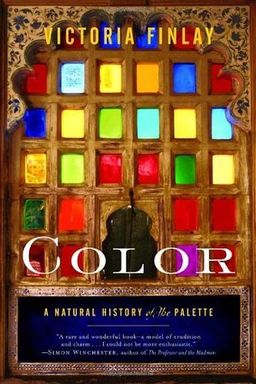
Color cover

Color

by Victoria Finlay

Color: A Natural History of the Palette unveils the fascinating tales behind the pigments that color our world. Victoria Finlay guides readers through an exploration of vibrant hues, revealing their unexpected roles in history, politics, and art. From the ancient use of ochre to the deadly beauty of lead white, this book offers a vivid journey into the rich and intriguing world of color.

Color as Human Story and Scientific Wonder

When you glance at a painting or a fragment of cloth, you probably feel color as a given—'the apple is red, the sky is blue.' But in Victoria Finlay’s Color: A Natural History of the Palette, that assumption dissolves. Finlay contends that colors are not properties of the world but creations of perception and culture: molecular dance meets human meaning. Her journey through pigments—earthy ochres, poisonous yellows, lapis blues, imperial purples—becomes both global travelogue and philosophical mirror. You learn that every pigment is a crossroad: science, story, and trade coalescing into something you see on a wall or wear on your body.

Seeing and Making Color

Finlay starts with light and perception. All colors you see depend on how materials interact with the electromagnetic spectrum: electrons absorb certain wavelengths and reflect others. That physical basis, drawn from Newton and Nassau’s taxonomies, grounds the real drama—the translation from spectrum to sensation. Chemical colors (like the red of a tomato) come from molecular electron transitions; physical colors emerge from structure and refraction (as in rainbows or beetle shells). Newton’s prism experiments remind you that white light is composite, and Finlay cleverly shows how that scientific revelation coexists with cultural naming—indigo’s uncertain position in the rainbow proving that a spectrum is also a social construct.

Matter, Myth, and Meaning

Finlay’s palette moves geographically and historically. Each hue functions as a miniature civilization’s biography. Ochre represents the oldest connection between geology and ritual, linking Aboriginal Dreamings to trade routes and ethical dilemmas of disclosure. Black and brown become origins of art and writing—from cave charcoal to iron gall ink. White reveals the deadly glamour of purity through lead’s toxicity. Red embodies desire and empire—its insect origins in kermes and cochineal entwined with colonial espionage. Orange reflects craft mysticism, where violin varnish connects color to sound. Yellow captures the strange intersection of chemistry and folklore through The Mango-Cow Mystery. Blue, green, and purple tell of trade, taste, and technology: indigo’s riots, celadon’s secrecy, lapis’s pilgrimage, and Perkin’s industrial revolution.

Color as Commodity and Religion

Pigments become theology in matter. Ultrarare hues—lapis ultramarine, Tyrian purple—embodied divine or royal presence. Finlay shows how scarcity made certain colors sacred: mi se celadon kept for Tang imperial altars, saffron threads sanctifying Persian and Spanish rituals, and cochineal dyes reserved for priests. Color tracks human hierarchy; even the humblest pigment carries moral and economic charge. Red and purple show empire’s grip, while indigo documents the cruelty of colonial agriculture. White and yellow unveil industrial exploitation and mythmaking. You begin to see art and ethics merging—every bright hue once passed through hands, risks, or rituals.

The Evolution from Mystery to Manufacture

Finlay’s narrative circles from ancient alchemy to modern chemistry. She portrays pigments as a slow revelation: substances once locked in sacred vaults eventually become open to analysis, replication, and industry. Perkin’s accidental discovery of mauve in 1856 sealed the transformation—color as democratic chemical rather than royal resource. Yet Finlay’s tone is elegiac: the move from pilgrimage and secret craft to industrial patent shifts how we experience beauty. In her closing chapters, she suggests that rediscovery—archaeologists at Famen Pagoda or craftspeople reviving tekhelet—can rekindle that sacred awe within modern science.

Why Color Still Matters

Finlay insists that color remains our most emotional science. It carries human longing and loss—as in Lascaux’s fragile hands or the vanished ultramarine skies of Bamiyan. You are invited to see pigments not as museum artifacts but as living correspondences: each molecule linked to memory, each hue a moral question about purity, authenticity, and exploitation. She concludes that to understand color is to understand ourselves: a species that turns sunlight into symbol. This book teaches you how physical wavelength becomes human testimony—the literal chemistry of civilization.


Ancient Earths and Human Rituals

Finlay begins her chromatic odyssey with ochre, the world’s first paint. Dug from iron-rich earths, ochre marks both the practical and the sacred origins of art. Across continents—from European valleys to Australian deserts—you see how a simple mineral could encode cultural law and social networks. In Aboriginal traditions, ochre trading routes and mining sites like Wilga Mia hold ceremonial power and convey Dreaming narratives. The pigment stood as currency, identity, and medium for transmission of sacred knowledge, yet secrecy dictated which stories could be shown.

Ritual and Secrecy in Pigment

Through the Papunya art movement Finlay explores how western materials met Aboriginal meaning. When Geoffrey Bardon encouraged desert elders to paint Dreamings with acrylics, it crystallized tensions between revelation and concealment—colors became vehicles for contested disclosure. Ochre thus bridges ancient spirituality and modern commodification: canvases travelled from bush towns to Sotheby’s, carrying ethical debates about authenticity and ownership.

Dark Foundations

Following ochre, Finlay turns to black, brown, and charcoal—the visual bedrock of human expression. From Altamira’s animal silhouettes to Borrowdale graphite and Chinese lampblack ink, she traces how 'non-colors' founded drawing and writing. Each dark mark reflects both invention and fragility; exposure ruins cave images as respiration alters chemistry. Later traditions—willow charcoal from PH Coate, Conté’s clay-graphite pencil—exemplify how darkness shaped technique and literacy. Kohl, gall inks, and soot all merge functionality with ritual, showing darkness as creative element, not void. When an artist begins with black, they summon a long lineage of making the invisible visible.

The Broader Lesson

Through these early hues Finlay teaches that art’s birth is geological and communal. Pigment is not just resource but relationship—earth to body, community to narrative. The ochre ceremonies and soot sketches remind you that color’s first purpose was not decoration but connection: to land, to ancestors, and to the act of recording human presence itself.


Purity, Danger, and the Chemistry of White

In Finlay’s world, white is paradoxical: symbol of purity born from poison. Lead white—basic lead carbonate—underpinned painting for centuries, its creamy opacity prized by artists from Vermeer to Reynolds. Yet the same compound sickened generations of painters and cosmetic users. Finlay describes how the Dutch 'stack process' mixed lead shavings with vinegar in manure-sealed pots, yielding soft white flakes after weeks. Ancient recipes met industrial scale, transforming toxicity into tradition.

The Hidden Costs of Beauty

White paints and powders symbolized refinement across Europe, yet the reality was tragic. Factory milk rations to offset poisoning illustrate desperate improvisation before health laws. Cosmetic creams like Laird’s Bloom of Youth blurred sickness into fashion—the pallor of beauty masking chemical injury. Finlay’s story of the St. Louis fatality turns aesthetic pursuit into moral caution.

Decay and Conservation

The Dunhuang caves in China unveil another dimension: how lead pigments degrade. Moisture transforms lead carbonates into sulphides, blackening pale frescoes. A legend of the 'Five-Pigment Girl' merging material and myth underscores Finlay’s thesis—every color carries its mortality. Restoration debates mirror earlier ethical ones: once purity fades, what remains is history’s shadow.

Alternatives and Local Whiteness

Zinc and chalk whites offered later substitutes, though each brought trade-offs in brightness and durability. Balinese artists bury secret white stones; chemists patent new pigments. Throughout, Finlay shows how the chase for perfect light exposes our dual impulse for brilliance and control. White forces you to weigh craftsmanship against consequence—a lesson that echoes beyond painting into all human inventions that prize purity yet invite peril.


Empire and Blood: The Power of Red

Red represents intensity: love, war, and value. Finlay’s account of crimson dyes—kermes and cochineal—reveals how microscopic lives powered empires. Medieval Europe harvested kermes insects from oak trees for royal scarlets; Rome taxed crimson cloth as tribute. When Spain discovered cochineal on Aztec nopal cactus, a new global economy was born. Tiny insects became the lifeblood of colonial wealth, their pigment staining altars and uniforms alike.

Trade, Theft and Technology

The daring tale of Thierry de Menonville—the French botanist who smuggled cochineal from Mexico in 1777—illustrates how color inspired espionage. His mission turned pigment procurement into national strategy: France vying with Spain for control of 'insect gold.' Such episodes bridge natural history with geopolitics, showing pigment as statecraft.

Symbolism and Continuity

Cochineal outlived empire. It survives today as food colorant E120 and in cosmetics, reminding you how aesthetics and consumption intertwine. Finlay meets modern producers in Chile, watching compressors crush insects into powder—a visceral confrontation with the industrialization of beauty. The Inca quipus and medieval robes share a thread of continuity: red as marker of hierarchy, warning, and holiness.

The Lesson Behind the Hue

Finlay’s red chapters make empire tangible. Dyes document human systems of control and desire; pigments are monetary and moral indexes. Beneath every glowing crimson there lies both conquest and creativity—and understanding that tension enriches how you see color in politics, art, and the marketplace.


Craft Secrets and the Sound of Color

Orange becomes Finlay’s bridge between art and craft: the luminous varnish on a Stradivari violin or an eighteenth‑century portrait. She recounts Cremona’s legend of a Sephardic luthier whose varnish shaped Amati’s school, suggesting that the transference of knowledge—resins, recipes, and patience—formed a cultural symphony. Dragon’s blood, benzoin, mastic and amber compose this vivid palette. Each material carries geography and ritual, forming not only appearance but resonance.

Varnish as Cultural Memory

Stradivari’s letters, sun‑drying instructions, and later speculation by Bergonzi and Beare show how artisans treated color as auditory engineering. Finlay parallels it with painters’ misadventures in megilp—a varnish medium that darkened over time—reminding us that perfection often decays. The orange glow of varnish, like music, evolves with age and repair: not static beauty but living transformation.

Synesthetic Connections

Finlay’s speculation that varnish color influences tone echoes Scriabin’s synesthetic theories (the composer who linked sound with color). You learn to perceive color as vibration—the physics of resonance tied to the metaphysics of longing. In every glowing instrument you hear history humming inside resin.

Continuity Through Craft

By culminating orange in this artisanal mythos, Finlay unites science with devotion. Varnish becomes metaphor for persistence—the human wish to keep secrets glowing. Orange teaches you that permanence is not fixed color but endless restoration through care and curiosity.


Myths, Ethics, and the Uncertain Yellow

Finlay’s journey to India confronts storytelling itself. Indian Yellow, long rumored to be made from mango-fed cows’ urine, exemplifies how scientific and moral curiosity intertwine. She retraces T.N. Mukharji’s 1883 letter about piuri production in Monghyr and discovers ambiguity: villagers remember little; clues dissolve in oral gaps. The pigment exists at the border between folklore and fact—a place where ethical horror and colonial fascination overlap.

Investigating Truth

Finlay’s interviews in Bihar with Chaku Pandit and locals reveal how knowledge evaporates through time. Modern experiments prove technical feasibility but moral impracticality. She concludes that color stories, like myths, reveal more about observers than about chemical practice. Colonial exoticism often amplified spectacle, creating legend out of rumor.

Yellow’s Dual Nature

Across cultures yellow oscillates between holiness and toxicity—divine halos or warning signs. In Buddhist robes and Renaissance glazes it signals transcendence; in arsenic or gamboge it signals danger. By combining folk inquiry and lab skepticism, Finlay instructs readers to treat pigment tales critically. Who benefits from belief? Who hides behind it?

A Mirror of Modern Inquiry

Finlay’s investigation of Indian Yellow becomes allegory for knowledge-making itself. Data, myth, and ethics assemble imperfectly—yet the pursuit enriches understanding. The color’s ambiguity mirrors our own search for truth in history and science: luminous but never fully transparent.


Toxic Splendors and Cultural Choice

Finlay’s foray into toxic pigments reminds you that beauty and danger are twins. Orpiment, realgar, and gamboge shine brilliantly while hiding arsenic or geopolitical scars. Artists from Cennino Cennini to modern conservators echoed the same warning: handle with care. You sense admiration tempered by fear—a medieval command, 'look out for yourself,' still valid today.

Arsenic Elegance

The arsenic sulfides of orpiment and realgar gave dazzling yellows and oranges. Finlay shows how their instability and toxicity symbolized humankind’s willingness to court peril for radiance. Gamboge, drawn as resin from Garcinia trees, adds political texture—harvested amid conflict, it carried fragments of bullets in shipments to paint stores decades later. Color literally absorbed violence.

Different Attitudes to Poison

Finlay contrasts cultural responses. In Asia arsenic compounds served as medicine; in Europe they terrified artisans. Through Rumphius’s writings and modern anecdotes she shows how belief systems mediate risk—some see divine favor, others scientific hazard. The pigment thus becomes moral text—the same compound read as cure or curse.

Respecting Materials

Her message extends to modern creators: know your pigments as histories, not just hues. Safe practice and analytical awareness pay homage to artisans who lacked protection. The toxicity chapter transforms aesthetic fascination into ethical mindfulness: brilliance demands responsibility.


Trade, Taste and the Blue Spectrum

Blue’s serenity hides human struggle. Finlay entwines lapis lazuli’s sacred ultramarine with indigo’s colonial politics and celadon’s imperial restraint. Each blue story explores longing for transcendence amid material constraint.

From Pilgrimage to Chemistry

Afghanistan’s Sar‑e‑Sang mines supplied medieval Europe’s ultramarine—the Virgin’s robe in Florence owed its sky to miners in remote valleys. Grinding lapis and extracting 'first pressing' pigment demanded ritual labor. Michelangelo’s financial struggle for blue paint dramatized dependence on patrons, while synthetic French ultramarine by Guimet and Gmelin later democratized color. Finlay’s contrast between Bamiyan’s ancient murals and factory pigment expresses both loss and progress.

Indigo’s Turbulent Legacy

Moving from rock to plant, she recounts woad’s European pride and indigo’s colonial cruelty. The Bengal dye riots of 1860 reveal how blue agriculture enslaved farmers; across the Atlantic, Eliza Lucas’s plantations show parallel exploitation. Even where chemistry improved, human cost persisted. Blue thus becomes not peace but protest—the 'Blue Mutiny' recast as hue of resistance.

Ceramic Greens of Wisdom

Finlay situates mi se celadon within Tang China’s philosophy of restraint: olive glaze as luxury of simplicity. The rediscovery at Famen Pagoda proves that subtlety can encode exclusivity—a muted green more precious than gold. Taste becomes politics, teaching that quiet color can signify ultimate power.

Altogether, blue and green chapters fuse material and mindset. You learn that serenity often masks struggle: behind every cool surface lies fire, trade, and hierarchy. Finlay’s palette of blues reminds you that calm tones can carry ferocious human histories.


The Age of Purple and Industrial Revelation

Finlay ends her journey with purple—a color bridging royalty, religion, and chemistry. Ancient Tyrians harvested murex snails to dye robes reserved for emperors. The process was slow, smelly, and revered. Fast‑forward to 1856: William Henry Perkin’s accidental synthesis of mauve rewrote history. Suddenly, color escaped monopoly and entered industry.

Mythic Origins and Modern Recovery

Archaeology in Tyre and ethnography in Mexico reveal parallel shell‑based traditions. Mixtec dyers in Oaxaca still coax purple from caracola snails with sunlight oxidation, echoing ancient Mediterranean practice. Finlay visits them, connecting biological mechanism to heritage. In both places, purple signifies respect and continuity.

Science Reconnecting Faith

Jewish tekhelet’s rediscovery synthesizes Finlay’s thesis perfectly: modern chemists recreated sacred blue using Murex trunculus photo‑chemistry. Light conditions yield purple or blue—the material proof of theology interacting with physics. Perkin’s mauve and tekhelet’s rebirth mark two revolutions: industrial and spiritual. Both show color as knowledge returning from oblivion.

The Closing Note

By ending with purple, Finlay situates color within continuity—ancient artisans, modern chemists, and seekers all collaborating across centuries. The palette cycle that began with earth and ritual concludes with synthesis and rediscovery. Color endures because humans keep chasing the invisible spectrum between matter and meaning.


Saffron and the Economics of Beauty

Finlay’s saffron narrative crystallizes how color operates as both labor and luxury. The stigma threads of Crocus sativus, plucked by hand, embody devotion and precision. In Spain’s Consuegra festival she watches villagers compete to extract hundreds of stigmas in minutes—a ritual of patience turned sport. In Iran’s industrial hubs she finds scale without losing touch: thousands of women sorting filaments under purple dawns, transforming local heritage into global trade.

Cycles of Prosperity and Decline

Saffron Walden’s history reveals color economics: boom, imitation, collapse. Authenticity swaps with fraud as markets fluctuate. In each phase saffron retains symbolic value—as purity, hospitality, or mourning hue. The spice’s spiritual resonance blends seamlessly with its material demand.

Global Contrast

Finlay juxtaposes handcraft Spanish rituals with mechanized Iranian sorting lines, showing that labor, economics, and meaning shift yet remain interrelated. Saffron’s appeal endures because it unites intimacy and scale: individual fingers and industrial billions converge in one color.

Saffron closes Finlay’s circuit of hues by returning to earth and devotion. It reinforces her insight that beauty always contains labor, and pigment stories are human economies of risk, faith, and delight—a thread of sunlight woven through hands worldwide.

Dig Deeper

Get personalized prompts to apply these lessons to your life and deepen your understanding.

Go Deeper

Get the Full Experience

Download Insight Books for AI-powered reflections, quizzes, and more.