
Idea 1
How Societies Choose Survival or Collapse
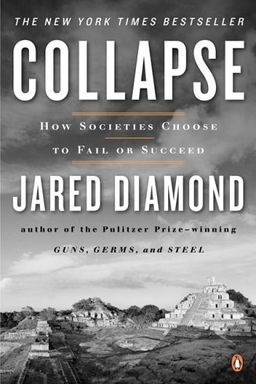
Why do some societies thrive for centuries while others destroy their environments and vanish? In Collapse: How Societies Choose to Fail or Succeed, Jared Diamond argues that societal survival hinges not on luck but on choices. Through a sweeping comparative lens—from Easter Island and Norse Greenland to modern Montana and China—he reveals how human responses to ecological stress determine whether civilizations endure or implode.
Diamond organizes his argument around a practical diagnostic tool—the Five-Factor Framework: environmental damage, climate change, hostile neighbors, loss of trade partners, and a society’s response. He shows that collapse rarely stems from one cause; instead, multiple stresses converge and amplify one another. The decisive variable is always how a society perceives and reacts to those stresses. You can use these five factors as your own checklist for evaluating modern crises, from deforestation in the Amazon to groundwater depletion in the U.S. Southwest.
Interlocking environmental damage
Throughout the book, Diamond maps eight recurring forms of ecological harm: deforestation, soil erosion, water mismanagement, overhunting, overfishing, invasive species, population growth, and rising consumption. These act together like compounding diseases. Easter Island’s deforestation led to soil loss and famine; Chaco Canyon’s irrigation and tree-cutting caused arroyos and water collapse; Australia’s clearing and overgrazing brought salinization that lasts centuries. When many damages overlap, recovery becomes nearly impossible.
Comparative method: history as experiment
Diamond insists collapse can be studied scientifically. Because you can’t run controlled experiments on societies, you must compare them as natural experiments. Archaeologists, climatologists, and geochemists provide data that replace myth with evidence—tree rings for droughts, packrat middens for vegetation change, isotopes for trade goods. This cross-checking allows you to test whether deforestation, drought, or isolation actually correlate with social decline. Through comparison, story becomes testable hypothesis.
Cultural choices and institutional will
Montana today mirrors ancient collapses and reminds you that wealth does not guarantee resilience. In the Bitterroot Valley you meet ranchers, developers, and miners torn between profit and preservation. Their debates over zoning, mine cleanup, and water rights echo Iceland’s conservative risk-aversion or Greenland’s fatal refusal to adopt Inuit whaling techniques. Diamond argues that values—what people consider success—often matter more than technology. A community that prizes short-term gain or status symbols can ignore slow ecological decay until it is too late.
Collapse and adaptation across time
From Easter Island’s isolated deforestation to the Maya’s drought-warfare spiral, Anasazi water failures, and Rim-driven Norse fragility, each case illustrates interacting systemic pressures. Meanwhile, success stories like Tikopia, New Guinea, and Tokugawa Japan prove that societies can learn restraint—through either bottom-up communal rules or top-down government foresight. The contrast between Haiti and the Dominican Republic, or Kutubu and Salawati oil fields, further shows how leadership and institutions can redirect environmental destiny even under identical geography.
Modern global stakes
Diamond closes with a global warning. Today the world faces twelve interconnected risks—from habitat loss and biodiversity decline to toxic pollution and resource exhaustion. Like the Dutch polder system, Earth is one shared dike: failure anywhere affects everywhere. China’s industrial surge, Australia’s land crisis, and global minerals extraction demonstrate that planetary scale now amplifies local mistakes. Yet Diamond remains cautiously hopeful: societies that recognize feedbacks, enforce accountability, and unite technical knowledge with political will can bend collapse into sustainability.
Core takeaway
Collapse is not inevitable. The deciding factor is collective response—how societies decide to see, value, and act on their environmental realities. Past societies failed or succeeded by their choices; the same test now applies to ours.
Across all parts, you learn to detect patterns: complex interactions, cultural inertia, scale mismatches, and the politics of denial. Diamond’s cases differ by geography and era, but all converge on one truth—you can’t ignore ecological feedbacks without paying an eventual price.