
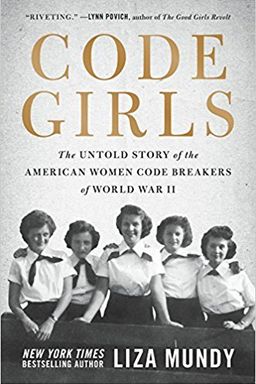
Code Girls cover

Code Girls

by Liza Mundy

Code Girls reveals the incredible story of American women code breakers who played a pivotal role in the Allied success during World War II. Through interviews and declassified documents, Liza Mundy uncovers their intelligence feats and societal impact, bringing to light a forgotten chapter in history.

The Hidden Army of Codebreakers

What if the secret weapon that shaped World War II wasn’t a machine or a general, but thousands of young women working in sealed offices? This book reveals how American cryptanalysis evolved from eccentric prewar experiments into a massive intelligence enterprise driven by women—college graduates, schoolteachers, linguists, and mathematicians—who turned intercepted noise into strategies that changed the course of the war.

You begin with an origin story grounded in unconventional places: George Fabyan’s Riverbank Laboratories in Illinois, where William and Elizebeth Friedman learned to decode messages under the eccentric millionaire’s patronage. Add to that Agnes Meyer Driscoll’s triumphs over Japanese fleet codes long before the war, and you see the seedbed of later brilliance. The craft of deciphering—once a fringe hobby—matures into a disciplined science of substitution, transposition, and pattern analysis. When war breaks out, that groundwork becomes the Army and Navy’s foundation for scaling up intelligence work.

Recruiting a secret brain trust

By 1942, this groundwork explodes into mass recruitment. Manila envelopes slide under dorm-room doors at Wellesley, Smith, and Radcliffe, quietly summoning top women for cryptanalysis training. Deans like Ada Comstock and professors like Helen Dodson organize clandestine classes on ciphers, frequency analysis, and secrecy protocols. The Navy scours elite campuses for language and math talent, while the Army recruits steadfast teachers like Dot Braden from the Midwest and South. Admittance tests measure discretion as much as intellect. The pitch, wrapped in patriotic secrecy, transforms ordinary classrooms into hidden laboratories of national defense.

In these rooms, instructors teach Vigenère squares, Playfair methods, and route transpositions using cardboard alphabets. Students submit weekly problem sets, forbidden to utter the word “cryptanalysis.” The result is a new professional identity—women trained in logic, secrecy, and precision—ready to move to Washington to serve as operational analysts. That silent social revolution marks one of the war’s quiet milestones.

Arlington Hall and the birth of industrial intelligence

Once in Washington, these recruits converge at Arlington Hall, a once-genteel finishing school converted into the Army’s main cryptanalytic station. Under the direction of Colonel Preston Corderman and pioneers like William Friedman, Arlington Hall becomes an information factory—corridors of desks, tabulating machines, typewriters, and bathtubs filled with intercepted messages. The place grows to 8,000 employees—7,000 of them women—and replaces the myth of the lone genius with the reality of an assembly line of analytical labor. Teams specialize as starters, overlappers, or readers, processing thousands of Japanese Army and merchant messages daily.

Here, secrecy breeds innovation. Practical authority outranks formal hierarchy; promotions depend on insight, not on uniform. Solomon Kullback jokes, “You didn’t go by rank. You went by what people knew.” The effect is a meritocracy that allows brilliant women like Ann Caracristi and Wilma Berryman to lead units despite lacking commissions. Arlington Hall becomes a paradox: rigidly secretive, yet intellectually fluid and collaborative.

Parallel power: The Navy Annex and the WAVES

Across town, the Navy’s Communications Annex operates in a culture both parallel and competitive. Its Women Accepted for Volunteer Emergency Service—the WAVES—turn cryptanalysis into uniformed service. Directed by Mildred McAfee and drilled at Smith and Mount Holyoke, the WAVES train on The Bluejacket’s Manual, salute in Mainbocher uniforms, then settle behind code sheets of five-digit groups, attacking the JN‑25 Japanese fleet code. The work is exacting—stripping additive upon additive until hidden coordinates reveal enemy convoys—and the payoff enormous: decrypted positions that guide victories at Midway and Guadalcanal.

The Navy’s female corps rapidly expands, running continuous shifts that make 80% of domestic codebreakers women by 1945. Their days blend patriotism, precision, and exhaustion. Over time, uniformed structure grants legitimacy even as it enforces limits: women can lead operations, but most never serve overseas. The contradictions of opportunity and confinement define the era’s gender politics.

The arc of triumph and cost

These intertwined operations—Arlington Hall’s Army brain trust and the Navy’s WAVES network—produce the breakthroughs that shape war strategy: breaking Purple and JN‑25, mapping the Japanese Army’s logistics, building bombes to defeat Enigma, crafting radio deceptions to secure D‑Day. And yet beneath the victories lies private strain. Secrecy oaths isolate workers even from family. Relationships falter under the burden of silence. Figures like William Friedman collapse under mental stress; others carry unspoken grief over intercepted deaths of loved ones.

When victory arrives in 1945, joy mingles with ambivalence. The women who powered cryptanalysis return to homes that seldom recognize their labor, though a few—Ann Caracristi, Wilma Berryman—continue into the founding years of the NSA. The story closes on a long-delayed recognition: the realization that America’s wartime intelligence, and much of modern computing’s lineage, stem from this hidden army of female minds.

Core understanding

World War II cryptanalysis was never a solitary pursuit of geniuses but a social, emotional, and industrial phenomenon—built largely by women whose secrecy kept them invisible for generations. Their story reveals how intellect, organization, and moral endurance can alter global events as profoundly as any weapon.


From Riverbank to War Rooms

You trace the story back to the eccentric beginnings of American codebreaking. At Riverbank Laboratories, millionaire George Fabyan funds bizarre research linking Shakespeare to hidden codes. There, Elizebeth Smith and William Friedman transform amateur curiosity into professional science. The couple’s studies of cipher systems produce early government manuals and methods that become templates for the Army’s Signal Intelligence Service (SIS). Agnes Meyer Driscoll, another pioneer, applies similar rigor in the Navy, dissecting Japanese systems like the earlier Red and Blue codes. These precursors establish both the intellectual lineage and the gendered tension that will define the wartime effort.

Building a professional discipline

Before WWII, cryptanalysis is an eccentric hobby—a blend of linguistics, mathematics, and obsession. The Friedmans professionalize it by treating messages as data rather than riddles. They develop frequency counts, statistical tests, and the discipline of error checking that later underpin all Allied decoding. (Note: These foundations anticipate today’s data‑science logic of pattern recognition.) By the 1930s, the SIS inherits their exacting standards, embedding method where previously there was art.

At the same time, institutional obstacles keep female cryptanalysts peripheral. Driscoll’s brilliance meets barriers of rank and pay inequity. Yet when the nation mobilizes for war, these experienced “code women” become the teachers of the next generation. The war expands what pioneers proved possible, and the amateur’s passion becomes a mass profession.

Key takeaway

Every large technological mobilization has its hidden root system—improbable innovators, marginal spaces, and informal learning networks that later scale into national infrastructure.

In that light, Riverbank and the Friedmans’ libraries are more than curiosities: they form the invisible prehistory of wartime intelligence, blending scholarship, secrecy, and improvisation into a replicable craft.


Secret Recruitment and the Making of a Workforce

You glimpse recruitment that feels closer to espionage than employment. Navy and Army officials quietly contact women through deans and professors at the Seven Sisters and elsewhere. Admiral Leigh Noyes defines ideal candidates as “bright, close‑mouthed native students,” signaling both elitism and bias of the era. Letters in plain envelopes summon women to interviews they cannot discuss. What emerges is a dual system: the Navy pulls from elite colleges for mathematical and linguistic excellence; the Army recruits teachers and practical problem solvers across states.

Training for secrecy

Courses in cipher work operate under fictional covers. Women sign oaths promising silence and learn substitution and transposition in locked classrooms. They complete problem sets using hand‑built cipher wheels, learn to grade each other’s work, and begin internalizing dual disciplines: analytic rigor and absolute discretion. To fail is not only academic but moral. Success means qualifying for transfer to Washington, where their real work begins at code rooms in the Munitions Building, later Arlington Hall.

Two recruitment cultures

The contrast between Army and Navy styles reveals much about institutional personality. The Navy prizes intellectual elite and social polish; the Army prizes endurance and loyalty. Dot Braden’s journey from Lynchburg through an interview at the Virginian Hotel embodies the Army’s pragmatic, door‑to‑door method. Both models succeed because they match the internal logic of their services—and together they produce the most female‑heavy intelligence workforce in U.S. history.

By the time these women reach Washington, they are already veterans of secrecy and self‑discipline. The mail slots and manila envelopes of 1941 quietly mark the creation of an entirely new labor category: intellectual soldiers of the home front.


Inside Arlington Hall’s Analytic Machine

Inside Arlington Hall, the landscape of intelligence changes from individual insight to coordinated production. The converted finishing school becomes a sprawling campus of temporary buildings and humming tabulators. Dot Braden’s desk is one of thousands forming a three‑shift operation to absorb global intercepts. The model resembles an industrial assembly line—each specialist handling a stage of the analytic process.

Division of cognitive labor

Messages move from traffic editors who de‑duplicate texts, to overlappers who align additive sequences, to readers who draft plaintext, and to translators who render it into intelligence. Color‑coded systems, pneumatic tubes, and filing banks increase throughput. What once took weeks now takes days. The improvement is systematic, not accidental: analytical pedagogy itself evolves into workflow engineering. You can think of it as a proto‑data‑processing network running on pencils and memory.

Meritocracy and collective mind

Rank dissolves in favor of expertise. Civilian women direct Army officers by virtue of technical knowledge; Corderman’s tolerant leadership sustains this unorthodox meritocracy. Humor and camaraderie coexist with exhaustion: friendly pranks about “solving” the Coke machine, glee clubs, and amateur theater temper the long nights. Files form a collective memory so strong that patterns often surface not from data but from someone’s recollection of a similar message weeks earlier.

Defining shift

Arlington Hall transforms cryptanalysis from intuition to industry. Its egalitarian culture accelerates discovery, showing that collective intelligence—distributed, persistent, and methodical—outperforms isolated genius.

The model established here anticipates modern analytic organizations from tech firms to intelligence agencies: information flows smoothly when expertise outweighs formality, and shared memory becomes the engine of speed.


Breaking Purple and the Machine Age of Ciphers

Among all wartime puzzles, none looms larger than the Japanese Purple machine—a cipher device using electric switches that change paths daily. Its complexity surpasses previous systems, splitting letters into multiple circuits. The Army team led by William Friedman, with mathematician Genevieve Grotjan, refuses to concede defeat. Months of pattern analysis lead to her pivotal observation: recurring cycles prove the switching hypothesis correct. The resulting mechanical replica can read Japan’s diplomatic communications, providing insights from Tokyo’s embassies across Axis Europe.

A human and technical drama

The Purple break illustrates how detailed observation converges with intuition. Grotjan’s modest, methodical work yields an insight that shifts policy: decrypted messages from Ambassador Oshima in Berlin reveal German defenses and morale, data vital to Allied strategy. Friedman calls it the hardest successful cryptanalytic challenge ever solved—but the pressure shatters his health, underscoring the psychological toll of secret success.

The victory also deepens ties with Britain, linking Purple decrypts with Ultra and creating the intelligence foundation for D‑Day. Yet Purple remains top‑secret; its “Magic” summaries circulate only among a handful of generals and the President. Public silence preserves advantage but erases credit. The same invisibility that saves the war consigns its workers to historical obscurity for decades.

Conceptual legacy

The Purple breakthrough refines modern cryptology: the fusion of human pattern recognition and machine logic. It marks the true birth of cybernetic analysis—where women mathematicians like Grotjan bridge intuition and computation.


The Navy’s Codebreakers and the Power of the WAVES

While the Army refines mechanical decryption, the Navy’s WAVES bring discipline and scale. Women like Anne Barus and Bea Norton dive into JN‑25, the Japanese fleet code built on five‑digit groups and hidden additives. Their task is arithmetic persistence: test, subtract, and verify, group by group, to uncover ships’ positions. This monotony conceals strategic power—each recovered additive helps chart enemy logistics and anticipate movement. In combination with radio intelligence, the results decisively aid Midway and later Pacific battles.

Training, image, and social friction

Creating the WAVES program required political finesse. To win Congressional approval, leaders like Eleanor Roosevelt and Mildred McAfee insist on professional uniforms and moral reassurance. Smith College becomes officer‑training ground; Mainbocher uniforms symbolize both respectability and constraint. Women oscillate between empowerment and surveillance—celebrated in press photos yet restricted in mobility. The Navy’s bureaucratic urgency overrides ideals: many WAVES are rushed through training and placed at Naval Annex desks within weeks, because cryptanalytic demand outweighs ceremony.

Human texture of uniformed labor

Within the Annex, night watches and code sheets define existence. The rotation of shifts becomes a metronome of secrecy. Despite cramped barracks, the WAVES build fellowship—bridge games, coded wartime jokes, even shared hair tonic doubling as cleaning fluid. Their visibility matters: they normalize women’s presence in technical military work and demonstrate that intellect can serve uniform as effectively as weaponry.

Operational insight

The JN‑25 effort proves that persistence, order, and teamwork—not flash brilliance—win wars of information. It translates the virtues of the classroom into national defense.

By war’s end, the Navy’s codebreaking ranks are predominantly female, an unprecedented inversion of hierarchy that prefigures later debates over gender equality in military intelligence.


Bombes, Enigma, and Allied Collaboration

The Atlantic war opens another front in cipher industrialization: the American bombe project. At Dayton’s National Cash Register Company (Sugar Camp), engineer Joseph Desch and hundreds of WAVES design and assemble electromechanical bombes capable of testing vast Enigma key spaces. Each commutator wheel must be wired precisely, an act of repetitive precision akin to factory labor but directed toward cryptologic ends. These bombes—descendants of British models but scaled to American engineering mass—become crucial to anti‑U‑boat operations.

Engineering meets secrecy

Dayton’s workshops pulse with urgency: broken relays, oil shortages, and nighttime soldering shifts dramatize how industrial America mobilizes not just tanks but thinking machines. When operational bombes reach the Naval Annex, many female assemblers accompany them to serve as operators. In Washington, they run bays of machines under Jimmie Lee Hutchison’s supervision, test printouts on M‑9 simulators, and relay successful key settings. Within a year, the cycle time from German transmission to Allied understanding drops to hours or minutes, enabling convoy rerouting and U‑boat ambushes.

Scale and consequence

By mid‑1944, American bombes run continuously in collaboration with British Ultra operations, feeding directly into D‑Day logistics. When decrypted traffic reveals German shortages or misdirected reserves, Allied commanders exploit the window. The effect is operational dominance over the Atlantic and steady erosion of the U‑boat threat. This mechanization of logic signals a new epoch—where codebreaking becomes engineering as well as language work. The often‑invisible Sugar Camp WAVES thus populate the hinge connecting mechanical invention to human analysis.

Underlying message

Every intelligence victory combined human intuition, female labor, and mechanical computation—showing that digital history began not with computers alone but with coordinated craftwork by unsung operators.


Deception and the Final Push to Victory

Intelligence shifts from passive reception to active manipulation in 1944. Beyond decrypting enemy traffic, Arlington Hall’s specialists master deception. Protective security units use SIGABA machines to encode Allied messages and simultaneously generate fake ones to mislead German analysts. Their crowning collaboration with British deception planners produces Operation Fortitude—the radio illusion of a massive phantom army poised at Calais. For months, these women fill the airwaves with counterfeit orders, maintaining the fiction even after Normandy begins.

When signals themselves become weapons

The craft of deception demands deep understanding of authentic radio rhythm—the cadence of real communications. Analysts and operators design fake traffic matching genuine call signs and workload. This sophistication pays off: intercepts on June 6, 1944 show Germans reporting landings at the Seine mouth while still believing Calais is the main target. In the Navy’s Enigma rooms, Ann White’s team reads these in near real time, verifying that strategic surprise holds. Signals intelligence thus acts as both dagger and shield, ensuring D‑Day’s success.

Endgame and transformation

By 1945, analytic precision achieves global reach. The Army’s address and transport code recoveries isolate Japanese supply lines; the Navy’s Enigma work corners the last U‑boats. When the JAH intercept detailing Japan’s surrender message arrives on August 14, language experts like Virginia Aderholdt translate it under silence orders until Truman’s announcement. The war that began in secrecy ends with a final act of linguistic clarity. For those inside Arlington Hall, celebration mixes with disbelief—they have helped collapse an empire from behind locked doors.


Secrecy, Strain, and the Afterlife of the Codebreakers

The victory exacted costs no medal could offset. For years, secrecy oaths forbade veterans from speaking of their work. Families, lovers, and even children remained uninformed. Many suffered isolation and mental fatigue. William Friedman’s breakdown epitomizes the psychic price, but ordinary women bore theirs silently—reading intercepted obituaries of ships carrying brothers or friends, then returning to duties as if nothing had happened.

Postwar silence and erasure

After demobilization, thousands of women leave Washington, marry, or resume teaching, carrying within them unspoken expertise. A small cadre stays, shaping Cold War cryptanalysis through projects like Venona. Ann Caracristi rises to deputy director of the NSA, proof that competence eventually pierces hierarchy. Yet public history forgets them for decades. Only declassifications in the late twentieth century restore their place as founders of modern information work.

Moral and social legacy

In retrospect, the codebreakers prefigure the digital age: data professionals before computers. They demonstrate the fusion of mathematics, linguistics, and intuition that centuries later defines cybersecurity. More personally, they rewrite what twentieth‑century womanhood could encompass: intellect under discipline, leadership under anonymity, and collaboration without recognition.

Enduring insight

Secrecy safeguarded the war effort but also postponed justice. The women of Arlington Hall and the WAVES teach that progress often begins invisibly—its pioneers confined by silence until history finally listens.

Dig Deeper

Get personalized prompts to apply these lessons to your life and deepen your understanding.

Go Deeper

Get the Full Experience

Download Insight Books for AI-powered reflections, quizzes, and more.