
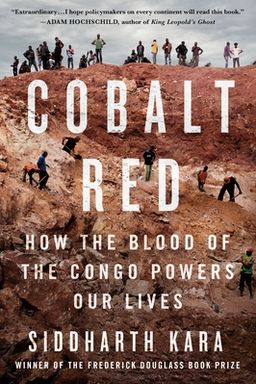
Cobalt Red cover

Cobalt Red

by Siddharth Kara

Cobalt’s Hidden Human Price

How do you reconcile a cleaner energy future with a bloodstained present? In Cobalt Red, Siddharth Kara argues that the cobalt powering your phone, laptop, and electric vehicle flows through a system that normalizes child labor, lethal hazards, and environmental poisoning in the Democratic Republic of the Congo (DRC). He contends that the global battery economy converts Congolese bodies and landscapes into invisible subsidies for technological progress—and that any ethical promise of electrification collapses unless you confront how this mineral is actually mined, traded, and refined.

Kara’s claim is stark: the world’s cobalt supply chain is both indispensable and irredeemably porous, with artisanal production—often involving children—blended into corporate streams at depots, processors, and refineries. He fuses field testimony, supply-chain mapping, and public‑health research to show why due‑diligence pledges from big brands ring hollow on the ground. Only structural reform that centers Congolese lives—fair pay, legal protections, health safeguards, and true traceability—can align clean tech with clean conscience.

What the book asks you to see

You begin with a child’s corpse at Kamilombe (September 21, 2019), a face fixed in dread. That image orients everything you encounter—Faustin’s family digging a five‑meter pit in Kipushi for roughly $1 per person per day; André and Kisangi, eight and ten, hauling sacks and sieving in copper‑colored pools; Priscille, who says “Here it is better not to be born,” after miscarriages and her husband’s death by lung disease. Kara keeps returning you to places—Kipushi, Likasi, Kambove, Kolwezi—so the horror you witness is a pattern, not an outlier.

A moral anchor

“The heart of Africa reduced to the bloodstained corpse of a child, who died solely because he was digging for cobalt.”

How cobalt really moves

The supply chain is not a tidy line; it’s a web that leaks everywhere. Creuseurs (diggers) sell sacks to négociants on motorbikes, who ferry them to depots (Depot Tiger, Depot 233, Depot 1818 run by Boss Peng, Boss Chen) where Chinese buyers post price lists and use handheld XRF devices to grade ore. From there, mixed loads go to processors—CDM (Congo DongFang/Huayou), CHEMAF, CMOC/TFM, KCC/Glencore, COMMUS—before export, often to China, which refines ~75% of the world’s cobalt (Huayou alone holds ~22% market share). Once ore is mixed at depots, on trucks, or in early processing, you cannot distinguish artisanal from industrial origin. That makes corporate clean‑sourcing claims largely unverifiable.

Why Congo is central

Geology is destiny here. The Katangan Copper Belt’s sediment‑hosted stratiform deposits (think “raisins in a cake”) put cobalt‑rich heterogenite near the surface, especially around Kolwezi—the richest, most accessible cobalt deposit on earth. Families can reach high‑grade “raisins” with shovels and buckets (Kipushi averages ~1% cobalt; Kolwezi pockets exceed 10%). Because cobalt stabilizes high‑energy cathodes (LCO for electronics; NMC/NCA for EVs), EV growth and energy storage bind global decarbonization to this narrow geography (Note: LFP batteries reduce cobalt demand in some EV segments, but tradeoffs in cold‑weather performance and energy density keep cobalt cathodes dominant for many mid‑to‑long‑range applications).

Who profits—and who pays

Kara measures the human and environmental toll. Germain, a University of Lubumbashi researcher, finds miners with 40x the cobalt in urine versus control groups, alongside 5x lead and 4x uranium. Villages inhale sulfuric dust from processing plants; children develop birth defects and lung disease; rivers near sites like Tilwezembe run with industrial acids and trace metals. Meanwhile, cooperatives (COMIKU, CMKK), soldiers, and state agencies (SAESSCAM/SAEMAPE) often extract fees and enforce control, sometimes violently—like Zeus, a soldier who shot a boy for selling outside his network at Mashamba East. Corporate assurances from the Responsible Minerals Initiative or Global Battery Alliance rarely translate into field presence or protection.

What must change

To square climate goals with human rights, you cannot leave the bottom of the chain untouched. ASM (artisanal and small‑scale mining) is not marginal; sites like Shabara (on Glencore’s Mutanda concession) reportedly produce 15k–17k tons per month for Chinese buyers, and Kasulo’s labyrinth of 2,000+ tunnels moves vast tonnage as well. Model sites—CHEMAF’s Mutoshi with Pact; CDM’s formalized Kasulo—show fleeting improvements but fail under weak pay, mixing, debt bondage, and political capture. Real reform means formalizing ASM with living wages, demilitarizing sites, redesigning logistics so miners can sell directly, mandating continuous on‑the‑ground audits, and enforcing environmental and health safeguards (compare: Fairtrade/Fairmined gold experiments that pair premiums with strict local governance—useful, imperfect analogs).

This book leaves you with an inescapable link: every charge you take today is tethered to a place where families dig, wash, and breathe to survive. Unless you push companies and policymakers to pay Congolese miners fairly, track cobalt credibly, and repair environmental harms, the energy transition risks repeating an old story—green at the tailpipe, red at the source.


Lives In The Pits

Kara brings you face‑to‑face with the labor system that makes cobalt cheap: families dividing tasks across generations under constant threat of injury, hunger, and coercion. He doesn’t let you generalize. He names people—Faustin, Priscille, André and Kisangi, Muteba and Kosongo—and places—Kipushi, Likasi, Kambove, Kolwezi—until the abstraction “child labor” becomes a ledger of daily choices forced by poverty and power.

A family economy of survival

You watch how men dig pits and tunnels, women and girls wash ore as laveuses, and small boys break stones and sieve (laveurs). At Kipushi, André (8) and Kisangi (10) haul sacks through copper‑colored pools. A team like Faustin’s might fill three raffia sacks a day, earning ~$2.80 split among many, which can mean about $1 per person. Priscille’s lament—“better not to be born”—captures a calculus where sending a child to school means sending a family to bed hungry.

Coercion that looks like choice

Debt bondage is common. Sponsors front tools, food, or rent, then buyers force miners to sell ore back at submarket prices until debts—poorly recorded—are “repaid.” At Tilwezembe, boys who cannot get registration cards pay daily fees (CF 200) to cooperatives like CMKK/COMIKU just to dig. SAESSCAM/SAEMAPE officers and militia appear regularly, turning regulation into rent extraction. The result: what looks like informal hustle is, in practice, a web of compulsion that meets ILO definitions of forced labor.

Violence as enforcement

When teenagers try to sell independently, soldiers intervene. Kabola was recruited by a soldier named Zeus at Mashamba East, paid CF 2,000 per day, then shot when he attempted a direct sale to a depot. At Tilwezembe, accounts of children locked in shipping‑container cachots, deprived of food, and beaten circulate as warnings. Lubo, a child replacing his injured father in a tunnel, died in a collapse; the family’s debt and hunger sent him underground.

Survival’s equation

“If we do not dig, we do not eat.”

Injury, grief, and abandonment

Muteba (15) lost both legs when a pit collapsed; his brother Beko died beside him. Kosongo started digging at 11 and now faces double amputation after a tunnel failure. SAESSCAM paid initial treatment in some cases but offered no sustained care—mirroring the broader health vacuum Kara documents. Meanwhile, sexual violence at sites like Kipushi leaves girls with infants strapped to their backs as they wash ore in toxic pools—compounding exploitation with lifelong burdens.

Why this persists

The root is structural: extreme poverty squeezes families into mining, and local power—cooperatives, soldiers, militias—converts need into reliable labor and revenue. Permit fees and “access charges” keep children unregistered and vulnerable; sponsors’ advances keep tunnels staffed; violence polices dissent. (Note: similar patterns appear in debt‑bonded garment work or brick kilns; Kara’s contribution is to trace those dynamics directly into a mineral central to green tech.)

What you can’t unsee

At Kamilombe, a 2019 collapse buried 63 men and boys; only four bodies were recovered. Kara’s point is not simply that hazards are high; it’s that the system prices children’s lives as expendable line items in a global supply chain that celebrates sustainability elsewhere. Unless miners receive living wages, social protections, and legal recourse, child labor will remain a feature—not a bug—of cobalt’s low cost.

  • Economic levers: daily fees, forced sales, opaque debts, monopoly depot pricing
  • Coercive actors: cooperatives (COMIKU/CMKK), SAESSCAM/SAEMAPE, FARDC soldiers, local militias
  • Predictable outcomes: child labor normalization, recurrent tunnel collapses, permanent disability, intergenerational poverty

Kara compels you to replace abstract outrage with operational clarity: if debt, fees, and gatekeeping yield cheap ore, then reform must break those specific gears. Otherwise, you are just paying for the appearance of change while the same children keep digging.


A Porous Supply Chain

You may picture clean procurement charts from mine to battery. Kara takes you into the mud and shows how cobalt actually flows: a polycentric market where artisanal and industrial streams mix repeatedly, erasing provenance long before metal reaches a smelter. The result is systemic laundering—not just of ore, but of ethical risk—through nodes designed to optimize opacity and price.

Bottom layer: pits, bike lanes, pink tarps

At the base are creuseurs digging heterogenite by hand. Négociants—often teenagers on motorbikes—shuttle sacks to depots marked by pink tarpaulins. At Depot 1818, Boss Peng grades two sacks (71.6 kg) with a handheld XRF (3.1% cobalt) and pays cash. Miners lose 25–50% to transport and middlemen; negotiants pay annual authorizations, rationalizing deep cuts from miners’ take. Depots seldom ask where ore came from; price lists by grade prioritize throughput over provenance.

Mixing nodes that erase origin

Depots (Depot Tiger, Depot 233, Hao, Jin, Diop, Cu‑Co) aggregate ore into red trucks that head to processors like CDM (Congo DongFang/Huayou), CHEMAF, CMOC/TFM, KCC/Glencore, and COMMUS. At Musompo—the region’s largest buying market—dozens of depots pool sacks from across Lualaba and Haut‑Katanga. Loads are combined by grade and moisture, not by mine, and then re‑mixed at concentrators. By the time a shipment becomes cobalt hydroxide for export, it is analytically impossible to segregate artisanal from industrial origin.

Structural opacity

“It is impossible to isolate artisanal from industrial production.”

Scale makes mixing unavoidable

Shabara, an enormous artisanal complex on Glencore’s Mutanda concession run by COMAKAT, reportedly moves 15k–17k tons of ore per month—volumes too large to bypass formal buyers. Kasulo’s 2,000+ tunnels add high‑grade tonnage from within a walled “formalized” site. In Fungurume, Kara watches depot trucks drive back into Tenke Fungurume Mining’s (CMOC) concession—evidence of circular flows where an industrial operator ends up absorbing artisanal ore gathered outside its gate. Night markets in forests, cross‑border routes to Zambia, and pre‑dawn convoys ensure supply never stops.

Why audits fail in practice

Corporate consortia—Responsible Minerals Initiative (RMI), Global Battery Alliance (GBA)—promise clean streams via smelter audits and action partnerships. Kara repeatedly fails to find them on the ground. Even if auditors visited a handful of pits, the system’s design—mass aggregation at depots, batch‑based pricing, and processor blending—would still convert tainted ore into acceptable hydroxide at scale. Mathy Stanislaus (GBA) concedes data gaps; OECD estimates suggest up to 70% of DRC cobalt may touch child labor. Without chain‑of‑custody controls beginning at first sale (and continuous monitoring), top‑down certification mostly ratifies a foregone conclusion.

Vertical integration, vertical amnesia

China refines the majority of global cobalt and dominates midstream components. Huayou’s ownership of Congo DongFang and refiners, and CATL’s 25% stake in Kisanfu, exemplify how upstream and downstream integrate. This efficiency shortens lead times but deepens opacity: when one corporate ecosystem procures ore, processes hydroxide, and supplies cathode makers, the incentive is to guarantee tonnage, not interrogate origins. (Note: Traceability startups propose blockchain tagging; Kara’s fieldwork shows tags lose meaning once ore is commingled in a single truck.)

The policy crux

Musompo’s “Trading Centre” was designed to centralize purchases, screen out child labor, and pay fairly. When Kara visits in late 2021, it sits empty while the old market thrives. Miners cannot shoulder transport to the new center; vested depot interests and bribery keep the status quo. Unless you redesign logistics (e.g., subsidized first‑mile collection with verified agents, mobile testing, and instant digital payments to miners), depots remain the gears that grind ethics into dust.

Once you grasp this plumbing, you understand Kara’s central warning: you cannot clean cobalt downstream. The system that delivers your battery-grade hydroxide is optimized to dissolve memory at the source.


Geology Meets EV Demand

Kara teaches you to hold a stone of heterogenite and see an entire world—tectonics, chemistry, and markets—compressed into a blue‑black chunk. The DRC’s geology makes artisanal mining feasible; the EV boom makes it inescapable. When you add battery science and corporate concentration, you see why cobalt from a few hundred kilometers of earth has become the spinal cord of modern electrification—and why the pressure on Congolese miners keeps rising.

A cake filled with “raisins”

In the Central African Copper Belt, sediment‑hosted stratiform deposits were laid down in layers and later uplifted by East African Rift tectonics. Weathering pushed cobalt‑bearing minerals close to the surface as discrete high‑grade pods—the “raisins” (per geologist Murray Hitzman). Above the water table, cobalt appears as oxidized heterogenite; below, as carrollite. Around Kolwezi, these raisins can exceed 10% cobalt—rich enough for pick‑and‑bucket extraction. Lower‑grade zones like Kipushi (~1%) still attract families because any grade, at scale, means survival.

Why cobalt matters in batteries

Cobalt stabilizes high‑energy cathodes, preserving capacity and safety across charge cycles. Consumer electronics rely on LCO; EVs mostly use NMC (nickel–manganese–cobalt) and NCA (nickel–cobalt–aluminum). Pushing nickel higher reduces cobalt but can erode thermal stability (recall early NCA thermal events in consumer cells). LFP (lithium iron phosphate) eliminates cobalt and is surging for standard‑range EVs, buses, and stationary storage; still, many long‑range EVs and premium electronics rely on cobalt‑bearing cathodes for performance, particularly in cold climates and fast charging (Note: chemistry roadmaps suggest diverse portfolios rather than a single cobalt‑free horizon).

Demand’s exponential curve

Battery pack prices crashed from ~$1,200/kWh in 2010 to ~$132/kWh in 2021, with ~$100/kWh the parity threshold for ICE vs. EV sticker prices. EVs jumped from 17,000 on the road in 2010 to 16 million by 2021; policies like EV30@30 and COP26 pledges project triple‑digit million fleets by 2030. Each EV battery can contain up to ~10 kg of refined cobalt, depending on chemistry and pack size. Industrial forecasts Kara cites point to several‑fold demand growth through 2050 even as thrifting proceeds.

Market concentration and vertical reach

Battery manufacturing is dominated by a handful of firms (CATL, BYD, LG, Samsung SDI, Panasonic); cobalt refining is even more concentrated (China refines ~75%; Huayou ~22% share). Upstream, Glencore (Mutanda, KCC), CMOC (TFM), and others control massive ore bodies; downstream, cathode makers and cell giants lock in supply via offtakes and equity (CATL’s 25% stake in Kisanfu). Vertical integration shortens supply risk—but also shortens patience for granular due diligence that could slow throughput.

The pressure on Katanga

Because high‑grade, shallow cobalt is geographically concentrated, demand growth lands like a boot on Kolwezi’s soil. Families dig more tunnels; depots pay less as buyers consolidate; soldiers grow bolder; processors expand capacity, spreading acid and dust. You see how an emissions‑reducing technology can still externalize harm if upstream safeguards lag. (In cobalt‑light scenarios, demand shifts to nickel and manganese—each with its own social and environmental risks. Kara’s point: swapping materials without fixing extraction ethics just relocates harm.)

What the stone teaches you

Holding that heterogenite “mbazi,” you feel both promise and peril. The same electron stability that gives you battery safety ties your life to a miner’s risk. Kara insists you honor that link by pushing for supply designs where better chemistry aligns with better conditions—formalized ASM with living wages, verified chain‑of‑custody from the first sack, and mandatory health and environmental protections wherever cobalt is extracted and processed.


Toxins And Healthcare Gaps

You cannot read this book and treat cobalt harm as “just” workplace risk. Kara, working with Congolese clinicians and scientists, documents a community‑wide toxic exposure: metal dust in homes, acids in rivers, and persistent poisoning of food chains. Illness is not a sporadic tragedy; it is the statistical expectation for people living in the Copper Belt.

Biomarkers that tell a grim story

Germain at the University of Lubumbashi finds artisanal miners with 40x the cobalt in urine compared to controls, alongside 5x lead and 4x uranium. Elevated metals show up even in non‑digging neighbors. Environmental sampling detects contaminated fish and chickens; cord blood in newborns carries cobalt, arsenic, uranium. Lead dust measurements reach ~170 µg/ft²—more than four times the U.S. EPA’s hazard threshold of 40 µg/ft²—implicating chronic cognitive risk for children.

Processing plants as pollution engines

Refineries and concentrators use sulfuric acid in solvent extraction (SX‑EW). Kara reports acid runoff, scalding spills, and clouds of sulfur and solvent fumes that travel kilometers. At Tenke Fungurume, residents describe mustard‑colored dust settling on food and bedding; Kara watches two boys fill bottles with sulfur deposits. A worker named Kafufu recounts routine releases that drift over residential areas—exposure pathways that bypass mine gates entirely.

Water you cannot drink

The Lualaba River near Mupanja (Tilwezembe) shows elevated lead, chromium, cobalt, and acidity; lakes like Malo and Golf host washing lines where women and children rinse heterogenite in scummy, chemical water. Washers speak of burning skin, miscarriages, and a pervasive malaise they simply call “poison.” Elodie—a young mother wasted by sickness while caring for a two‑month‑old infant—embodies the convergence of mining poverty, toxic exposure, and collapsed social support.

Clinics without tools

Local healthcare capacity is a fraction of what chronic exposure requires. Doctors Tshihutu and Ngoy describe clinics without vaccines, antibiotics, x‑ray machines, or trained toxicologists. Gloire’s shattered leg from a pit wall collapse goes without proper surgery; Makano survives an operation only to face infection, fever, and unaffordable follow‑up. When injury is a business cost and care is a luxury, disability and early death become the hidden price of cheap cobalt.

Intergenerational damage

Kara emphasizes that even children who never set foot in a pit inhale dust at home, drink from contaminated wells, and eat exposed food. Birth defects—holoprosencephaly, agnathia otocephaly—rise; “hard‑metal lung” and cancers (breast, kidney, lung) appear on clinic ledgers. Deforestation, stripped topsoil, and polluted rivers erase farms and fisheries, closing off alternatives and pushing the next generation into the same mines that sickened their parents.

Public‑health imperative

Without enforceable environmental safeguards and funded community health systems, cobalt extraction will continue to translate into chronic disease and premature death across the Copper Belt.

What accountability would look like

Tie export permits to independent emissions monitoring and community health financing; mandate real‑time air and water sensors around plants; require companies to fund local clinics proportionate to throughput; and create compensation pathways for exposure‑linked illness. (Note: Think of the Mine Health and Safety Act reforms in South Africa or community‑benefit agreements in U.S. mining towns—imperfect but precedented levers.) Absent these, the health ledger will always be written in Congolese bodies, not corporate books.


History, Power, And Remedies

Kara frames cobalt not as a new rush but as the latest chapter in a long arc of extraction. From Leopold II’s Congo Free State to Gécamines and today’s joint ventures, the pattern is stable: outside capital and local elites capture mineral rents; ordinary people absorb the risk and the waste. That throughline explains why corporate promises fail and why reform must be structural—not performative.

Continuities you cannot ignore

E. D. Morel and Roger Casement once exposed forced labor for rubber through shipping ledgers and testimonies, helping end the Congo Free State (1908). Post‑independence hope under Patrice Lumumba was crushed by secession, assassination, and Cold War interference. Mobutu’s nationalization under Gécamines concentrated control without delivering prosperity. In the Kabila era, leaked BGFIBank/CCC records and deals like SICOMINES signaled elite capture within new partnerships. The actors change; the extraction template persists.

Local power brokers today

Cooperatives such as COMIKU, CMKK, and COMIAKOL, tied to provincial and national elites (e.g., Governor Richard Muyej’s family; Kabila’s circle), function as gatekeepers, not guardians. FARDC soldiers and the Republican Guard recruit diggers, collect rents, and enforce control—sometimes with live ammunition. Agencies like SAESSCAM/SAEMAPE oscillate between oversight and extortion. When a system is built to skim value at every step, safety and wages become negotiable line items.

Model sites, model illusions

CHEMAF’s Mutoshi (with Pact and donors like Apple, Microsoft, Google, Dell, Trafigura) promised bag‑tagging, PPE, and fences; in practice, the fence was spaghetti wire, tags were absent, and drivers were told to scoop extra ore en route. CDM’s formalized Kasulo allowed deep tunnels, underpaid miners 20–25% below off‑site depots, and entrenched debt bondage to sponsors; 554 displaced families saw meager compensation. Cosmetic fixes cannot survive misaligned incentives and political capture.

COVID’s aftershock

When COVID hit, depot buyers left, prices collapsed, and children re‑entered the mines. Clinics, already weak, lacked vaccines and staff. The shock revealed how precarious miners’ livelihoods are—and how quickly progress unravels without institutional ballast.

A remedy that matches the harm

Kara’s prescription is not a new pledge but a new architecture. Treat artisanal miners as essential workers in the battery economy—pay living wages; provide safety equipment; fund clinics; enforce environmental limits; and build transport/logistics that break the depot chokehold. Replace sporadic audits with continuous, independent, community‑based monitoring empowered to halt shipments. Demilitarize mining zones; prosecute violent actors; and publish all royalties and offtake terms so communities see—and can claim—their share. (Note: The Extractive Industries Transparency Initiative offers a platform; real impact requires enforcement teeth and local civil‑society capacity.)

Principle of repair

“More than any king, slave trader, warlord, or kleptocrat, history reigns supreme in the Congo.” Breaking history’s rule requires redistributing power and value—starting at the first shovel of ore.

What you can insist on

As a consumer or policymaker, press brands to name their processors, disclose depot sourcing policies, and publish on‑the‑ground audit schedules and outcomes. Demand capped child‑labor exposure metrics tied to automatic penalties. Support ASM formalization led by Congolese institutions (Ambassador Balumuene’s call) with enforceable labor, health, and environmental standards. Without shifting incentives at the source, every “responsible cobalt” claim risks being a marketing line written over someone else’s grave.

Dig Deeper

Get personalized prompts to apply these lessons to your life and deepen your understanding.

Go Deeper

Get the Full Experience

Download Insight Books for AI-powered reflections, quizzes, and more.