
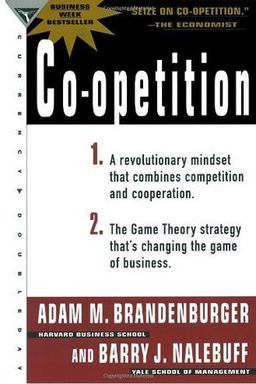
Co-opetition cover

Co-opetition

by Adam M. Brandenburger

Co-opetition revolutionizes business strategy by seamlessly integrating game theory with cooperative competition. Authors Nalebuff and Brandenburger provide a strategic roadmap to mastering the business game through understanding players, value, rules, and tactics. This insightful guide empowers readers to navigate complex market dynamics and enhance their competitive edge.

Changing the Game of Business

How can you stop playing by someone else’s rules and start shaping the game itself? In Co-opetition, Adam Brandenburger and Barry Nalebuff argue that business isn’t just war or peace—it’s a mix of both. The smartest players use game theory not to predict outcomes, but to change the game they’re in. You create cooperation when building value and compete when dividing it. That simple distinction reframes how strategy works.

The book’s core architecture is built around two maps: the Value Net, which helps you see your ecosystem—customers, suppliers, competitors, and complementors—and PARTS, a five-element checklist (Players, Added values, Rules, Tactics, Scope) for systematically changing your game. Together they turn abstract game theory into practical business design.

The Value Net: seeing full interdependence

The Value Net teaches you to visualize your ecosystem’s symmetry: customers and suppliers mirror each other vertically; competitors and complementors mirror each other horizontally. You start by putting yourself at the center and asking four questions: Who are my customers? Who are my suppliers? Who are my competitors? Who makes my product more valuable—my complementors? This map reveals neglected opportunities where cooperation expands the pie.

(Example: Intel and Microsoft are classic complementors—faster chips make powerful software more attractive, stimulating joint value creation. Likewise, hot dogs and mustard, cars and loans, or TVs and streaming services show cross-industry complements.)

Co-opetition: simultaneous cooperation and rivalry

Business works through dual forces. You cooperate when growing the pie, then compete to divide it. Treating everyone purely as enemies makes you blind to shared opportunities; treating everyone only as partners makes you naive in negotiations. The Value Net mindset forces you to balance both. American and Delta Airlines compete fiercely for passengers but both complement Boeing when purchasing aircraft designs—they simultaneously enlarge and contest the market.

PARTS: your levers for game design

The PARTS framework gives you an operating system for strategic change. To alter a game, you modify one or more of its five parts:

  • Players: who’s in or out. You can invite new customers, suppliers, complementors, or even competitors (IBM licensing Intel’s 8086 helped standardize PCs).
  • Added values: who brings what unique contribution? Power flows from being indispensable.
  • Rules: how the game is structured—laws, norms, contracts, and permissions.
  • Tactics: moves that affect perceptions, timing, and credibility.
  • Scope: which related games you link or sever to strengthen your position.

Intel’s ProShare initiative exemplifies all five elements: Intel subsidized communication software (Added value) to spur ISDN phone service adoption (Players/Rules), signaling its commitment (Tactics) and shaping demand across adjacent markets (Scope). The point: you can engineer the game, not just play in it.

Strategy as ecosystem design

In real markets, you rarely have control over everything—but you can design the interactions. You create complementors when missing pieces stall growth, you structure contracts that stabilize payoffs, and you cultivate loyalty programs that tie customers closer while dampening price wars. Every tactical or contractual move you make changes what others believe, and beliefs drive behavior as much as facts do.

This book’s message is practical and philosophical: think allocentrically—imagine the game from others’ eyes. Strategy isn’t about predicting fixed equilibria; it’s about reframing the interaction space so cooperation yields more value and competition distributes it wisely. Once you adopt that dual lens, everything from contracts to pricing to loyalty becomes part of your toolkit to reshape your game.

Core insight

Business is not purely rivalry or partnership—it’s co-opetition. You grow the pie through collaboration and claim your share through smart competition. The art lies in recognizing when to cooperate and when to compete—and how to design the structure so you capture lasting advantage.

Throughout the book, Brandenburger and Nalebuff turn business into a living laboratory of strategic game design. Draw your Value Net. Apply PARTS. Learn to read incentives, perceptions, and linkages. When you do, you’ll see opportunities others miss—and realize that you can change the game instead of just playing it harder.


Mapping Interdependence

Brandenburger and Nalebuff’s Value Net is your visual blueprint for recognizing all players who shape your fate. Most strategies fixate on direct competitors or customers, but the Value Net widens your lens. You stand in the middle, surrounded by four groups—customers, suppliers, competitors, and complementors. By sketching these relationships, you see how cooperation and competition coexist.

Complementors and competitors

A competitor makes your product less valuable to customers; a complementor makes it more valuable. Intel and Microsoft show how complementarity creates shared success: faster chips let software run better, and better software justifies faster chips. Similarly, hot dogs and mustard or cars and loans expand joint consumption. Thinking in complements dissolves rigid industry boundaries—Citibank and Microsoft aren’t in the same industry, yet digital payment interfaces could turn them into complements or rivals.

Multiple roles and symmetry

The symmetry principle—competitors and complementors across one axis, customers and suppliers across another—helps you see overlapping roles. A player can be both enemy and ally. Airlines compete for passengers but collectively complement aircraft manufacturers. Once you see that, new collaborative opportunities arise. If you treat every rival as an opponent, you may miss the chance to co-create new technologies or standards that expand total demand.

How cooperation grows the pie

The book’s mantra—“business is cooperation when creating the pie and competition when dividing it”—captures the dual reality. Grow through joint value creation, then compete intelligently over shares. Intel subsidizing its ProShare communication system stimulated ISDN line installation; both Intel and phone companies gained. Co-opetition means deliberately enlarging total value so division becomes less zero-sum.

Practical application

  • Draw your Value Net from your customer’s point of view. You’ll discover complements you never noticed.
  • Spot multi-role players—those who simultaneously compete and complement. They are strategic leverage points.
  • Ask what products or services would make yours more valuable if they existed—then consider creating or subsidizing them yourself.

Once you internalize that structure, you stop reacting to competitors and start orchestrating ecosystems. That clarity enables every other insight in the book—from how you enter markets to how you change rules. The Value Net isn’t just a map; it’s a living view of cooperation and competition that changes how you think about power.


Power through Added Value

Added value measures how much value disappears if you’re removed from the game. It’s simple yet revolutionary arithmetic: your added value equals the pie with you minus the pie without you. That number bounds what you can claim. If others can make nearly the same pie without you, your bargaining power evaporates.

Understanding leverage

The Card Game analogy makes it tangible. When there’s an exact match between buyers and sellers (Adam’s 26 black cards for 26 students), each player contributes meaningfully and splits value fairly. But reduce supply slightly (Barry’s 23 cards), and individual added value tumbles to zero—Barry monopolizes nearly all the payoff. A tiny structural shift converts competitive balance into massive power asymmetry.

Scarcity, monopoly, and control

When your participation is essential, your added value approaches the entire pie. Nintendo’s early 8-bit monopoly is the textbook case. By managing cartridge supply tightly, it multiplied leverage: developers and consumers had no alternative platform. Similarly, DeBeers controlled diamond supply and shaped perception, amplifying its pricing power. The principle holds for individuals too—Hollywood stars like Macaulay Culkin suddenly capture huge value when their absence collapses a project’s earning potential.

Engineering added value

If your added value is small, don’t despair—change the game. Bring in missing complementors, create loyalty programs, or redesign processes. Club Med’s minimalist model increased social satisfaction while reducing cost—a trade-on that boosted perceived customer value. Frequent-flyer programs turned empty seats into valuable rewards, linking customer loyalty directly to your product use and stabilizing price competition.

The arithmetic of power

Formula

YOUR ADDED VALUE = Pie with you − Pie without you

This simple equation converts bargaining talk into logic. Ask whether the pie collapses without you—if yes, demand your share; if not, change the conditions until it does. Added value doesn’t mean greed—it means clarity about what you contribute so negotiations become grounded rather than emotional.

As Brandenburger and Nalebuff insist: imagine the world without you. That exercise is humbling and empowering—it tells you when to ask for $2,000 or $20, and when to redesign the game before negotiating at all.


Contracts and Rules that Shape Power

Contracts are not administrative details—they are rule changes in disguise. The authors show that small clauses can dramatically redistribute power. Rules decide who moves first, what offers are allowed, and which commitments are binding. From ultimatum games to real-world clauses, sequencing and structure often outweigh skill.

Most-Favored-Customer and Meet-the-Competition

A Most-Favored-Customer clause sounds pro-consumer but often strengthens sellers. When one buyer gets guaranteed best treatment, the seller must bargain harder with others to avoid losing margin elsewhere, enhancing average prices. Similarly, Meet-the-Competition clauses give incumbents right of last match, defusing rivals’ incentive to undercut. Challenger bids lose meaning when the incumbent can replicate them without turnover.

Option and commitment rules

Granting rights of first refusal—as the Miami Dolphins’ owners did—shrinks bidder interest and depresses auction outcomes. In commodity markets, take-or-pay clauses stabilize suppliers by spreading fixed costs but risk harsher retaliation if price wars erupt. Contract length itself changes scope: long terms consolidate multiple rounds into one, and short terms preserve flexibility.

Negotiation and perception

Sequencing matters: the side making the first credible offer tends to capture more pie (the ultimatum game’s proposer advantage). When perception gaps widen, deals fail—allocentrism, or truly seeing through the other’s eyes, lets you craft agreements others will accept. Good strategists design not only content but context—rules that create credibility and foresight.

Practical rule: if you’re weaker, lock in favorable long-term contracts; if stronger, keep options short and flexible. Treat every contract as a strategic move, not paperwork.

Contracts make invisible architecture visible—they define who moves first, who gets to react, and what changes are costly. By designing rules thoughtfully, you can shift negotiation outcomes before the players even bargain.


Signals, Perceptions, and Fog

Games are not played in full light—information is foggy. You can win by managing perception: signaling strength, lifting uncertainty when trust aids deals, and preserving fog when ambiguity keeps options open. Brandenburger and Nalebuff teach when to reveal and when to obscure.

Credible signals

Good signals must be costly for imposters. Murdoch’s limited price cut on Staten Island convinced rivals he meant business, deterring full-blown price war. FedEx’s delivery guarantee shows how calculated exposure can amplify credibility—the expected cost of $200 refunds was tiny, but the confidence signal enormous. What you don’t do also speaks loudly—silence or restraint implies weakness or hidden priorities.

Lifting or preserving the fog

Sometimes transparency helps. Gertner and Miller’s settlement escrow mechanism lets both sides privately reveal limits to a mediator, enabling honest bargaining without public risk. Yet sometimes secrecy protects value—hiding E.T.’s missed opportunity or limiting due diligence avoided panic and reputational loss. Context decides whether clarity helps or harms.

Creating fog strategically

You can stir confusion too—IBM’s handling of the Pentium error controversy exemplifies calculated turbulence. In pricing, deliberate complexity makes rivals struggle to compare offers. Use this tactically but ethically; manipulation is effective only when it doesn’t destroy trust.

In sum, perception management is a core game-design skill. Choose what others know, what they think you know, and what they infer. Align signals, guarantees, and disclosures with your strategy so information becomes your instrument, not your enemy.


Expanding or Linking the Game

Scope determines whether you fight locally or orchestrate across markets. Linking or delinking games reshapes advantage. You decide which arenas connect through contracts, products, or perception. Misjudging scope can destroy value—managing it can create new power structures.

Judo strategies and timing

Sega’s 16-bit Genesis launch was judo strategy against Nintendo. Nintendo’s success trapped it into protecting its 8-bit base; Sega’s timing and pricing exploited that inertia to win momentum. Minnetonka’s Softsoap used similar logic—big soap brands feared cannibalizing their bars, giving the small entrant a window to dominate liquid soap temporarily.

Linked deterrence

NutraSweet’s European price war was an intentional link to its U.S. game—punishing entrants abroad discouraged competition at home. Scope allows deterrence across boundaries. Holland Sweetener learned the hard way: entering the aspartame market helped buyers more than itself, compressing prices. Sometimes the best play is to be paid to play—or to stay out entirely.

Engineering complementary ecosystems

You can expand scope by bringing new players. Invite customers, suppliers, complementors, even competitors to enlarge total value. American Express’s HMO buying coalition multiplied supplier competition and slashed premiums. Intel created complementors to boost chip demand. Each scope decision transforms industry balance.

Your strategic question: which games should I link for joint growth, and which must I isolate to protect my core? Scope is architecture beyond markets—it’s the border controlling where your power extends or leaks.


PARTS: A Discipline for Change

The book culminates in a practical discipline: apply PARTS—Players, Added values, Rules, Tactics, Scope—as a continuous checklist. Rather than reacting, you methodically search for levers to change outcomes.

Players

List every participant in your Value Net—not just direct ones. Consider whom to bring in (GM invited Household Bank) or exclude. Entry changes power structures; sometimes, being paid not to enter is smarter than entering.

Added values

Quantify your own and others’ contributions. Boost yours through data loops, branding, and relationships. Reduce rivals’ added value by changing rules (MCC) or providing unique complements (frequent-flyer programs, Individual Inc.’s SMART feedback).

Rules and Tactics

Audit contracts for leverage. Test perception strategies. When you hold advantage, make credible signals visible (like Murdoch’s pricing move or FedEx’s refund promise). When vulnerable, use mediators, fog preservation, or escrow mechanisms to prevent costly disclosures.

Scope

Decide where your games connect and where they end. Link for growth; delink for protection. If expansion risks cannibalization or retaliation, stage it carefully.

Final takeaway

Strategy is ongoing game design. Revisit PARTS regularly to stay ahead. You’ll see opportunities others miss and anticipate rivals’ rule changes before they strike.

By turning PARTS into habit, you stop operating by luck or emotion and start mastering structure. That’s the book’s ultimate promise—co-opetition as strategic engineering rather than instinctive rivalry.

Dig Deeper

Get personalized prompts to apply these lessons to your life and deepen your understanding.

Go Deeper

Get the Full Experience

Download Insight Books for AI-powered reflections, quizzes, and more.