
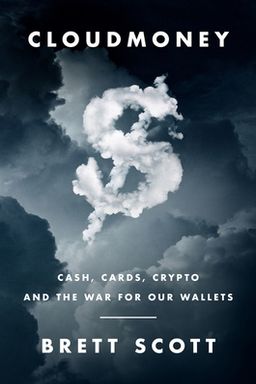
Cloudmoney cover

Cloudmoney

by Brett Scott

Cloudmoney delves into the complex dynamics of our modern payment systems, revealing the hidden agendas behind the push for cashless societies. Brett Scott uncovers how financial and tech giants exploit digital payments for profit and data, urging readers to reconsider the value of cash in a rapidly changing world.

The Hidden Power Shift: From Cash to Cloudmoney

When was the last time you paid for something in physical cash—and did you even pause to think about what happens when you tap your card or phone instead? In Cloudmoney, economic anthropologist and former broker Brett Scott argues that this seemingly simple act marks a profound transformation in global power. Beneath the glow of our contactless cards and sleek banking apps, he contends, lies a merger between Big Finance and Big Tech—a fusion creating a transnational system of surveillance, control, and profit extraction that he calls “cloudmoney.”

Scott contends that the shift to digital money is not organic progress but a political and economic coup: the banking sector’s effort to eliminate physical cash, centralize transactions in its private data centers, and partner with technology corporations to automate our economic lives. What looks like convenience hides enclosure. Where cash was tangible, peer-to-peer, and anonymous, digital money requires you to pass through corporate gatekeepers every time you buy a cup of coffee. In return, they gain your data, your behavior, and your dependence.

Understanding the Nervous System of Money

Scott begins by reframing the global economy as a nervous system—a network of impulses transmitted via money. Financial centers like London, New York, and Frankfurt form its brain and motor cortex, sending commands across the world to activate human labor and natural resources. From that vantage point in the skyscrapers, money appears not as people’s property but as the communication medium of capitalism itself. The flow of financial signals animates corporations, supply chains, and workers like neurons firing through a global body. Yet, at its margins, this nervous system still relied on the “peripheral nerves” of cash—tangible tokens outside its digital mesh. That’s what the finance industry wants to destroy.

The War on Cash and the Birth of Cloudmoney

In the chapters “The War on Cash” and “The Bank-Chip Society,” Scott lays bare how institutions from Visa and Mastercard to central banks and fintechs have quietly waged a campaign of persuasion and pressure to render cash obsolete. Initiatives like the Better Than Cash Alliance, funded by the UN, USAID, Citigroup, and the Gates Foundation, promote digitization in the name of inclusion, while their real goal is to capture every transaction in privately controlled data networks. Scott traces examples from Sweden and India—where demonetization campaigns or cash thresholds were justified as anti-corruption measures—to show how states and corporations have jointly undermined people’s right to transact offline.

For Scott, digital transactions are not money flying through the air but messages sent into distant datacenters. Each payment request triggers updates in remote computers owned by banks, card companies, or tech platforms. This “cloudmoney” is less an upgrade than an enclosure: a system that locks users into the banking sector and its digital intermediaries. Cash is like a bicycle—simple, durable, independent—while digital finance is a motorway owned by an oligopoly of corporate toll collectors.

Big Finance Meets Big Tech

Scott calls the alliance between banks and Silicon Valley the defining merger of our age. Financial institutions want automation and efficiency; tech companies crave profitable data streams. Together they are creating a world of apps, algorithms, and AI-driven decision systems that tie people more tightly to the global network. Chapters like “Shedding and Re-skinning” and “Sherlock Holmes and the Strange Case of the Data Ghost” trace how banks are turning themselves into software platforms—with chatbots like Bank of America’s “Erica,” facial recognition payments in China, and AI credit scoring that categorizes citizens like insects under a digital microscope. Big Tech meanwhile gains access to the payments layer that keeps commerce humming, allowing companies such as Amazon, Uber, Apple, and Google to extend their reach into finance itself.

Crypto and the Illusion of Escape

For those alarmed by this centralization, cryptocurrencies initially looked like a way out. Scott devotes several chapters—including the vivid “A Paranormalist’s Guide to the Spectre of Bitcoin”—to tracing their origins in the cypherpunk desire for autonomy. Yet he shows that Bitcoin, despite its promise of decentralization, merely produced numbered digital collectibles rather than true money. The myth of “digital gold” repackages conservative monetary longing in libertarian language. Far from overthrowing the monetary system, most crypto tokens function as speculative assets priced in ordinary dollars. They have been reabsorbed into the system they rebelled against, from “stablecoins” backed by banks to corporate token projects like Facebook’s Libra.

Scott calls this cycle one of raiding and re-absorption: every time rebels create a new alternative, the financial corporations adapt it as infrastructure. Blockchain technology now helps banks coordinate their internal ledgers rather than replace them. Even central banks are developing “digital cash” versions of fiat money that could further entrench surveillance and control.

Why This Matters for You

What makes Cloudmoney gripping is not just Scott’s analysis of finance—it’s his insistence that this is about our daily lives. Each tap, swipe, and online transfer nudges us deeper into dependence on unaccountable institutions. We treat the loss of cash as progress, but it marks the collapse of private, local, human-scale exchange into a fully mediated system. Scott’s conclusion restores the humble banknote as a symbol of resistance: a peer-to-peer technology that protects freedom through tangible decentralization. To defend cash, he argues, is to defend civic autonomy in a world where every financial gesture is recorded, analyzed, and potentially denied.


How Money Really Works: The Giant in the Mountain

One of Scott’s most striking contributions is his parable of the Giant in the Mountain, which reawakens an anthropological understanding of money as a system of promises and power—not just objects of exchange. Imagine a mysterious giant who issues enchanted tickets granting villagers access to life-saving water from his mountain spring. To get those tickets, they must bring him food and labor. Soon, the villagers trade these tickets among themselves as general tokens of exchange. Over generations, they forget the giant’s original role but keep obeying the logic his tokens created. The giant has captured the economy without swinging a sword.

From IOUs to State Power

Scott uses this story to illustrate how modern states issue IOUs (promises) that circulate as currency—fiat money created “by decree.” Like the giant, governments create obligations (taxes) that can only be paid using tokens they issue. Citizens therefore work to obtain and pass around those tokens, enabling large-scale economies of strangers. Far from emerging spontaneously from barter, money is born as a tool of political coordination and control. Anthropologists from David Graeber to Caroline Humphrey have made similar arguments, and Scott builds on this lineage to show that even today, fiat currency is a web of promises linking society to the state.

When governments spend, they issue tokens outward, expanding the money supply; when they tax, they withdraw tokens, destroying them. The illusion that governments must first collect money from citizens to spend it is as false, Scott argues, as believing the giant needs to steal potatoes to feed himself. In truth, he creates demand by issuing tickets and reclaiming them later. This view flips classical economics on its head: states are not caretakers of spontaneous markets but architects of the monetary ground those markets walk on.

From State Money to Bank Money

As capitalism evolved, private banks emerged as secondary money issuers, issuing their own IOUs based on the state’s promise system. To visualize this, Scott employs the metaphor of a casino: when you deposit cash at the casino cage, the casino issues chips—private promises for state money—that you can use inside its walls. The same is true, he explains, of your bank account. The “money” you see on the screen isn’t your cash stored somewhere; it’s the bank’s promise to pay you cash upon demand. The vast majority of modern money is therefore bank money, not state money.

Once you realize this, the term “deposit” becomes misleading. When you put cash in the bank, you don’t store money—you exchange one IOU for another. Banks can issue far more IOUs than they have reserves, which is why they can create credit out of thin air. The real power of money lies with the issuers, not the users. This insight underpins Scott’s later critique: the cashless world abolishes the last vestige of public money (cash) and leaves everyone dependent on the private money of banks and their corporate partners.

Why the Parable Matters

By reintroducing mythology into economics, Scott helps you see the invisible architecture that holds society together. The “giant” is not a fantasy—it’s the state-bank alliance that compels all citizens to play its game. Recognizing this re-enchants the mundane numbers on your banking app with political meaning: they’re not neutral digits but legal promises backed by power. Once you grasp this, the stakes of the cashless shift become clear. Abolishing physical tokens cuts the last thread connecting people directly to the monetary commons. Without cash, we are forever citizens of the giant’s casino, playing with his chips under his watchful eye.


The War on Cash: Control Masquerading as Progress

Scott’s investigation into the war on cash reveals how industries and governments have conspired—often without open conspiracy—to remove the one form of money that resists surveillance. He recounts telling incidents: a British Airways flight attendant refuses his £5 note for coffee; a vending machine in the Netherlands won’t take coins; Visa’s “Cashfree and Proud” campaign floods London billboards. Each moment dramatizes a global movement: the sidelining of cash as dirty, unsafe, old-fashioned, and inefficient. Yet the real motive, he argues, is profit and power.

Manufacturing Consent for Cashlessness

Behind the marketing slogans of “progress” lies coordinated lobbying. Scott traces organizations like the UN’s Better Than Cash Alliance and corporate-funded initiatives such as “No Cash Day” to show how multinationals use humanitarian rhetoric to mask self-interest. Donations from Visa, Mastercard, Citigroup, and the Gates Foundation bankroll campaigns linking cash with crime, terrorism, disease, and inefficiency. Even public agencies and NGOs echo this message, unaware (or unwilling to admit) that they’re serving the data-harvesting ambitions of private finance and Big Tech.

When India demonetized large notes in 2016, millions of poor workers lost livelihoods overnight. Western economists like Kenneth Rogoff and Richard Thaler publicly applauded the move as modernization. Visa bragged in its annual report that it had “worked closely with the Indian government” to replace cash with digital payments. In Sweden—often celebrated as futuristic—bank branches now refuse cash deposits, effectively trapping citizens inside digital systems. Scott calls this a new kind of enclosure: the privatization of the monetary commons under the guise of evolving consumer preference.

Cash as a Public Utility

What we lose, Scott warns, is not nostalgia but sovereignty. Cash isn’t just paper; it’s the only offline, public mode of exchange that citizens control without corporate mediation. It works in emergencies, during blackouts, and between strangers. Cash transactions generate no data, leaving no trail for governments or corporations to analyze and monetize. Every tap or online payment, by contrast, produces information that can be used to categorize, manipulate, or exclude you. To call cash “dirty” while celebrating data extraction as clean progress inverts sanity itself.

The Psychology of the Slump

So why do most people comply? Partly because, as Scott quips, the myth of inevitability works like gravity—we slump into digital dependence through inertia. Fintech branding frames digitization as youthful rebellion and cash as a relic. PayPal’s “New Money” and similar campaigns appeal to millennials’ fear of being left behind. The old system isn’t replaced because it’s worse; it’s replaced because marketing tells us our identity depends on it. As banks shutter ATMs and branches, they create the very shortages they cite as justification for going “cashless.”

Scott likens the disappearing ATM to the vanishing exit door of a casino: once you can’t redeem your chips for cash, you’re trapped inside. Calling financial digitization progress, he concludes, is like praising a fish for getting better at swimming in smaller tanks. Cashlessness isn’t natural evolution—it’s a deliberate enclosure of economic life within privately owned clouds.


Surveillance Capitalism and the Data Ghost

In chapters like “Big Brother, Big Bouncer, Big Butler” and “The Strange Case of the Data Ghost,” Scott shows how the cashless economy morphs into an architecture of surveillance. Every digital payment produces a breadcrumb in a vast system watched by banks, governments, and tech companies. In the analog past, some obscurity was the norm; today, algorithms watch your habits with telescopic precision. Buying toothpaste, donating to a political cause, or visiting a specific café becomes part of your behavioral fingerprint available for sale and scrutiny.

Big Brother, Big Bouncer, and Big Butler

Scott divides surveillance power into three archetypes. Big Brother monitors everyone, gathering massive data for state control. Big Bouncer decides access—who gets credit, loans, or even permission to transact—through algorithmic scoring and censorship. Big Butler flatters you with personalization—curated ads, discounts, or loan offers—while steering your behavior toward corporate profit. The combination, he argues, turns digital finance into a behavioral operating system for society, one that knows you better than you know yourself.

He connects historical thinkers like David Chaum—the cryptographer who warned of traceable digital payments in the 1980s—to contemporary AI surveillance systems. The same predictive models that serve YouTube recommendations now power automated loan approvals and fraud detection. AIs like those built by Palantir, Google, and major banks scan millions of data points: your phone contacts, typing speed, GPS patterns, even pause times between sentences. These systems don’t just watch—they judge.

Digital Exclusion and the Panopticon Effect

Scott warns that digital finance creates both inclusion and exclusion. The “unbanked” are told they’ll be empowered by phone-based wallets, yet these systems also police them more tightly than any cash regime ever could. In China, Alipay and WeChat payments link to a social credit system that can block travel or purchases. Western parallels—credit scores that determine jobs or housing—are creeping closer. Each data point becomes a lever of control. And even if you have “nothing to hide,” the awareness of being watched—the modern panopticon—changes your behavior, just as Scott found himself acting differently under a smart camera in a friend’s apartment.

The “data ghost” that algorithms construct from your transactions, he writes, soon matters more than you do. It predicts your desires, prices your risks, and mediates your access to society. Cashlessness doesn’t free us from bureaucracy—it replaces human clerks with invisible AIs that can deny you service without appeal. The price of frictionless finance is total transparency—for everyone except the corporations and states managing the system.


Bitcoin and the Cult of Digital Gold

In one of the book’s most imaginative chapters, “A Paranormalist’s Guide to the Spectre of Bitcoin,” Scott portrays himself as a detective at an early Bitcoin meetup surrounded by believers describing a ghost. Some shout “decentralized,” others “immutable,” “cryptographic,” or “mathematically pure.” He records the phenomenon like a paranormal investigator, noting that everyone swears they’ve glimpsed something transcendent but can’t agree on what it is. This playful framing leads to a serious insight: Bitcoin is an elaborate myth built from numbers mistaken for money.

Carving Digital Bottle Caps

Bitcoin’s system, he explains, is essentially an immense global network “carving” numbered digital objects—the equivalent of engraving “1” on a bottle cap and calling it currency. Without underlying IOUs or liabilities, these objects are self-contained; their meaning comes only from the communal story imposed on them. Through enormous computational effort (the “proof-of-work” mechanism), the network mines numbers out of cyberspace and fetishizes them as tokens of value. The result is a collective act of imagination: many believe that energy and mathematical beauty bestow intrinsic worth.

Scott’s metaphors—audiences syncing Excel spreadsheets, digital sculptures stitched together into blockchains, techno-clerks performing rituals of computation—demystify the complexity without trivializing it. Bitcoin solves the technical problem of synchronizing records among strangers without a central authority but fails to solve the social problem of what those records represent. Its numbers aren’t IOUs or legal promises; they are empty signifiers. To turn them into money, believers overlay moral and political mythologies: “digital gold,” “freedom from fiat,” “math-backed purity.”

The Two-Pronged Attack on Banking

Bitcoin initially appealed across the political spectrum after the 2008 crisis. Leftists saw it as anti-bank; conservatives saw it as anti-government. Its two core features—decentralization and fixed supply—combined anarchist distrust of hierarchy with a creditor’s love of scarcity. But these principles clash. Decentralization implies community dynamism; fixed supply freezes growth. Thus, Bitcoin channels not revolution but digital austerity, embedding conservative gold-standard ideology in code. Early enthusiasts chanting “digital gold backed by mathematics” were, in Scott’s reading, reviving a theological belief in natural monetary purity born of cosmic scarcity.

From Digital Gold to Digital Collectible

Ultimately, Bitcoin became less a currency than a speculative commodity. People don’t buy groceries with it; they buy it hoping to sell it to someone else for more dollars. Scott calls this “countertrading collectibles.” Like gold, it has a money-like price but not the function of money. Its myth of liberation conceals its absorption into the same global capitalist circuits it claims to transcend. The haunting conclusion of Scott’s investigation: the specter of Bitcoin doesn’t abolish financial power—it materializes it in new, digital form, worshipping scarcity while feeding speculation.


Raiding, Repackaging, and Reclaiming Power

Scott closes Cloudmoney with a sweeping survey of how every rebellion—crypto, fintech, or central bank experiment—gets recaptured by the financial system. After tracing how banks borrowed blockchain ideas to coordinate their oligopolies (“private distributed ledgers”), he shows how Big Tech followed suit: Facebook’s Libra, Amazon Coins, and China’s digital yuan are all attempts to rebrand corporate or state control as innovation. Even central banks now explore “CBDCs” (Central Bank Digital Currencies) in the name of convenience and stability. Each step pulls the cloud tighter around our daily lives.

The Cycle of Raiding and Absorption

The dynamic, Scott argues, resembles cultural colonization: subversive innovations are “raided” by dominant powers, stripped of their radical edge, and redeployed to reinforce authority. Blockchain, born as a weapon against Big Finance, becomes its coordination tool. Stablecoins, meant to escape the dollar, become dollar proxies. Central banks join the game with digital currencies that might remove any remaining anonymity from transactions. Meanwhile, corporations from Facebook to Amazon seek to issue their own money-like tokens, creating feudal micro-economies inside their platforms.

CBDCs and the Chinese Model

Scott’s discussion of China’s digital yuan serves as a cautionary tale. There, digital payments integrated with facial recognition and social credit scores already fuse financial and behavioral control. Western policymakers fear falling behind but rarely question the premise that more control equals progress. The result is what Scott calls a looming digital Leviathan—a fusion of state and corporate surveillance with no offline escape. Even well-meaning central banks that claim to modernize money risk abolishing its last democratic layer: the ability to pay privately.

Resistance Through the Tangible

Amid this tightening web, Scott ends with a personal and political plea: protect cash. It’s not backwardness; it’s a meditative practice of retaining friction, locality, and dignity in economic life. Like slow food or cycling, cash reasserts physical presence in a world of seamless automation. Defending it means defending the right to transact person-to-person without third-party permission. The fight for physical money, he insists, is the fight for human autonomy within a machine that insists we outsource everything—including trust—to the cloud.

Dig Deeper

Get personalized prompts to apply these lessons to your life and deepen your understanding.

Go Deeper

Get the Full Experience

Download Insight Books for AI-powered reflections, quizzes, and more.