
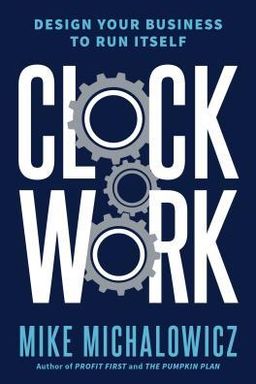
Clockwork cover

Clockwork

by Mike Michalowicz

Clockwork by Mike Michalowicz offers entrepreneurs a blueprint to streamline operations and build self-sustaining businesses. By implementing smart systems and focusing on key roles, business owners can achieve growth without constant oversight, reclaiming their time for strategic pursuits.

Design Your Business to Run Itself

What would it feel like to take an entire month off—without your business falling apart while you’re gone? In Clockwork: Design Your Business to Run Itself, entrepreneur and author Mike Michalowicz argues that every business owner deserves that freedom. He believes the ultimate test of a healthy company is whether it can thrive without you doing all the work. His central claim is simple but revolutionary: your business should serve you, not the other way around. To achieve this, you must shift from frantic Doing to deliberate Designing.

Michalowicz’s approach dismantles the myth that productivity alone leads to success. In fact, most entrepreneurs work too hard and burn out precisely because they’re chasing endless to-do lists. Instead of equating success with working harder, he proposes a systematic way to make your company operate like clockwork—predictable, efficient, and self-sustaining. The result is not just financial freedom, but personal liberation: time to think, innovate, and, yes, take a true vacation.

The Core Problem: Productivity Is a Trap

Most entrepreneurs believe that being more productive will fix their overloaded schedules. Michalowicz reveals how that belief backfires. Working faster only means fitting more tasks into the same time, leaving owners still trapped in the grind. He cites conversations with former productivity coach Chris Winfield, who confessed that productivity had become a curse—making people work more, not less. The more efficient they became, the more work piled up. To escape that cycle, you need a business built for efficiency, not busywork.

The Clockwork Solution

Michalowicz proposes seven steps to transform a business from chaos to clarity. These include analyzing how time is spent (the Four Ds: Doing, Deciding, Delegating, Designing), declaring the company’s core function (the Queen Bee Role or QBR), protecting that function so it always operates smoothly, capturing existing systems instead of creating new ones, balancing the team around natural talents, committing to serve a focused niche of customers, and finally proving the business runs on its own through a four-week vacation.

At its heart, Clockwork turns a company into an organism where everything functions in harmony. Each person focuses on the tasks that matter most to the organization's health, while waste and redundancy are systematically removed. The goal isn’t perfection—it’s predictability. When each gear in the machine works as intended, you can step away and still watch it spin.

Why This Matters

For overwhelmed entrepreneurs, this book restores what Michalowicz calls “lifestyle integrity.” It reconnects business leaders with the reasons they started their companies—to gain autonomy, flexibility, and meaning. Without designing systems and empowering others, you become the bottleneck. Clockwork offers tools to analyze where your time really goes, how to transfer decision-making authority, and how to build systems so that day-to-day operations don’t depend on you.

He grounds his ideas in vivid true stories: Celeste, a preschool owner on the brink of collapse who represents entrepreneurs drowning in exhaustion; Cyndi Thomason, who regained peace by defining her company’s QBR as “clear communication”; and Greg Redington, a construction CEO who doubled revenue while living two years abroad. Through such examples, Michalowicz proves that designing a business to run itself is not fantasy—it’s replicable.

From Doing to Designing

Clockwork emphasizes that efficiency is not about actions, but systems. Your role as founder evolves from performer to architect—from “doing” every task to engineering the flow of work. Michalowicz compares this to becoming a coach rather than a player on the field. Designing means anticipating problems, clarifying responsibilities, and building feedback loops. When you finally operate at the “Designer” level, your team sustains the business while you focus on innovation, strategy, and vision.

In short, Clockwork is a practical manifesto for reclaiming your time and sanity. It challenges you to stop heroically saving your business every day and start crafting systems that save themselves. When your company runs like clockwork, it doesn’t merely survive—it thrives while you live the life you intended to lead.


Mastering the Four Ds of Work

One of Michalowicz’s most useful models is the Four Ds—the four types of activities that consume every entrepreneur’s time: Doing, Deciding, Delegating, and Designing. By measuring how much time is spent in each category, you can diagnose precisely why your day feels overloaded. His goal is to move you from the bottom of the hierarchy (Doing) to the top (Designing).

Doing: The Hustle Zone

In the Doing phase, you personally complete every task. This is essential when starting out but disastrous long term. Michalowicz found that many entrepreneurs keep doing even after hiring staff. They believe “no one can do it like me,” which traps them in perpetual firefighting. As he puts it, you’re “the CEO, the chief bottle washer, and everything in between.” Doing keeps you busy—but never free.

Deciding: The Bottleneck Zone

Deciding happens when you assign tasks but still make every decision afterward. Michalowicz’s famous quip, “Bug the Sh*t Out of Me System,” captures how this works: employees constantly return with questions, forcing the owner to interrupt their work to grant approval. The company stalls while waiting for the boss’s input. This phase masquerades as leadership but is really micromanagement.

Delegating: The Freedom Zone

True delegation means passing not only tasks but also decision-making authority. Michalowicz borrowed from entrepreneur Scott Oldford’s hierarchy: give tasks, then responsibility, then results, then ownership of outcomes. By rewarding employees for making decisions—even when imperfect—you build independence and momentum. This is the gateway to scalability.

Designing: The Mastery Zone

The Designing phase elevates you from worker to architect. You orchestrate systems and strategy. Think of this as moving to the owner’s suite during the game. Your work becomes defining the landmark, adjusting the flow, and nurturing the Queen Bee Role. Designing is where joy returns because you’re acting on vision rather than reacting to chaos.

“It’s not about doing more with less. It’s about doing less with less to achieve more.” —Mike Michalowicz

By performing a “Time Analysis,” you determine your current mix. The ideal, he says, is for the company as a whole to spend 80% of its time Doing (focused on customer value), 2% Deciding, 8% Delegating, and 10% Designing. Your personal goal, however, is much more Design-heavy. Start with just 1% of weekly time on Design activities—strategizing, reflection, or process innovation—and expand as systems take hold. The transformation happens gradually, but the mindset shift starts now: stop asking “How will I get everything done?” and start asking “Who will get this done?”


Find and Protect the Queen Bee Role

Michalowicz’s most memorable metaphor comes from nature: every business, like a beehive, has a Queen Bee Role (QBR)—a core function that sustains its success. In a hive, worker bees protect the queen because her job of laying eggs ensures survival. In your business, the QBR is the activity that determines whether the organization thrives or dies. The Queen Bee herself isn’t the person; it’s the role—the heartbeat of the company.

Discovering the QBR

To identify it, Michalowicz suggests his famous “Sticky Note Method.” Each team member writes down six major tasks, then whittles them down until one remains: the task without which their job—and the company—would fail. That task becomes their “Primary Job.” When every employee completes this exercise, you consolidate all the notes and find the function common to all—the single activity on which success hinges. That’s your QBR.

Examples in Action

Cyndi Thomason’s bookkeeping firm discovered its QBR was “clear communication with clients.” When she focused on that function and delegated distractions, her stress dropped and profits rose. The Savannah Bananas baseball team defined its QBR as “extraordinary entertainment”—not perfect baseball. Their fan dedication skyrocketed. A Cape Cod hospital’s QBR was rapid diagnosis; protecting that role saved both lives and efficiency compared to a slower Brooklyn ER.

Serving, Not Swooping

Protecting the QBR means ensuring the people who fulfill it are not distracted. A designer shouldn’t be doing data entry. A chef shouldn’t handle payroll. Michalowicz urges teams to trash, transfer, or trim anything that pulls energy from the QBR. When he visited Mrs. Wilkes’ Dining Room in Savannah, he saw this principle beautifully embodied: every worker, from cook to server, was focused on keeping the food “top shelf.” That’s QBR protection in real life.

Whether your QBR is innovation, conversion, quality, or speed, its health determines the entire business. If the role falters, everything slows. When it hums, the entire hive thrives. Your Queen Bee Role is your company’s pulse—protect it, and your enterprise can finally buzz in perfect harmony.


Systematize by Capturing, Not Creating

Michalowicz turns traditional system-building upside down. Instead of spending months writing detailed manuals no one reads, he teaches you to capture what you already do naturally. Every business already has systems—most just live in people’s heads. The goal isn’t to create new processes but to record existing ones as they happen.

Capture As You Work

The banana experiment illustrates the idea. You might think peeling a banana is trivial—but most people do it inefficiently. Monkeys do it best. Instead of writing instructions, Michalowicz asks employees to watch a quick YouTube video demonstrating the right technique and replicate it. Likewise, you record your real work—whether invoicing, shipping products, or onboarding clients—using screen and video capture. Do the task while narrating what you’re doing. The output becomes a reusable training system.

The Power of ACDC

Captured systems are organized under the “ACDC” categories: Attract (marketing), Convert (sales), Deliver (operations), and Collect (accounting). This universal model simplifies filing and access. When employees need a procedure, they go straight to the right folder. It’s intuitive, scalable, and keeps the company aligned.

Freedom Through Systems

By capturing instead of creating, you gain leverage. When tasks evolve, team members simply re-record the newest version. Michalowicz’s own business used this method to delegate invoicing, shipping, and even paying bills. Each employee is responsible for updating and improving their recordings. The process becomes dynamic, not static. Anyone can learn, teach, and redesign without slowing down operations.

This “capture” mindset makes systematizing achievable for businesses of any size—from solopreneurs to corporations. It’s not about perfection; it’s about movement. As he writes, “Boom. Bam. Slam.” Efficiency doesn’t mean rigidity—it means flow. Capture your expertise once, free yourself forever.


Balance the Team Around Talent

Even perfect systems fail if you have the wrong people running them. Michalowicz’s fifth clockwork step—Balance the Team—ensures every person does what they do best, in the right proportions, right. He borrows insights from organizational experts like Verne Harnish and Darren Virassamy (of 34 Strong) to match people’s natural strengths to their roles instead of forcing them into one-size-fits-all job descriptions.

Match Strengths, Not Titles

Virassamy calls this the “fish and monkey principle”: don’t measure a fish by how well it climbs a tree or a monkey by how long it can breathe underwater. The same goes for employees. Some excel at detail; others at storytelling or empathy. Nicole Wipp, a Michigan attorney, learned that she was best at generating ideas (the first 20%) and refining results (the final 5%). When she hired people to manage the middle 75%, her law practice thrived—even though she worked only five days per month.

Hiring and Trust

Michalowicz warns that many entrepreneurs overvalue skill and undervalue traits. Skills can be taught; traits cannot. Hire for energy, intelligence, and cultural fit, then train for technical ability. One of his best examples is Alice, a teenager hired to handle social media and shipping. She worked short hours but excelled because she cared deeply and matched the culture. Building trust slowly, he says, transforms fear of delegation into partnership. “You can’t get married at first sight with staff—court them first.”

The Web, Not the Pyramid

Clockwork replaces traditional hierarchies with webs of connection. Job Traits Analysis charts which tasks match which talents. Instead of climbing ladders, employees shift laterally to where their strengths create the most impact. The result: a balanced organization, less stress, and more joy. When everyone works within their zone of genius, the company finally runs smooth—like gears meshing perfectly instead of grinding against each other.


Know Exactly Whom You Serve

In Step Six, Michalowicz introduces the Commitment: define whom you serve and how you serve them. Without focus, even efficient systems waste energy. A Clockwork business thrives on clarity about its ideal customer—the “Top Client.” Serving everyone means serving no one.

The Power of Narrowing

He advises owners to home in on a specific niche by analyzing current customers using the “Crush/Cringe” technique. Sort your client list by revenue and emotional response: which clients do you love (crush) and which drain you (cringe)? Then identify groups with established congregation points—places where they network regularly, like industry associations or online communities. (Inspired by his earlier book The Pumpkin Plan.) When you find those groups, you find leverage.

Align Desire With Audience

Your niche must match your personal passion. Don’t pivot to customers’ desires; align your desires with those who value them. Lisé Kuecker, who owned five Anytime Fitness gyms, succeeded because she served communities most in need—small towns battling obesity. Her QBR was “customer support,” and her commitment statement read: “We serve people struggling with weight loss by providing education and motivation to reach their goals.” That clarity fueled massive growth and freedom.

Build Fame in a Small World

Michalowicz cites UGG founder Brian Smith, who became world famous by mastering one narrow niche: surfers wanting warm boots. “If you want big success,” Smith told him, “you must first dominate a small community.” Once you earn trust and recognition in your micro-niche, that community carries you to broader markets. Focus like sunlight through a magnifying glass—the concentrated energy ignites growth.

Knowing your whom and how simplifies everything—from marketing to operations. When your QBR and audience align, you achieve efficiency, loyalty, and freedom. Your company finally moves with purpose, not noise.


Measure What Matters Through Metrics

Nothing runs like clockwork without a dashboard. In Step Seven, Michalowicz explains how to “keep an eye on your business” using simple, actionable metrics. You don’t need complex analytics; you need visible indicators showing whether the company’s pulse is strong or weak.

The Blue Light Lesson

Manufacturing consultant Kevin Fox taught Michalowicz the “blue light” test: at a car bumper factory, welding torches emitted blue light. When the light stopped flashing, production slowed. The simple act of watching the lights became the performance metric. Your goal is clarity like that—signals so visible anyone can spot inefficiency instantly.

The ACDC Dashboard

Every business revolves around four functions: Attract prospects, Convert them to customers, Deliver promises, and Collect payment. Michalowicz calls this the ACDC cycle. Each part deserves one clear metric—such as number of leads per day, conversion rates, completion rates, and percentage of paid invoices. Tracking these lets you see where the bottleneck lies and turn one dial at a time to fix it.

Real Examples

In his company Profit First Professionals, Michalowicz tracks “messaging moments”—how often the brand spreads its mission of eradicating entrepreneurial poverty. He monitors daily applications (Attract), new memberships (Convert), certification completion (Deliver), and payment consistency (Collect). When any gauge dips, he investigates instead of guessing.

From Numbers to Insight

Metrics free you from emotional decision-making. Cyndi Thomason used them to streamline client flow when overwhelmed with leads. Lisé Kuecker used them to run five gyms from another state, spending five hours a week managing via spreadsheets. Michalowicz urges small firms to track no more than five to eight metrics. “What gets measured gets done,” he writes. Measure what matters, then let the data guide the rhythm of the machine.


Test Freedom with the Four-Week Vacation

The grand finale of Clockwork is the Four-Week Vacation Test—a practical challenge proving your business can run on its own. Michalowicz defines success as the moment your company operates smoothly while you’re entirely disconnected for four consecutive weeks. Why four? Because most businesses cycle through all major activities—marketing, sales, delivery, and cash flow—within that timeframe.

Freedom Through Absence

Greg Redington, who ran a $25 million construction firm, tested this by moving his family to Rome for two years. When he returned, his company had doubled to $50 million and operated autonomously. The vacation isn’t indulgence—it’s diagnosis. If everything collapses while you’re gone, the systems need work. If it hums, you’ve achieved clockwork status.

Preparation Timeline

Michalowicz lays out an 18-month plan: declare your vacation date; analyze time; inform your team; reduce Doing to zero; test shorter absences; assign backups; plan full disconnection; and finally depart. During the break, you must sever cell, email, and internet ties—forcing the business to solve its own problems. As he jokes, “Your business needs a vacation from you, too.”

When You Return

Reuniting with your business after the test reveals growth areas. Hold debrief meetings and schedule your next four-week vacation within a year. Michalowicz compares this freedom to “reclaiming your life,” not escaping work but reinventing your role. Once you’re no longer the bottleneck, you can choose which projects ignite your passion. As he tells his readers, “You aren’t forced to leave your business; you are freed to leave.”

The challenge isn’t merely symbolic—it’s the culmination of all clockwork steps. It forces clarity, trust, delegation, and design. If your business can thrive while you’re sipping coffee in Rome—or just watching squirrels in your backyard—you’ve built more than a company. You’ve created freedom by design.

Dig Deeper

Get personalized prompts to apply these lessons to your life and deepen your understanding.

Go Deeper

Get the Full Experience

Download Insight Books for AI-powered reflections, quizzes, and more.