
Idea 1
Seeing Success Through New Eyes
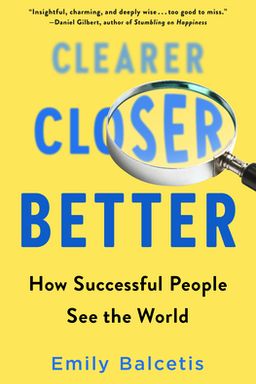
How often do you feel like reaching your goals is a matter of willpower? In Clearer, Closer, Better, psychologist Emily Balcetis argues that it’s not just about grit — it’s about how you see. Literally. Drawing on her research in vision science and motivation psychology at New York University, Balcetis contends that success begins with perception: how we visually and mentally frame the world around us shapes the goals we set, the motivation we feel, and the actions we take.
Through a blend of storytelling, behavioral research, and practical applications, Balcetis shows that our eyes are much more than passive observers; they’re tools that can transform our perception of effort, distance, and possibility. She reveals that the difference between people who thrive and those who flounder isn’t only in talent or discipline, but in how they look at what’s in front of them. She encourages readers to literally retrain their eyes — to narrow focus when goals feel far away, to widen perspective when stuck, and to frame what they see in ways that motivate action instead of avoidance.
Perception Shapes Motivation
Balcetis opens the book by exploring the deep connection between perception and ambition. We like to think that success flows from internal qualities like willpower, but she shows that visual perspective exerts powerful effects on how achievable our goals appear. For example, research finds that athletes who focus their eyes on the finish line actually perceive it as closer, push harder, and finish faster. Our literal field of view changes our sense of possibility, and small adjustments in how we look can recalibrate our motivation.
This basic insight — that we can use perception to design motivation — anchors the book’s central message. Our eyes, and how we use them, affect feelings of effort, temptation, and distance. Just as optical illusions distort what we see, cognitive illusions distort our experience of challenge. The solution, Balcetis argues, is to turn vision into an intentional strategy rather than an automatic habit.
Four Tools for Seeing Smarter
Through stories of athletes, scientists, artists, and everyday pursuits — including her own humorous struggle to master one song on the drums — Balcetis introduces four perceptual tools that reshape how we think and act:
- Narrow Focus: Channeling attention to what matters most while blocking out distractions. This brings distant goals within reach.
- Materializing: Making abstract objectives visible and concrete through vision boards, lists, or tangible progress logs.
- Framing: Deliberately designing what appears inside your visual and mental “frame,” focusing on helpful cues rather than temptations.
- Widening the Bracket: Taking a broader perspective that reveals patterns over time and helps balance short-term impulses with long-term goals.
Each tool offers a different way to change what you “see” when motivation falters or goals feel overwhelming. Balcetis draws parallels between these strategies and camera techniques — focusing sharply on details to propel action or zooming out for creative clarity. She shows that top performers and creative innovators master their success by switching deftly between these visual modes.
Why Vision Matters
Our visual system does far more than record reality; it interprets meaning. Perception filters information through memory, emotion, and expectation — and these subtle biases define how approachable or impossible a challenge feels. For example, when people are tired, hills appear steeper and distances longer. When motivated, they literally see destinations as nearer. If we learn to manage those distortions, Balcetis claims, we gain a competitive edge in both endurance and decision-making.
Approaching work, parenting, fitness, or finances with eyes attuned to opportunity instead of exhaustion unlocks energy. The book’s recurring metaphor — seeing “clearer, closer, better” — captures this transformation. Clarity helps us assess reality accurately, closeness turns distant ambition into manageable progress, and “better” vision aligns perception with success.
From Research to Real Life
Balcetis’s gift lies in translating psychological science into relatable guidance. She moves seamlessly from experiments on optical illusions to stories about goal-setting in music, marathon training, and parenting. The recurring personal thread — teaching herself to drum while raising an infant — grounds abstract science in everyday trial and error. Each chapter peels back a cognitive bias that hides within our sight, revealing how to tweak focus or perspective to improve performance.
Ultimately, Clearer, Closer, Better argues that success begins when you stop seeing effort as fixed and start viewing vision as flexible. You already have within your eyes and mind the power to reshape your motivation. By training your perception, you train your potential. How you look determines what you can do — and perhaps, who you become.