
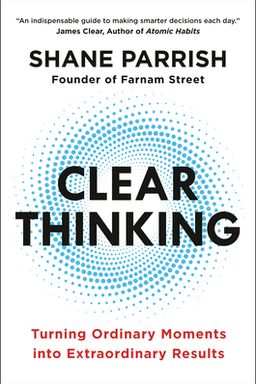
Clear Thinking cover

Clear Thinking

by Shane Parrish

Clear Thinking by Shane Parrish delivers a transformative approach to mastering decision-making. Uncover mental traps, strengthen key personal traits, and align actions with values to lead a life of purpose and clarity. This guide synthesizes insights from thought leaders to help you navigate complex reasoning and achieve extraordinary results.

Clear Thinking: Creating Space Between Reaction and Reason

How many moments in your life have gone wrong not because you lacked intelligence, but because you reacted too quickly? In Clear Thinking: Turning Ordinary Moments into Extraordinary Results, Shane Parrish argues that success is rarely determined by brilliance, but by our ability to pause, think, and choose clarity over impulse. Drawing from his experience in intelligence work and two decades studying decision-making masters like Charlie Munger and Daniel Kahneman, Parrish contends that cultivating “clear thinking” begins by mastering the ordinary moments—the countless small decisions that quietly shape your fate.

According to Parrish, our brains are wired for survival, not for clarity. The instincts that helped our ancestors stay alive now hijack our judgment in an environment where physical threats are rare but cognitive ones abound. The book’s central idea is that by understanding and managing our biological defaults—emotion, ego, social pressure, and inertia—we can create mental space to replace reaction with reflection. Clear thinking, he argues, is not about erasing emotion or instinct, but about regaining control over them so that they serve your goals instead of sabotaging them.

Ordinary Moments Shape Extraordinary Outcomes

We like to believe that big choices—who we marry, which career we pursue, which investments we make—define us. Parrish challenges this idea. The truth, he says, is that ordinary moments determine whether those big decisions succeed or fail. How you respond when criticized in a meeting, when road rage flares, or when fatigue clouds your mind—these seemingly trivial moments reveal whether you’re in control of your thinking or your thinking is controlling you. Over time, these micro-decisions compound. Each one positions you slightly better or worse for the challenges ahead, until your trajectory becomes inevitable.

Parrish illustrates this concept vividly: a company with cash reserves and low debt enjoys flexibility and strength under pressure; one loaded with debt has no good options when trouble comes. The same principle applies to life: your position determines your freedom. Clear thinkers consistently improve their position by managing daily reactions wisely. The goal isn’t to be smarter—it’s to avoid unforced errors that erode trust, time, and opportunity.

From Instinct to Intentionality

Parrish divides the path to clarity into two major phases. The first involves identifying and reprogramming the default settings that govern our reactions. Our ancient biology pushes us to act impulsively, defend our egos, conform to the group, and resist change. These instincts once ensured survival but now often make life harder. As he puts it, “When we react without reasoning, our position weakens and our options get worse.”

The second phase involves replacing those destructive defaults with constructive behaviors. Through the deliberate strengthening of self-accountability, self-knowledge, self-control, and self-confidence, we can transform biology’s headwinds into tailwinds. Mastery, Parrish says, comes from replacing compulsive reaction with deliberate choice. The book blends timeless wisdom—from Stoic philosophers to Warren Buffett’s investing discipline—with practical tools for everyday decision-making.

A System for Better Judgment

Once you’ve created the space to think clearly, Parrish shows how to apply that skill to real-world decisions. He introduces a rigorous process familiar to intelligence analysts: define the problem accurately, explore possible solutions, evaluate options using sound criteria, and act decisively—but with a margin of safety. Along the way, he emphasizes the importance of process over outcome, arguing that true success stems from disciplined reasoning rather than lucky breaks.

To sustain clear decision-making, he offers safeguards such as automatic personal rules (like Kahneman’s habit of never saying “yes” over the phone), pre-mortems to anticipate failure, and trip wires to trigger action before it’s too late. The structure resembles a mental operating system—one designed not just for big strategic calls but for everyday life choices.

Knowing What’s Worth Wanting

In the final section, Parrish turns philosophical. Clear thinking isn’t merely about making effective decisions—it’s also about making good ones. Many people achieve immense success only to find themselves unfulfilled because they pursued goals handed down by culture or ego. Drawing lessons from Dickens’s A Christmas Carol, Stoic reflections on mortality, and research by gerontologist Karl Pillemer, Parrish argues that wisdom means knowing what’s worth wanting. The happiest and wisest people recognize that life’s real wealth lies in meaningful relationships, learning, and contribution—not in status or accumulation.

Ultimately, Clear Thinking is both a philosophical manifesto and a practical handbook for mastering yourself. It invites you to slow down in a world that rewards speed, to reason in moments when emotion reigns, and to build a position that makes the future easier rather than harder. In a society drowning in noise, Parrish’s message is simple but profound: clear thinking is the quiet superpower that turns ordinary moments into extraordinary results.


The Four Defaults That Sabotage Reason

Parrish identifies four primary biological programs—what he calls our defaults—that silently shape our behavior. These defaults evolved to protect us from danger but now confuse survival with success. Unless we manage them, they take command of our ordinary moments and lead to predictable failure.

1. The Emotion Default: Feelings Over Facts

When emotions hijack judgment, thinking collapses. Parrish uses the story of The Godfather’s Sonny Corleone—whose impulsive rage leads to his own death—as an archetype. Like Sonny, we lash out when slighted, make snap financial decisions when afraid of missing out, or destroy relationships with words spoken in anger. He warns, “Emotions can multiply all of your progress by zero.” To counter this, Parrish recommends building ritualized pauses: “When someone slights you in a meeting, take a deep breath before you speak and watch how often you change what you’re about to say.”

2. The Ego Default: Protecting Self-Image Over Truth

The ego default drives us to defend our image even at the expense of outcomes. Examples range from Benedict Arnold’s betrayal of his country after feeling underappreciated to everyday workplace resentment when recognition feels insufficient. Parrish’s point: “Our desire to feel right overpowers our desire to be right.” The ego confuses validation with value, trapping us in self-defeating loops where proving we’re right matters more than doing what’s right.

3. The Social Default: Conformity Over Clarity

We evolved to belong to tribes, where rejection meant death. Today, that wiring keeps us clapping for bad speeches and agreeing with poor group decisions. Parrish uses Walter Lippmann’s words—“Where all think alike, no one thinks very much”—to capture this trap. He argues that independent thinkers often seem foolish in the short term but visionary over time. Warren Buffett’s refusal to follow financial fads is one example. As Lou Brock said, “Show me a guy who’s afraid to look bad, and I’ll show you a guy you can beat every time.”

4. The Inertia Default: Comfort Over Change

The inertia default keeps us stuck in jobs, relationships, and habits long after they stop serving us. Doing nothing feels safer than risking change. Parrish cites Edward Bernays’ observation, “Civilization is limited by inertia.” The lesson: the comfort zone slowly becomes a trap, and by the time we notice, it’s often too late. Recognizing this pattern allows you to act before “good enough” ossifies into “too late.” Together, these defaults explain why smart people make dumb choices—and why awareness is the first defense against them.


Building Strength: The Four Core Practices

After diagnosing the enemies of clear thinking, Parrish turns to the antidote: cultivating inner strength. He identifies four interdependent abilities that together form the architecture of good judgment: self-accountability, self-knowledge, self-control, and self-confidence. Each one counters a specific default.

Self-Accountability: Owning Every Outcome

Accountability, Parrish says, is the foundation of strength. His motto: “It’s all your fault.” This isn’t self-blame—it’s self-empowerment. Taking responsibility for your actions reclaims power from circumstances. Parrish’s story from his intelligence career makes this visceral: when he missed a deadline and began making excuses, his colleague cut him off—“That’s bullshit. Stop making excuses.” That tough feedback transformed his mindset from victim to owner. “No one cares about your excuses as much as you do,” he writes. The goal is to stop bargaining with reality and focus energy on the next move that improves your position.

Self-Knowledge: Understanding Your Boundaries

Echoing Charlie Munger’s dictum to “play games you can win,” Parrish stresses knowing where your edge lies. He recalls a dinner with a wealthy investor who declined a seemingly wonderful deal, saying simply, “I don’t know that space.” True experts define the limits of their competence as carefully as their strengths. This humility also applies to emotional triggers—knowing when you’re hungry, tired, or socially pressured keeps your defaults in check.

Self-Control: Mastering the Pause

To master your reactions is to master your fate. Parrish compares emotional discipline to steering a ship: the waves (your emotions) don’t disappear, but you can still set the course. Success often depends less on intensity than consistency. The disciplined athlete who trains daily outperforms the inspired amateur who trains sporadically. Self-control enables rational navigation even when the seas of emotion rage.

Self-Confidence: Trust in Reality

Confidence, unlike ego, is grounded in truth. It’s the courage to face reality as it is—not as you wish it to be. One of Parrish’s most striking stories features a woman competing for a CEO role who initially insisted on her own plan until realizing her rival’s idea was better for the company. Supporting her rival’s plan ultimately won her the job. Confidence enabled humility—outcome over ego. Together, these four strengths transform you from a reactor into a reasoner, from someone who blames luck to someone who builds it.


Creating Systems and Safeguards

Clear thinking doesn’t rely on willpower alone; it requires systems that protect you from your own weaknesses. Parrish introduces the idea of safeguards—practical devices that make good choices the path of least resistance. Biology is strong; therefore, structure must be stronger.

Automatic Rules and Environmental Design

Daniel Kahneman told Parrish that one of his best rules was never to say yes to requests made on the phone. Knowing his tendency to please people, he created a buffer: he’d wait before agreeing. Parrish built his own rule of no meetings before lunch to protect creative time. These automatic rules remove friction from doing what matters and add friction to doing what doesn’t. As James Clear (in Atomic Habits) similarly teaches, environment beats motivation—change your surroundings, change your defaults.

Prevention and Friction

One cornerstone safeguard is prevention—avoiding decisions under bad conditions like fatigue or stress. Parrish adapts the Alcoholics Anonymous acronym HALT: never decide when Hungry, Angry, Lonely, or Tired. Another is creating friction against self-destructive habits, such as removing junk food from the house or disabling email notifications before noon. These interruptions buy time for your rational mind to engage before instinct reacts.

Perspective Shifts and Guardrails

Parrish borrows from physics: to understand motion, shift the frame of reference. Seeing problems from another perspective—like USS Benfold’s captain who dined with his sailors instead of outranking them—reveals blind spots invisible from your usual vantage point. Similarly, personal guardrails such as checklists or reflection questions (“Is this reaction making the future easier or harder?”) ensure that reason stays in the driver’s seat when emotion barges in. Safeguards turn deliberate thinking into a reflex—and that’s the paradoxical secret of sustained discipline.


Decision-Making in Action

After building internal and external frameworks for clarity, Parrish applies them to a system for disciplined decision-making. He breaks it into four stages—defining the problem, exploring solutions, evaluating options, and executing with precision and safety.

Defining the Real Problem

Most failures, he notes, begin here: solving the wrong problem. Teams rush to act after hearing the first plausible narrative. Instead, Parrish insists that the leader—the true decider—must own the definition. At an intelligence agency, only the operation’s commander could define the objective; everyone else could suggest. To find root causes, ask the piercing question: “What would have to be true for this problem not to exist in the first place?” Lori Weise of LA’s Downtown Dog Rescue used this reasoning to cut pet surrenders by 75%—she addressed poverty, not adoption rates.

Exploring Possibilities and Second-Level Thinking

Mediocre thinkers stop at the first answer; masters imagine alternate futures. Parrish illustrates this with the “Stockdale Paradox”: maintain faith you’ll prevail while confronting brutal facts. Through premortems and “And then what?” analysis, he teaches readers to anticipate failures before they occur. Borrowing from investor Howard Marks, he calls this second-level thinking—looking beyond immediate gains to long-term consequences. He applies it to career decisions through a case called “Maria,” showing how thinking in second and third orders—the chain reaction of choices—reveals better information and better futures.

Evaluating and Executing

When evaluating options, clarity of criteria is key. Avoid jargon, pick one most important value, and know how much trade-offs cost. Once the best option emerges, execution requires courage. Parrish advocates acting fast when reversibility is high (the “ASAP Principle”) and waiting as long as possible when stakes are irreversible (“ALAP Principle”). Add a margin of safety—a buffer that protects you from being wrong. He cites investor Warren Buffett, who buys only when prices are 30–50% below intrinsic value. The guiding principle: preparation beats prediction. Clear thinkers don't bet on the future—they build protections against being wrong about it.


From Effective to Good: Knowing What Matters

In the book’s final section, Parrish pivots from judgment to wisdom. He challenges readers to distinguish between decisions that are merely effective—those that achieve short-term wins—and those that are good—those aligned with values and long-term fulfillment. This is where reasoning meets meaning.

Escaping the Hedonic Treadmill

Through the cautionary tale of Ebenezer Scrooge, Parrish shows how power and wealth rarely deliver happiness. The “hedonic treadmill,” discovered by psychologists Philip Brickman and Donald Campbell, ensures that new achievements quickly become the baseline. Comparison, he warns, is “the thief of joy.” We think we’re chasing success, but often we’re just feeding ego and social defaults. True success lies in cultivating relationships, integrity, and gratitude—the things that compound satisfaction rather than diminish it.

Learning from the Happiness Experts

Gerontologist Karl Pillemer interviewed hundreds of older Americans for 30 Lessons for Living. Their greatest insight: life is short. None regretted making less money; many regretted worrying too much and loving too little. Happiness, they told him, “is a choice, not a condition.” Parrish connects this to Stoic philosophy: external events don’t disturb us—our judgments about them do. Choosing clear thinking means choosing perspective.

Memento Mori and the Lens of Death

In perhaps the book’s most reflective exercise, Parrish invites you to imagine being eighty and looking back. What moments would matter? Whom would you wish you had loved better? This memento mori meditation reorients life around values that endure. As Steve Jobs said, remembering death strips away illusion and leaves only what’s essential. The wise convert future hindsight into current foresight, ensuring that today’s actions match tomorrow’s regrets avoided. Clear thinking, Parrish concludes, isn’t just about making better decisions—it’s about making decisions worth making.

The payoff of this philosophy is peace: less wasted energy repairing self-inflicted damage, more time investing in what lasts. “Good judgment is expensive,” he writes, “but poor judgment will cost you a fortune.” The fortune he refers to isn’t just financial—it’s the fortune of a well-lived life.

Dig Deeper

Get personalized prompts to apply these lessons to your life and deepen your understanding.

Go Deeper

Get the Full Experience

Download Insight Books for AI-powered reflections, quizzes, and more.