
Idea 1
Cleaning Up the Mental Mess: Taking Charge of Your Mind
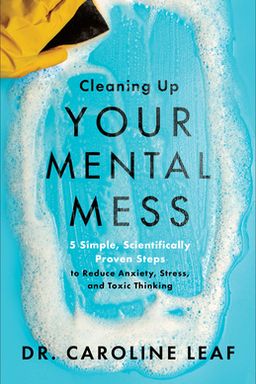
Have you ever felt like your thoughts are spiraling—like no matter how much you try to stay positive, your mind rebels with anxiety, guilt, or exhaustion? In Cleaning Up Your Mental Mess, Dr. Caroline Leaf—a communication pathologist and cognitive neuroscientist—argues that you are not stuck with the patterns your mind has fallen into. She asserts that while we cannot control what happens to us, we can control how we respond. This shift, she says, is the foundation of mental peace, resilience, and health.
Dr. Leaf contends that modern society misunderstands mental health by focusing almost exclusively on brain chemistry and medication, ignoring the central role of the mind. She draws on more than thirty years of research to show that our thoughts—how we think, feel, and choose—physically shape the brain. This influence is called neuroplasticity, which means the brain is constantly changing in response to the mind’s activity. In other words, by managing our thinking patterns, we can rewire our brains.
The Core Argument: Mind-Management Changes Everything
The heart of Dr. Leaf’s message is that mind-management—the skill of regulating our thoughts and reactions—is both learnable and vital. Without it, our thinking becomes toxic, leading to stress, anxiety, depression, and even physical illness. She argues that up to 90% of diseases may be stress-related, often triggered by unmanaged thoughts that repeatedly activate the body’s fear systems. Yet, she reassures readers that this doesn’t mean we’re hopelessly broken; it means our healing begins with awareness and deliberate mental action.
She introduces a five-step program called the Neurocycle, a structured, scientifically validated method to identify negative thought patterns (what she calls your “mental mess”), process them, and replace them with healthier ways of thinking. This is not a one-time exercise but a lifestyle of continual self-regulation—a way to become, as she puts it, the “first responder” to your own thoughts.
Why It Matters Now
We are living, Dr. Leaf notes, in an age of escalating mental distress despite the billions spent on psychiatric drugs and therapies. Suicide rates, burnout, and emotional exhaustion are at historical highs. She argues that we’ve entered what she calls a “data-overload culture,” where we consume information but fail to process it. This overabundance of knowledge, combined with poor mind-management, floods our brains with mental clutter and stress hormones. “It’s as if,” she writes, “we’ve traded the processing of knowledge for the gathering of data.”
Here, she directly challenges the biomedical model, which sees mental distress as a chemical imbalance rather than a human reaction to life’s challenges. Depression, she insists, is not a disease but a signal—your mind and body warning that something needs attention. This reframing aligns with emerging perspectives in psychology that treat emotions as messengers rather than malfunctions (similar to the views of Carl Rogers and Bessel van der Kolk).
The Science of Hope: You Are Not Your Brain
Dr. Leaf spends much of the book explaining that the brain doesn’t control you—your mind directs the brain. Every time you think, feel, or choose, you send electrical and chemical signals through neural networks, forming physical structures that store your thoughts. These formations—represented as “trees” in her model—can be either healthy or toxic. The hopeful message: toxic trees can be uprooted and replaced.
In her words, “Whatever we plant in our minds and nourish with repetition and emotion will one day become a reality.” She backs this assertion with clinical research, including a 2019 study where participants lowered anxiety and depression scores by up to 81% after 63 days of Neurocycling. Their brain scans (qEEGs) showed measurable increases in coherence and balance—a biological reflection of clearer thinking.
Structure and Learning Journey
Part One of the book explores why our minds become messy, defining the difference between the mind and brain, and describing how mismanagement leads to physical and emotional breakdown. She critiques modern psychiatry’s labeling culture and shows how fear, shame, and comparison fuel toxic thinking. Part Two moves into application: the 5 Steps of the Neurocycle—Gather, Reflect, Write, Recheck, and Active Reach. Dr. Leaf guides readers through how to use these steps for different goals: healing trauma, breaking bad habits, improving relationships, and establishing daily mind-management routines.
Why Mind-Management Is the New Self-Care
In contrast to quick-fix self-help trends, Dr. Leaf emphasizes that cleaning up your mental mess is a lifelong commitment. “You can’t go even three seconds without thinking,” she reminds us, so mind-management must be as habitual as brushing your teeth or eating breakfast. True peace is not found in suppressing emotions but in understanding them.
“Mental mess is something we all experience often, and it isn’t something we should be ashamed of... The key is to learn how to manage it.” —Dr. Caroline Leaf
For anyone overwhelmed by the noise of modern life, her message lands as both empowering and relieving: your mind is not a labyrinth you’re trapped inside—it’s a muscle you can train. The process takes effort and compassion, but your biology is on your side. By harnessing the power of neuroplasticity and the practical tools of the Neurocycle, you can transform anxiety, burnout, or self-doubt into mental strength and peace.