
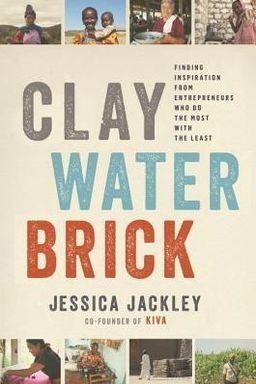
Clay Water Brick cover

Clay Water Brick

by Jessica Jackley

Clay Water Brick reveals how entrepreneurs worldwide, using limited resources, create meaningful change in their communities. Through inspiring stories and strategies, Jessica Jackley shows how microlending and resourcefulness can transform lives and combat global poverty.

Building Something from Nothing: The Entrepreneurial Spirit

Have you ever looked around and thought you lacked the tools, money, or credentials to begin something meaningful? In Clay Water Brick, Jessica Jackley tells us that you don’t need wealth or permission to start—you need vision, courage, and relentless action. The book’s central claim is that entrepreneurship isn’t about access to resources, but about the pursuit of opportunity regardless of what you currently control—a definition inspired by Harvard’s Howard Stevenson. Through her own journey, from confused Sunday school girl to co-founder of Kiva, Jackley explores how anyone, anywhere, can live entrepreneurially.

Jackley argues that true entrepreneurship begins in the imagination and heart before it manifests in capital or structures. The title story—Patrick the brickmaker turning mud into livelihood—embodies this truth. By combining her experiences with entrepreneurs in East Africa and her adventures building Kiva, she shows how determination, empathy, and optimism reshape both lives and economies. This book is both a memoir and a call to action—a challenge to redefine how we see poverty, business, and purpose.

Rethinking Entrepreneurship and Poverty

Jackley’s revelation began when she stopped framing the poor as helpless and started seeing them as entrepreneurs. Influenced by Nobel laureate Muhammad Yunus, she came to realize that the world’s “poor” are often deeply resourceful people disabled not by laziness but by lack of opportunity. She traveled to East Africa to see this firsthand, meeting people like Katherine the fishmonger, Blessing the shopkeeper, and Fatuma the charcoal seller. Each story revealed how microenterprise transforms spirit and community when even $100 becomes a seed of dignity.

These encounters birthed Kiva—the world’s first person-to-person microlending platform—connecting lenders across the world to small entrepreneurs who needed a hand up, not a handout. Instead of charity, Jackley’s model invited connection and accountability. Behind every loan was a story, a face, a dream. And that connection altered how both sides understood giving and growth.

From Disillusionment to Purpose

Jackley’s story begins with her early misunderstanding of poverty. As a child, she felt crushed by images of suffering presented by nonprofits and churches. The endless appeals for donations made her feel powerless and obligated rather than inspired. Her worldview shifted only when she realized that empowering people requires trust and partnership, not pity. Traveling to Haiti, she confronted her own guilt and learned to balance compassion with realism. Over the years, this tension between wanting to do good and wanting to do it effectively drove her search for new models of impact.

Her time at Stanford Business School further sharpened this clarity. Immersed in an environment where entrepreneurship was a way of life, she learned to connect big ambitions with practical tools. In Silicon Valley’s innovative culture, she saw how creativity and business acumen could change the world—and resolved to apply those same tools to social problems. That decision would redefine her life and inspire millions to view purpose and profit as allies rather than opposites.

Why These Ideas Matter

Jackley’s credo—that entrepreneurship is accessible to all—matters because it democratizes hope. Her journey from a Pennsylvania church to the dusty roads of Uganda and back to Stanford reveals that transformation begins by choosing to see opportunity where others see despair. In an age when many feel disempowered by systems too vast to change, she argues that change starts with individual action, guided by empathy and iteration. Whether you’re a CEO or a student, her examples invite you to reframe obstacles as raw materials for creation—your own clay and water waiting to be shaped into bricks.

Key Message

“The heart of entrepreneurship is never about what we have. It’s about what we do.” This simple truth anchors Clay Water Brick. Through story after story, Jackley shows that progress—personal, economic, and spiritual—comes from action undertaken with faith and persistence. Anyone can create something meaningful from what seems like nothing.

From there, the book explores how to question assumptions, act bravely, listen deeply, take risks without permission, embrace chaos, define purpose, and continuously reinvent yourself. Together, these lessons form a blueprint not only for entrepreneurship but for living a purpose-driven life. As you read, you encounter the DNA of real innovation: courage, empathy, and the conviction that hope itself is a road made by walking.


Find the Courage to Question

Early in her life, Jessica Jackley was taught that helping the poor was a moral duty. Yet this belief trapped her in guilt rather than empowerment. In church, she heard that the poor would “always be with us,” believing that their suffering was an unchangeable fact—and that her small contributions would never matter. Her first awakening came as she began to question the very narratives that formed her compassion.

From Pity to Partnership

Jackley’s disillusionment grew from years of giving to charities that offered only momentary relief and emotional manipulation. The turning point came during her volunteer work—from painting houses for the poor to serving in orphanages—where she saw that good intentions often lacked sustainable impact. These experiences forced her to ask: Am I actually helping, or am I serving my own need to feel helpful?

Her trip to Haiti epitomized this internal struggle. She confronted her privilege—a prom gown waiting for her at home while children in Port-au-Prince lived with nothing—and yet she learned that guilt alone changes nothing. The real question became: what kind of action nurtures dignity rather than dependency?

Hearing a New Story

Years later, at Stanford, a lecture by Dr. Muhammad Yunus, founder of Grameen Bank, transformed everything. Yunus’s story of lending $26 to Bangladeshi women so they could escape the grip of loan sharks flipped her paradigm. These women weren’t helpless—they were entrepreneurs. They needed access, not charity; trust, not pity. For the first time, Jackley saw that small capital paired with belief could create massive change.

Reframing the Lens

“Hear a story about poverty, and you feel sad. Hear a story about a hardworking entrepreneur, and you feel inspired.” That distinction became the foundation of Kiva’s storytelling approach.

A Moral of Inquiry

The chapter ultimately argues that questioning deeply held beliefs—even righteous ones—is the first step toward meaningful innovation. By refusing to accept the narrative of hopelessness, Jackley unlocked the moral imagination that would later build a movement. Her story invites you to examine your own assumptions: How do we see those different from us? As problems to fix, or as collaborators in progress?


Bravely Go: Learning Through Action

Once Jackley resolved to see the poor as entrepreneurs, she decided to meet them directly. With guidance from Village Enterprise founder Brian Lehnen, she traveled to East Africa to interview small business owners. This was her leap from theory into experience—her “first valley,” as she calls it.

Stepping into Uncertainty

Without a clear plan or prestigious title, she went anyway. Living among communities in Kenya, Uganda, and Tanzania, she documented how a single $100 grant could transform a household. Blessing the shopkeeper showed her how listening mattered more than leading. Katherine the fishmonger taught her that risk-taking—like venturing to the lake to buy fish directly from fishermen—creates breakthroughs. Each entrepreneur illuminated a piece of the human spirit that thrives under constraint.

The Birth of Kiva

These journeys birthed the idea that ordinary Americans could lend directly to these entrepreneurs online. Back home in San Francisco, alongside her husband Matt Flannery, Jackley built Kiva with borrowed code, makeshift Wi-Fi, and friends paid in pizza. Their first borrowers—ranging from tailors to goat herders—received loans that would ripple through dozens of lives. Kiva’s first $3,500 loans became $600 million within a decade.

Courage Before Confidence

Jackley emphasizes that bravery precedes knowledge. You become capable as you move. Her insight mirrors psychologist Carol Dweck’s idea of the growth mindset—that our abilities expand through effort and experimentation. Rather than waiting for credentials or the perfect plan, she suggests simply acting in alignment with your curiosity and compassion. “You can’t know until you’ve gone and seen for yourself,” she writes.


Listen Between the Lines

One of Jackley’s most powerful lessons came not from speaking, but from listening. During her fieldwork in Tanzania, she met Innocent, a mother of six who used her microgrant to sell dried maize. When Jackley asked how her life had changed, Innocent answered simply: “Now, I have sugar in my tea.”

Learning What Matters

At first, Jackley failed to grasp the significance. Sugar seemed trivial compared to health, education, or income. But Innocent explained: sugar allowed her to serve guests and extend hospitality, to feel pride and belonging. A teaspoon of sweetness symbolized dignity. The lesson? Outsiders can’t decide what “improvement” means for others. Real help begins by listening to what people value most.

The Great Rift

From such moments, Jackley saw that bridging empathy and economics requires humility. The “great rift” she describes—the gulf between donors and those they help—can only be closed through relationship. Every entrepreneur she met wished for partnership, not charity. “They didn’t want handouts; they wanted loans,” she realized. This insight became Kiva’s core design and reshaped global microfinance storytelling.

Samuel the goatherd deepened the lesson. His reverence for each animal revealed a profound truth: how we see others determines how we treat them. If we view people as capable and worthy, we act accordingly. If not, we confine them to limitation. Samuel’s gentle care became a metaphor for leadership rooted in respect.


Don’t Ask for Permission—Take It

When Jackley and Flannery launched Kiva, almost everyone told them their idea was impossible. Lawyers warned them that online lending across borders broke countless regulations. Investors doubted that strangers would ever lend money to unknown farmers in Uganda. Yet they persisted, guided by what they called “faith in possibility.”

Inventing Legality

Instead of waiting for permission, they created it. Dozens of $20 legal consultations later, they learned that by having loans carry 0% interest, they could bypass securities laws. This workaround allowed Kiva to launch. “Sometimes the rules just hadn’t been written yet,” Jackley notes. Her boldness echoes Steve Jobs’s mantra to “ask forgiveness, not permission.”

Speaking the Right Language

Convincing others required storytelling fluency. To technologists, Jackley explained Kiva as a “Peer-to-Peer PayPal for good.” To investors, she likened poor entrepreneurs to Silicon Valley start-ups raising “seed capital” in smaller amounts. By translating ideas into each audience’s vernacular, she built understanding and momentum. The result was a network effect—each believer shared the story forward.

Confidence Over Credentials

Leila and Zica, founders of Brazil’s Beleza Natural salons, illustrate this same truth. Despite lacking degrees or chemistry training, they built a multimillion-dollar company by trusting their own resourcefulness. Their journey reminds us that authority often begins with self-belief, not permission. In entrepreneurship, the greatest validation comes from progress itself.


Embrace the Rough Edges

Every venture begins ugly. Jackley reminds readers that Kiva’s first website crashed repeatedly, their Wi-Fi came from a neighbor’s router, and no one received a salary for months. Yet out of this chaos came creativity. The absence of polish forced iteration—a process of “learning forward.”

Action Beats Perfection

This philosophy links Kiva’s messy dorm-room origins to Constance the banana farmer in Kenya, who carved her niche by declaring, “I am the bananas.” Both understood that progress requires defining your mission amid imperfection. As Jackley writes, “Don’t be embarrassed by your first drafts—they mean you’ve begun.”

Learning from Chaos

Constance’s confidence in her imperfect world reveals the same entrepreneurial DNA: clarity of purpose. She chose one crop, specialized, and inspired her neighbors to collaborate. Her motto mirrors Kiva’s: focus on what you can uniquely do and keep improving. The lesson applies universally—projects and people evolve through raw, unrefined movement, not through waiting to be ready.


Decide Who You Will Be

Every enduring enterprise begins with identity. Jackley’s father, a lifelong student of self-improvement, taught her to create a personal mission statement each year. Kiva’s mission—to connect people through lending to alleviate poverty—became its compass. It clarified not only what Kiva did, but who it refused to become.

Mission as GPS

During rapid growth, Kiva faced the temptation of a $10 million corporate donation that demanded efficiency over connection. Accepting would have undermined its purpose. Saying no preserved integrity. “Sometimes your toughest competition is another version of yourself,” she notes. Defining who you are is as vital as deciding what you do.

The same principle guided Raj the rickshaw driver in Jaipur. Ignoring traffic jams, he navigated side streets and got Jackley home faster. “Best way,” he smiled. His improvised path became a parable: walking your own route—guided by purpose, not consensus—will always take you further.


Invent. Iterate. Repeat.

At Stanford’s d.school, Jackley learned design thinking’s golden rule: build, test, learn, and rebuild. Whether designing water bags for farms in Myanmar or prototypes at Kiva, she discovered that innovation is a process, not a product. Perfection is replaced by continuous iteration.

Learning by Doing

The “InfiniCan,” a collapsible tarpaulin water container designed by students, became a real-world lifesaver after Cyclone Nargis. This example underscores her lesson: small, patient improvements yield enormous impact. “Little by little, the pot gets filled,” goes the Swahili proverb she cites.

Li the tailor from Beijing embodies this mindset metaphorically. She knew when to rip seams and start again. In leadership, Jackley argues, the courage to undo and redesign is essential. Progress depends on willingness to examine the fabric—of your company, your team, or yourself—and restitch it stronger.


Show and Tell: Radical Transparency

When Kiva’s trusted field partner in Uganda committed fraud—diverting over $125,000—Jackley faced a leadership crossroads. Would she hide the truth or share it publicly? She chose transparency. Kiva emailed every lender, refunded money, and posted the full story online.

Trust Over Perfection

The surprising result: trust deepened. Lenders appreciated Kiva’s honesty and reinvested immediately. The crisis birthed stronger systems and a culture of openness. “Transparency trumps perfection,” Jackley writes. Authenticity creates loyalty; secrecy breeds fragility. This echoes Jim Collins’s Good to Great principle of confronting the brutal facts without losing faith.

Reinvention After Loss

When personal changes forced her to leave Kiva, Jackley framed the exit not as failure but continuation. “It was time to find the next adventure,” she told a student who asked why she left. Her story, paired with Abasi the Rwandan farmer who “harnessed the storm,” underscores that true resilience comes from adapting to change—not avoiding it.


Hope Is a Road

Jackley closes with Fatuma, a Tanzanian charcoal seller who literally buried her profits in the dirt. Fatuma’s fear of risk mirrored the spiritual poverty Jackley warns against: having potential but refusing to use it. “She had all she wanted—the same life she had always had,” Jackley writes. Hope, she concludes, is not a gift; it’s a decision to act.

Invest Your Days

Our truest asset is time. Like capital, it must be invested boldly. Her husband Reza Aslan’s “escalator principle” captures it: on life’s down escalator, walking keeps you still; only leaps move you upward. Taking the big jumps—quitting jobs, starting ventures, moving cities—is how real growth happens. Playing small guarantees stagnation.

Choose the Courageous Path

Jackley insists that hope itself is entrepreneurial: a route forged only by walking it. Her call to action is universal—see yourself not by what you lack but by what you can create. As Chinese writer Lin Yutang said, “Hope is like a road…when many people walk on it, the road comes into existence.” Each step of courage, in clay, water, and brick, lays the foundation for something new.

Dig Deeper

Get personalized prompts to apply these lessons to your life and deepen your understanding.

Go Deeper

Get the Full Experience

Download Insight Books for AI-powered reflections, quizzes, and more.