
Idea 1
A Life Built From Jokes
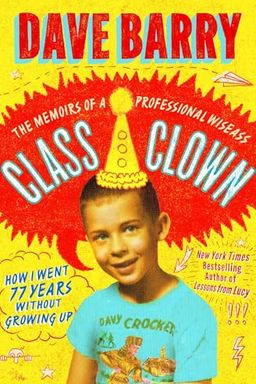
How can you turn class clown energy into a life’s work without losing the human being behind the laughs? In Class Clown, Dave Barry argues that humor isn’t a cute side dish to life; it’s the main course that helps you face the heavy stuff and stay connected to people. He contends that the funniest material doesn’t come from cleverness alone—it comes from real experience, decency learned at home, relentless practice in unglamorous places, and the willingness to keep testing the line between silly and sincere.
Barry’s throughline is simple: the jokes kept saving him, then his readers, then (sometimes) his subjects, because humor disarms, invites, and clarifies. But to get there, he had to grow up in a half-built, spider-filled house in Armonk; learn from a good father and a wickedly funny mother; muck through small-town obits and zoning meetings; get rejected and rerouted by the Associated Press; become a business-writing consultant who preached the power of a strong lead; crash Tropic magazine’s mad-science lab; and then write columns so relentlessly that a national audience started mailing him Pop-Tarts and Barbie skates to set on fire on the Letterman show.
Why This Memoir Matters Now
You live in a world that treats laughter as either an indulgence or a weapon. Barry offers a third path: humor as a way to stay sane, humane, and curious. He shows you how comedy coexists with grief (his mother’s depression and suicide; his father’s alcoholism and recovery) and how it survives the velvet ropes of celebrity culture (Johnny Carson; Steve Martin; the Rock Bottom Remainders) and the bramble patches of politics (New Hampshire primaries, conventions, and the Florida 2000 fiasco). The stakes here aren’t trivial: he’s wrestling with what counts—family, craft, integrity—and how to know when to quit while you’re still funny.
What You’ll Learn
First, you’ll meet the parents—his wise, gentle father who literally dug the family foundation and later used his AA recovery to help incarcerated alcoholics, and his mother, whose lethal one-liners (“Don’t drown, kids!”) taught him timing and edge. You’ll see how a free-range Boomer childhood—ice-skating, BB guns, and rope-towed snowplows—seeded a sensibility: the world is ridiculous and resilient; notice it carefully, then say so plainly.
Second, you’ll trace Barry’s apprenticeship in the Daily Local News newsroom, where obituaries, sewage authorities, and Cyclone Agnes taught him speed, accuracy, and nerve. You’ll step into the unexpectedly formative sabbatical as a business-writing consultant, where he became evangelical about structure—write a real lead; stop mutilating verbs—and where he learned how to hold a room, a skill that later powered book tours and TV spots.
Third, you’ll tour Tropic magazine’s madcap era with editor-geniuses Gene Weingarten and Tom Shroder: engineered rivalries (Heat vs. Magic), questionable covers (Dave with an incriminating basketball), fearless profiles (Bob Graham’s harmonica safety and Don Shula’s cover-starring midriff), and that Pulitzer-earning cocktail of mischief plus precision. Here Barry refines investigative humor: tell the truth, but make it funnier than the lies.
Fourth, you’ll see how readers turned into collaborators. Barry’s mailbox becomes an engine for columns and civic pranks: lighting underpants with Rollerblade Barbie, toasting Pop-Tarts, Justice John Paul Stevens writing about Beano, Mister Language Person’s glorious wrongness, a telemarketer phone jam that made national news, and a colonoscopy column that almost certainly saved lives.
Fifth, you’ll cross the campaign trail, where Barry’s political coverage treats primaries as a form of Kabuki—earnest, exhausting theater where sincerity and stunt merge—and where his core ethic remains: mock pomposity, not humanity.
Finally, you’ll roam through the green rooms: Johnny Carson’s desk, the Oscars writers’ room with Steve Martin, Hollywood’s development hamster wheel, a best-selling YA prequel to Peter Pan, and a bar band night when Bruce Springsteen sang backup for Barry. Then you’ll watch him make the hardest funny move: quitting his weekly column before slipping into self-parody, guided by Dorothy Parker’s truth that anybody can say, “I don’t think that’s funny.”
Core Promise
Humor won’t spare you pain, but it can keep you human—curious, decent, and awake—long enough to take care of the people you love, tell the truth with style, and quit while you still own your voice.
How To Read This Summary
Treat each key idea like a backstage pass. You’ll get a scene, a craft lesson, a value, a caution. Whether you write, lead, parent, or simply want to laugh more wisely, Barry gives you a blueprint: earn your jokes the unglamorous way; respect your readers like collaborators; and remember—amid the noise—that it’s probably going to be OK.