
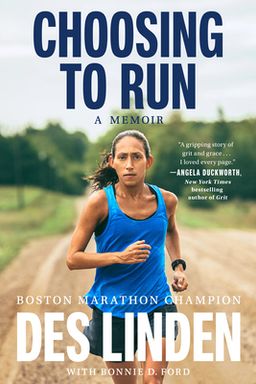
Choosing To Run cover

Choosing To Run

by Des Linden With Bonnie D. Ford

The Boston Marathon winner and Olympian shares her racing highlights and training methods.

Choosing to Run: Turning Endurance into Agency

When life tells you to slow down—or flat-out quit—how do you decide what to do next? In Choosing to Run, two-time Olympian and 2018 Boston Marathon champion Des Linden argues that endurance isn’t just a physical trait; it’s a daily decision to claim agency, design your own rules, and keep showing up even when the conditions, gatekeepers, or your own body say otherwise. Linden contends that choosing to run is less about mileage and more about mindset—about creating a personal system that honors your values, your health, and your long game.

This memoir isn’t a straight-line sports story. It’s a braided narrative of an outsider forging belonging, an athlete learning to negotiate her worth, and a champion who wins the biggest race of her life on a day she intended to drop out. The core arc moves between Linden’s rain-lashed triumph in Boston 2018 and the two decades of choices that made that moment possible: a tough-love childhood in San Diego, formative mentorships at Arizona State (with coach Walt Drenth) and with the Hansons-Brooks Original Distance Project, a near-mythic 2011 Boston runner-up by two seconds, a shattering 2012 Olympic DNF from a misdiagnosed femur fracture, and a near-death spiral in 2017 from severe hypothyroidism that forced her to rebuild everything—body, training, business, and beliefs.

The Choice Behind Every Mile

Linden reframes endurance as a choice you renew daily. Some days it flows; others feel like “trudging through hell.” Her mantra—“keep showing up”—isn’t about romantic grit; it’s pragmatic permission to be imperfect and still proceed. That ethos is tested at scale on Marathon Monday 2018. After a winter of illness, uneven training, and a serious conversation with her chiropractor-triage-whisperer John Ball about the wisdom of dropping out, Linden boards the bus to Hopkinton with one plan: protect her health and, if needed, step off the course. Then a historic Nor’easter slams Boston. The conditions become both enemy and equalizer, and Linden chooses—to start, then to help a rival (Shalane Flanagan’s midrace bathroom break), then to work for the chase pack in the headwind, and finally to put herself at risk and race to win. Choice stacks on choice until it becomes identity.

The Course and the System

This is also a book about learning how systems work—teams, sponsors, media narratives, and anti-doping—and then choosing where you stand. Linden grows up in the blue-collar Hansons program near Detroit—high-mileage, low-gloss, “running tired,” sharing houses and shop jobs, building value the old-fashioned way. She learns to think like a pro: no pacers on Boston’s rolling course; earn appearance fees; negotiate bonuses; treat the marathon like both craft and business. And she learns to speak—publicly—about integrity, including when her own group signs Dathan Ritzenhein, a former Nike Oregon Project athlete entangled in a USADA investigation. Her stance (“I can’t be super-supportive until that’s cleared”) costs comfort but preserves alignment.

The Team That Makes You

Linden’s team is a cast of quietly crucial characters: her sister Natalie (the original risk-taker), husband Ryan (equal parts calm and fire; the night-before-Boston truth-teller), agent Josh Cox (who repeats “You don’t get what you deserve, you get what you negotiate”), physio John Ball (who saved her career more than once), Mary Kate Shea (the Boston insider who believed when it mattered), and the late Gloria Ratti (guardian of Boston’s soul). Their loyalty shows up—in garages, hotel hallways, and sideways rain—when outcomes are unknown.

The Weather Inside

In 2017 Linden nearly disappears under an undiagnosed endocrine crash: hair falling out, CK at 900, eyelids swollen, breath short, a nurse practitioner warning coma or death without Synthroid. She resists—thyroid medication is stigmatized in her sport—then relents and rebuilds. The comeback isn’t cinematic; it’s calibrated. She cuts junk miles, trains by effort, adds rest, and relearns to prize health over volume. The payoff is paradoxical: a win on the ultimate test course on the very day she tried not to care about winning.

Mantra

“Keep showing up.”

Why This Matters To You

You don’t need to run Boston to use this playbook. Linden offers a template for hard seasons: choose health first, design your own metrics, find teammates who tell you the truth, and keep your ethics when it’s inconvenient. You’ll see how to negotiate for yourself at work, shift from pace to effort when life’s hills get steep, and reframe setbacks as data. You’ll also learn what it looks like to risk your story in public—to help a competitor midrace, to speak up about doping, to leave a familiar team—because agency isn’t just finishing; it’s choosing the terms on which you start.

In the pages ahead, you’ll dive into Linden’s outsider origin story, the scrappy making of a pro, the breakdowns that recalibrated everything, the tactical anatomy of her Boston win, the courage and costs of speaking up, and her post-Boston reinventions—from dedicating miles to Gabriele Grunewald to setting a 50k world record. Along the way you’ll be invited to build your own version: a life where endurance is not a punishment you endure, but a power you choose.


The Outsider Advantage

Des Linden makes a case for the competitive edge of feeling like you don’t quite belong—and choosing to channel that. As a kid in San Diego, she lives inside a parental sports machine: clinics after practice, soccer balls ricocheting off a front-yard wall, and a dad whose mantras—“No shortcuts,” “Everything is earned”—come with a price tag of pressure. She learns to compete early and often, but also to chafe. When youth soccer politics reward the in-crowd, she’s already allergic to gatekeeping. The first time she lines up for a one-mile kids’ road race in Carlsbad wearing cotton sweats while the ‘real runners’ sport tiny split shorts, she crushes. The chip on her shoulder finds a lane.

From Team Sports to Independent Work

Running becomes independence. With the MLK Blasters, an all-Black sprint-centric club in San Diego, she is the distance outlier and welcomed anyway. Coach Adam Henderson writes her lonely workouts; a local runner named Doug tells her she’ll make the Olympics. She falls in love with crunchy cinder tracks and the sound of improvement you can measure with a watch rather than politics. The clock, she learns, “doesn’t play favorites.”

Mentors and Maps

Frank Browne, the English teacher-coach who mixes split charts with music and movies, asks to see her long-term goal card at a youth camp. She writes: “Make an Olympic team.” He’s unfazed and sketches a path: build speed at shorter distances, graduate to 5,000 and 10,000 meters, then the marathon. She recoils—the marathon sounds like a jog, not a race (an assumption she’ll later dismantle)—but the seed’s planted. The other pivotal mentor is Arizona State’s Walt Drenth, whose calm intensity and belief in getting “the absolute most out of people” lure her away from the safe choice of Berkeley. Choosing ASU means choosing growth over prestige, self-belief over parental preference.

Refusing Harmful Myths

NCAA women’s running in the early 2000s often idolizes the stick figure. Linden and teammate Amy Hastings make a pact: strong, not starved. They eat to fuel, not to impress. (Compare to Lauren Fleshman’s Good for a Girl for a broader industry critique; both reject a culture that normalizes disordered eating for performance.) Linden keeps her off-season a true off-season. She finds joy in indie shows—Saves the Day soundtracks the mosh pit—learning that belonging doesn’t require uniformity. This insistence on health as a performance strategy underpins her longevity; it’s also an early practice of agency.

Learning to Love the Long Run

Sundays on South Mountain, she and Amy climb red-dirt trails and descend into what Des calls “the Church of the Sunday Long Run.” There’s ritual—8 up, 8 down—witnessing college nightlife’s aftermath on the way to worship. They play “heading home or going out?” with wobbling students; then they bank work. The contrast crystallizes an identity: she’s not missing normal life; she’s choosing another version of it. When plantar fasciitis ruins her senior year, finishing dead last at NCAAs, she feels both done and not done—the dual engine that will drive her pro career.

Takeaways for You

  • Outsider status is a tool, not a wound. Use it to resist bad norms and double down on fair metrics (the clock, the work).
  • Pick mentors who take your goals seriously, then expect you to evolve (Frank maps a marathon future she can’t yet imagine; Walt makes belief practical).
  • Define health as a performance edge. Eat, sleep, and live in ways you can sustain across seasons, not just one peak.

(Context: Angela Duckworth’s Grit frames perseverance as passion plus persistence; Linden adds boundaries—health and self-respect—as prerequisites to sustainable grit.)


Building a Career the Hard Way

Linden’s pro origin story is not a Nike campus fairy tale; it’s a spare bedroom near a leaky window in suburban Detroit, a job answering emails at Moosejaw at 3 a.m., and a team house run by the Hansons-Brooks Original Distance Project. Contracts are bonus-only; checks arrive if you perform. You might read that as exploitation; she reads it as opportunity to be seized with eyes open. The Hansons’ philosophy—“running tired”—means stacking 100–120 mile weeks, learning to race well on dead legs. Teammates like Brian Sell (4th in Boston in 2006, Olympian in 2008) make blue-collar excellence visible: 160-mile weeks, doubts about dental school, and a body that keeps showing up.

Falling for the Marathon

She doesn’t love the marathon at first. Then Chicago 2006 turns her into a believer from the finish line, where Robert Cheruiyot knocks himself out on a slick sponsor logo and still wins; where pros and amateurs share a course and the marathon reveals everything. Boston 2007 is cold rain and survival—2:44 in a Nor’easter—plus a tour with Gloria Ratti, guardian of the race’s soul. It’s also a preview of Boston’s tactical PhD: no pacers, rolling physics, late-race math. The 2008 Trials loop course teaches her about fueling—blowing up from glycogen mismanagement while running in 4th is a hard-earned lab result.

The 2011 Almost

Boston 2011 becomes the north star. Training is monastic: 120-mile weeks, tempos at 5:24–5:29, long runs, and a full-body rehearsal of smells (lead-vehicle exhaust), sounds (Citgo sign roar), and taste (sticky palms from bottles). She executes: ignoring early fireworks, picking off casualties, cresting Heartbreak in front with Sharon Cherop and Caroline Kilel. Boylston turns into a drag race. Both calves seize; she loses by two seconds in 2:22:38—the fastest American ever at Boston at the time. The world applauds “potential,” a word she loathes because it both praises and withholds. She goes back to work, not to be congratulated for almost, but to find out what still hides inside two seconds.

Learning the Business

Enter Josh Cox—runner, agent, fellow San Diegan—who brings a mantra Linden weaponizes: “You don’t get what you deserve, you get what you negotiate.” He helps her add digits to her Boston appearance fee (Mary Kate Shea on the other side of the table, tough and fair), craft side deals (sponsor bonuses for small race wins—her “Filthy Rich Saturdays”: Turkey Trot, Jingle Jog, New Year’s Run), and decouple coaching from contracting. She learns to love the unsexy email-and-invoice grind because it buys choice—where to race, when to build, and eventually, where to draw lines.

Play This in Your Career

Track what you produce, learn your market, and negotiate for alignment, not just money. Linden’s arc shows how business acuity is endurance by other means.

(Comparison: Deena Kastor’s Let Your Mind Run tracks mindset gains; Linden expands the frame to contracts and field-building—how you earn the right to be on the start line you want.)


Breakdowns, Bombings, and Recalibration

The easy story would claim straight-line ascent: near-win, then win. Linden’s truth: breakdowns do essential recalibration. In 2012, a tightness she’d been ignoring becomes a knife-edge pain. She chooses to fly to London anyway, walks into the opening ceremony with Amy Hastings, and then steps onto the Olympic course determined to at least start. She lasts 2.2 miles. Back home, a delayed MRI pinpoints a mid-femur stress fracture—serious, near the femoral artery. The relief is perverse: at least her pain had a name. The lesson: denial is not toughness; information is.

Aftermath and Aftershocks

She attends Boston 2013 as a guest, finishes a 10-miler, and then watches, stunned, as bombs detonate near the line. The cruelty sears a home-course bond more deeply. In 2014, she’s back racing 2:23:54 as Meb Keflezighi—also counted out—wins and holds the flag for the city. Personal life weaves through: a wedding in Petoskey (20-miler in the morning, vows at night), a careful Berlin 2013 to feel like herself again, and Kenya trips that reaffirm running as cultural passport. In Iten, she shares dirt roads with little kids yelling “How are you?” and sips chai with Boston champ Sharon Cherop, who shows her a wedding cake shaped like the BAA trophy.

Doping Fog and a New Beacon

Rio 2016 delivers a top-10 sweep for the U.S. women—Shalane (6th), Des (7th), Amy (9th)—on a day that “didn’t add up.” Later, the gold and silver medalists face doping bans elsewhere; retroactive justice does not fix an Olympic day. Linden and Flanagan swallow their restraint with reporters, then talk privately about what clean athletes can say in a world that punishes truth-telling. She pivots her beacon. If the Olympics are fickle and political, Boston is tactical and accountable. As an invitational, it can still get fooled, but it tries to right records and honor the work in real time. She claims Boston as home—smells, hills, crowds, and all—because it rewards thinking runners and long memories.

Your Recalibration

Breakdowns force boundary updates. Linden’s show you how to move from denial to data (get the scan), from anger to action (Berlin rebuilds, Kenya renews), and from cynicism to a new definition of success (pick a race, role, or craft whose rules you can live with). Her lesson isn’t that you’ll overcome; it’s that you get to choose what you aim at next, eyes open.

(Context: Alex Hutchinson’s Endure explores limits as elastic; Linden’s memoir supplies the lived case study—the elasticity includes ethics and identity, not just VO2 max.)


Into the Deepest Well—and Back

Summer 2017 yanks the floor out from under Linden. She can’t climb stairs without stopping. Her hair clogs drains; feet go numb; CK (muscle enzyme) spikes to 900. She assumes puppy allergies or low iron. Urgent Care calls with an alarm bell: severe hypothyroidism, Synthroid now or risk coma. She resists—thyroid meds carry stigma in a sport scarred by misuse—and a nurse practitioner levels with her: “You’ll be in a coma, or dead, before you can get an appointment.” The starkness cuts through fear. She starts the meds.

Relearning Health Before Fitness

Recovery is non-linear. Eyelid swelling fades; breath returns by degrees; the couch still claims her. She studies her numbers like split charts: TSH > 92 (normal 0.45–5.33), free T4 < 0.2 (normal 0.7–2.0). She realizes symptoms had been whispering for months—sore throats, “flu” that wasn’t—ignored in the culture of cumulative fatigue. This time she ditches mileage machismo. She trains by effort, not ego: 12–14 miles easy instead of 18+ when the body says no; doubles only when additive; fewer junk miles; more sleep. She reframes the grind as a creative challenge—how to be consistent without hollowing herself out.

Resetting the Team and the Story

The Hansons sign Dathan Ritzenhein as USADA’s NOP investigation lingers. Linden asks hard questions and later answers publicly when pressed: she can’t be supportive “until it’s cleared.” Tension rises; so does her need for a training model that fits a new physiology. She keeps her anchor relationships tight—Ryan’s steadiness; MK’s belief; Josh’s advocacy; John Ball’s pragmatism (“Treat this like an injury”). She keeps her private devastation private, letting the world assume she’s on a mental health break. Then she posts the tweet that will become a credo:

Credo

“Some days it flows… other days it feels like I’m trudging through hell. Every day I make the choice to show up… My advice: keep showing up.”

Checkpoint in New York

The 2018 NYC Half is the litmus test. It’s windy, hilly, and perfect for effort-based honesty. She runs 1:13:33—slow by her old standard, strong by her new rubric—and leaves with something she couldn’t have negotiated: felt confidence. Lindsey Vonn’s Olympic bronze becomes another mirror: if the legend can still fling herself down a mountain because she loves the work, Linden can steward one more build toward Boston—even if the end isn’t what it used to be.

(Note: The Bhagavad Gita’s counsel—“You’re entitled only to your labor, not to the fruits of labor”—becomes a north star here; Linden cites it by name.)


How the 2018 Boston Win Happened

The anatomy of an unlikely win begins with an unlikely plan: start, protect health, and step off if wise. In the Fairmont lobby, Linden feels like a quitter in waiting. Outside, a horizontal wall of rain smacks truth into her. The storm will be cover and crucible. On the bus, John Ball quietly calibrates: “Mile by mile. If you think you’re doing long-term damage, step off.” She nods. Then, on course, she makes the first surprising choice: help someone else.

Serve First, Then Race

Around Wellesley, Shalane Flanagan asks if it’s okay to make a bathroom stop. Linden slows the field as best she can, then tows Shalane back through slicing rain and crosswinds. The act does something to her headspace: working for someone else frees her from self-surveillance. At Mile 17, off the back again, she makes another choice: get to the front, cut the wind, and glue the chase pack together. She’s solo down Newton Lower Falls, running tangents with relentless economy, gradually reeling in Gladys Chesir and race leader Mamitu Daska.

Heartbreak Decisions

Cresting Heartbreak, Chesir launches to catch Daska; Linden, the tactician, notes Chesir’s wasted meters—missing tangents, overpacing into the headwind. Within fifteen seconds Linden’s on her heels. Decision time. Sit and draft, or test? She goes by decisively, even skipping a bottle to press. Effort not pace rules; she’s learned to trust feel in a year of thyroid chaos. On the Chestnut Hill descent, she tunes out splits and hunts silence—gaps in the crowd roar that might betray chasers. Her headband is soaked; she decides to believe the absence of sound.

Racing Principle

“You run the first 20 miles with your head and the last 6.2 with your heart.” —Agent Josh Cox

The Final Turns

At Mass Ave she contemplates unzipping her jacket so the finish photo shows the bib; her hands won’t work, and she refuses to risk seconds. Right on Hereford feels like Everest; left on Boylston detonates with a gale. She allows a half-smile, then sprints into a vacuum so rare on that boulevard it feels like fiction. Tape breaks. Joanie Samuelson barrels into her arms. Security chief Dean Mini drapes a flag. Linden looks for Ryan and Josh—the two people who, hours earlier, had urged her to try. She whispers what both are thinking: “I can’t believe that just ______ happened.”

What You Can Steal

  • Serve first to unlock flow (helping Shalane reoriented Linden’s mindset).
  • When in chaos, privilege effort over pace; tangents over bravado.
  • Decisions stack. Today’s small brave choice becomes tomorrow’s finish line.

Loyalty, Courage, and Speaking Up

Loyalty in Linden’s world is not silence; it’s presence with truth attached. The week of Boston 2018, she sits at a table at the Fairmont and answers a LetsRun question about her team signing Dathan Ritzenhein, whose name threads through USADA’s Nike Oregon Project investigation. “I can’t be super-supportive until that’s cleared.” She knows this will rupture comfort with the Hansons and spark awkward brand conversations. She says it anyway. Later, Brooks staff try to backstop messaging; she hears them—and continues to own her stance. Courage is lonely in the ballroom; no one confronts her in the moment. She races anyway.

What Loyalty Looks Like

It also looks like Josh Cox walking with her into the storm, hand on Padres cap, making the absurd laughable; like Mary Kate Shea ensuring Linden’s invitation and appearance fee match her real value; like husband Ryan, the night before, urging her to try when she intends to DNF (“You’re mentally tougher than everyone; this is perfect for you”). It looks like John Ball repeating the unglamorous plan: finish only if it won’t hurt your future. After the win, Linden meets the Hansons to talk like adults. They propose she remain on the team jersey; she hears echoes of indebtedness. She chooses to leave the group but not scorched-earth the relationship. She reaches out to Dathan privately. They talk. Boundaries set, bridges unburned.

Ethics as Endurance

Linden’s career insists that ethics are part of endurance. Speaking up in an insular sport costs. So does saying nothing. She picks the pain she can live with: truth with consequences. (Compare Brené Brown’s “clear is kind”; Linden models clarity without theatrics.) That clarity extends to business (“You don’t get what you deserve…”), to health (take the Synthroid), to race-day choices (help a rival, then race her). The result is not perfection but coherence—a person recognizably the same in press rooms, on rainy roads, and at negotiation tables.

Your Move

  • Define loyalty as showing up with the truth, not enabling comfort.
  • Practice clarity in low-stakes contexts so you can hold it when it matters.
  • Choose partners (work, health, life) who can tolerate honest weather.

Redefining the Finish Line

Winning Boston isn’t an ending; it’s new oxygen. The next April, Gabriele Grunewald—middle-distance pro, rare-cancer advocate—tweets that she misses running and is “triggered” by talk of comebacks. Linden replies: “All my miles for you.” On race day 2019, when the Newton pack drops her and the hill fatigue is more mental than muscular, she changes her why in real time: today’s last 10K is for Gabe. She claws back places, proof that a borrowed why can power your own legs. (Grunewald would pass away two months later; Linden’s tribute has the weight of lived vows.)

Calendar Club and a Global Stall

COVID cancels the majors; the trials leave her 4th by 11 seconds. She invents Destober with Brooks: run the date—1 mile on the 1st, 26 on the 26th—inviting the community to “keep showing up” together. By Day 26, she’s a “rusty robot” creaking out the door for a second run. The lesson is unglamorous and universal: motivation returns mid-run, not before. Meanwhile, she stays first Olympic alternate, trains to be ready, and turns a blank calendar into a training ground for identity, not just races.

The 50k World Record

In April 2021, Linden and her crew build a record attempt in Oregon: a bike path along Dorena Lake, USADA testing, five finishers minimum (including ultrarunner Sally McRae and Atlantic CEO Nick Thompson), Charlie Lawrence as metronome. Training is old-school and specific: long steady runs punctuated by race-pace 5-mile repeats inside a 26.2-miler. On race day, she runs 2:31 for the marathon split, then fights brain fog and slipping pace. At the final turnaround, she chooses to hurt long enough to go sub-3: 2:59:54—world best and a round number worth savoring. The road beyond the marathon is no exile; it’s another expression of the same agency.

Life Bigger Than Splits

Threaded through is a life not mortgaged to the next start line: bourbon neat (then a splash of water), coffee obsession, lakes, kayaks, golden retrievers Atlas and Boston, travel that teaches (Varanasi’s paradox of purity and pollution; Iten’s red dust and kids in bare feet). These are not distractions; they’re stabilizers that help her hold both sides of the best mornings: “I need to stand here and soak this in” and “I need to get warm now.”

(Note: Linden’s reinventions echo Kilian Jornet’s move into multi-discipline mountain projects—both treat endurance as a canvas, not a cage.)


Your Playbook to Keep Showing Up

You don’t have to be a marathoner to use Linden’s system. This final playbook distills her choices into moves you can practice at work, in health, or on literal roads.

1) Build a Why You Can Carry

Write the card Frank Browne asked for: the long-term goal you’re a little scared to say out loud. Then collect shorter-term why’s you can swap in mid-race—help a teammate (Shalane’s pit stop), honor someone (Gabe), protect future you (John Ball’s caution). Strong why’s are stackable and situational.

2) Train by Effort When Life Tilts

When health shifts (thyroid) or context wobbles (pandemic), swap pace for effort. Keep the spine (tempos, long runs), trim the margins (junk miles), and double only if additive. Track how you feel with the same seriousness you apply to splits. Your body is the first coach.

3) Assemble Your Inner Circle

Find your MK (institutional belief), your John (honest diagnostics), your Josh (negotiation and advocacy), and your Ryan (truth-teller at 9 p.m.). Loyalty is attendance in storms, not applause at finish lines.

4) Learn the Course and the System

Know the external rules (no pacers in Boston, tangents matter), and the backstage ones (appearance fees, bonus structures). Practice race moves and business moves alike. “You don’t get what you deserve, you get what you negotiate” applies to promotions and start lists equally.

5) Speak Up—Kind, Clear, and Early

If ethics matter to you, say so before you need to. Linden’s public stance on NOP-aligned signings shows how to be specific without self-righteousness. Clarity is aerobic fitness for your character.

6) Visualize Like a Scientist

Linden rehearses smells, turns, surges, and aid-table grabs. Do the same for your presentations, negotiations, or interviews. See the Citgo sign; smell the exhaust; practice zipping the jacket—or not.

7) Accept Nonlinear

The line from 2011 to 2018 is not straight: London DNF, bombing grief, health collapse. Forward is a direction, not a rate. Keep showing up is a practice, not a slogan.

Action Starter

This week: write your long goal, identify one truth-teller, trade one junk mile (or hour) for sleep, and visualize a tough turn. Then show up.

Dig Deeper

Get personalized prompts to apply these lessons to your life and deepen your understanding.

Go Deeper

Get the Full Experience

Download Insight Books for AI-powered reflections, quizzes, and more.