
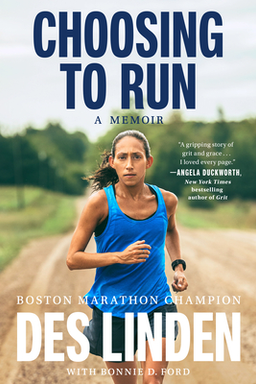
Choosing to Run cover

Choosing to Run

by Des Linden

Choosing to Run offers an inspiring glimpse into Des Linden''s transformation from a reluctant runner to Boston Marathon champion. Her story highlights resilience, mental fortitude, and personal growth, providing valuable lessons in perseverance and authenticity amidst the challenges of professional sports.

Choosing to Run: Endurance, Identity, and the Art of Showing Up

When life tests your endurance—physically, emotionally, or mentally—how far are you willing to run for who you want to become? In Choosing to Run, two-time Olympian and Boston Marathon champion Desiree Linden invites you inside the mind, heart, and miles of a professional runner who transforms pain, isolation, and setbacks into power. Her memoir is far more than a sports story; it’s an exploration of identity, resilience, and the conscious decision to keep showing up when everything else says stop.

Linden contends that endurance—on the road and in life—isn’t about surviving the pain, but choosing to engage with it. She argues that true strength comes not from winning races but from deciding who you’ll be in the hardest miles. To her, bravery isn’t innate—it’s built, one step at a time. The Boston Marathon serves as both a metaphor and a crucible, revealing how she learns to run through identity crises, disillusionment, and the literal exhaustion of professional sport while redefining success for herself.

A Life Measured in Miles

Linden’s life unfolds along a series of metaphorical and literal miles—from competing as a ten-year-old in the Junior Carlsbad road race to chasing Olympic dreams across continents. Each phase represents a different form of distance: familial expectation, institutional pressure, injury, and self-discovery. Her 2018 Boston Marathon victory, achieved amid horizontal rain and hurricane-force winds, encapsulates her philosophy: the conditions rarely cooperate, but commitment is non-negotiable. You don’t wait for perfect weather—you run through the storm.

The book alternates between chapters of her historic Boston win and the internal miles that shaped her—her childhood clashes with a demanding father, collegiate battles with injury and body image, her ambivalent relationship with coaches and sponsorships, and her near-collapse from undiagnosed hypothyroidism. Through every detour, Linden keeps returning to the same decision point: you can quit, or you can choose to run.

The Power of Choice and Identity

Linden’s narrative doesn’t romanticize the idea of perseverance—it interrogates it. Endurance, she insists, can be toxic when confused with self-erasure. Her diagnosis of hypothyroidism nearly killed her, revealing how marathon mentality can go too far. Yet it also forced her to rebuild her relationship with discipline. As she gradually recovers, she wrestles with the meaning of ambition: can you still be a runner when your body demands mercy? Her eventual answer—yes, but differently—reframes endurance as compassion, not punishment.

This theme echoes psychological research on “grit” (Angela Duckworth) and the idea that perseverance must align with purpose to be sustainable. Linden’s version of grit is embodied, visceral, and emotionally intelligent. She isn’t chasing validation; she’s chasing alignment. The marathon becomes a mirror for identity work—when the body hurts, the mind must decide what matters most. Every mile marks a negotiation between desire and surrender, and each finish line becomes proof of choice, not fate.

Running as Metaphor for Creative and Moral Endurance

In her storytelling, running becomes a universal metaphor for human persistence. Linden likens her grind to artistic creation, referencing Joan Didion’s essays and other writers who turn struggle into expression. Her coaching relationships—particularly with Walt Drenth and Frank Browne—show how mentorship translates athletic discipline into life wisdom. Walt’s dictum, “It doesn’t matter how you feel; it’s whether you’re ready,” evolves into Linden’s own paradox: feeling matters, but readiness is cultivated through consistent choice. The deeper lesson for readers is that art, sport, and meaning-making all demand sustained discomfort. You learn to run tired, but you also learn to rest without guilt.

Her Boston triumph serves as both cinematic climax and internal epiphany. Amid torrential rain and despair, Linden slows down to help fellow runner Shalane Flanagan after a bathroom stop—an act of pure sportsmanship that reawakens her drive. In helping someone else, she helps herself rediscover joy in the race. The moment reminds readers that loyalty and community can restore identity more powerfully than ambition. It’s not only about winning—it’s about belonging.

Why These Ideas Matter

Linden’s memoir resonates deeply in an era obsessed with optimization and performance. She rejects the myth of the flawless athlete or perpetually joyous achiever. The point is not never to fall, but to choose to rise—and sometimes to walk. She reminds you that courage is cumulative, built through micro-decisions: getting out the door, showing up to practice, facing fear. Her mantra “Keep showing up” becomes a philosophy of life as well as sport. Whether you’re chasing a marathon PR, recovering from burnout, or navigating self-doubt, Linden’s message reframes commitment not as heroism but as humanity.

Core Message

Choosing to run is more than athletic choice—it’s moral courage. It’s deciding to engage with life’s headwind, stay present through pain, and trust that every step counts even when no one is watching.

Across twelve major themes—from family and mentorship to injury, ethics, and self-redefinition—Choosing to Run offers a living blueprint for endurance that extends far beyond sport. Linden proves that the hardest races are never about the miles on the road—they’re about the ones you run inside yourself.


The Outsider: Running Away to Find Herself

Des Linden introduces herself as an outsider before she ever becomes an Olympian—a small, intense kid pushed into sports by ambitious parents. Her early years in San Diego were filled with pressure, competition, and constant lessons about earning everything. Her father, Dennis, drilled her with maxims like “Nothing is given; everything is earned.” Yet beneath his good intentions lay control and emotional strain. Young Des learned to associate effort with obligation, not pleasure. Running, which she discovered accidentally through youth track, quietly became rebellion—her way of reclaiming time, agency, and autonomy.

Sports as Flight and Freedom

Her childhood sports served as confinement until running flipped the narrative. Linden recounts drills in front of their retaining wall, nights when her father barked instructions, and her own silent resistance during post-practice “clinics.” When she entered her first one-mile youth race—wearing sweatpants amid sleek uniforms—she beat everyone. That victory wasn’t about medals; it was liberation. “Choosing to run,” she says, “was the first real decision I ever made.” The act of racing revealed how effort could belong fully to her. Unlike team sports haunted by politics and favoritism, the clock didn’t lie.

Learning the Power of Otherness

Linden’s underdog status becomes a lifelong identity. Too small, too late-blooming, too introverted—she cultivates independence instead of resentment. Running alone, she finds a meditative rhythm that replaces the chaos of family dynamics. She trains with African American sprinters at the MLK Blasters Club, standing out racially and athletically but finding inclusion in effort. Those early track sessions foreshadow her adult ethos: the road doesn’t discriminate, only distance does.

Coach Adam Henderson and local runners like Doug, who predicted she’d go to the Olympics, fed her imagination. Yet it was high school coach Frank Browne who crystallized her potential by asking her to write her dream on a notecard: “Make an Olympic team.” Browne’s advice—combine speed with stamina and think in years, not days—became the blueprint of her journey. He also was the first to mention “marathon,” planting the seed Linden would grow to embody.

Choosing Against Expectation

When college arrived, the outsider theme persisted. Linden defied her parents’ wish that she join her sister Natalie at UC Berkeley and chose Arizona State instead, betting on Coach Walt Drenth’s philosophy of mental toughness. She wasn’t chasing prestige—she wanted development. Walt’s belief that “a champion’s mentality values effort more than outcome” shaped her long-term resilience. (This parallels Carol Dweck’s concept of “growth mindset,” valuing progress over perfection.)

In those desert dawns and long, dusty runs, Linden found the essence of independence. Her Sunday trail rituals, her camaraderie with teammate Amy Hastings, and even her punk-rock nights showed she could balance seriousness and joy. “Running felt like independence,” she writes. “It gave me time completely within my control.” That autonomy would become the compass guiding every future decision—from joining the Hansons-Brooks team to surviving injury and burnout.

Lesson

You can’t become your strongest self by perfecting someone else’s dream. Linden’s youth teaches that individual purpose often begins as defiance, and choosing your own pace is the first act of self-respect.


Investment: Building a Life Around Running

Linden’s move to Michigan after college marks her first real leap of faith—an investment in herself that sets the foundation for everything that follows. Joining the Hansons-Brooks Original Distance Project, a bare-bones team for overlooked athletes, she enters an environment that prizes work ethic over glamour. Her contract is bonus-only, meaning no guaranteed money if she’s injured. For Linden, it’s perfect: risk equals motivation. Her motto mirrors her father’s tough creed, transformed: “Find opportunities wherever you can, and don’t squander them.”

Running Tired: The Hansons Philosophy

The Hansons trained runners to “run tired”—a concept both brilliant and brutal. It meant simulating the fatigue of a marathon every day so no mile on race day would surprise you. Linden takes to it intuitively. She logs 100–120 miles per week, balancing exhaustion with routine at her minimum-wage job at a gear store. This immersion creates emotional equilibrium: running may be obsessive, but normal life keeps her human.

Her teammates—Melissa White, Dot McMahan, and Brian Sell—become her training family. Watching Sell make the Olympic team in 2008 reinforces her belief that “ordinary endurance can yield extraordinary outcomes.” His mantra, like hers, is simplicity: keep showing up. (Note: this echoes the ethos of distance running philosopher George Sheehan and author Matt Fitzgerald’s idea of “mental fitness” in sport.)

The Economics of Passion

Linden’s candid look at the business of running demystifies the sport. She sees contracts, profits, and diplomacy behind every medal. When she meets agent Josh Cox, she begins to reclaim the financial aspect of her career—learning that advocacy is as vital as athleticism. “You don’t get what you deserve,” Josh tells her. “You get what you negotiate.” Their partnership becomes a definitive turning point, freeing her from dependence on her coaches and redefining loyalty.

Through relentless effort, Linden breaks the 2:30 marathon barrier, places tenth at World Championships, and finally runs 2:22:38 in Boston 2011—missing victory by two seconds. That near-win becomes her emotional teacher. Losing teaches her what winning actually means. She stops chasing the perfect race and starts building the perfect mindset.

Lesson

Sometimes, the best investments aren’t glamorous—they’re gritty commitments made with limited resources. Linden’s early professional years prove that self-trust can generate wealth in more ways than money.


Dreams and Dust: When Ambition Breaks and Rebuilds

The chapters surrounding Linden’s Olympic highs and lows capture the emotional core of her memoir. After making the 2012 Olympic marathon team—a dream she’s chased since high school—she arrives in London only to discover a fracture in her femur that ends her race after two miles. What follows is existential collapse. “I wasn’t sure I’d ever return to my former self,” she confesses. Yet, paradoxically, this breaking point births transformation. Injury becomes philosophy.

Failure as Forward Motion

Instead of treating her withdrawal as tragedy, Linden studies it. She meets chiropractor John Ball, who becomes a brilliant fixer of broken bodies and introduces her to recovery as art, not punishment. Through him, Linden begins seeing pain as data. “You don’t have to suffer,” he says. “You have to pay attention.” That idea anchors her later comeback philosophy. She learns that broken bones heal; broken identities must be rebuilt.

Her time away from running coincides with massive external events—the Boston Marathon bombing, doping scandals, and the evolution of women’s long-distance running. Each event widens Linden’s perspective from personal ambition to collective purpose. Watching Meb Keflezighi win Boston in 2014 fills her with pride and rage: proof that redemption is possible. She vows to make her own next chapter count.

Love and Loyalty in Recovery

Ryan Linden’s role during her recovery becomes the heart of this section. While Des questions her relevance, he reminds her she’s never run out of chances. Their shared rituals—training with dogs Miles and Atlas, long coastal drives, and a simple wedding up north—help her regain equilibrium. They symbolize what endurance scholars call “social anchors”: relationships that stabilize self-concept amid burnout. Linden’s friendships with runners like Amy Hastings and her sister Natalie mirror this same theme—love that endures when speed doesn’t.

By the time she returns to racing with a respectable time in Berlin and later requalifies for Rio 2016, Linden understands pain differently. It’s not an enemy—it’s an unwelcome but honest teacher. “Sometimes, life happens, and your only choice is a comeback,” she writes later, echoing fellow runner Gabriele Grunewald’s words. In her story, choosing to run post-failure becomes a moral stance: persistence as gratitude.

Lesson

Ambition that doesn’t break never teaches resilience. Linden’s collapse and comeback show that losing everything can strip you down to what’s real—your will to show up again, without applause.


The Deepest Well: Survival and Self-Redefinition

Linden’s unexpected battle with hypothyroidism in 2017 reframes her entire philosophy of endurance. After years of pushing through fatigue and pain, she wakes one night gasping for breath—her body finally demanding mercy. Severe hypothyroidism nearly shuts down her organs. Her hair falls out, she sleeps twenty hours a day, and her once iron body feels foreign. For someone whose creed was “run tired,” it’s a devastating betrayal. Yet it’s also revelation: endurance without awareness becomes destruction.

From Denial to Diagnosis

Linden’s medical odyssey reveals the shadow side of athlete culture. Distrustful of shortcuts and doping rumors, she resists treatment at first—Synthroid feels like cheating. Her denial is symbolic of modern perfectionism, where help looks like weakness. It takes a nurse practitioner’s stark warning—“If you don’t start taking this, you’ll be dead before your next appointment”—to make her listen. This moment exposes how identity built on endurance must evolve to include acceptance. She realizes medicine isn’t an advantage; it’s equilibrium.

Through recovery, Linden confronts self-worth beyond performance. The marathon had conditioned her to tolerate intolerable pain. Now she must retrain herself to notice joy. Simple acts—walking upstairs without gasping, fishing, reading, playing with her dogs—become her marathon. This vivid contrast mirrors concepts from Zen philosophy and Joan Didion’s reflections on living “recklessly and fully.” Linden learns that slowing down isn’t failure; it’s choosing to survive.

What Endurance Really Means

Emotionally, she reinterprets running as dialogue rather than dominance. When she begins gentle runs again, she tells herself: “The math doesn’t matter; the effort does.” This mindset evolution—effort over pace—becomes the foundation for her miracle comeback at the 2018 Boston Marathon. She emerges from the deepest well physically renewed and mentally transformed. Instead of “no pain, no gain,” she believes, “Know pain, know yourself.”

Lesson

Endurance without awareness can kill you. Linden’s illness forces a radical recalibration of strength: the courage to stop, heal, and emerge wiser—a form of endurance often overlooked in life and sport alike.


The Right Why: Redefining Motivation and Joy

Emerging from illness, Linden searches for purpose beyond external validation. She reconstructs what “why” means in training and life—learning that discipline without meaning breeds collapse. Borrowing from philosophy and literature, she reframes running as craft. Her meditations on motivation recall Viktor Frankl’s question: “Are you able to find meaning in suffering?” Linden’s answer is pragmatic—meaning isn’t found, it’s built.

Freedom Through Discipline

She begins running in Rome and Morocco during recovery, testing whether she can balance exploration with effort. Training alone by the Tiber River, she learns joy is not a luxury; it’s fuel. She structures her workouts by intuition—no longer by rigid mileage. Instead of chasing splits, she listens to how she feels. This flexibility, paradoxically, makes her stronger. She discovers that “the grind” can coexist with curiosity, echoing stoic philosopher Marcus Aurelius’s idea that purpose is daily practice, not punishment.

Meaning deepens in friendship. A simple act—helping another runner return to rhythm—later mirrors her decision to pull Shalane back into the Boston 2018 race. Linden realizes that service can reignite self-belief. Running becomes less about proving and more about connecting. Even her admiration for Lindsey Vonn’s gritty bronze medal in 2018 reminds her that success needn’t sparkle to carry glory. Motivation evolves from “I have something to prove” to “I love the work enough to do it anyway.”

Keep Showing Up: A Universal Mantra

Through years of tumult, Linden distills her philosophy into five words: “Keep showing up.” She tweets it to others as encouragement, but it doubles as self-reminder. The phrase encapsulates resilience theory—small, consistent acts sustain big transformations. Whether facing burnout, illness, or weather, persistence becomes an ethical act. She treats effort as sacred, echoing the Hindu idea in the Bhagavad Gita: “You are entitled only to your labor, not its fruits.”

Lesson

Purpose doesn’t precede effort—it emerges from it. Linden’s evolution from chasing wins to embracing work teaches you that consistency, not motivation, reveals meaning.


Loyalty Shows Up: The Race that Changed Everything

The 2018 Boston Marathon is the emotional and philosophical climax of Linden’s story—the moment where every lesson converges. Battling freezing rain and personal doubt, Linden begins the race intending to drop out. Instead, she shows up for others. When Shalane Flanagan veers for a bathroom break around mile thirteen, Linden slows down to help pace her back—a gesture both tactical and human. That act turns into momentum; aiding someone else revives her own spark. It’s the paradox of loyalty: selflessness reignites selfhood.

Running Through Chaos

The Boston storm mirrors Linden’s internal one. She’s weighed down by strained coaching relationships and uncertain sponsorship. Yet amid headwinds and pelting rain, she stays present. Each mile becomes meditation: effort over ego. As competitors drop out, she channels instinct rather than tactics. Around Heartbreak Hill, she overtakes Gladys Chesir and Mamitu Daska, repeating to herself, “I’ve run thousands of miles so I would know what to do in these next four.” It’s her philosophy incarnate—preparation meeting surrender.

Victory Without Glamour

Crossing Boylston Street alone in torrential rain, Linden wins Boston—the first American woman in 33 years to do so. The triumph is raw, unscripted, and perfectly imperfect. She hugs Joan Benoit Samuelson at the finish, cups her frozen hands to her mouth, and whispers disbelief. Later, she reflects, “Choosing to run was choosing life.” The scene completes her transformation from outsider to champion without sacrificing humility. Winning, she realizes, is a by-product of loyalty—to others, to herself, and to the act of running.

Lesson

Showing up for others can save you from your own quitting point. Linden’s Boston win proves that compassion can be the strongest performance strategy of all.


Another Season: What Endurance Teaches About Time

After victory, Linden refuses to idolize the finish line. “Winning bought me time,” she says. Another season means not resting on triumph but using success as breathing space. She grasps endurance’s quiet truth: it’s not infinite acceleration—it’s sustained curiosity. Post-Boston, she handles fame, sponsorship reshuffling, and the reshaping of her coaching future with pragmatism instead of vanity.

Grace in Success and Closure

Meeting Joan Benoit Samuelson, reuniting with Shalane, and receiving Gloria Ratti’s heartfelt scrapbooks cement her sense of legacy. But Linden recognizes legacy isn’t a pedestal—it’s partnership. She extends empathy to Dathan Ritzenhein and reconciles tension with former coaches. In a move symbolic of maturity, she hands her race gear to Gloria for the Boston museum, letting go materially but holding onto meaning. Each relationship, she realizes, stands as mile marker for growth.

The Eternal Race

Linden keeps racing beyond Boston—setting world records in the 50K, supporting cancer survivor Gabe Grunewald, and creating “Destober,” her pandemic running challenge. Yet her deeper motivation shifts toward legacy through example: proving that consistency outlasts peaks. She applies the same principle to life transitions, echoing Joan Didion’s wisdom: live in the world fully, not just endure it.

Lesson

The finish line is never final. Real endurance is using victory to craft more time—time to learn, to love, and to choose to run again.

Dig Deeper

Get personalized prompts to apply these lessons to your life and deepen your understanding.

Go Deeper

Get the Full Experience

Download Insight Books for AI-powered reflections, quizzes, and more.