
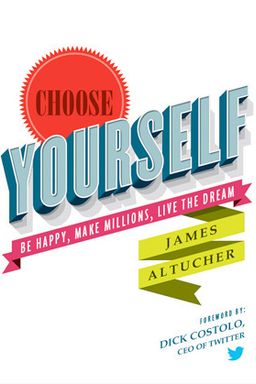
Choose Yourself cover

Choose Yourself

by James Altucher

In ''Choose Yourself,'' James Altucher challenges you to take charge of your future in a world where waiting to be chosen is no longer an option. Discover tools and practices to reclaim your dreams, achieve happiness, and thrive in the ''choose yourself'' era by nurturing your mind, body, and spirit.

Choosing Yourself in the New Economy

Have you ever felt trapped by expectations — the job you’re supposed to keep, the degree you’re supposed to earn, the life you’re supposed to live? In The Choose Yourself Guide to Wealth, James Altucher argues that the world has completely changed — and most people haven’t noticed. Gone are the days when loyalty to a company meant stability, when a college degree meant security, and when saving in your 401(k) guaranteed a comfortable future. The middle class, he insists, is dead. In its place is a chaotic but abundant new world, driven not by money or institutions, but by ideas.

Altucher’s message is simple but radical: you must choose yourself. Stop waiting for gatekeepers — employers, schools, financial advisors — to approve your success. Instead, become an Idea Machine, build your own networks, and cultivate personal practices that create physical, emotional, mental, and spiritual wealth. In this economy, ideas are the new currency, and those who generate and share valuable ideas will find more opportunities than ever before.

The End of the Old System

Altucher begins by describing how he spent much of his life in what he calls a prison — the system that told him success meant school, career, home ownership, and retirement. He followed the script: went to college, worked corporate jobs, started businesses, bought houses. Each time, he ended up broke or unhappy. Then he realized the prison door was never locked. The traditional economy built on dependency is collapsing under debt and inefficiency. Housing, healthcare, and education costs have ballooned while real wages have stagnated. The companies and advisors promising safety are simply selling illusions.

Ideas as the New Currency

In the twenty-first century, Altucher explains, ideas have replaced gold as the store of value. Whether you invent technologies, create digital content, or simply improve the systems around you, the ability to generate original insights is the foundation of wealth. He diagrams this with his “Idea Matrix”: at the bottom left are people who work on others’ bad ideas — typical employees stuck in obsolete jobs. At the top right are creators whose ideas help millions — entrepreneurs, visionaries, connectors. Moving toward that top right corner means strengthening your idea muscle and sharing it openly.

The Daily Practice: The Engine of Abundance

Becoming an Idea Machine doesn’t start with brainstorming; it starts with well-being. Altucher’s Daily Practice asks you to improve four aspects of life — physical, emotional, mental, and spiritual — by just one percent each day. Eat and sleep well, surround yourself with people who support you, write down ten ideas every day, and practice gratitude instead of complaining. This small consistent improvement compounds faster than interest rates ever can. Within six months, he says, your entire life changes — you begin attracting health, money, relationships, and purpose.

From Scarcity to Choice

Choosing yourself isn’t about rebellion; it’s about embracing abundance. The old world operated on scarcity — limited jobs, limited seats, limited opportunities. The new one rewards those who create, connect, and give. Altucher encourages quitting unfulfilling jobs, abandoning toxic financial advice, and replacing goals with themes — ongoing directions like “create something every day” or “stay healthy.” Themes liberate you from the heartbreak that fixed goals bring when circumstances change.

Why This Matters Now

The book speaks directly to the anxiety of modern readers facing automation, outsourcing, and financial volatility. Altucher provides a practical philosophy for thriving amid disruption: reinvent constantly, develop idea habits, avoid debt traps, and view every career as a platform for learning and connection. Wealth, in this framework, isn’t about possessions — it’s the side effect of continuous creativity and contribution. You’re not climbing a ladder anymore, he promises. You’re wandering an amusement park. The key is to enjoy the ride while building something that gives value to others.

Altucher’s challenge to you: stop waiting for permission. The most important choice you can make today is to choose yourself — for peace, abundance, and gratitude — and the wealth will naturally follow.


The Daily Practice: Your Four Foundations

Every lasting transformation begins with daily habits. Altucher insists that success doesn’t start with money or ambition—it begins with maintaining four types of health: physical, emotional, mental, and spiritual. He calls this the Daily Practice, a simple system for becoming stable enough to generate good ideas and use them effectively.

Physical Health

Your body is the first leg of the success stool. Get enough sleep, eat real food, and move. Altucher argues you don’t need a gym membership or a trainer—just a short walk three times a week keeps your energy flowing. When he neglected this, his creativity collapsed; when he rebuilt it, ideas returned. (Comparable idea: Arianna Huffington’s Thrive emphasizes sleep as the foundation of productivity.)

Emotional Health

Surround yourself only with people who uplift you. Altucher learned this painfully; spending time with toxic colleagues and partners drained him of hope. He advises protecting your emotional boundaries—ignore critics, avoid gossip, refuse arguments. His rule: don’t get in the mud with pigs, because they enjoy it and you just get dirty.

Mental Health

This is the training ground for your creativity. You must keep your idea muscle active by writing down ten new ideas every day, no matter how absurd. Some ideas will be terrible, but exercising the muscle ensures that when a crisis arrives, you’ll have the mental stamina and fluency to respond. (In psychology, this mirrors Carol Dweck’s concept of a growth mindset—ideas multiply when you cease fearing bad ones.)

Spiritual Health

Altucher doesn’t preach religion; he practices awareness. His mantra is “Complaining is draining.” Whenever anxiety or anger rises, pause and say: “I notice I’m anxious.” This small distance breaks identification with the feeling. Then, identify one thing—any thing—to be grateful for. Gratitude, he insists, transforms despair into creative openness.

Compounding Change

Altucher calls this the one percent rule: improve each area of health by one percent a day. Tiny progress compounds faster than you expect. In six months, coincidences begin to appear, luck seems to favor you, and people respond differently. Abundance follows because you’re generating energy instead of consuming it. He likens this to compound interest, except the dividends are happiness and creativity instead of dollars.

As Altucher reminds us, “Nobody can be perfect every day, but even one small action in each category rewires your life.” Mastering these four foundations turns your day into the engine of your own reinvention.


Becoming an Idea Machine

If money is no longer the world’s currency, ideas are. Altucher’s central method for wealth generation is to become what he calls an Idea Machine—someone whose creativity flows endlessly because they exercise it like a muscle. You don’t wait for inspiration; you deliberately train your brain to produce solutions, connections, and innovations daily.

The Idea Muscle Workout

The method is simple: write down ten ideas every day in a small waiter’s pad. The exact type of ideas doesn’t matter—business concepts, books, ways to help people, or things to improve in your life. By around idea number six, your brain starts to sweat; that’s when growth happens. Bad ideas still count because quantity breeds quality. Altucher himself began this practice when broke and depressed; six months later his life kept transforming every half-year as new ventures and friendships appeared.

Idea Sex and Evolution

Once you’re generating consistently, combine ideas to create better ones—a process he calls Idea Sex. All innovation, he argues, comes from cross-pollination: Google emerged from merging search algorithms with academic citation logic; Airbnb grew from mixing spare bedrooms with hotel economics. Ideas evolve faster than people if you let them mate freely.

Execution and Flow

You don’t need all ten ideas to be grand. Write a “first step” beside any promising one. When Altucher wanted a website but couldn’t code, his first step was hiring programmers through an online platform. That small move led to Stockpickr, which he later sold for millions. As he tells it, nine out of ten of his ideas fail, but the tenth can redefine your future.

Giving Ideas Away

Don’t hoard them. Scarcity breeds fear; abundance encourages flow. Altucher routinely sends lists of ideas to companies like Amazon or individuals he admires. Sometimes nothing happens, sometimes doors open later. The moment you become the person who constantly creates and gives ideas, people recognize you as a source of value and connection. That’s the true wealth in a new economy.

“Ten ideas a day will change your life every six months,” Altucher promises. The practice doesn’t just make you richer; it turns your mind into an unstoppable engine of possibility.


Quitting the Job, Choosing Freedom

Altucher’s chapter “Why You Have to Quit Your Job This Year” is provocative, but his reasoning is practical. Traditional employment, he argues, is designed around obedience, not creativity. Corporations want average workers to support the company’s ideas—not their own. The result? A hollowed-out middle class replaced by automation, outsourcing, and temporary contracts. Staying put means slowly losing relevance.

The Death of the Middle Class

From his conversations with a fund manager overseeing a trillion dollars, Altucher learns that most office floors are empty. Productivity software and global competition have wiped out the paper-pusher tier of employees. Robots, algorithms, and freelance platforms have taken their place. If you depend on institutions for stability, you’ll be caught when those institutions dissolve.

Why Corporations Don’t Love You

He recounts lunching with a major editor who resented his own writers for building personal brands. The system rewards conformity; individual brilliance threatens hierarchy. Hence his advice: never stake your future on someone who sees you as replaceable. Diversify your sources of income, build projects that express your individuality, and recognize that your job is not your identity.

Creating Themes, Not Goals

Instead of waiting for promotions or salaries to rise (which only make you spend more), operate by “themes.” A theme might be “freedom from financial worry” or “creating valuable things daily.” Within that theme, you decide each morning: Who can I help today? What can I make? Altucher calls this becoming an “entre-ployee”—someone who treats their work as entrepreneurship even inside the system, until they create enough autonomy to leave it entirely.

From Abandonment to Abundance

Quitting isn’t instantly romantic. Altucher knows fear, debt, and uncertainty will visit. But staying trapped guarantees the same pain without the possibility of gain. Abundance comes from serving others through creativity, not from clocking hours. He illustrates this with a story of a fired coworker who reinvented herself as a consultant—and looked younger and freer six months later.

Altucher’s call is clear: you can’t see the gardens while locked in jail. Walk away from the illusion of career security and build your own freedom garden. The moment you choose yourself, abundance rushes in to fill the space your fear once occupied.


Creating and Leading in the Idea Economy

Being creative isn’t enough—you must learn to lead and connect through ideas. Altucher’s sections on leadership, persuasion, and networking show how to transform raw creativity into influence. In his view, the best leaders today don’t control people; they ignite others’ success. The most persuasive communicators don’t overpower—they connect at human level. Wealth flows toward networks built on ideas, trust, and generosity.

Modern Leadership: Desire Success for Others

A real leader wants others to succeed more than himself. This reversal of ego distinguishes innovators like Marcus Lemonis (of The Profit) or Warren Buffett. Altucher’s own failure as CEO taught him humility—he realized leadership means listening, caring, and sharing credit. Gratitude and dignity, he says, are not soft skills; they are survival skills in a collaborative economy.

Persuasion and Negotiation

From his HBO experiences interviewing strangers at 3 a.m., Altucher learned how to convince anyone of anything. His six “U’s” formula—Urgent, Unique, Useful, Ultra-specific, User-friendly, Unquestionable proof—resembles modern startup pitches and behavioral psychology (Robert Cialdini’s reciprocity principle echoes here). True persuasion builds trust by satisfying the listener’s core desires: recognition, relief, results. Empathy beats argument every time.

Networking as Service

Altucher redefines networking. Instead of collecting business cards, help people meet one another who can benefit mutually—what he calls “permission networking.” Always ask both sides first. When you connect two connectors, opportunity multiplies. Hosting small dinners or introducing professionals who can collaborate becomes a magnet for goodwill. You don’t trade favors—you build bridges that everyone can walk across later.

Speaking and Selling with Stories

Great communication, he insists, means storytelling. Emotions connect faster than logic. When Altucher speaks publicly, he follows “ABS: Always Be Storytelling” and “ABV: Always Be Vulnerable.” Instead of pretending expertise, share personal struggles. Audiences crave authenticity more than perfection. His style mirrors the approach of storytellers like Brené Brown—truth-telling as leadership.

Leadership in the idea economy isn’t about commanding; it’s about connecting. Ideas build communities, generosity builds reputation, and reputation builds wealth.


The New Rules of Wealth and Investing

Altucher’s concept of wealth breaks from the personal finance gurus of the past. Forget 401(k)s and conventional savings plans, he says—they’re designed to enrich banks, not you. Real wealth arises from creativity, diversification, and gratitude. In short, abundance is about freedom, not accumulation.

Old Myths vs New Rules

He lists the myths that have quietly bankrupted millions: college guarantees success, homeownership builds equity, long-term saving is smart, hard work ensures wealth. None hold up in today’s data. Tuition and housing have outpaced inflation, wages remain flat, and corporations reward debt over independence. The new solution: live small, create big. Invest time in learning and producing value rather than hoarding possessions.

The 18 Rules of Abundance

Among Altucher’s “18 New Rules,” several stand out: Always Be Selling (generosity creates value), Always Be Negotiating (seek win-win outcomes), Idea Sex (combine good ideas), Failure Is a Myth (view it as an experiment), and Save Big, Not Small (cut out major wastes like college debt or unnecessary mortgages instead of skipping coffee). Each rule invites mental freedom rather than penny-pinching.

The Scam of Traditional Finance

Altucher calls mutual funds and IRAs “a tax on the middle class.” Money locked away until sixty-five is money stripped of opportunity. He advises holding tangible cash, investing in smart idea-driven businesses, and practicing “street smarts” based on models like Taleb’s Antifragile—systems that get stronger under stress. When markets collapse, creativity becomes the only hedge that never loses value.

Investing as Self-Development

Altucher’s own portfolio reflects his philosophy: mostly cash, some blue-chip dividend stocks for preservation, and a few hard-to-value startups for growth. He emphasizes investing in experiences—learning, travel, creation—instead of objects. He equates gratitude with compounding interest: give value, and exponential returns follow.

Putting it bluntly, Altucher’s wealth equation is psychological: less fear, more gratitude, relentless creativity. Money is just the side effect of a well-practiced life.


Reinvent Yourself Continually

The final theme of Altucher’s book is reinvention. Every six months, he says, his life changes completely—new projects, new networks, new mindset. Reinvention isn’t luck; it’s a skill. In a world where industries die overnight, the ability to start again is the ultimate wealth strategy.

The Reinvention Manifesto

Altucher treats reinvention like a scientific experiment. Don’t label failure; replace it with exploration. He urges readers to view every chapter of their life as temporary software—upgradeable through learning and human connection. (In parallel, Adam Grant’s Think Again echoes this call to intellectual flexibility.)

Trends as Opportunity

He identifies seven major trends driving today’s reinventions—biotech, healthcare, robotics, temporary work, chemistry, financial technology, and observation industries (data and surveillance). Seeing these shifts early lets you position yourself at intersections where ideas are scarce but demand is infinite. Each trend, he argues, holds trillion-dollar trajectories waiting for new thinkers to ride them.

Fail Fast, Learn Forever

To reinvent effectively, detach identity from outcomes. Altucher’s mantra: preparation beats prediction. Don’t guess which idea will work—generate many, test small, pivot quickly. Diversification isn’t just financial; it’s personal. Whether trying businesses, writing books, or hosting podcasts, he treats each as an experiment in creative evolution.

Freedom Through Reinvention

Altucher’s version of freedom isn’t utopian; it’s daily practice. Choosing yourself every morning—through ideas, gratitude, and connection—creates motion. Change stops being frightening when it becomes your default. Reinvention lets you enjoy wealth not as accumulation, but as continuous exploration. As he closes, “Freedom is something you practice every day.”

In Altucher’s worldview, your only true asset is adaptability. If you improve one percent daily and reinvent every six months, you’ll never be obsolete—you’ll be limitless.

Dig Deeper

Get personalized prompts to apply these lessons to your life and deepen your understanding.

Go Deeper

Get the Full Experience

Download Insight Books for AI-powered reflections, quizzes, and more.