
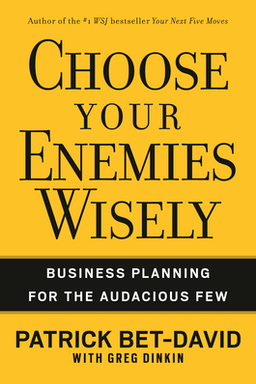
Choose Your Enemies Wisely cover

Choose Your Enemies Wisely

by Patrick Bet-David

Choose Your Enemies Wisely reveals a groundbreaking approach to business planning that harnesses emotional drive and logical strategy. Patrick Bet-David guides audacious entrepreneurs to channel personal motivations into transformative success, achieving ambitious goals through a unique blend of passionate purpose and practical execution.

Turn Enemies into Fuel for Audacious Success

Why do some entrepreneurs thrive in chaos while others collapse under pressure? Patrick Bet-David, in his 2023 book Choose Your Enemies Wisely, argues that the difference often comes down to how you channel emotion — especially the negative kind. According to Bet-David, your greatest breakthroughs depend on your relationship with your enemies. The right enemy, he says, can light a fire that no motivational quote ever could.

Bet-David contends that success in business and life is not solely driven by logic, skill, or opportunity, but by learning how to harness emotional energy — anger, shame, frustration, or ambition — and integrate it into a disciplined plan. That’s the central paradox of the book: the fuel that burns hottest must be directed by cold strategy. Only by combining the heart of a fighter with the mind of a strategist can you join what Bet-David calls “the audacious few.”

Enemies as Emotional Fuel

The book opens with a vivid story that defines Bet-David’s philosophy. In his early twenties, broke and aimless, he attends a Christmas Eve party where a relative mocks his father — once a respected chemist in Iran, now a cashier at a dollar store in America. Bet-David witnesses his father’s humiliation and promises that “the world will know our last name.” That insult became his defining moment. The rage he felt that night became the drive that turned him from indebted army veteran into multimillionaire entrepreneur and media founder.

This isn’t about revenge. Bet-David warns that unwise enemies — petty rivals, jealous relatives, or trolls — drain energy. Wise enemies, on the other hand, are those who challenge your self-concept and reflect your deepest insecurities. They compel growth. Whether it’s a competitor outperforming you or a mentor doubting you, the right opponent exposes what you lack and forces you to rise.

From Emotion to Execution

Bet-David argues that traditional business planning overlooks the emotional core of ambition. Standard plans rely on spreadsheets, KPIs, and forecasts but omit the most powerful motivator: feeling. In his framework, emotion fuels execution; logic directs it. He pairs each emotional driver (like enemies, will, dreams, culture, and vision) with its logical counterpart (like competition, skill, systems, team, and capital). These pairs form the “12 Building Blocks” — a complete template for business planning that combines passion and process.

The book’s title signals a strategic decision: if you don’t define your enemies, Bet-David says, they’ll define you. And without an enemy worth fighting, your plan will lack urgency. But emotion must be harnessed systematically. Through personal stories and examples from figures like Tom Brady, Steve Jobs, and Elon Musk, he illustrates how great performers use external doubt as rocket fuel — but always with a disciplined plan to convert it into outcomes.

The Audacious Few

The “audacious few,” as Bet-David defines them, are leaders who dare to think long-term, set seemingly impossible goals, and fuse intensity with analytics. They’re both logical and emotional, strategic and bold. These are the people who build multigenerational enterprises instead of short-lived businesses. Throughout the book, Bet-David contrasts them with the “cautious majority,” those who avoid risk, mute their emotions, and settle into mediocrity.

He admits his approach is not for everyone. To write a business plan his way is to unearth your wounds and ambitions, confront fear and ego, and translate them into daily action. In his workshops, he has seen participants moved to tears as they recognize their true motivations — not money or status, but validation, pride, and love. Those feelings, once channeled, yield what he calls “maniacal focus.”

Emotion Plus Logic: The Sustainable Formula

Bet-David’s larger philosophy aligns with what leaders like Sun Tzu and Elon Musk have preached: that victory comes from thinking many moves ahead and combining precision with passion. This is not self-help fluff; it’s battle planning. The entrepreneur must act as both warrior and general — feeling deeply yet planning meticulously. Emotion creates energy, but logic preserves longevity.

Ultimately, Choose Your Enemies Wisely challenges you to rethink everything you’ve been told about motivation and planning. Instead of numbing conflict, Bet-David insists you ignite it — but with direction. If you cultivate the right enemies, pair emotion with logic, and follow the 12 Building Blocks, your goals stop being fantasies and start becoming inevitabilities. The book is both a call to arms and a manual for transformation, showing that in business, as in life, your enemies aren’t obstacles — they’re the architects of your greatness.


Integrate Emotion and Logic to Win

Early in the book, Bet-David introduces two archetypes — Larry and Ernie — to illustrate why most business plans fail. Larry, a polished college graduate with perfect spreadsheets, represents logic. Ernie, a rough-around-the-edges nineteen-year-old with fire in his eyes but zero structure, represents emotion. Larry has knowledge but no passion; Ernie has passion but no plan. Bet-David reveals that neither archetype succeeds long-term because true winners integrate both mind and heart.

Why Logical Plans Fail Without Emotion

Logical people excel at data, systems, and planning — but they often fail to inspire action, either from themselves or others. Their presentations are dry. Their goals lack urgency. Without emotion, they burn out or plateau, much like Larry, who peaks in his corporate job and joins what Bet-David calls the “4:59 club,” the employees who can’t wait to clock out each day. Logic without emotion leads to stagnation.

In contrast, emotional entrepreneurs ignite movements, sell ideas, and galvanize teams. Yet they often crash because they lack structure. Ernie, driven by a hatred of poverty, works tirelessly but scatters his energy. Bet-David shows how emotion, when unrefined, can become impulsive and self-destructive. That’s why emotion must be paired with logical systems — the antidote to chaos.

The 12 Building Blocks

To fuse emotion and logic, Bet-David lays out his signature framework — six emotional blocks paired with six logical ones:

  • Enemy & Competition (find what fuels you and study who threatens you)
  • Will & Skill (use internal drive but sharpen it with capability)
  • Mission & Plan (connect purpose to execution)
  • Dreams & Systems (balance wild imagination with repeatable processes)
  • Culture & Team (channel emotional belonging with operational strength)
  • Vision & Capital (cast a vision that inspires investors and sustains growth)

Each pair fuses a human emotion with a tactical skill. Together, they create a blueprint that doesn’t just look convincing on paper but actually drives action year after year.

Emotion That Moves, Logic That Directs

Bet-David compares creating a business plan to leading an army into battle. Without emotion, no one fights; without logic, everyone dies. He even cites Sun Tzu’s The Art of War: victory belongs to generals who calculate many outcomes long before the first move. For entrepreneurs, “calculation” means planning while staying emotionally charged.

He recounts raising $10 million in capital only after he learned to bridge both sides. Early in his career, emotion helped him excite investors but failed to reassure them. After hiring strategist Tom Ellsworth to ground his vision in hard data, his logical plan aligned perfectly with the emotional narrative — and the checks came flooding in.

The Balance of Power

Bet-David advises readers to self-diagnose: “Are you more Larry or Ernie?” Logical types must learn to tell stories and channel passion; emotional types must learn systems and numbers. The integration of the two, he argues, is what defines legendary performers. Michael Jordan, Serena Williams, and Elon Musk exhibit both masculine drive and analytical precision. As Bet-David puts it, “Emotion reminds us why we do it. Logic tells us how.”

This credo captures the heart of Choose Your Enemies Wisely — it’s not about emotions versus plans, dreams versus metrics, or enemies versus allies. It’s about seeing that all these dualities must coexist in one audacious plan if you want lasting success.


Look Back Before You Scale Forward

Before you rush forward with new ideas, Bet-David urges you to pause and perform an “autopsy” on the last year. This process, drawn from both military debriefings and Japanese manufacturing philosophy (The Toyota Way), ensures that your future plans have depth and durability. Instead of chasing new goals mindlessly, you look backward to see what worked, what didn’t, and what patterns repeat.

The Danger of Fresh Starts

Many entrepreneurs love the idea of a clean slate — a new year, a new plan, a new you. Bet-David calls this “the delusion of zero.” You can change jobs, logos, or markets, but you bring yourself — your habits, your leaks, your blind spots — to every new start. That’s why he insists that every business leader must review the previous twelve months ruthlessly, studying successes and failures like a general replaying battlefield footage.

The Previous Year Review

Bet-David’s framework for reflection includes three steps:

  • Identify distractions — the time-sucking habits and relationships that derailed progress. He calls this “cutting the fat.”
  • Evaluate percentage of goals achieved — not just results, but whether your goals were ambitious enough.
  • Conduct honest postmortems — like Top Gun pilots who dissect missions, uncover what decisions, trends, or behaviors caused breakdowns.

He warns that without this debrief, you’ll repeat the same mistakes under new banners. He references military strategist Robert “Cujo” Teschner’s advice that accountability — owning your decisions collectively and personally — is crucial to sustained success.

Depth, Duration, and Magic

Bet-David introduces three measures of meaningful success: duration (longevity), depth (impact), and magic (passion). Duration without depth is mediocrity; depth without longevity is burnout. Magic — that sense of wonder and belonging — binds the two together. He compares this to marriage: couples plan lavish weddings but rarely plan the actual marriage. Likewise, businesses over-plan launches but under-plan sustainability.

He encourages thinking long-term — “plan like Japan, execute like America.” Japanese companies like Kongo Gumi, he notes, have lasted more than a thousand years by mastering patience and discipline. American entrepreneurs add speed and adaptability. The goal is to find equilibrium: vision that lasts and systems agile enough to evolve.

This look-back process grounds Bet-David’s entire methodology. Dreams are nothing without discipline, and discipline is impossible without reflection. Before looking forward, he insists, sit down with your mistakes — not to wallow, but to weaponize them.


Choose Enemies, Not Excuses

Few ideas in Bet-David’s philosophy are as provocative as his insistence that you must consciously choose your enemies. A worthy enemy — whether a rival company, a dismissive boss, or an ideology — gives you purpose. He contrasts healthy external enemies, which unify teams, with toxic internal ones, which destroy them.

Tom Brady and the Art of Upgrading Enemies

Tom Brady’s career, Bet-David explains, is a masterclass in evolving your rivals. Drafted 199th, Brady began with six quarterbacks ahead of him as his enemies. Each stage of his career presented new ones: age, his own coach Bill Belichick, the next generation of stars like Patrick Mahomes. Every time he crowned a new enemy, his motivation reignited. When ESPN’s Max Kellerman said Brady would “fall off a cliff,” he responded with another Super Bowl. That cycle — choose enemy, conquer, upgrade — keeps champions hungry.

External vs. Internal Enemies

Bet-David warns that misdirected hostility destroys teams. External enemies (rivals, doubters, ideologies) foster unity; internal enemies (jealous colleagues, power struggles) breed decay. Leaders must manage competition so it sharpens performance without turning inward. He recounts playing games with his sons — he pits both against himself so they bond as teammates, not rivals. The same principle applies to organizations.

Wrong Enemies, Right Lessons

For every right enemy, there’s a wrong one. Bet-David lists five unworthy foes: those trailing you, people you’ve already surpassed, petty critics, toxic manipulators, and small thinkers. Fixating on them wastes energy and feeds ego. The right enemies challenge your vision — the “Harry” in his story, a rival who told him he’d “never be a great leader.” Instead of fighting Harry physically, Bet-David used his words as motivation, printing and laminating them as fuel.

Graduating to New Enemies

As you grow, so should your enemies. Bet-David shares the story of “Pablo,” an entrepreneur whose business plateaued at $40 million revenue until he realized his new enemy wasn’t a childhood bully or jealous relative — it was complacency. When he shifted his focus from old emotional grudges to surpassing a superior competitor, his energy and profits returned. Bet-David calls this “graduating to new enemies” — a ritual that prevents stagnation and keeps vision scalable.

Choosing enemies wisely reframes adversity. Each painful insult or rejection is a spark, not a scar. As author Ryan Holiday argues in The Obstacle Is the Way, obstacles define greatness; Bet-David goes further, saying they *animate* it. The right enemy isn’t someone you hate — it’s the mirror that shows who you can become.


Willpower Over Wantpower

Bet-David separates dreamers from doers with one word: will. Most people say, “I want success.” The audacious few say, “I will succeed.” This shift from wantpower to willpower defines character. Through personal stories — from his son Dylan’s martial arts lessons to entrepreneurs who built empires through grit — Bet-David shows that will can be trained, not inherited.

The Lesson of “I Will”

In one of the book’s most touching scenes, his eight-year-old son Dylan tells him, “I will be the greatest fighter in the world,” then later changes “will” to “want.” When confronted, Dylan confesses, “If I say ‘will,’ I have to do it.” Bet-David recognizes that fear of accountability kills greatness. Declaring “I will” activates action. This applies everywhere — to starting a business, fixing a relationship, or building a legacy. As Bet-David notes, “No one achieves anything with wantpower.”

Will and Skill: Two Sides of Mastery

Willpower without skill is wasted energy; skill without will is lifeless. Bet-David trains both. He cites examples like Marlene Gaytan, who scraped money to attend a Tony Robbins seminar and turned that decision into a six-figure career, and executives he sent to Harvard and Wharton to build competence. Successful teams, he says, must invest constantly in learning. Companies die not from lack of vision, but from stagnation.

Performance vs. Trust Matrix

Borrowing from Simon Sinek’s insight on Navy SEALs (“Performance wins the battle; trust wins the war”), Bet-David maps people on a two-axis grid: high/low performance versus high/low trust. Always choose high trust, he advises, even if skill lags — you can train skill, not integrity. This principle guided his decision to invest thousands to train loyal employees like Maral Keshishian, who later became president of his firm.

When fear, comfort, or ego dull discipline, Bet-David returns to a harsh but freeing truth: no one will rescue you. Will is your inner general, commanding the army of your skills. If you strengthen both, you can face any enemy, crisis, or setback without losing your identity.


Translate Mission into Plan

Once you know why you fight, Bet-David guides you through crafting a plan that turns passion into progress. Your mission gives meaning; your plan gives movement. Every bullet point, he argues, must be emotionally charged and logically structured. “You and your team must know both your why and your how.”

Recruiting Your Mission

Bet-David describes mission discovery as an act of “recruiting” — searching until your purpose recruits you. He suggests listing what you love, hate, and can’t ignore. His own mission crystallized in 2009 after hearing political commentator George Will speak about America’s decline in free enterprise. That day, Bet-David realized his crusade was to defend capitalism and teach entrepreneurship to preserve freedom. It was no longer about money but impact.

Replace “Just” with “Because”

When writing your mission statement, Bet-David warns against shrinking your dreams with the word “just.” (“I just want to pay the bills” kills ambition.) Replace it with “because.” (“I’m on a mission to build wealth because my family deserves security.”) Adding “because” attaches emotion; removing “just” removes guilt. He credits Harvard psychologist Ellen Langer’s research showing that “because” triggers compliance and conviction.

SWOTs and Systems

Your plan must balance self-awareness with structure. Bet-David integrates a SWOT analysis (strengths, weaknesses, opportunities, threats) with emotional honesty. He stresses anticipation — always think three to five moves ahead. Prepare for crises before they hit: know what happens if you lose your biggest client, face a lawsuit, or fall ill. Business plans, he says, are useless; planning is indispensable.

The Toyota and Kobe Lessons

From Japanese manufacturing, he learns long horizons; from Kobe Bryant, year-round discipline. Kobe planned family alternatives for every Christmas game and treated his calendar like a wartime schedule. Similarly, Bet-David teaches you to plan twelve months ahead, mark crises, goals, and rituals, and design the life before you live it. Mission gives meaning to the journey; the plan makes sure you arrive.


Dream Big, Systemize Bigger

Dreams are emotional fire. Systems are the fuel lines that deliver it. Bet-David’s story about becoming a minority owner of the New York Yankees — a fantasy he once voiced as an immigrant child — shows how distant dreams become real through consistent systems. In his framework, every dream must have matching systems to sustain it.

From Fantasy to Future Truth

Bet-David encourages dreamers to turn goals into “future truths.” Speak them as certainties rather than wishes. As Jay-Z says, “Speak things into existence.” But belief alone isn’t enough — systems turn visions into inevitabilities. That means automating processes, setting quarterly routines, and delegating what doesn’t match your hourly worth. As he writes, “Time is money. Systems save you time. Saved time makes you money.”

Dream Language and Visualization

Use “Imagine if one day…” as daily fuel. Visualize specific rewards — a yellow Hummer, a family trip, a dream office. Like a vision board, these images condition your subconscious. But beware of empty motivational posters; instead create personalized visuals that connect to your story. Notre Dame’s “Play Like a Champion Today” sign, for instance, is meaningful because it links to identity and pride.

Systems That Scale

Systems aren’t corporate jargon; they’re habits on autopilot. Bet-David praises Jiffy Lube’s “3,000-mile sticker” as a masterclass in systemized behavior — a small visual that drives billions in repeat business. Businesses must systemize follow-ups, analytics, and delegation just as individuals systemize training, nutrition, or learning. Whether through AI tools or assistants, automation turns discipline into default.

Stay Childlike

Perhaps Bet-David’s most poetic insight is the need to remain childlike. When leaders lose their sense of wonder, their organizations go stale. Keeping dreams alive through rituals — celebrations, storytelling, friendly competitions — revitalizes teams. He reminds you to ask: “What makes me feel like a kid on Christmas morning?” If you can systemize that feeling, you create a culture of magic — and magic scales faster than management.


Build Culture Before You Build Product

“Culture eats strategy for breakfast,” Peter Drucker once said — and Bet-David agrees. Culture, he says, is the daily behavior of your team when no one’s watching. It’s the rituals, language, and beliefs that turn employees into evangelists. Without culture, your team won’t follow you into battle.

Culture Is Contagious

Bet-David recounts the Japanese soccer fans who, after winning a World Cup match, cleaned the stadium seats. Their behavior spread to opposing fans. That’s culture — visible, repeatable, imitable. In business, he mirrors this by turning his offices into gyms, making fitness and competition routine. Culture, he says, is “personality at scale.”

More Is Caught Than Taught

Culture begins at the top. Leaders model behavior — generosity, curiosity, discipline — and people emulate them. When Bet-David tips service staff 40 percent, he’s not showing off; he’s teaching abundance. He warns leaders not to demand learning if they don’t read themselves. “More is caught than taught.” Actions outperform slogans.

Choosing the Right Team

He introduces the “Running Mate Scorecard” and “Net Positive Index” to evaluate character and skill. Integrity is nonnegotiable, competence trainable. High-trust people may lack finesse now but can become executives later. He also espouses the Netflix-style “rock star principle”: one top performer equals ten mediocre ones. Pay them accordingly, treat them like allies, and your culture will multiply greatness.

Culture becomes your competitive moat. It attracts believers, repels opportunists, and transforms your company into what he calls “the thing people want to be part of.” Benefits like free lunch or laundry fade; shared values endure. In the end, Bet-David asserts, people don’t quit jobs — they quit leaders. Be the kind of leader they refuse to leave.


Cast a Vision and Raise Capital

For Bet-David, vision is the nuclear engine of success — self-sustaining fuel that, like the USS John C. Stennis, can run for decades without refueling. Capital, by contrast, is the oxygen that turns vision into propulsion. Fusing them is the entrepreneur’s ultimate test.

Be Stubborn on Vision, Flexible on Details

Quoting Jeff Bezos, Bet-David urges you to protect your vision like a sacred flame but adapt tactics endlessly. His own vision — spreading entrepreneurial freedom — fuels everything from his insurance firm PHP to his media brand Valuetainment. Like FedEx’s “overnight reliability” or Papa John’s “Better Ingredients, Better Pizza,” your vision should be short enough to remember and strong enough to survive decades.

Vision Rituals

Bet-David turns vision into ceremony. On Jekyll Island, he gathered 28 top leaders to craft their firm’s principles, reciting “I. We. Never.”—I for personal ownership, We for unity, Never for nonnegotiables. This ritualized declaration reinforced belief and identity. Such events, he suggests, can cement your culture for decades — much like patriot founders signing a constitution for business.

Raising Capital with Storytelling and Structure

When approaching investors, Bet-David blends heart and numbers. He trains you to deliver a 30-second elevator pitch that hooks with emotion and proves legitimacy through data. Then present a 15-slide deck (problem, solution, market, team, ask) that shows scalability. Emotion makes them care; logic makes them sign. As he says, “People don’t buy what you do — they buy why you do it.”

Measure Legacy in Decades

A true visionary doesn’t chase quarters; they chase quarters of centuries. Like Doyle Brunson’s poker wisdom — “Ask me in twenty years” — Bet-David insists vision must outlive founders. If your mission would still matter after you’re gone, it’s worthy. Both capital and time compound only around visions that endure.


Roll Out Your Plan Like a Movement

By the end, Bet-David equips readers to turn theory into transformation. A plan only works when others believe it too. Rolling it out means enrolling people — employees, partners, investors — into a shared mission fueled by daily accountability and clarity. “You’re not telling people your plan,” he says. “You’re inviting them to believe in it.”

From Blueprint to Buy-In

He outlines a nine-step rollout: perfect your plan, rehearse it, present it in an inspiring venue, assign KPIs and visual reminders, and review quarterly. Events like retreats, contests, and ceremonies are not luxuries — they’re catalysts for momentum. Every rollout should balance logic (metrics, calendars) and emotion (stories, rewards).

Enroll Everyone, at Every Level

Even interns or assistants should write mini business plans. When people articulate their own enemies, goals, and dreams, they naturally align with the company’s mission. Bet-David has seen receptionists and interns transformed by this process — more engaged, loyal, and creative — simply because someone asked, “Who do you want to be in five years?”

Plan the Reward, Earn the Faith

Bet-David encourages collective visualization: let teams choose rewards for hitting milestones — trips, bonuses, symbolic trophies. This creates emotional buy-in. But he insists accountability sustain it: “Can I cash your word?” becomes his mantra. Like credit scores, reputations compound through consistency. Teams follow leaders they trust to keep promises.

Leadership, in the end, is credibility in motion. By teaching others to build and execute their own twelve-block plans, you multiply leadership across generations. That, Bet-David says, is how you build not just a great year — but a great legacy.

Dig Deeper

Get personalized prompts to apply these lessons to your life and deepen your understanding.

Go Deeper

Get the Full Experience

Download Insight Books for AI-powered reflections, quizzes, and more.