
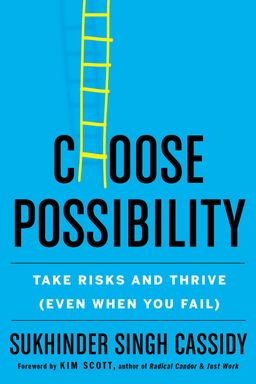
Choose Possibility cover

Choose Possibility

by Sukhinder Singh Cassidy

Choose Possibility by Sukhinder Singh Cassidy redefines risk-taking as a skillful art. Through her journey in the tech industry, she reveals how embracing risk as a process, rather than a singular choice, can unlock endless possibilities. Learn to transform fear into momentum and seize opportunities for professional growth.

Choosing Possibility: Redefining Risk and Success

Have you ever hesitated before making a big life or career decision, fearing that one wrong move could unravel everything? In Choose Possibility, Sukhinder Singh Cassidy invites you to replace that fear with curiosity and courage. Drawing from her remarkable journey as a Silicon Valley leader and entrepreneur, she argues that risk-taking shouldn’t be a leap off a cliff—it’s a continuous process of making small, thoughtful choices that accumulate into major success. She contends that most of us misunderstand risk: we treat it as a single, monumental event rather than the rhythm of experimentation that gives life its momentum.

Her central claim is simple but transformational: success comes not from one perfect choice but from many imperfect, iterative ones. Risk-taking isn’t about betting everything on the unknown—it’s about deciding repeatedly, learning from both wins and setbacks, and developing resilience in the process. To “choose possibility” means to act even amid uncertainty, with the faith that every decision refines your next one. Cassidy’s message liberates us from perfection paralysis and replaces fear with movement.

The Myth of the Single Choice

We often imagine our lives as grand hero’s journeys—one defining moment that will make or break our destiny. Cassidy dismantles this “Myth of the Single Choice,” arguing that it traps us in indecision and fear. Her sister Nicky’s story epitomizes this myth: as her optometry business faltered, Nicky resisted change because she thought one wrong choice would ruin everything she’d built. In truth, it was the compound of many smaller, exploratory decisions—negotiating leases, seeking new opportunities, testing alternatives—that eventually led her to a fulfilling new career path. Life isn’t determined by one monumental leap but by a series of smaller steps that yield insight, learning, and confidence over time.

Risk as Continuous Creation

Cassidy reframes risk-taking from a high-stakes bet into a lifelong creative process. She likens it to the way entrepreneurs iterate—launching small, imperfect products, learning, refining, and eventually building something extraordinary. Risk-taking, she says, is like “choosing possibility” in motion: experimenting, adjusting, and always learning more about what matters. Her own career offers vivid proof—from her early job struggles, failed ventures, and corporate leaps to becoming CEO of StubHub and founding multiple startups. Each experience was a stepping stone, not a singular gamble, teaching her to value process over perfection.

The Freedom in Micro-Risks

Instead of saving courage for one big moment, Cassidy urges you to take “micro-risks”—small chances that stretch your comfort zone and build your capacity for the next. Cold emailing someone new, speaking up in meetings, applying for an ambitious job—each micro-risk strengthens your “risk-taking muscles.” These acts compound over time, creating resilience and a mindset that views setbacks not as defeats but as lessons to build upon (similar to Carol Dweck’s concept of growth mindset in Mindset).

Why This Matters Now

Cassidy’s call to choose possibility resonates deeply in today’s volatile world. Career paths are nonlinear, technological disruption is constant, and uncertainty is the norm. You no longer succeed by following a fixed “track”; you succeed by adapting. As she writes, the riskiest move is not action but inaction—waiting for perfect clarity or perfect conditions that never come. Through examples from business leaders like Satya Nadella, Stacy Brown-Philpot, and Reshma Saujani, the book illustrates how choosing possibility repeatedly not only drives achievement but creates meaning and authentic power.

“Risk-taking is not the single, epic brush with peril we imagine. It’s a continuous process we humbly but hopefully embrace, knowing that each choice helps unlock the next.”

The Promise of Possibility

Choosing possibility isn’t just about making career moves—it’s about cultivating agency. When you start moving, even with small risks, you strengthen your “locus of control,” the belief that you can shape outcomes rather than merely endure them (a concept echoed by psychologist Julian Rotter). Each choice—successful or not—teaches adaptability, courage, and clarity. Cassidy’s philosophy merges business insight with emotional resilience: failure isn’t a verdict; it’s feedback. This mindset shifts risk from something to fear into something to practice.

In her words, “We don’t need to be mighty or perfect. We just need to keep choosing our way imperfectly through possibilities.” That’s the art of modern risk-taking—less about heroics, more about human curiosity and persistence. By reframing risk as movement rather than a moment, Cassidy offers you both the permission and path to build a life defined not by fear, but by the ongoing adventure of choosing what’s next.


Building Your Risk-Taking Muscles

Cassidy believes that risk tolerance isn’t innate—it’s a muscle you can strengthen through repetition. This idea underpins the chapter “Pump Your Risk-Taking Muscles,” where she traces her own initiation into risk through sales jobs and cold calling. As she answered phones for a vacuum company in her teens, she saw firsthand how salespeople faced rejection all day and still stayed upbeat. Every failed call was a micro-risk, a tiny act of courage that built resilience.

Micro-Risks and Everyday Courage

You don’t grow fearless by waiting for big opportunities—you do it by taking small ones consistently. Cassidy echoes Eleanor Roosevelt’s advice: “Do one thing every day that scares you.” Cold-calling, pitching new projects, asking for feedback—these micro-risks teach your mind to embrace discomfort. Like salespeople rolling with hang-ups, you learn to detach failure from identity. Over time, small risks compound, making larger choices less terrifying. This psychological conditioning turns anxiety into excitement—the essence of confident risk-taking.

Reframing Risk for Upside

Most people define risk as danger; Cassidy reframes it as pursuit of upside. We take risks not to court failure but to gain mastery, growth, or discovery. Her examples—from her entrepreneurial father in Canada, who tried branding his small medical clinic before branding health care was a thing, to Adam Zbar, the consultant who quit McKinsey to pursue film school—show that risk-taking can be strategic, purpose-driven, and joyful. Whether it’s learning new skills, escaping bad situations, or chasing passion, each risk contributes to long-term possibility.

Early and Often: The Multiplier Effect

Cassidy calls early, habitual risk-taking a “multiplier effect.” The more frequently you act, the easier it becomes. She illustrates this through her friend Gina, who turned early academic failure into entrepreneurial success. Dropping out of high school, Gina learned to redefine failure as feedback and later built a multimillion-dollar software company. By normalizing failure early, she freed herself to take bigger risks later—proof that the muscle of resilience grows stronger each time you lift the weight of uncertainty.

“The risk-taker who hits a grand slam in his first and only time at bat is not the rule but the extreme exception.”

In short, practice is progress. Start small. Fail fast. Repeat often. These iterative acts teach the body and spirit that risk isn’t lethal—it’s how you build strength to take the leaps that matter.


Proximity Beats Perfect Planning

Cassidy turns the myth of the perfect plan on its head. In “Why Proximity Beats Planning,” she explains that the best way to figure out your path is not to craft flawless blueprints but to get closer to people and environments that embody the possibilities you aspire to. The magic starts with movement, not maps. She learned this when she quit her comfortable job at Sky Broadcasting in London, moved across the ocean without a concrete plan, and embedded herself among entrepreneurs in Silicon Valley. It was proximity, not preparation, that transformed her career.

The Myth of Perfect Preparation

We often believe planning eliminates risk. Cassidy cites psychologist Oliver Burkeman, who warns that elaborate goal setting often stems from our discomfort with uncertainty, not our need for clarity. Rigidity masquerades as safety, but it prevents discovery. Real growth begins when you choose exposure over control, curiosity over caution. The paradox: planning feels safe but often delays meaningful action.

The Power of Proximity

Getting closer to ambition—physically and socially—is a faster route to success. When Cassidy moved to Silicon Valley, simply being near entrepreneurs transformed her mindset. Neuroscience backs this up: “social learning theory” shows humans learn faster by imitation and collaboration. Apprenticeships, mentorships, or even coffee chats immerse you in real-world feedback loops. The closer you are to opportunity, the easier it is to see, learn, and act. It’s why Alyssa Nakken became Major League Baseball’s first female coach—she didn’t wait for a perfect plan; she followed her curiosity, embedded herself in the sports industry, and learned by doing.

Whiteboard Your Way Forward

Instead of rigid plans, use “whiteboard thinking”—flexible mapping that evolves as you gain insight. Draft rough goals, outline a few hypotheses, and update them as reality unfolds. Whiteboards can be erased; your journey can’t. This iterative planning style cultivates agility—the ability to adjust direction quickly, a skill echoed in Eric Ries’s Lean Startup. In Cassidy’s view, every plan should breathe, flex, and evolve alongside your environment.

Perfection is not progress. Proximity is. Move closer to your dreams, even if your route is messy. The people, experiences, and insights you gain will teach you more than any beautiful plan ever could.


Facing Fear: FOMO vs. FOF

Fear is the most common barrier to meaningful risk-taking. Cassidy frames the emotional calculus simply: you’ll act when your Fear of Missing Out (FOMO) outweighs your Fear of Failure (FOF). Action happens at the intersection of these two forces. Behind every courageous move is someone who dreads regret more than embarrassment.

Balancing the Fear Formula

Cassidy challenges the myth of fearlessness. Great risk-takers don’t erase fear—they negotiate with it. She introduces the concept of an “inner risk manager”—the voice that warns you of danger. Instead of silencing it, she urges you to converse with it: clarify your anxieties, define their real costs, and discover what mitigations make those fears manageable. By acknowledging, rather than ignoring, fear you transform panic into planning.

Managing Fear Through Preparation

Cassidy offers four strategies to tame FOF: (1) Imagine the choice-after-the-choice—visualize recovery plans, so failure feels survivable. (2) Name your risks—financial, ego, and personal—to demystify them. (3) Size your risks by context—big decisions rarely destroy careers because recovery options abound. (4) Plan for downside more than upside—anticipating failure paradoxically grants confidence. She uses examples from entrepreneurs like Alan Eustace, the Google executive who broke a skydiving record after mapping every risk exhaustively. The lesson: preparation is not perfection—it’s fear’s antidote.

“Most people dislike planning for the downside. But successful risk-takers do it precisely because it fuels their conviction to act.”

Cassidy concludes that fear management, not fear elimination, shapes courage. When your urgency to grow overtakes your fear of failing, momentum begins. The day your FOMO exceeds your FOF is the day your life expands.


Smart Risk: The Five Factors Framework

Big career leaps require more structure. Cassidy introduces the Five Factors Framework, a pragmatic tool for evaluating choices across ambition, personal qualities, fit, external conditions, and fears. Drawing from her decision to leave Google at the peak of her career, she shows how this framework transforms anxiety into clarity.

The Five Factors Explained

  • Ambition: Define your specific goals over a 2–5 year horizon—not vague life dreams.
  • Personal Qualities: Assess your passions, superpowers, and values to ensure the opportunity aligns with who you are.
  • People Fit: Evaluate the micro-culture—bosses, mentors, peers—since relationships shape outcomes.
  • External Conditions: Look for tailwinds and headwinds in industries and markets that influence your choice’s upside.
  • Fears: Confront potential downsides head-on, then define recovery options to reduce perceived risk.

Gut, Data, and Guidance

Cassidy links instinct and analysis in what she calls “Gut-Data-Gut.” Begin with intuition, verify with data, return to instinct informed by evidence. Successful decisions marry heart and logic. She also advocates consulting “professional priests”—mentors, coaches, and peers who balance empathy with distance, offering honest counsel without emotional bias. These conversation partners bring clarity when analysis alone stalls.

From MinVC to MaxVC

Cassidy distinguishes between a Minimum Viable Choice (MinVC) and a Maximum Viable Choice (MaxVC). A MinVC is a safe step forward—taking recruiter calls, enrolling in a class, or testing ideas. A MaxVC is a full leap—quitting your job or founding a company. Her rule: if fear paralyzes you, start small but start. Motion beats hesitation. When she transitioned from Google to becoming a startup CEO, she experimented gradually, moving from discovery (MinVC) to decision (MaxVC). This laddered risk strategy enabled her biggest transformation without reckless leaps.

By quantifying opportunity and risk while honoring emotion, the Five Factors Framework makes bold moves calculable and humane. It turns “Should I?” into “How can I?”—and that’s the essence of smart risk.


The Myth of Risk and Reward

We love to believe that bigger risks yield bigger rewards. Cassidy calls this the “Myth of Risk and Reward” and exposes how life rarely operates linearly. Her own story—leaving Google for Polyvore, failing as CEO, then reaping indirect success years later when the company sold for millions—shows that risk and reward often unfold asymmetrically and over time.

Nonlinear Journeys

Our minds prefer straight lines; reality draws scatter plots. A “failure” today can become tomorrow’s foundation. Cassidy compares her nonlinear path—from analyst to entrepreneur to e-commerce investor—as proof that rewards emerge cumulatively, not immediately. Like compound interest, small choices and setbacks accrue value they conceal at first. (This resonates with James Clear’s Atomic Habits, which views progress as exponential rather than instant.)

Multiple Moves Yield More

Cassidy argues that consistent risk-taking delivers larger rewards than sporadic big leaps. Her case study of Corey Thomas, CEO of Rapid7, illustrates this: Thomas left Microsoft for startups, took pay cuts, and made successive small bets that later propelled him to lead a billion-dollar public company. Life’s rewards, she writes, accrue across cumulative courage.

“Take a risk, and you might get a reward right away. But more likely, you’ll get another opportunity to take a risk—only eventually getting where you want to go.”

Reward rarely arrives as expected. You learn, redirect, and grow. The linear myth promises causality; real risk delivers complexity—and that’s what enables enduring success.


Possibility and Powerflow

Cassidy closes with an empowering redefinition of success: possibility and power are abundant, not scarce. True power isn’t control or domination—it’s energy that flows through you when you help others realize their possibilities. She calls this concept “powerflow,” and it’s both personal and systemic.

From Scarcity to Abundance

Early in her career, Cassidy equated power with competition—wanting the “best bits” of opportunity before others. Over time, she discovered that abundance, not rivalry, fuels sustainable confidence. We generate inherent power by choosing possibility repeatedly, learning through risk, and enabling impact. As spiritual teacher Gary Zukav notes (whom she cites), power begins when you stop reacting as a victim and start choosing as a creator.

Power That Flows

Cassidy’s father modeled powerflow—quiet strength used to empower others. His kindness propelled people forward, including aspiring doctor Bobby, whom he inspired with a single comment: “These are most certainly the hands of a surgeon.” Power isn’t possession—it’s transmission. Like renewable energy, personal power regenerates when shared. Helping others choose possibility multiplies your own impact.

Changing Systems Through Possibility

Cassidy extends this idea to social change. Her initiative, theBoardlist, was born from an op-ed titled “Tech Women Choose Possibility,” which spotlighted gender bias in Silicon Valley. By connecting women leaders to corporate board openings, she created an ecosystem of powerflow—where creating opportunities for others enhances possibility for all. Similarly, entrepreneur John Krause of Big House Beans channels his power through business, employing formerly incarcerated individuals and spreading possibility through purpose.

Cassidy’s final message: you don’t need permission to feel powerful. Power grows through action and sharing. Every choice you make expands not just your own horizon but those of the people you touch. Choose possibility often enough, and power will inevitably flow.

Dig Deeper

Get personalized prompts to apply these lessons to your life and deepen your understanding.

Go Deeper

Get the Full Experience

Download Insight Books for AI-powered reflections, quizzes, and more.