
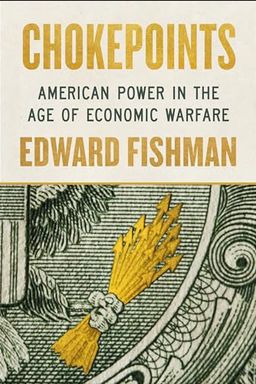
Chokepoints cover

Chokepoints

by Edward Fishman

A former State Department sanctions official gives insights into how the United States uses its economic and technological strength as unconventional weapons.

The Power of Modern Chokepoints

How can you coerce an adversary without troops, tanks, or ships? In this book, Edward Fishman argues that twenty-first-century power runs through invisible gateways—financial rails, legal standards, and technology supply chains—that function as modern chokepoints. If you can control the dollar’s plumbing, the insurance contracts that let tankers sail, or the tools that etch semiconductors, you can project influence globally with regulations and export licenses instead of missiles.

Fishman contends that sanctions and export controls work when they exploit these chokepoints; they fail when they are symbolic or unilateral. To understand why, you need to see the system: correspondent banking in New York and London, SWIFT messaging, maritime insurance from a handful of British P&I clubs, and irreplaceable technology from firms like ASML, Applied Materials, and TSMC. He weaves a narrative from Iran to Russia to China, showing how policy entrepreneurs inside Treasury, State, and Commerce turned this system into a strategic toolkit.

What counts as a chokepoint

A chokepoint is an essential node whose control lets you shape cross-border flows. Fishman highlights three clusters. First, currency and payments: dollar dominance, correspondent banking, CHIPS/Fedwire, and central-bank reserves. Second, financial messaging and services: SWIFT, maritime insurance, shipping brokers, and flag registries. Third, technology and supply chains: advanced semiconductors, design software, lithography, and machine tools. Control of any one—especially in coalition—turns a guideline into a global constraint. (Note: This is a structural-power update to Susan Strange’s “power of finance” and resonates with Chris Miller’s Chip War on semiconductor leverage.)

Dollar rails as leverage

Fishman shows you the math: the dollar appears in ~90% of FX trades; ~60% of reserves are in dollars; ~70% of cross-border corporate debt is dollar-denominated. If a bank loses access to dollar clearing or a correspondent account in New York, its global business seizes up. That is why fines against BNP Paribas (~$8.9B) and HSBC (~$1.9B) bent foreign compliance worldwide. The threat of losing the U.S. market—and with it, the dollar—makes private intermediaries the enforcers of public policy.

Sanctions technocrats and the Iran laboratory

After 9/11, Treasury assembled the Office of Terrorism and Financial Intelligence (TFI) as a war room for financial pressure. Stuart Levey, Adam Szubin, David Cohen, and colleagues pioneered a method: map networks, declassify enough intelligence to persuade CEOs, and use credible penalties to make “voluntary” de-risking the rational choice. Iran became the proof of concept—from CISADA to escrow accounts that kept oil flowing while trapping Iran’s cash abroad. This was financial engineering as statecraft, not a blunt embargo.

From Crimea to full-scale war

Russia forced an upgrade. In 2014, Dan Fried, Victoria Nuland, and Daleep Singh crafted a “scalpel” of sectoral measures to constrict refinancing and advanced oil technology without detonating Europe’s economy. MH17’s tragedy broke EU resistance; the ruble’s plunge—compounded by an oil price collapse—showed timing matters. In 2022, the coalition vaulted to a new rung: immobilizing the Central Bank of Russia’s reserves, removing key banks from SWIFT access, and launching a price cap on Russian oil enforced by a cartel of service providers.

Tech controls and the chip battlefield

Export controls matured into a coequal pillar. ZTE’s denial order proved that shutting off U.S. chips and software can halt a firm overnight. Fujian Jinhua’s blacklisting and the Foreign Direct Product Rule (FDPR) extended U.S. reach through allied supply chains: if a product is made with U.S. tools or IP, Washington can condition its sale. Coordinating with the Netherlands and Japan to limit ASML and Tokyo Electron machinery transformed chokepoint theory into global practice.

Politics, coalitions, and backfill

Sanctions are political operations. Congress often plays bad cop (ILSA/ISA, CISADA, Menendez–Kirk), allies fear collateral damage, and markets look for backfill when firms exit. Fishman shows how diplomacy, waivers, and staging—paired with private-sector risk aversion—build staying power. He also charts countermoves: Russia’s SPFS and Mir, China’s CIPS and stockpiles, BRICS expansion, and a scramble for “economic security” and friendshoring.

Why this matters to you

If you run a business, invest, or advise policymakers, this playbook is your map. You learn where leverage actually lives (banks, insurers, fabs), how to calibrate pressure (scalpels before sledgehammers), and why market psychology multiplies legal authority. You also see the costs: humanitarian spillovers in Iran, price spikes in energy, and long-term questions about the dollar’s legitimacy when central-bank assets become sanctionable. Fishman’s conclusion is sober: economic power can deter and degrade, but it demands coalitions, enforcement muscle, and public willingness to absorb trade-offs.

Key idea

Modern chokepoints let you convert regulations into strategic effects—if you align law, intelligence, allies, and private intermediaries to do the work of enforcement.


Dollar Rails And Leverage

Fishman explains that the dollar is not only a unit of account—it is a system. Central banks hold ~60% of reserves in dollars; nearly 90% of FX trades involve the dollar; roughly 70% of cross-border debt is dollar-denominated. That structure gives the United States outsize leverage over global finance because access to dollar clearing and New York correspondent accounts determines whether a foreign bank can function internationally.

(Note: This argument updates John Connally’s quip—“the dollar is our currency, but your problem”—with operational detail on CHIPS/Fedwire and correspondent-banking dependencies.)

How the plumbing works

Most cross-border payments rely on correspondent banks. A Saudi buyer paying an Indian seller often routes dollars through New York; messages ride on SWIFT; settlement occurs on CHIPS or Fedwire. If OFAC tells U.S. banks not to process a counterparty—and foreign banks fear losing New York access—global trade with the target grinds down. That is why penalties like BNP Paribas’s ~$8.9B and HSBC’s $1.9B matter far beyond the courtroom: they reset risk models in compliance offices worldwide.

Case studies: from Iran to Russia

Iran’s banks learned that being cut off from U.S. correspondent accounts makes even non-dollar trades difficult; stripped messages and front companies only bought time. In 2022, immobilizing the Central Bank of Russia’s reserves weaponized the same mechanics at sovereign scale. By preventing reserve managers from moving dollars, euros, pounds, and yen through allied jurisdictions, the coalition turned a $600B war chest into a paper asset, prompting bank runs and currency controls in Moscow.

Enforcement psychology

Fishman stresses an underappreciated lever: fear of franchise loss. Banks accept fines as business costs; they cannot accept severed access to dollar markets. Sanctions technocrats exploit this asymmetry by declassifying evidence, briefing boards, and making consequences credible. Once CEOs internalize that dollar access is existential, they exit risky markets voluntarily—multiplying enforcement far beyond OFAC’s staff size.

Calibrating carve-outs

Total exclusion can boomerang. Policymakers often stage measures and design licenses—like GL8 for Russian energy payments—to keep critical flows moving while pressure builds elsewhere. Treasury’s brief allowance for Russia’s sovereign-debt payments illustrates the tightrope: avoid chaotic defaults that could spill into EU banks, then toggle restrictions to box in the target strategically. Sequencing, not just severity, decides market reaction.

Risks and alternatives

Overuse invites hedging. Russia built SPFS and Mir; China promotes CIPS and pilots e-CNY; BRICS talk reserve diversification. Network effects and liquidity still favor the dollar, but Fishman warns that legitimacy matters: if allies and neutrals fear arbitrary financial coercion, they will accelerate alternatives. The policy antidote is coalition discipline, transparent rules, and sparing use of the system’s sharpest blades.

Practice note

To assess exposure, map your counterparties’ correspondent banks, dollar-clearing pathways, and SWIFT dependencies; one blocked node can cascade through your entire transaction chain.


Building The Sanctions Machine

Fishman’s institutional story begins after 9/11 with the creation of Treasury’s Office of Terrorism and Financial Intelligence (TFI). Under Stuart Levey, Adam Szubin, and David Cohen, the United States built a repeatable method: intelligence-driven targeting + legal authority + CEO persuasion + secondary-sanctions credibility. This combination turned regulators into operational strategists who could shape global bank behavior in weeks.

(Note: This is the bureaucratic precondition for everything that follows—without TFI’s integration of OFAC, intelligence, and diplomacy, later campaigns against Iran, Russia, and Huawei would lack execution capacity.)

The operating model

Levey’s team mapped networks: front companies, procurement agents, correspondent accounts, insurers, and freight forwarders. They declassified tailored dossiers for bank risk committees, showing illicit payments and “stripping” schemes. The pitch was clinical: comply now or jeopardize your U.S. franchise later. Section 311 of the Patriot Act (“primary money laundering concern”) became a scalpel—used against Banco Delta Asia in 2005 to isolate North Korean funds and trigger broader de-risking far beyond Macau.

Legislative leverage and allied buy-in

Congress often served as the bad cop. ILSA/ISA set early markers; CISADA (2010) revived secondary-sanctions pressure but paired it with waivers (“special rule”), giving foreign firms managed exit paths. Diplomats like Dan Fried shuttled between Brussels, London, and Abu Dhabi to transform unilateral threats into multilateral norms. The result: when Treasury spoke to banks in Europe or the Gulf, it spoke with congressional urgency and allied backing.

Escalation ladder and calibration

The machine runs on sequencing. Start narrow (individuals, banks); escalate to sectoral limits (new debt, equity, technology); consider secondary sanctions only when diplomacy stalls; preserve exemptions for humanitarian goods and essential energy. Fishman emphasizes calibration to avoid market panics and allied fractures—less sledgehammer, more scalpel, until behavior requires harder blows.

Psychology over pyrotechnics

The standout lesson is psychological leverage. Once banks believe the U.S. will impose real costs and reveal evidence publicly, they self-police. Compliance officers, insurers, and shipping executives become de facto enforcers, scrutinizing vessels and invoices because their licenses, reputations, and market access depend on it. Sanctions work best when private incentives do most of the lifting.

Limits and evasion

Targets adapt: rerouting payments, forming shell companies, or recruiting non-aligned intermediaries. Fishman argues you must invest as heavily in evasion detection—data analytics, customs cooperation, end-use checks—as in the initial designation. Without that, the machine’s power decays as adversaries learn to route around your rules.

Operational takeaway

Map the network, show the evidence, align the law with market incentives, then escalate predictably—this is how modern sanctions turn legal text into real-world pressure.


The Iran Playbook

Iran is Fishman’s template for how to build a durable sanctions campaign. The arc runs from early, controversial secondary sanctions (ILSA/ISA) to the more sophisticated CISADA regime that combined legal pressure with diplomacy and private-sector persuasion. Treasury’s team—Levey, Szubin, Danny Glaser—treated banks as rational actors and Iran as a network problem, not a monolith.

(Parenthetical note: Compared to Cold War trade embargoes and naval blockades, this approach is surgical; it relies on banks, insurers, and standards bodies to execute policy.)

From statutes to exits

CISADA created leverage, but diplomacy created exits. The “special rule” let European energy majors—Eni, Total, Shell—unwind projects and repatriate funds without triggering corporate collapse or allied ire. In the UAE, a pivotal meeting persuaded Sheikh Abdullah bin Zayed to sever ties with Iranian banks; Dubai’s financial spigot tightened, triggering a broader exit.

Escrow innovation

To avoid spiking oil prices while starving Tehran of cash, Washington required that Iran’s oil revenues be paid into restricted escrow accounts in buyer countries. Iran could buy goods locally but could not repatriate dollars freely. Oil kept flowing; net usable revenue shrank. This was financial engineering designed to balance market stability and strategic squeeze.

Humanitarian carve-outs and unintended harm

Despite exemptions for food and medicine, the rial collapsed, inflation soared, and ordinary Iranians bore pain. Bazaar strikes erupted; political dynamics shifted, aiding Hassan Rouhani’s election. Fishman insists you must plan for distributional effects; otherwise, sanctions lose legitimacy and can harden regime narratives.

Lessons that travel

Four lessons migrate to later cases. First, coalitions and waivers turn unilateral pressure into global norms. Second, targeted finance beats broad embargoes. Third, market psychology—declassified evidence and credible fines—drives compliance. Fourth, innovative payment controls (escrow, correspondent-account limits) can square pressure with price stability. These insights reappear in Russia’s oil price cap and in export controls on Chinese tech.

What you can apply

If you manage exposure to sanctioned jurisdictions, identify where funds settle, which banks clear dollars, and how insurance is written. Design counterparties’ exit ramps; pair sticks with off-ramps to avoid market seizures. And never assume humanitarian exceptions will self-execute—build dedicated channels, compliance comfort letters, and monitoring to ensure life-saving goods flow.

Core insight

Sanctions work best when they are multilateral, exploit chokepoints, and anticipate evasion—policy design must weigh strategic impact against humanitarian and market spillovers.


Precision After Crimea

In 2014, the United States and Europe faced a harder target: a G20 economy deeply wired into European finance and energy. Fishman shows how Dan Fried, Daleep Singh, and Victoria Nuland designed sectoral sanctions—a scalpel meant to constrict new financing and advanced oil technology to Russian champions like Rosneft, while sparing day-to-day operations and households. This minimized blowback to EU banks and consumers while shrinking Russia’s future capacity.

(Note: This diverged from the Iran playbook’s immediate choke on banking and oil revenue; it aimed for long-term attrition rather than instant collapse.)

Coalition-building and MH17

European unity was fragile until a shock—MH17’s downing—shifted politics. With 196 Dutch victims, Frans Timmermans’s emotional plea broke resistance. Within days, the EU joined the U.S. in barring major state firms from EU/U.S. capital markets and in restricting access to Arctic/fracking tech. Targeting cronies (Rotenberg brothers, Timchenko, Kovalchuk) and Bank Rossiya added personal pressure on Putin’s circle.

The ruble crisis and oil shock

Timing amplified impact. Sectoral restraints collided with a global oil-price collapse (from ~$100 to ~$60 by late 2014), exposing Russia’s dependence on oil revenue and short-term dollar debt. Rosneft’s refinancing needs and corporate-dollar repayments spiked as the ruble plunged. Central bank governor Elvira Nabiullina burned reserves and hiked rates to 17%, but capital flight (~$150B in 2014) and reserve declines (~$120B) forced state rescues.

Russian countermeasures and the China pivot

Moscow scrambled to de-dollarize at the margin: SPFS for messaging, Mir for cards, a ruble–renminbi swap line, and Power of Siberia gas deals. These were partial hedges; Europe remained the core market. Politically, the Kremlin courted weak links—Greece’s Syriza, Hungary’s reactor deals, Nord Stream 2 advocates—to split the EU. Fishman cautions that sanctions pressure invites such wedge strategies; sustaining a coalition demands continuous diplomacy.

What you learn as a designer

Precision tools can hurt a large economy without detonating yours—if you target refinancing windows, choke advanced technology, and synchronize with allies. External shocks (like oil price swings) can multiply your measures, for good or ill. And high-salience events (MH17) can deliver political will that months of memos cannot—be ready with pre‑vetted options to seize those moments.

Operational lesson

In systemically important economies, aim at future capacity (capital markets and technology) first, then escalate—precision maintains allied unity and manages contagion risk.


Day Zero: Freezing A Central Bank

February 2022 pushed the toolkit to its edge. Daleep Singh and G7 sherpas planned a first-ever immobilization of a major power’s central-bank reserves to prevent Russia from cushioning sanctions with its “Fortress Russia” hoard. Fishman details the bet: if you simultaneously deny the Central Bank of Russia (CBR) access to dollars, euros, pounds, and yen, you transform hundreds of billions from liquid ammunition into unusable entries on a ledger.

(Parenthetical note: Treasury Secretary Janet Yellen worried about reserve-currency blowback; Singh argued coalition breadth would contain it. The choice epitomized strategy versus orthodoxy.)

Mechanics and shock

The move worked through the same plumbing that empowers sanctions: correspondent accounts and custodial arrangements in allied jurisdictions. Once blocked, the CBR could not freely sell reserves to buy rubles or support banks. Bank runs and the ruble’s dive followed; Russia imposed draconian currency controls and forced exporters to convert FX, creating what Fishman calls a “Potemkin currency”—a nominally stable rate engineered by emergency decree, not market confidence.

Calibrating collateral risk

To avoid global financial chaos, the U.S. at first allowed limited sovereign-debt servicing; later it reversed course to force default optics and cement pariah status. This toggling shows how sequencing shapes expectations: too permissive, and you signal a path back to markets; too abrupt, and you risk contagion into European banks and funds. Fishman’s point: order and timing are strategic choices, not legal footnotes.

Symbolism and long-term stakes

Freezing a central bank crosses a normative Rubicon. It tells the world that even sovereign reserves are not sacrosanct in cases of egregious aggression. That is powerful—and risky. Over time, some states will hedge (more gold, renminbi, or commodities), but the dollar system’s depth and rule-of-law reputation remain advantages. Fishman urges judicious use: keep the coalition broad, the justification clear, and the objective limited to exceptional breaches.

What this teaches you

Sovereign-level sanctions are feasible if allied, fast, and well messaged. They must pair with domestic resilience in target states (expect currency controls) and with consistent enforcement to close evasion routes. If you design policy, pre‑clear the legal authorities, map custodianship of foreign reserves, and wargame market responses—before the first tanks move.

Key trade-off

Immobilizing reserves maximizes shock but also tests the credibility of reserve currencies; sustaining legitimacy requires coalition action, narrow triggers, and transparent goals.


Energy Statecraft And The Price Cap

Energy is both leverage and liability. Europe depended on Russian gas; global oil markets were tight. Fishman chronicles how officials turned from bans to price management, building a “services cartel” to keep Russian barrels flowing while capping Moscow’s revenue. At the same time, consumers, unions, and brands mounted “sanctions by stigma,” boycotting cargoes and exiting Russia—accelerating market shifts beyond formal rules.

(Note: This flips classic embargo logic—rather than shrinking volume to raise price, the coalition kept volume but forced a discount through control of enabling services.)

SPR and supply cushioning

To create political space, the U.S. released 180 million barrels from the Strategic Petroleum Reserve (1 mb/d for six months), coordinated with allies. Engineers warned about cavern integrity; lawyers asked about authority. The administration proceeded, betting that dampened prices would make tougher measures palatable at home and abroad. Brian Deese framed SPR as a bridge to sanctions-induced market rewiring, not just an emergency spigot.

The price-cap design

Treasury’s Andrea Gacki and Peter Harrell spearheaded a cap enforced through insurance, finance, and shipping—an EU services ban waived only for cargoes at or below the cap. With British P&I clubs dominating maritime insurance and European shipping prevalent, the G7 effectively became price gatekeepers. After political haggling, the cap settled near $60/barrel—low enough to dent Russia’s budget, high enough to keep buyers like India engaged.

Friction and early results

On launch, Turkey demanded fresh insurance confirmations for Bosphorus transits, producing a tanker jam—a case of overcompliance that diplomacy soon resolved. Russian crude sold at steep discounts to Brent; by early 2023, Russia’s oil revenues fell nearly 50% year-over-year. Markets partitioned: capped barrels flowed via service-backed routes, while Russia built a shadow fleet to bypass Western insurance—raising costs and risks but sustaining exports.

Consumers and reputational enforcement

Workers at European ports refused to unload Russian oil; brands like Apple, McDonald’s, and Coca-Cola exited Russia. These nonstate choices tightened constraints ahead of law, proving that stigma can act like sanctions. Policymakers then formalized reality, moving from initial energy carve-outs to bans and caps once private actors had already shifted demand.

Design lessons

If you control services, you can influence price without collapsing supply. To sustain it, you need constant coordination among treasuries, insurers, shipowners, and buyers—and rapid troubleshooting of choke-induced bottlenecks. Pair supply interventions (SPR, IEA stock draws) with regulatory tools (cap + services ban) and diplomatic outreach to non-aligned buyers to prevent backfill from nullifying pressure.

Practical takeaway

In commodity wars, the chokepoint is often the service layer, not the barrel—control insurers, brokers, and financing, and you can shape prices globally.


Chips, FDPR, And Tech Control

Technology is the new high ground. Fishman shows how Washington learned to weaponize chokepoints in semiconductors: U.S. design tools and IP, ASML’s lithography, and U.S.-made equipment from Applied Materials, Lam Research, and KLA. If you can deny a firm or a state these inputs, you can stall entire industries—often overnight.

(In Chip War, Chris Miller argues the same: a few irreplaceable nodes decide national power in AI, aerospace, and military systems.)

Proof points: ZTE and Fujian Jinhua

After ZTE violated a 2017 Iran-related settlement, Commerce’s denial order cut it off from U.S. chips and software; operations halted immediately. A political reversal later undercut deterrence but proved the tool’s potency. Fujian Jinhua, seeded with >$5B and accused (with UMC) of stealing Micron secrets, landed on the Entity List in 2018; DOJ filed criminal charges. Without U.S. equipment and software, Jinhua stalled—an industrial blackout at the flip of a regulatory switch.

FDPR: reach beyond borders

The Foreign Direct Product Rule extends U.S. licensing to foreign-made products built with U.S. tools or IP. TSMC and other fabs had to choose: supply Huawei/SMIC or keep U.S. supply chains and customers. Most chose the latter. In October 2022, Commerce rolled out economy-wide China controls—three FDPRs aimed at high-end chips, AI accelerators, and fab equipment—forcing rethinks across Nvidia, ASML, and Tokyo Electron.

Allies and the ASML chokepoint

U.S. leverage depends on allies. The Netherlands and Japan control critical tools (EUV/DUV lithography, photoresists). After months of diplomacy and industry pushback, both aligned on tighter export controls in 2023. ASML even instructed U.S.-linked staff to halt certain China engagements, illustrating how rules ripple through corporate behavior faster than litigation.

Limits, countermoves, and minerals

Controls slow, but do not stop, capability growth. Huawei and SMIC’s Mate 60 Pro—built with stockpiled gear and painstaking engineering—surprised observers. China responded with export restrictions on gallium and germanium, spotlighting critical-mineral chokepoints that run the other way. Fishman’s policy answer is a “small yard, high fence”: protect a narrow band of foundational tech with high rigor, while subsidizing allied capacity (CHIPS Act, IRA) to reduce vulnerabilities.

What you should do

If you operate in tech supply chains, map your dependencies on U.S. IP, EDA tools, lithography, and specialty materials. Assume rules will tighten on high-end compute and military-adjacent use cases. Build compliance muscle, diversify suppliers with trusted partners, and engage early with licensing authorities. Controls are now a feature of geopolitics, not a bug.

Strategic point

Control the tools that make chips, and you can shape an adversary’s military and digital future—if you coordinate with allies and invest at home.


Backfill, Hedging, And Fragmentation

Every sanction spawns a search for workarounds. Fishman documents the backfill problem: when one set of firms exits, others—often in non-aligned states—step in. After 2022, India, China, and Turkey expanded purchases of discounted Russian oil; the UAE and Turkey emerged as logistics and finance hubs; Russia built a shadow tanker fleet and expanded SPFS and Mir. BRICS enlargement (Saudi Arabia, UAE, Iran, Argentina, Egypt, Ethiopia) signaled broader hedging against Western leverage.

(Note: Hedging does not equal replacement; network effects, scale, and trust still anchor the dollar-led system, but diversification is accelerating.)

Financial and digital alternatives

China’s CIPS and e-CNY, Russia’s SPFS, and bilateral currency arrangements (rupee–ruble experiments) are partial detours from dollar rails. Cryptocurrencies proved poor escape hatches at scale due to compliance and liquidity constraints, but state-backed digital currencies could create new, monitored corridors in time. Fishman argues that perceived overreach will hasten the maturation of these systems.

Friendshoring and the new consensus

The G7’s answer is “de‑risking,” not full decoupling. Jake Sullivan’s “new Washington consensus” blends industrial policy (CHIPS Act, IRA), export controls, and allied supply-chain deals. The goal is to trade a margin of cost for resilience—secure fabs, battery plants, and critical-mineral processing inside a trusted network. Fishman is frank about trade-offs: higher prices, diplomatic friction, and possible retaliation.

Private enforcement and reputational risk

Even as states hedge, companies adjust faster. Insurers raise premiums on shadow fleets; banks adopt stricter KYC on trade finance; port workers and consumers stigmatize certain cargoes. This soft power compresses room for backfill and can outrun formal law, as seen when UK dockworkers refused to unload Russian oil before formal bans.

Managing fragmentation risks

To prevent a fractured order, Fishman recommends clarity on triggers, narrow targeting (“small yard”), and building carrots: financing packages, development tools, and investment vehicles that compete with coercion. Without carrots, neutrals will hedge away from the G7 system, dulling its leverage over time.

Rule of thumb

Design sanctions to minimize profitable backfill and pair them with positive incentives—otherwise, competitors will reorganize around your pressure.


A Playbook For Economic Power

Fishman ends with a strategist’s checklist: sanctions and export controls are most effective when you match tools to goals, calibrate escalation, lock in alliances, and prepare institutions. Deterrence may fail; then you shift to attrition and long timelines. The hard part is sustaining public support and offering partners affirmative benefits—not just punishments.

(Parenthetical note: Think of this like military doctrine for economics; planning and training matter as much as the platform.)

Tools and sequencing

Start with blocking sanctions and SDN listings to isolate bad actors. Move to sectoral debt/equity limits when a target is systemically important. Apply export controls and FDPR to slow military-relevant tech. Consider secondary sanctions when backfill threatens objectives. For oil-rich targets, use escrow or a price cap to separate revenue from volume. Sequence with waivers and humanitarian channels to maintain legitimacy.

Coalitions and Congress

Allied buy-in transforms policy from national edict to market norm. Congress can force action and raise credibility, but it can also tie the executive’s hands; the art is channeling legislative energy into flexible authorities and well-timed waivers. Diplomacy must be continuous—Brussels today, Abu Dhabi tomorrow—because backfill never sleeps.

Institutionalizing capacity

Fishman proposes a permanent economic war council spanning State, Treasury, Commerce, CIA, and private-sector experts. It would run scenario planning, pre‑vet packages, stockpile critical inputs (minerals, spare parts), and develop standing channels with insurers, shippers, and fabs. Train sanctions technocrats like combatant commanders—because in crises, speed beats deliberation.

Politics and sacrifice

You cannot coerce adversaries cost-free. Leaders must prepare citizens for higher prices or slower rollouts (5G without Huawei; EVs with friendshored minerals). Waiting until war narrows options; building resilience early widens them. Carrots matter: sovereign funds, development finance, and industrial partnerships help partners choose your side.

Actionable checklist for you

  • Map your dependencies on dollar rails, insurers, and critical tech; build redundancy with trusted partners.
  • Design sanctions with clear objectives, metrics, and exit ramps; brief private gatekeepers early.
  • Invest in evasion detection and humanitarian channels from day one.
  • Align industrial policy with controls (CHIPS/IRA) to backstop long wars of attrition.

Final takeaway

Economic statecraft is now the primary lever short of force. Use it deliberately: small yard, high fence; coalitions over unilateralism; carrots alongside sticks; and constant attention to the invisible gateways that move money, goods, and code.

Dig Deeper

Get personalized prompts to apply these lessons to your life and deepen your understanding.

Go Deeper

Get the Full Experience

Download Insight Books for AI-powered reflections, quizzes, and more.