
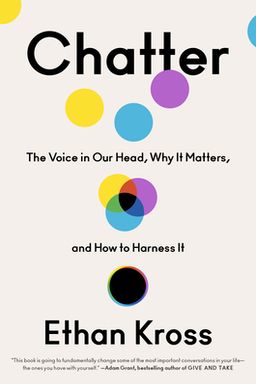
Chatter cover

Chatter

by Ethan Kross

Chatter by Ethan Kross explores the power of your inner voice and provides actionable strategies to tame negative self-talk. Backed by research, the book offers techniques to gain perspective, fulfill emotional needs, and engage with the world to transform your inner critic into a supportive ally.

Transforming the Inner Voice: From Chatter to Clarity

Have you ever lain awake replaying an argument, reliving an embarrassing moment, or worrying about the future on a loop? That is the voice inside your head—what psychologist Ethan Kross calls “chatter”—talking too much and too harshly. In his book Chatter: The Voice in Our Head, Why It Matters, and How to Harness It, Kross argues that your inner voice is both your greatest asset and your biggest liability. When it works for you, it helps you reason, learn, plan, and regulate emotions. When it backfires, it traps you in cycles of anxiety, rumination, and self-criticism that can damage relationships, performance, and even your health.

Kross, a neuroscientist and psychologist at the University of Michigan, combines research from cognitive science, social psychology, and neurobiology with vivid stories—from a major league pitcher’s breakdown to survivors of tragedy—to show how the conversation within shapes everything we feel and do. His central thesis: controlling chatter isn’t about silencing your inner voice but about changing your relationship with it—learning to step back, reframe, and use the mind’s natural tools to think wisely rather than destructively.

Why Chatter Matters

Kross begins with a paradox: introspection is supposed to help us solve problems, but in moments of emotional distress it often makes things worse. The internal monologue that evolved to guide us becomes a relentless critic, narrowing our perspective and amplifying pain. He shares his own story of receiving a violent threat letter as a researcher and discovering that his normally calm analytical mind turned into a panicked stream of what-ifs. This personal crisis set him on a mission to understand—and harness—the inner voice.

Through neuroscience and behavioral studies, Kross demonstrates that our brains are wired for internal talk. The “default mode network” activates when the mind wanders, replaying the past and simulating futures. This capacity underlies memory, creativity, and planning—but also anxiety and regret. In modern contexts saturated with stress and digital distraction, chatter can spiral unchecked, carrying mental and physical costs: elevated cortisol, impaired focus, and even adverse gene expression related to inflammation.

From Self-Coach to Inner Critic

The book shows that chatter operates like two sides of a coin. The same verbal stream that lets Simone Biles visualize world-record gymnastic routines can sabotage her under pressure. In Rick Ankiel’s case—a young baseball star whose career imploded when he began overthinking every pitch—self-talk became paralysis. Kross calls this shift from fluent execution to “unlinked” performance a tragic display of analysis overwhelming intuition.

We also see how chatter isolates us socially. Bernard Rimé’s research found that people compulsively share emotional experiences to soothe distress, but venting often worsens anxiety and strains relationships through co-rumination—reliving and rehashing pain without finding solutions. Online, these dynamics magnify: social media’s constant feedback loops of comparison and venting intensify chatter rather than relieving it. (Kross’s own studies show that passive social media use drives envy and sadness by encouraging distorted self-comparisons.)

The Science of Distance

Kross’s breakthrough insight is that chatter diminishes when we gain psychological distance—stepping back to observe our thoughts rather than drowning in them. Techniques such as “distanced self-talk” (using your name: “Ethan, you’ll get through this”) or mental time travel (“How will this feel a year from now?”) disengage the brain’s emotional circuits and activate cognitive control networks. This shift allows wiser judgment—a state Kross compares to moving from emotional Captain Kirk to logical Mr. Spock in one’s own mind.

Throughout the book, Kross presents a toolbox of evidence-based methods for creating distance: imagining yourself as a neutral observer, reframing stress as challenge rather than threat, writing expressively about painful experiences, or engaging in rituals and placebos that leverage belief and structure to restore a sense of control. The key is flexible application—no single trick works for everyone or every situation.

Beyond the Self: People and Places as Tools

Inner conversations don’t happen in isolation. Kross reveals how our relationships and environments can either calm or ignite chatter. Socially, the best helpers balance empathy and problem-solving—a blend he nicknames “Kirk and Spock.” Too much sympathy fuels co-rumination; too little feels cold. Building a “board of advisers”—trusted friends who satisfy both emotional and cognitive needs—creates a safety network for crisis moments.

Externally, our surroundings influence mental order. Nature, awe-inspiring experiences, tidy spaces, or comforting tactile rituals all replenish attention and soothe inner noise. Even belief itself acts as a cognitive placebo: when we expect healing—from a sugar pill or a personal ritual—our minds often make it real. These insights converge in Kross’s “toolbox” chapters, mapping tools we can use alone, through others, or with our environments to shift the dialogue inside.

Why It Matters

Kross closes by reflecting on how knowledge of chatter should reshape education and culture. His research inspired the “Toolbox Project,” teaching adolescents emotional-distancing skills like journaling and reframing. The ultimate message: the goal isn’t to silence your inner voice but to partner with it—to turn chatter into insight, criticism into guidance, and isolation into connection. The voice in your head is unavoidable; the challenge is to make it your ally.

“The key to beating chatter isn’t to stop talking to yourself,” Kross writes. “The challenge is to figure out how to do so more effectively.”


Why We Talk to Ourselves

Kross begins by asking why humans evolved to talk to themselves at all. Our inner voice, he explains, is not a quirk but an evolutionary superpower, built on language and memory to help us plan, learn, and manage behavior. The anthropologist Andrew Irving’s recordings of New Yorkers’ spoken thoughts provide an intimate look into these inner monologues—ranging from mundane errands to existential fears—revealing that inner speech structures experience and emotion alike.

The Brain’s Default Mode

Even at rest, our minds default to wandering—a state neuroscientists call the default mode network. This is when introspection thrives. Studies show people spend up to half their waking hours away from the present, often conversing silently with themselves. This mechanism supports reflection and preparation but easily slips into rumination—the mental chatter that keeps us stuck in pain or worry.

Learning to Self-Regulate

Kross traces the roots of the inner voice to the Soviet psychologist Lev Vygotsky, who described how children develop private speech—talking out loud to guide themselves—then internalize it into silent self-control. What begins as parental instruction (“No hitting,” “Be careful”) becomes an inner coach directing adult behavior. In this sense, our minds contain layers of inherited voices from parents, culture, and community.

(This parallels Daniel Kahneman’s concept of System 2 thinking—deliberate, language-based reasoning guiding instinct.)

The Double-Edged Sword

When functioning well, our inner dialogue fuels goal pursuit, creativity, and moral reasoning. It’s what allows us to simulate “what ifs,” plan for outcomes, and maintain a coherent life story. But Kross illustrates the peril of losing control through neuroscientist Jill Bolte Taylor’s stroke story. When her left brain shut down, she lost language, identity, and the ability to time-travel mentally—but also felt euphoric peace. Without chatter, life felt free yet empty. The episode underscores both the cost and gift of verbal thought: without it, we lose meaning; with it uncontrolled, we suffer.

Finding the Balance

Kross concludes that our mental life depends on balancing inner noise with mindful management. The human brain is designed to talk to itself—but also to listen wisely. The challenge isn’t to silence the voice inside but to guide it toward reflection rather than repetition.


When Talking to Ourselves Backfires

In the second chapter, Kross explores how self-talk can derail performance, focus, and health. The cautionary tale of Rick Ankiel—a prodigious baseball pitcher whose career collapsed when anxiety took over—illustrates how the mind’s inner dialogue can sabotage automatic skills. By overanalyzing movements he once performed instinctively, Ankiel “unlinked” his muscle memory, succumbing to what psychologists call paralysis by analysis.

Cognitive Overload

When chatter hijacks attention, it floods the brain’s limited executive functions—the same system we rely on to plan, focus, and regulate emotion. Like a computer overwhelmed with too many open tabs, a mind caught in worry underperforms. Kross notes this explains choking under pressure, poor academic test results, or even destructive relationship spirals.

The Cost of Social Sharing

Belgian psychologist Bernard Rimé found that after trauma, people feel compelled to share emotions but that constant venting rarely heals. In tragedies like the Virginia Tech and NIU shootings, survivors who talked incessantly about the event showed no long-term relief. Excessive sharing can reinforce distress instead of resolving it—a dynamic echoed in our era of online oversharing.

Social media, Kross warns, supercharges this tendency: platforms prompt “What’s on your mind?” but lack empathy and emotional timing. The result is a landscape of co-rumination and social comparison that heightens envy and isolation rather than connection.

Chatter in the Body

The mind’s turmoil doesn’t stop at thought—it invades biology. Kross’s research on heartbreak showed brain patterns of emotional pain mirror those of physical pain. Chronic rumination prolongs stress responses, raises cortisol, impairs immunity, and even alters gene expression toward inflammation—a process he calls “death at the molecular level.” Loneliness and self-critical loops, he notes, carry risks comparable to heavy smoking.

From Liability to Asset

Kross closes this section by reframing chatter as potential energy. Just as Ankiel eventually returned to baseball as an outfielder, reclaiming joy in his craft, anyone can convert self-talk from sabotage into strategy. The key, explored in later chapters, is distancing—learning to see thoughts rather than be them.


Zooming Out to Gain Perspective

The third chapter introduces one of Kross’s most powerful methods: psychological distancing, or zooming out. Using the story of Tracey, a young NSA recruit overwhelmed by pressure and isolation, Kross shows how stepping back from our immediate perspective restores calm and wisdom.

How Distance Disarms Emotion

When you zoom in on pain, emotion floods reason. Zooming out activates the brain’s executive network, giving rise to clarity. Kross’s experiments confirm that people who reflect on experiences as observers—imagining watching themselves from afar—feel less anger and shame and recover faster physiologically. This “fly-on-the-wall” view offsets emotional intensity without promoting avoidance.

The Wisdom Effect

Distance also breeds wisdom. Recalling the biblical and historical examples of King Solomon and Abraham Lincoln, Kross notes a universal tendency: we reason better for others than for ourselves. Experiments where participants analyze a problem as if advising a friend double their measured wisdom—open-mindedness, humility, and compromise. Psychologically, self-distancing turns self-immersion into perspective taking.

Tools of Distance

  • Temporal Distancing: imagining how you’ll feel about a problem in ten years from now diminishes its intensity (echoing Stoic philosophy).
  • Expressive Writing: journaling as a narrator rather than a victim transforms chaos into story, a process pioneered by psychologist James Pennebaker.
  • Meaning Making: connecting present pain to larger narratives—such as Tracey’s family history—normalizes adversity and renews purpose.

Used together, these tools shift the self from actor to author of its own experiences.


When I Become You: Language as a Tool

After exploring psychological distance, Kross uncovers a simpler mechanism: linguistic distance. He noticed that when people faced crisis—himself, Malala Yousafzai, LeBron James—they instinctively spoke to themselves using their own names. This practice, called distanced self-talk, turns internal chaos into calm guidance.

Talking to Yourself as Another Person

Through experiments where participants confronted stress-inducing speeches, Kross found that people who mentally coached themselves using “you” or their name (“You’ve got this, Maria”) felt less shame, performed better, and recovered emotionally faster. Brain scans show the effect emerges within a second—nearly instantaneous reappraisal without taxing willpower.

From Threat to Challenge

Distanced language also transforms how the body interprets stress. Saying your name primes cognitive control, shifting physiology from “threat mode” (tightened blood vessels) to “challenge mode” (relaxed and energized circulation). This reframing echoes Fred Rogers’s private note to himself: “Get to it, Fred.” The same principle underlies performance psychology techniques that label nerves as readiness.

The Universal You

Another linguistic tool Kross identifies is generic ‘you’. When tragic events strike, switching from “I” to “you” generalizes suffering, normalizing it as part of shared humanity. Sheryl Sandberg used this construction after her husband’s death—“When tragedy occurs, you can give in or find meaning”—turning personal grief into collective wisdom. Language itself, Kross concludes, secretly supplies emotional distance when we choose our words carefully.


The Power and Peril of Other People

Kross devotes a full chapter to the social dimension of chatter. While talking to others is our instinctive reaction to distress, it can heal or harm depending on how it’s done. Studies following the Virginia Tech and Illinois shootings showed that survivors who shared their feelings extensively didn’t recover faster—and sometimes felt worse. The mere act of venting, he explains, can amplify pain when it spirals into co-rumination.

Emotional vs. Cognitive Needs

When upset, we crave validation (“I’m here for you”) but also perspective (“Here’s what might help”). Most support conversations satisfy the first need and neglect the second. The best friends balance compassion and reasoning—the “Kirk and Spock” combination. Skilled helpers, like hostage negotiators, first build empathy then guide reflection toward solutions, following stages of active listening → empathy → rapport → influence → change.

Choosing Your Chatter Advisors

Kross encourages you to build a personal “board of advisers.” Identify who helps you zoom out versus who fuels your emotional fire. Diversify sources of support for work, family, and personal issues. Digital communities can also help; campaigns like “It Gets Better” demonstrate that even strangers offering hope online can normalize pain and transform inner dialogue.

Invisible and Nonverbal Support

Sometimes the best help is unseen. Columbia psychologist Niall Bolger found that partners studying for the bar exam benefited most from “invisible support”—help they weren’t aware of, like quietly doing chores or easing stress indirectly. Other subtle aids include affectionate touch; even a brief hand on the shoulder reduces stress hormones. These social tools, used with sensitivity, turn relationships into buffers against chatter.


Outside In: Environment and Awe

While much of Kross’s work focuses on the mind’s internal tools, he also reveals how external surroundings can quiet mental storms. Psychologist Ming Kuo’s study of Chicago’s Robert Taylor Homes found that residents whose apartments faced trees and grass exhibited more focus and well-being than those facing concrete. Nature, it turns out, replenishes the mental resources chatter drains.

Attention Restoration

The husband-and-wife team Stephen and Rachel Kaplan developed Attention Restoration Theory: natural environments evoke “soft fascination,” gently engaging involuntary attention while allowing directed attention to recharge. From urban parks to photos of greenery, exposure to nature improves memory, mood, and creativity—benefits confirmed in Marc Berman’s and Gregory Bratman’s experiments.

Awe and the Small Self

Kross extends this to awe: the emotion of wonder that transcends ego. Military veterans rafting through Utah’s canyons in Craig Anderson’s studies reported reduced PTSD and greater life satisfaction, especially those who felt strong awe. As neuroscientists find, awe decreases self-focus by quieting the brain’s default mode network, literally shrinking the self and, with it, chatter.

Order and Control

From Rafael Nadal’s pre-serve bottle rituals to Marie Kondo’s minimalism, Kross shows that creating physical order restores perceived control. When life feels chaotic, organizing your space imposes predictability, soothing the inner voice. This principle of compensatory control—establishing outer structure to restore inner calm—links environment to mental health.


Mind Magic: Belief and Ritual

In his final scientific exploration, Kross uncovers perhaps the most surprising ally in mastering chatter—the mind’s own capacity for belief. From eighteenth-century mesmerists to modern placebo studies, he shows how expectations can physically alter emotion and pain. Simply believing a saline spray will ease heartbreak, his research found, caused brain patterns of relief identical to real medication.

The Power of Expectation

Our brains constantly predict outcomes; belief primes physiology accordingly. Doctors’ white coats, ritual acts, or even price labels influence healing because they shape anticipation. Harvard researcher Ted Kaptchuk demonstrated that even nondeceptive placebos—when patients know a pill is inert but understand how belief works—can relieve symptoms from IBS to depression. Awareness itself becomes medicine.

Rituals as Cognitive Anchors

Anthropologist Bronisław Malinowski revealed that Trobriand Islanders performed elaborate rituals before dangerous fishing trips but not safe ones. Rituals, Kross explains, respond to uncertainty: they impose structure, connect us to meaning, and distract working memory from fear. Whether a rosary, athletic routine, or personal pre-meeting ritual, these structured acts fulfill the craving for control, reducing anxiety and restoring focus.

Cultural Transmission of Tools

Cultures, families, and religions serve as repositories of emotion-regulation wisdom—ranging from prayer to mourning customs—each functioning as built-in chatter antidotes. The “magic” lies not in superstition but in human cognition: belief reshapes experience. Science, Kross suggests, is only now rediscovering what culture always knew—the mind can heal itself when it believes it can.


Building Your Toolbox

Kross concludes with a practical synthesis—the toolbox of strategies anyone can use to manage inner noise. These methods fall into three groups: tools you can use on your own, those involving other people, and those leveraging your environment. Their common thread is distance: every technique creates perspective between you and turmoil.

Tools You Can Use Alone

  • Use distanced self-talk and mental time travel to cool emotions.
  • Write expressively to impose narrative structure on chaos.
  • Normalize experiences by using the general “you.”
  • Reframe stress as a challenge and reinterpret bodily anxiety as readiness.
  • Engage in rituals or hold lucky objects to trigger soothing expectations.

Tools Involving Others

  • Seek Kirk-and-Spock support—empathetic yet practical guidance.
  • Offer invisible support or affectionate touch to those in need.
  • Curate a board of advisers and avoid co-ruminators.

Environmental Tools

  • Create order in your surroundings to restore inner control.
  • Spend time in green spaces or view nature imagery to replenish focus.
  • Seek out awe—art, music, nature—to shrink self-focus and expand perspective.

Kross reminds us that no single tool is universal. Like any craftsman, you must experiment to find which combination—linguistic, social, or environmental—quiets your inner storm. Used well, these tools turn the voice in your head from tormentor to trusted guide.

Dig Deeper

Get personalized prompts to apply these lessons to your life and deepen your understanding.

Go Deeper

Get the Full Experience

Download Insight Books for AI-powered reflections, quizzes, and more.