
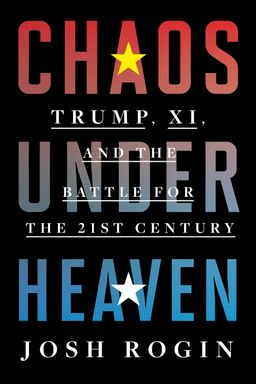
Chaos Under Heaven cover

Chaos Under Heaven

by Josh Rogin

Chaos Under Heaven delves into the complex and often chaotic U.S. policy toward China during the Trump administration. It uncovers the internal conflicts, economic entanglements, and global influence struggles that shaped this critical foreign policy challenge, offering a compelling look at the future of international relations.

The Making of a Chaotic Great Power Clash

How does a global superpower relationship unravel into confusion, competition, and coercion? This book traces the U.S.–China dynamic through the Trump era to reveal how personal politics, factional struggles, and structural shifts collided—transforming what had once been a stable engagement into open rivalry. The author argues that this period wasn’t a single linear policy but a collision of styles, systems, and personalities that accelerated great‑power competition across trade, technology, human rights, and global norms.

From Chaos to Confrontation

The transition itself set the tone. Senior Chinese officials encountered an uncoordinated, improvisational Trump team in late 2016, receiving contradictory signals—provocation via Trump’s call with Taiwan’s president and reassurance via Henry Kissinger’s parallel visit to Beijing. Jared Kushner’s informal channels became primary conduits for diplomacy, bypassing institutional systems. This produced a “fog of signals” that Beijing interpreted as strategic ambiguity, but Washington saw as confident transactionalism.

Factions Instead of Strategy

Once in power, Trump governed through rival camps, each pursuing a different China vision. “Superhawks” like Steve Bannon and Peter Navarro wanted confrontation and decoupling. “Wall Street” figures like Mnuchin, Kushner, and Gary Cohn tried to preserve business ties. Military professionals—the so‑called Axis of Adults—sought process and balance. Because Trump valued loyalty and spectacle, policy meetings often devolved into competing briefings rather than cohesive decision‑making.

Personal Diplomacy and Mixed Motives

Trump’s courtship of Xi Jinping at Mar‑a‑Lago symbolized how personal rapport replaced institutional clarity. The summit generated a temporary lull in tensions—the "one hundred day plan"—but encouraged China’s use of personal channels and soft corruption (as seen in Ivanka Trump’s trademarks or Kushner’s private investor contacts). For Beijing, the lesson was clear: influence the family to influence the presidency.

Trade War and the Birth of Strategic Competition

By late 2017, confrontation became inevitable. Lighthizer launched the Section 301 investigation, producing formal allegations of intellectual‑property theft and unfair subsidies—turning campaign rhetoric into legal warfare. Tariffs, investment restrictions, and blocked acquisitions followed. Behind the scenes, economic hawks, national‑security professionals, and market pragmatists fought over every detail. Legislation like FIRRMA hardened scrutiny on Chinese investments, signaling a structural shift from “engagement” to managed competition.

Ideas That Reframed U.S. Strategy

Amid the chaos, figures like Matt Pottinger built an intellectual backbone. His memo, nicknamed “Bill’s Paper,” declared that China sought not coexistence but regional hegemony. It introduced concepts like reciprocity, “salami slicing,” and regional balancing—frameworks later embedded in the National Security Strategy and Indo‑Pacific vision. This marked the first coherent articulation of competition rather than transformation—a strategic doctrine that outlasted administration turnover.

Influence, Technology, and Coercion Abroad

Parallel fronts opened in influence, technology, and moral confrontation. U.S. civil‑society activists mapped Chinese United Front operations in universities, think tanks, and media, exposing covert funding and lobbying. The CCP’s export of authoritarian control—pressuring global corporations from the NBA to Apple, or enforcing Taiwan labelling compliance—showed how economic power became political coercion. In tech, Huawei, TikTok, and surveillance systems tied commercial competition to ideological struggle.

The Pandemic and Information Warfare

COVID‑19 exposed both nations’ weaknesses. In January 2020, while trade truce ceremonies unfolded, early pandemic warnings were ignored. Beijing’s secrecy and America’s politicization of data turned a public‑health crisis into a geopolitical fault line. Disinformation networks—spanning Chinese state media, diaspora figures, and opportunistic Western actors—blurred truth and propaganda, culminating in election‑year manipulations and online conflicts.

Core message

The book argues that great‑power competition today is driven as much by fragmented domestic politics and personalized diplomacy as by ideological differences. The Trump era revealed not just tensions between Washington and Beijing but between governance and improvisation—a warning for how modern democracies can lose strategic coherence amid spectacle and short‑termism.


Factions, Personality, and U.S. Decision Chaos

You can’t understand the Trump‑era China policy without grasping its internal tug‑of‑war. Competing factions shaped every major decision—each personified a different answer to the question: Should America confront, cooperate, or cut deals with Beijing? The author illustrates how personality politics replaced process, producing volatile swings between hostility and accommodation.

The Factional Map

  • Superhawks: Ideologues like Bannon and Navarro powered the trade war, painting China as a civilizational rival to be dismantled through tariffs and decoupling.
  • National‑security professionals: Mattis, Pottinger, and Bolton prioritized competition but sought structured strategy without open war.
  • Wall Street pragmatists: Mnuchin, Kudlow, and Kushner emphasized financial stability and personal diplomacy, preserving engagements for business value.
  • Axis of Adults: McMaster, Kelly, and Mattis tried to impose formal machinery on decision‑making, frequently lost to the president’s whims.

How Personality Shaped Policy

Trump’s instincts rewarded drama. He valued vivid visuals and emotional loyalty more than bureaucratic discipline. Internal battles—the infamous tariff chart fights in the Roosevelt Room—showed how visuals could outweigh analysis. Advisors learned to tailor arguments to his business intuition (“leverage”) rather than to strategy. The resulting moves—tariffs, Huawei bans, sudden conciliations—were reactive, transactional, and heavily personal.

Practical insight

Personnel and personality shape geopolitics as much as doctrines. When leaders reject process, their governments oscillate between acceleration and paralysis.

This dysfunction rendered U.S. policy unpredictable—sometimes fearsome, sometimes incoherent. For China, volatility was exploitable; for America, it was a strategic liability that echoed across institutions well into the following years.


The Art and Cost of Personal Diplomacy

Trump’s preference for personal dealmaking transformed foreign affairs into theater. His Mar‑a‑Lago summit with Xi Jinping in April 2017 illustrated how charisma and spectacle displaced structure. Behind the steak dinners and golf‑course photo ops lay a risky gamble: that personal chemistry could deliver national interests more efficiently than bureaucracy.

A Weekend That Shaped Years

Xi’s visit produced a "one hundred day plan" promising trade progress, security dialogues, and cooperation on North Korea. Trump moderated earlier threats—avoiding currency‑manipulator labels—to secure goodwill. For a moment, the two countries entered détente. Yet beneath this calm were private overtures—Ivanka’s trademark approvals and Kushner’s venture meetings—that blurred the line between national diplomacy and family influence.

When Charm Replaces Structure

Xi understood the value of Trump’s ego. By combining flattery, controlled concessions, and promises of cooperation, Beijing preserved structural advantages while satisfying Trump’s desire for visible wins. National‑security hawks, however, saw the summit as a tactical defeat: China gained PR cover while deferring any systemic concessions. The “personal diplomacy” model proved useful for short‑term optics, disastrous for long‑term leverage.

Key lesson

Personal relationships can defuse tension, but they cannot substitute for institutional discipline. Without a structure, promises become traps and goodwill becomes leverage.

The Mar‑a‑Lago moment offered temporary harmony, yet it highlighted a principle recurring throughout modern power politics: admiration without accountability empowers manipulation.


Economic Warfare and Strategic Tools

When rhetoric turned into law, the U.S.–China conflict took material shape. Through trade probes, tariffs, and investment reviews, America weaponized economic policy. The Section 301 report (March 2018) became the cornerstone of the trade war, detailing how Beijing’s industrial policy forced technology transfer and subsidized strategic sectors like AI and semiconductors.

Instruments of Confrontation

The administration employed multiple tools: Section 301 tariffs for punishment, CFIUS investigations for blocking acquisitions, and FIRRMA legislation to extend scrutiny over data and dual‑use tech. The focus moved from market fairness to national security. Corporate examples—from Ant Financial’s failed MoneyGram deal to Broadcom’s aborted Qualcomm takeover—demonstrated this legal militarization of economics.

Factional Friction and Market Panic

Internally, trade hawks and market guardians fought bitterly. Mnuchin feared market crashes; Navarro sought confrontation. Shouting matches between advisers epitomized how domestic theater overlapped geopolitical stakes. Gradually, tariffs became symbols of strength rather than tools of negotiation—a feedback loop that reinforced nationalist bravado but unsettled global markets.

Strategic takeaway

Economic laws can be turned into geopolitical weapons—but when guided by domestic politics instead of clear doctrine, they risk escalation without solution.

For you, this chapter’s insight is practical: understanding how trade tools interact with security concepts is crucial to predicting modern power behavior. Legal mechanisms now function as instruments of statecraft, not just commerce.


Ideas That Redefined Strategy

Among the chaos, intellectual coherence emerged from Matt Pottinger’s “Bill’s Paper.” This unofficial memo became the seed for America’s Indo‑Pacific strategy. It argued China’s rise required containment, not conversion—a paradigm shift from hoping China would liberalize to accepting it pursued hegemonic control over its region.

The Memo’s Core Arguments

  • Reciprocity: Stop one‑sided openness—demand equal access for media, universities, and companies.
  • Salami‑slicing: Recognize cumulative coercion, like island‑building in the South China Sea.
  • Regional balance: Treat Asian allies as independent planets, not satellites orbiting Beijing.

From Theory to Policy

These ideas migrated into official strategies—the National Security Strategy and Indo‑Pacific frameworks—triggering renewed partnerships with Japan, India, and Australia. They reframed the narrative: rather than reforming China, the United States must manage competition while defending openness. Pottinger’s analogy—“Think Jupiter, not the Sun”—captured the mindset: build gravitational alternatives to Beijing's dominance.

Historical echo

Like George Kennan’s containment doctrine for the Soviet Union, “Bill’s Paper” became a blueprint for long‑term competition with an ideological peer.

You can apply this insight beyond statecraft: when institutions face predatory systems, reciprocity and balance—not appeasement—preserve stability.


Influence Networks and Hidden Power

While officials debated tariffs, China’s United Front quietly expanded. Through funding partnerships, lobbying, and diaspora networks, it shaped favorable narratives inside American institutions. The author tracks how academics, businessmen, and even lobbyists became inadvertent channels for Beijing’s interests—often under the guise of cultural exchange or philanthropy.

Mapping the United Front

Groups like the China‑United States Exchange Foundation (CUSEF) sought influence in universities (the UT‑Austin case), while civic coalitions such as Dimon Liu’s “Bingo Club” exposed covert ties. Elite networks—including financiers like John Thornton and Neil Bush—advocated engagement, sometimes echoing CCP messaging. The system’s genius lies in its subtlety: embedding friendly intermediaries, normalizing self‑censorship, and eroding awareness of manipulation.

Civil‑Society Awakening

Grassroots resistance began with academics, journalists, and congressional staff identifying patterns: opaque donations, sponsored delegations, and targeted harassment of dissidents. Their work reframed foreign influence as a civic‑security issue, not a partisan talking point. The result: new scrutiny of Confucius Institutes, lobbying disclosures, and FARA enforcement.

Moral insight

Influence rarely announces itself. The price of openness is vigilance; without transparency, soft power turns into silent control.

This idea teaches you to track money, affiliations, and narratives. Influence operations thrive in confusion; clarity is their enemy.


Technology, Surveillance, and Norm Warfare

Technology became a moral battlefield. As Huawei, ZTE, and TikTok expanded globally, their links to state surveillance collided with Western norms on privacy and rights. The author connects corporate compliance, human‑rights repression, and strategic competition—showing how the tech race is also a struggle over the ethical code of the digital age.

From Chips to Camps

Sanctions and bans reflected more than industrial rivalry. Reports of mass detention in Xinjiang and AI surveillance using technologies from Hikvision and CloudWalk anchored moral outrage. U.S. universities unwittingly partnered with Chinese firms tied to repression, exposing how innovation pipelines can feed authoritarian control. Global institutions—from the UN to the ITU—faced Chinese pressure to sanitize human‑rights discussions while advancing “sovereignty‑first” norms.

Digital Authoritarianism

The book introduces “social credit internationalization”: coercing global firms—like Marriott, Apple, and airlines—to conform to political restrictions abroad. Corporate compliance ceased to be neutral; it became participation in censorship. The NBA’s crisis over Hong Kong tweets showed how Beijing mobilizes markets and online armies to enforce ideological obedience globally.

Ethical conclusion

Tech competition isn’t merely economic—it’s normative. Whoever shapes the rules of data and surveillance will shape the future of freedom itself.

If you work in technology or policy, you’re now part of a global moral debate: how to innovate without enabling oppression. Transparency, export scrutiny, and ethics are as strategic as hardware and code.


Money Flows and Invisible Dependencies

Financial markets, often seen as apolitical, became Beijing’s hidden advantage. The book exposes how index providers like MSCI and Bloomberg re‑channeled billions from U.S. pension funds into Chinese companies connected to the CCP or PLA. These automatic capital flows created quiet paradoxes: while Washington imposed sanctions, Wall Street financed the very structure of Chinese expansion.

Mechanics of the “Big Con”

When MSCI added mainland stocks, passive funds followed, sending massive inflows into firms like Hikvision and AVIC. Roger Robinson’s activism highlighted how index governance lacked security filters. The Federal Thrift Savings Plan and CalPERS controversies exposed conflicts between fiduciary duty and national security. Political battles ensued over whether Americans should fund adversarial systems unintentionally.

Strategic Implication

These capital dependencies entangle geopolitics and finance: investors become lobbyists against sanctions, and adversarial regimes gain foreign legitimacy. The author argues this financial blindness may be the most profound vulnerability—proof that economic globalization, without ethical reform, undermines strategic autonomy.

Action principle

Follow the money. Understanding index composition and fund exposure is no longer just an investor’s task—it’s a national‑security imperative.

The takeaway for you: finance is policy in disguise. Markets now project power as effectively as militaries.


Pandemic, Secrecy, and Global Fallout

The outbreak of COVID‑19 revealed the perils of secrecy and politicization. While U.S. and Chinese officials celebrated the 2020 Phase One trade deal, warnings of a dangerous pneumonia in Wuhan circulated. Matt Pottinger, relying on open‑source intelligence and human contacts, urged action. Bureaucratic hesitation—fearing market reactions—delayed travel restrictions while the virus spread globally.

Beijing’s Silence and the Global Crisis

Chinese authorities punished whistleblowers like Dr. Li Wenliang, concealed early genomic data, and sanitized evidence, mirroring SARS‑era censorship. The result: a vacuum of reliable information. The U.S., in turn, fragmented its response—driven by internal faction fights and political theatrics. Transparency collapsed on both ends.

Competing Narratives and the Lab Debate

Embassy cables and research on bat coronaviruses sparked the lab‑origin hypothesis, though engineered‑bioweapon claims were rightly dismissed. The broader lesson wasn’t scientific—it was institutional: opaque systems with advanced research pose global risks. Independent oversight of biosafety and information pipelines became a geopolitical necessity.

Global moral

Secrecy kills trust. When science becomes a political asset rather than a shared human discipline, crises multiply and cooperation collapses.

This episode closes the book’s arc: from miscommunication to moral reckoning. It shows that great‑power rivalry can turn deadly when truth itself becomes a strategy.


Information Wars and Political Manipulation

The epilogue zooms into hybrid influence—private actors, exiles, and disinformation campaigns that distort democratic discourse. The alliance between Chinese businessman Guo Wengui and Steve Bannon during the 2020 election exemplified how information warfare blurs political and foreign interests. GNews platforms circulated unverified claims about Hunter Biden, amplifying chaos that benefitted particular factions.

Hybrid Influence Networks

Guo’s media empire and funding channels targeted both Chinese and Western audiences. Meanwhile, online trolls harassed dissidents like Pastor Bob Fu, showing how personal vendettas overlap with propaganda ecosystems. The ODNI’s assessment that Beijing preferred Trump’s defeat contrasted with these networks—illustrating multidirectional interference and the difficulty of attributing motives.

Guarding Democratic Integrity

The author urges media literacy and verification: explosive stories should be scrutinized for foreign origin, timing, and amplification channels. Protecting elections means protecting information supply chains—from data manipulation to proxy funding. It demands bipartisan commitment and public resilience against emotional misinformation.

Final insight

In modern political warfare, influence no longer requires armies—it requires algorithms, amplification, and the absence of skepticism.

For you, the call is clear: treat information integrity as national security. In the age of hybrid power, every citizen is part of the defensive line.

Dig Deeper

Get personalized prompts to apply these lessons to your life and deepen your understanding.

Go Deeper

Get the Full Experience

Download Insight Books for AI-powered reflections, quizzes, and more.