
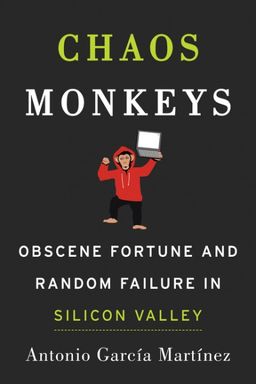
Chaos Monkeys cover

Chaos Monkeys

by Antonio Garcia Martinez

Chaos Monkeys pulls back the curtain on Silicon Valley, exposing the high-stakes games and relentless ambition that fuel the tech world''s meteoric rise. Through candid storytelling, Antonio Garcia Martinez provides an insider''s look at the gritty reality behind the glamour, offering invaluable insights for anyone daring to venture into this cutthroat arena.

Building Startups in the Chaos of Silicon Valley

What happens when the quantitative precision of Wall Street meets the raw improvisation of Silicon Valley? In Chaos Monkeys, Antonio García Martínez reveals the mechanics, psychology, and fallout of competing in the fastest-moving ecosystem on earth. The book traces his journey from Goldman Sachs quant to Facebook ad product manager, using the lens of his startup AdGrok to unpack how digital advertising, data ethics, and power politics define the modern tech economy.

At its core, Martínez argues that technology doesn’t just disrupt industries—it rewires human behavior and moral boundaries. The startup world is less a meritocracy than a theatre of personality, risk tolerance, and calculated manipulation. To survive, you need both mathematical acumen and social ruthlessness. The narrative alternates between gritty startup lessons and insider portraits of Facebook’s culture, binding together themes of ambition, data, and ethical compromise.

From Wall Street to Ad Tech

Martínez’s Wall Street experience in algorithmic trading sets the intellectual foundation. He learned to price risk, exploit inefficiencies, and treat computation as competition. Moving to ad tech, he sees human attention as the new currency. Online ads, like financial instruments, are traded at lightning speed: each impression an auction for user attention. This parallel between finance and ads introduces a deeper argument—advertising has become financialized, a domain where data replaces traders and algorithms replace emotion.

The Cofounder Gamble and Governance Lessons

AdGrok’s founding drama illustrates how fragile human chemistry can destroy a technically sound idea. Equal equity splits, unclear authority, and mismatched personalities turned a promising venture into internal conflict. Martínez’s reflection—'founding a company is like marriage with a divorce already planned'—underscores that governance design must precede coding. Y Combinator’s startup gospel encourages fast iteration, but it doesn’t immunize teams against emotional politics. The real challenge is aligning power and incentives before stress tests appear.

Ad Tech, Data, and the Moral Edge

The technical core of the book unpacks online advertising’s machinery: auctions, targeting, and attribution. Ads translate human behavior into monetary signals. But the adjoining theme—data ethics—reveals the peril. When Martínez joins Facebook, his projects around the Like button and cookies push the limits of acceptable surveillance. Technical feasibility collides with political risk. Zuckerberg’s directive, 'You can do retargeting, but don’t use the Like button,' encapsulates this tension between innovation and trust. You learn that every new monetization idea is also a social contract that can unravel overnight under public scrutiny.

Inside Facebook: Culture and Conflict

Facebook’s internal world unfolds as militant corporate spirituality. Lockdowns, slogans, and quasi-religious rituals feed speed and conformity. The Analog Research Lab and its propaganda-style posters (


Founder Dynamics and Survival Tactics

Your company’s success depends less on its idea than on how its founders handle chaos. Martínez turns the AdGrok story into a playbook for understanding startup alliances. Three founders—Matthew McEachen, Argyris Zymnis, and Martínez himself—split equity equally, an act of moral idealism that led to governance deadlock when the company faced lawsuits and acquisition pressure.

Power Structure Over Fairness

Equal splits create psychological paralysis. When everyone has veto power, pivots stall and minor arguments metastasize. In practice, someone must hold the reins—a principle endorsed by Paul Graham at Y Combinator. Martínez’s reluctant acceptance of the CEO role without full authority captured a familiar trap: leadership without legitimacy. As the company faced Adchemy’s lawsuit, those undefined lines became existential hazards.

Conflict and Personality

Personalities drive decision outcomes. Argyris’s mood swings, Matt’s pragmatism, and Antonio’s charm formed an unstable triad. Technical teams often forget emotional alignment matters as much as skills. The AdGrok case shows that mismatched communication styles can become strategic liabilities, especially when boards, investors, or acquirers enter the picture. (Note: many founder guides, including Ben Horowitz’s works, echo this concept—emotional resilience beats technical insight.)

Lesson

Establish governance structures early. Decide who leads and how decisions are made before stress arrives. Emotional clarity is a strategic advantage.

Litigation and Strategic Survival

The Adchemy lawsuit became a crash course in startup warfare. Martínez used his network—Paul Graham’s reputation, investor connections, and Fenwick law firm’s equity-for-defense deal—to pressure plaintiffs into settlement. Legal fights often turn reputational, not legal. Understanding that social capital and brand influence weigh more than courtroom logic transforms how you view legal strategy in entrepreneurship.

Ultimately, what kills startups isn’t market failure, but moral misalignment under pressure. Martínez’s key insight: build trust and hierarchy before stress tests erupt. Otherwise, even small shocks fracture your company faster than any technical bug.


Money, Equity, and Investor Politics

Funding seems like a numbers game—but it’s really a negotiation of fear and leverage. Martínez unpacks the financial and political plumbing of Silicon Valley: convertible notes, valuation caps, and dilution. Through AdGrok’s turbulent fundraising amid a lawsuit, he shows how power shifts from founders to investors in moments of vulnerability.

Understanding Convertible Notes

A convertible note is disguised debt, turning into equity at the next priced round. The valuation cap acts as a mini-pre-money valuation—an invisible price tag on founder control. A lower cap rewards early risk but sells more of the company. In Martínez’s case, an angel’s $100k note with a $3M cap translated to roughly 3% ownership after conversion—small arithmetic, huge implications.

Investor Archetypes and Behavior

Martínez draws portraits: old-school angels like Russ value reasoned returns and stability; new-school stars like Chris Sacca chase exponential outcomes and influence. Each capital source carries personality. You should not treat funding as commodity—it’s a set of psychological relationships. The wrong investor can distort not only terms but long-term company behavior.

Practical takeaway

Model dilution over time. Understand that every cap and option pool decision today determines your control a year later.

The Politics of Fundraising

Litigation made fundraising political. Legal uncertainty lowered AdGrok’s valuation and forced compromises. Martínez learned that financing is negotiation amplified by desperation. Each term reflects power dynamics, not fairness. In Silicon Valley, capital flows toward narrative confidence. When confidence falters, math turns punitive.

You come away understanding that fundraising is theater—investors buy belief, not spreadsheets. That insight guides how you structure both story and survival plans in early-stage companies.


Data, Privacy, and Identity Engineering

Once inside Facebook, Martínez becomes an architect of how data powers advertising. This portion of the book maps the tension between innovation and intrusion—how off-platform tracking through social plugins, cookies, and identity joins can create enormous value or reputational disaster.

The Like Button Controversy

Facebook’s seemingly trivial Like button functions as a global surveillance system. When users browse external sites with embedded plugins, Facebook can record those visits. Martínez realized that these traces could link users’ browsing habits to their social profiles, enabling retargeting at scale. Zuckerberg’s response—“Do retargeting, but not via the Like button”—highlights a corporate balance between commercial value and ethical restraint.

Identity and Data Joins

The essence of modern advertising is identity resolution: connecting you across your devices and data sources. Martínez’s work with Custom Audiences shows how Facebook matches hashed emails and phone numbers against user accounts to produce precision targeting. Match rates approaching 90% make such tools indispensable for marketers—but technically sophisticated and politically delicate. Regulators, notably Ireland’s Data Protection Agency, demanded proof that this matching respected privacy law, leading to late-night SQL fixes that embodied both moral and technical tension.

Ethical lesson

Build data systems as social contracts. Technical compliance alone won’t prevent backlash—users and media judge intent as much as architecture.

By showing how identity bridges link people, cookies, and offline databases, Martínez gives you a view from inside the engine of attention economics. The result is a cautionary tale: success in ad tech requires not just speed and precision, but empathy and governance aligned with public trust.


Inside Facebook’s Cultural Machine

Facebook’s internal life is described as a cross between a monastery and a war room. Martínez portrays an organization where zealotry meets performance metrics. Lockdowns, hackathons, and propaganda posters unify employees around existential missions, fusing personal identity with corporate dogma.

Militant Culture and Rituals

Zuckerberg’s “Carthago Delenda Est” rally during Google+’s launch triggered a lockdown that blurred morale and warfare. Employees treated deadlines like crusades. The Analog Research Lab printed slogans—“Move Fast and Break Things,” “This Journey 1% Finished”—to keep morale high and dissent low. The rhetoric transformed speed into virtue, erasing caution as weakness.

The Costs of Velocity

Speed optimizes execution but invites accidents. Projects like Beacon and Sponsored Stories show how cultural zeal can override privacy prudence. Martínez argues that culture magnifies product decisions: militant environments reward audacity and punish skepticism. The wisdom lies in building internal checks that preserve humanity amid velocity.

Cultural takeaway

Culture is a multiplier: what you celebrate repeatedly becomes your company’s reality. Choose slogans as carefully as you choose architectures.

If you lead teams, this chapter teaches the hidden cost of high-speed execution: creative exhaustion and conformity. Use rituals wisely—they can fuel progress or become the leash that binds innovation to group obedience.


Product Management, Metrics, and Pragmatism

Martínez demystifies the product manager’s role inside a complex ecosystem. At Facebook, PMs act as both diplomats and engineers, defining success through ruthless measurement and quick iteration. His stories of Kitten and Project Chorizo illustrate the discipline behind scalable experiments and metric-driven evaluation.

Designing Adoption and Frictionless Change

The “Kitten” project explored new targeting categories but risked alienating advertisers. Instead of forcing migration, Martínez innovated UI signaling—new segments marked with hashtags—to leverage existing habits. The decision minimized cognitive load and elevated the adoption curve. Effective PMing is less about invention than empathy with how users think.

Metrics as North Star

At Facebook, metrics drive ideology: “you make what you measure.” When Project Chorizo’s complex model failed to show lift, the team killed it. The moral is clear—data beats dogma. Yet Martínez warns of metric blindness: optimizing the wrong KPI can deform the product. The PM’s craft is balancing speed with reflection.

PM credo

Ship small, instrument everything, and measure truth—emotionally and numerically.

Technical fluency strengthens PM authority. When the Irish audit demanded immediate database changes, Martínez personally verified compliance through SQL checks, showing how hands-on skill converts crisis into credibility. In his portrayal, PMs are systems thinkers mediating ambition and constraint—the linchpins of monetization at scale.


Personal Trade-offs and the Price of Ambition

Behind the noise of ads and IPOs lies a personal reckoning. Martínez concludes his journey by mapping the financial and emotional costs of aggressive careers. Facebook’s IPO, equity vesting cycles, and his life on a sailboat all symbolize a businessman torn between freedom and belonging.

IPO Arithmetic and Reality

Paper wealth hides complexity. Vesting schedules, lockups, and taxation transform millions on spreadsheets into uncertain real-world outcomes. Martínez demystifies this illusion with examples: RSUs vest annually, lockups freeze liquidity, and tax obligations can exceed sellable shares. The Facebook IPO pricing strategy—minimizing first-day pop—was rational finance disguised as altruism. You learn that even “wins” need actuarial interpretation.

Freedom, Identity, and Exit

Post-Facebook, Martínez chooses the literal mobility of a sailboat and the figurative freedom of writing. His decisions—declining family entanglement, refusing convention—frame the existential question: how much autonomy are you willing to trade for high-status success? Silicon Valley sells liberation through capitalism, yet many insiders live chained to vesting clocks and cultural debt.

Personal insight

Choose wealth types consciously—financial, temporal, and emotional. Only by separating them do you design your own life rather than inherit someone else’s ambition.

By its end, Chaos Monkeys transcends its business narrative. It becomes a meditation on control—whether over startups, data, or destiny. Martínez shows that while algorithms may price attention, only you can price your freedom.

Dig Deeper

Get personalized prompts to apply these lessons to your life and deepen your understanding.

Go Deeper

Get the Full Experience

Download Insight Books for AI-powered reflections, quizzes, and more.