
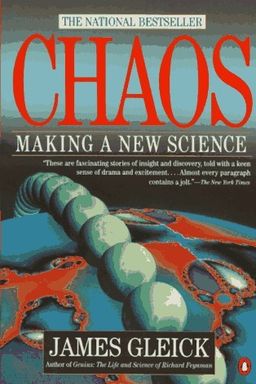
Chaos cover

Chaos

by James Gleick

Chaos: Making a New Science by James Gleick explores the groundbreaking field of chaos theory, revealing how disorder and unpredictability shape everything from weather patterns to biological systems. Through captivating stories and scientific insights, this book unravels the complexity of our universe, highlighting the strange order within chaos.

The Discovery and Spirit of Chaos

How can perfect laws yield unpredictable outcomes? In Chaos: Making a New Science, James Gleick tells the story of a scientific revolution that reshaped how you understand the world. Chaos theory reveals that deterministic systems—those governed by precise laws—can still produce behavior that is irregular, seemingly random, and fundamentally unpredictable. It reshapes physics, biology, mathematics, and even art by emphasizing nonlinearity and sensitivity to initial conditions. The book follows the pioneers who built this new science piece by piece: Lorenz in meteorology, Feigenbaum in mathematics, Mandelbrot in geometry, and experimentalists like Libchaber and Shaw who brought chaos to life in laboratories.

Lorenz and the Birth of Sensitive Dependence

The story begins with Edward Lorenz, a quiet meteorologist at MIT who stumbled upon a profound truth while running a toy weather simulation on his Royal McBee computer. To save time, he restarted a run using rounded numbers (.506 instead of .506127). The results diverged dramatically. With that small mistake, Lorenz discovered sensitive dependence on initial conditions—the insight later called the Butterfly Effect. He realized that even a perfect deterministic system could become unpredictable because tiny differences in starting points could grow exponentially over time. This shattered the Newtonian belief that the future of a system was fully determined by its present state.

For you, Lorenz’s discovery points to a humbling limit on prediction. Weather models, no matter how advanced, will always be constrained by measurement precision. He also visualized this paradox in his Lorenz attractor—a delicate butterfly-shaped pattern in three-dimensional phase space that captured both order and disorder. It showed that chaos was not randomness; it was structure concealed within unpredictability.

Nonlinearity and the Fall of Linearity

Before chaos, science worshipped linearity. Newton’s equations implied that the whole could be broken into parts. But many systems—fluids, oscillators, biological populations—are nonlinear, meaning small changes can have disproportionate effects. A pendulum at large swing angles or a dripping faucet may obey perfect laws yet behave unpredictably. Nonlinearity makes simple systems capable of complex motion, a revelation that blurred the line between basic and complicated physics. Mathematicians like Steve Smale made this geometry vivid with models like the horseshoe map, showing stretching and folding processes that create mixing and disorder in simple iterative systems.

From Rebellion to Revolution

Gleick frames chaos as a Kuhnian revolution. Dissidents from several fields decoded anomalies that once looked like computational noise: Lorenz in meteorology, Yorke in mathematics, May in ecology, Mandelbrot in geometry. Each was initially marginalized. Yet by the 1970s, they connected through conferences, homemade computers, and shared imagery. A new language—attractor, bifurcation, fractal—emerged. Institutions like Los Alamos and Santa Cruz became chaos hubs, embracing computers as experimental tools. The revolution wasn’t only theoretical; it was visual, collaborative, and interdisciplinary.

A New Science of Patterns

Across all these stories, you learn a deeper moral: chaos restores respect for complexity. Instead of seeking perfect prediction, scientists began to look for structure within irregularity—patterns that persist in the midst of noise. From period-doubling in population maps to fractal geometry in coastlines, the chaotic revolution redefined the goal of science. The aim shifted from reducing systems to linear parts toward understanding how feedback, iteration, and self-similarity create global behavior. This perspective now informs everything from weather forecasting to cardiac physiology.

In sum, Gleick’s book shows how simplicity breeds complexity, how determinism can coexist with unpredictability, and how the collaboration of mathematics, experiment, and visualization forged a wholly new way of seeing the natural world. Chaos is not disorder—it is the hidden architecture of change itself.


The Mathematics of Nonlinearity

When you study nonlinear systems, you realize that small tweaks can unleash dramatic consequences. Gleick illustrates this with pendulums, oscillators, and feedback equations that, despite being simple, can behave beyond intuition. Newton’s linear world offered predictability: double the input, double the output. Nonlinearity shatters this proportionality. Interactions become self-modifying—causes alter the rules as they operate. This insight reframed many classical problems across physics and engineering.

From Simple Toys to Complex Motion

Take the magnetic pendulum: a bob swings over magnets arranged on a table. Slight differences in initial release cause it to settle into different magnets unpredictably. Map these outcomes and you find fractal basin boundaries—fine interleavings where near-identical conditions lead to opposite fates. The waterwheel, a damped and driven device with leaky buckets, also reveals erratic rotation and reversals. The lesson: nonlinear feedback doesn’t require vast complexity; it can emerge in the simplest toys.

Geometric Thinking and Smale’s Horseshoe

Steve Smale’s horseshoe map provides a geometric metaphor for chaos. Picture stretching a square, folding it like taffy, and reinserting it. Points once near each other separate exponentially while still confined within a bounded region. The horseshoe captures two essentials of chaos—mixing and sensitivity—through simple geometry. It also introduced topology to dynamics, emphasizing shapes over equations. (Note: Smale’s approach inspired later visualization of strange attractors.)

Global Behavior and Predictability

Once you accept nonlinearity, prediction becomes a matter of geometry rather than calculation. Local equations can no longer guarantee global foresight. Engineers, biologists, and meteorologists must ask: How stable are solutions? Where do trajectories diverge? This new viewpoint replaces control with understanding. You can still steer systems but not foresee every consequence—a profound conceptual shift introduced by chaos theory.

In short, nonlinearity teaches that order and unpredictability coexist. The task isn’t to eliminate feedback or complexity but to grasp how they shape behavior across scales—from the swinging pendulum to populations, economies, and climate dynamics.


Population Maps and the Path to Chaos

When biologist Robert May began analyzing population changes using the simple equation xₙ₊₁ = r·xₙ(1−xₙ), he didn’t expect to ignite a new branch of nonlinear science. The so‑called logistic map linked ecology to chaos theory, showing that even minimal deterministic formulas can yield unpredictable yet structured results. As the reproduction rate r increases, behavior evolves from stability to oscillation to chaos through a series of bifurcations—period doubling upon doubling until predictability vanishes.

The Period‑Doubling Cascade

May plotted bifurcation diagrams to illustrate this process. At low r, the population stabilizes. Slightly higher, it alternates between two values, then four, then eight. Eventually, the intervals between bifurcations shrink geometrically, producing a fractal pattern of order within disorder. This visualization made chaos visible and measurable. James Yorke’s famous paper “Period Three Implies Chaos” formalized the observation: if a map exhibits a cycle of period three, chaos inevitably follows. Suddenly, ecologists saw erratic outbreaks as intrinsic mathematics, not random noise.

Biological and Practical Lessons

Deterministic chaos offered new ways to understand epidemics, predator-prey cycles, and cellular rhythms. For instance, measles data once attributed to random factors could be reinterpreted as deterministic oscillations near a chaotic threshold. Such models implied that small parameter shifts—like vaccination rates—could trigger abrupt qualitative changes in outbreak patterns. The same principle applies in finance or resource management: feedback loops can amplify fluctuations into unpredictable swings.

The Conceptual Leap

What May and Yorke revealed is essential: determinism doesn’t equal predictability. Even with full knowledge of the rule, you can’t foresee the distant future. That paradox became one of chaos theory’s defining motifs—a realization that understanding global behavior sometimes means embracing limits to prediction rather than chasing precision.


Feigenbaum and the Law of Universality

Mitchell Feigenbaum transformed chaos from curiosity to law. Working with scarce computer access at Los Alamos, he explored period‑doubling in nonlinear maps and discovered a constant ratio governing the spacing of bifurcations: about 4.669. This numerical pattern—identical across very different equations—proved that chaos follows universal scaling laws. That constancy replaced randomness with self‑similarity, revealing order beneath noisy transitions.

Renormalization and Scaling

Feigenbaum borrowed ideas from particle physics’ renormalization group: rescale, iterate, and look for fixed transformations. He realized that as nonlinear maps undergo period‑doubling, the ratios between successive bifurcations converge to the same number. The implication is stunning: all systems that share a certain smooth shape (so‑called unimodal maps) belong to the same universality class. You can study a toy map and describe turbulence, fluids, or circuits with the same mathematics.

From Skepticism to Proof

Initially, physicists dismissed the claim as numerology. Journals rejected his papers for two years. Only after Oscar Lanford’s computer‑aided proof in 1979 did universality gain full acceptance, confirming that numerical experiments could reveal fundamental constants of nature. This event symbolized a cultural shift: computation became as critical as algebra, and discovery could emerge from programming as much as pen and paper.

A Bridge Between Worlds

Feigenbaum’s discovery gave scientists a new way to generalize. Instead of cataloging separate systems, they identified families governed by the same scaling laws. The constant 4.669 became the signature of chaos’s universality. Subsequent experiments—most famously Albert Libchaber’s helium convection cell—measured the same values in physical systems, fusing abstract math with laboratory reality. In chaos, universality replaces reductionism: the details vary, but the structure of change remains the same everywhere.


Fractals and the Geometry of Roughness

Benoit Mandelbrot reimagined geometry for a jagged world. Traditional mathematics smoothed mountains into cones and clouds into spheres, but nature is rarely regular. Mandelbrot coined the term fractal to describe shapes that show self‑similar structure at every scale. Through fractals, he gave you a new lens for viewing randomness, whether in coastlines, markets, or human lungs.

Scaling, Self‑Similarity, and Fractional Dimension

Mandelbrot recognized that many irregular phenomena follow scaling laws: zoom in or out, and the statistical pattern remains consistent. The Koch curve, for example, repeats endlessly while enclosing finite area but infinite length—a paradox resolved through fractional dimension. This “in‑between” number quantifies roughness, revealing that a coastline is more than one‑dimensional but less than two. His maxim, “Clouds are not spheres,” flattened centuries of geometric convention into an elegant truth.

Applications Across Sciences

Fractals became practical tools. Geophysicists modeled earthquake clustering using fractal fault networks. Biologists analyzed alveoli branching in lungs. Economists applied heavy‑tailed distributions to cotton prices. Mandelbrot’s work offered both metaphor and measurement—a way to capture complexity through scaling laws rather than equations of motion. (Note: his geometrical worldview paralleled Lorenz’s in showing pattern within apparent randomness.)

The Mandelbrot Set: Art Meets Mathematics

Using computers, Mandelbrot visualized iteration in the complex plane to produce the now‑iconic Mandelbrot set—a black cardioid surrounded by infinite filigree. Each magnification reveals familiar yet new shapes, linking abstract math to tangible beauty. The set became both scientific catalog and cultural symbol: an image of infinite complexity born from a single formula. More than aesthetics, it embodied a principle central to chaos: simple rules can generate endless variety.


From Lab to Life: Chaos in Experiment and Biology

After theorists mapped chaos in equations, experimentalists tested it in reality. Two milestones—Albert Libchaber’s tiny helium experiment and the Santa Cruz group’s creative analog investigations—proved that the mathematics of chaos manifests in the physical world and even in living systems.

Libchaber’s Matchbox Universe

Libchaber built a miniature convection cell of liquid helium, a millimeter across, with precision thermometers resolving thousandths of a degree. As he increased the temperature gradient, the system moved through steady rolls, oscillations, period‑doubling, and finally chaos—exactly as Feigenbaum’s theory predicted. He measured the same numerical constants seen in abstract maps, confirming that universality was not just mathematical. His experiment demonstrated that dissipation strips away unnecessary degrees of freedom, reducing complex fluids to effectively low‑dimensional dynamics.

The Santa Cruz Collective and Data Geometry

Meanwhile, Rob Shaw, Doyne Farmer, and colleagues at UC Santa Cruz built analog computers to simulate chaos directly. They learned to reconstruct phase space from time series—a technique that turned single data streams into multi‑dimensional attractors. Their work grounded chaotic theory in measurement: from dripping faucets to cardiac signals, patterns could be visualized and quantified. This group also invented practical methods for estimating Lyapunov exponents and fractal dimension from real data, creating a toolkit now central to nonlinear science.

Chaos in Physiology and the Heart

Chaos made its way into medicine when researchers like Leon Glass and Arthur Winfree examined arrhythmias as dynamical phenomena. Cardiac tissue behaves as a network of oscillators; under stress, it can bifurcate into fibrillation—an erratic but deterministic form of chaos. Studies using cultured heart cells and multi‑electrode “socks” confirmed that small parameter shifts can provoke sudden transitions. Dynamical thinking reframed notions of disease: a healthy rhythm isn’t rigid equilibrium but a flexible, self‑adjusting dynamic. Understanding those shifts promises smarter interventions in defibrillation and drug design. In this sense, biology exemplifies chaos’s most human lesson: life itself balances on the edge between order and disorder.


The Universe Within Unpredictability

Chaos turns unpredictability into insight. Its mathematics exposes limits of prediction, yet simultaneously reveals universal patterns—scaling, fractal geometry, self‑organization—underlying phenomena from fluid turbulence to population dynamics. Gleick closes by emphasizing that chaos doesn’t destroy the scientific mission; it redefines it.

Boundaries, Predictability, and Control

The discovery of fractal basin boundaries shows why control often fails. Systems with multiple possible outcomes, such as forced pendulums or power circuits, have interleaved basins where minuscule uncertainties dictate which attractor wins. Yorke likened it to a pinball machine whose result depends sensitively on how you pull the plunger. For engineers, this means that safety margins can vanish unpredictably, confronting design with the realities of fractal geometry. Chaos reminds you that in complex systems, precision has diminishing returns.

Computation as a New Sense

Throughout this revolution, computers became microscopes for the invisible. Lorenz’s printer plots, Mandelbrot’s zooms, Feigenbaum’s calculator, and Lanford’s proof all blurred distinctions between experimentation and mathematics. Simulation exposed artifacts but also offered unprecedented clarity. Computation evolved into an essential scientific faculty: you see patterns, test theories, and even prove theorems by computation. The caution: trust visuals only when grounded in rigorous checks, as Mandelbrot learned when early images deceived with false detail.

A New Vision of Science

Chaos completes a philosophical cycle. It resurrects wonder about determinism’s boundaries and insists that complexity is not an anomaly but a natural consequence of simple rules interacting. It shifts your focus from prediction to pattern, from reduction to relationship, from control to comprehension. The final image Gleick leaves you with is not a world of disorder but one vibrant with structure—an unfolding universe whose beauty lies precisely in its unpredictability.

Chaos is the science of the unexpected made intelligible. It tells you that between rigidity and randomness lives creativity, and that understanding complexity begins with accepting sensitivity, feedback, and the strange order of the turbulent world you inhabit.

Dig Deeper

Get personalized prompts to apply these lessons to your life and deepen your understanding.

Go Deeper

Get the Full Experience

Download Insight Books for AI-powered reflections, quizzes, and more.