
Idea 1
Art, Attention, and the Fate of the Self in the Internet Age
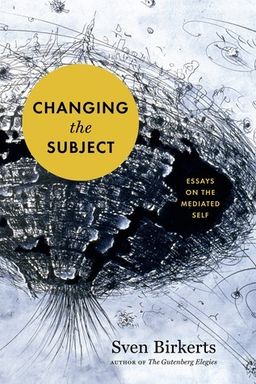
What happens to our inner lives when every moment demands a response, a click, or a swipe? In Changing the Subject: Art and Attention in the Internet Age, Sven Birkerts tackles this urgent question with reflection, lyricism, and unease. A sequel in spirit to his 1994 classic The Gutenberg Elegies, this book returns to the territory of reading, imagination, and the self—asking what becomes of all three when our attention lives on borrowed time.
Birkerts contends that the digital revolution has not only altered how we gather information but reshaped what it means to be human. He sees our devices as extensions of a larger paradigm shift—from inwardness and solitude toward dispersion, connectivity, and a new kind of collective self. In this transformation, the role of art and literature stands as both casualty and remedy: they are threatened by diminished attention but remain our most powerful tools for reclaiming it.
The Age of Too Much Information
Birkerts opens with a haunting image from his own memory: the 1979 Three Mile Island nuclear incident. He recalls the panic of hearing invisible dangers move through the atmosphere—a sense of being threatened by something unseen but omnipresent. Decades later, that fear returned in an unexpected form: a new kind of radioactive force—data. When his teenage daughter exclaimed “TMI!” (too much information), Birkerts recognized the dark poetry of the acronym. The invisible flood of information shaping our reality today feels equally systemic and pervasive. We live, he argues, inside an all-encompassing informational ecosystem that subtly remakes our consciousness, often without our noticing.
To illustrate this shift, he contrasts two archetypal figures—Adam, a man from 18th-century Boston, and Zeno, his 21st-century counterpart. Adam’s world is defined by locality and sensory contact; Zeno’s by abstraction and mediated connection. Both stand on the same beach, looking at a figure approaching from afar—but the experience of watching, Birkerts claims, is fundamentally different. Adam’s perception is grounded, while Zeno’s is dispersed across networks, screens, and systems of information. What was once direct and embodied has become mediated and detached. The very texture of our attention has changed.
The Collapse of Context and the Rising Digital Hive
Information without context becomes noise, Birkerts warns, and the systems built to give us order—Google, Wikipedia, the cloud—paradoxically deepen our dependency. Citing Kevin Kelly’s vision of a “universal library,” where every text is linked and cross-referenced in a single global brain, Birkerts sees a new form of collectivized intelligence emerging. On the surface, this seems utopian: a shared human consciousness. But Birkerts views it with suspicion. When information becomes universally aggregated, individuality—the very condition that produced art, invention, and dissent—faces extinction. He calls this drift toward connected sameness “the hive life.”
Our digital age, he argues, has moved from a world of books—discrete objects produced by individuals—to one of glowing terminals modeling the logic of systems. The result is a weakening of presence. The person who once stood as author, reader, or artist now dissolves into a participant in vast mechanical circuits. Birkerts aligns with critics like Nicholas Carr (The Shallows) and Jaron Lanier (You Are Not a Gadget) in suggesting that neural plasticity and digital immersion are reshaping our brains, favoring speed and distraction over concentration and reflection. The cost is what he calls the “specific gravity” of things—the weighted sense of their significance.
Art, Imagination, and the Power of Attention
Yet Changing the Subject is not only a lament; it’s a defense of imagination as the self’s last frontier. For Birkerts, art is not just cultural ornament but a “feat of concentration”—an act that generates attention rather than consuming it. Reading Shirley Hazzard’s The Transit of Venus, he rediscovers the galvanizing force of a book that demands full mental and emotional presence. “Works of art are feats of concentration,” he writes, “and imagination is the instrument of concentration.” When we engage deeply—with a poem, a novel, a photograph—we reconnect with the self that digital life erodes.
His essays move from analyses of technology (GPS, iPads, AI assistants like Siri) to meditations on reading, photography, and attention. Each returns to the same conviction: artistic experience is both an antidote and an inoculation against the weightlessness of our time. “Art,” he insists, “demands and creates attention.” And through attention, we retrieve our individuality, our capacity for wonder, and a reconnection with what he calls “the soul”—a term often absent from contemporary discourse, but essential to his vision.
Why This Matters Now
In a culture that celebrates multitasking and algorithmic efficiency, Birkerts reminds us that attention is the moral act of our age. The book’s subtitle, “Art and Attention in the Internet Age,” is no metaphor: he means it literally. Attention directs consciousness, determines values, and defines identity. To change attention is to change the subject—to alter not just what we focus on, but who we are. Through a blend of memoir, criticism, and cultural reflection, he shows that how we attend to the world—through reading, art, or simple noticing—shapes our freedom, our empathy, and our humanity itself.